
第四范式

Search documents
港股AI龙头延续强势,港股互联网ETF(513770)9连涨,再探新高!阿里巴巴重回3万亿市值!
Xin Lang Ji Jin· 2025-09-17 02:07
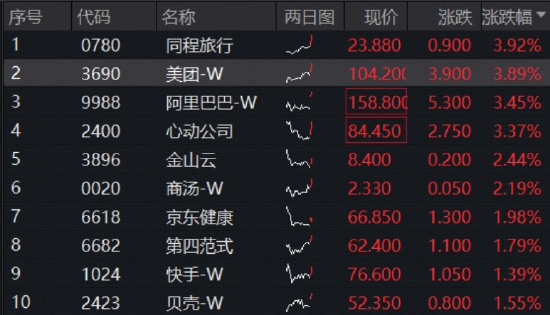
隔夜中概股继续攀升,纳斯达克中国金龙指数涨1.76%,创下自2022年2月以来新高。9月17日,港股早 盘高开,恒指、恒科指分别上涨0.44%、0.91%。 大型科技龙头继续走强,美团-W涨近4%,阿里巴巴-W涨超3%,股价续创近4年新高,港股总市值重回 3万亿港元。快手-W、小米集团-W涨逾1%,腾讯控股、哔哩哔哩-W跟涨。 | 序号 | 代码 | 名称 | 两日图 | 现价 | | 涨跌 涨跌幅 | | --- | --- | --- | --- | --- | --- | --- | | | 0780 | 同程旅行 | | 23.880 | 0.900 | 3.92% | | 2 | 3690 | 美团-W | | 104.200 | 3.900 | 3.89% | | 3 | 9988 | 阿里巴巴-W | Map | 158.800 | 5.300 | 3.45% | | 4 | 2400 | 心动公司 | 5 | 84.450 | 2.750 | 3.37% | | 5 | 3896 | स्नार् | mm | 8.400 | 0.200 | 2.44% | | 6 | 0020 | 商汤-W ...


第四范式(6682.HK):营收大超预期 先知AI平台高速增长
Ge Long Hui· 2025-09-16 10:47
Core Insights - Fourth Paradigm reported a significant revenue increase of 40.7% year-on-year for H1 2025, reaching 2.626 billion yuan, with a gross profit of 990 million yuan, reflecting a 25.4% growth [1] - The company's AI platform, "Prophet AI," generated 2.149 billion yuan in revenue, marking a 71.9% increase and accounting for 81.8% of total revenue [1][2] - The average revenue per benchmark user increased by 56.6% year-on-year to 17.98 million yuan, indicating enhanced value capture in the enterprise sector [1] Revenue and Profitability - The company achieved a gross margin of 37.71%, down 4.61 percentage points from the previous year, primarily due to a shift towards integrated delivery models [1][2] - Adjusted net loss narrowed by 71.2% to 44 million yuan, showcasing improved financial performance despite the loss [1] R&D and Expenses - R&D expenses rose by 5.1% year-on-year to 893 million yuan, with an R&D expense ratio of 34.0%, down 11.5 percentage points [1][2] - Total expenses for sales, management, and R&D were 189 million, 86 million, and 893 million yuan respectively, with corresponding expense ratios of 7.2%, 3.29%, and 34.0% [2] Market Position and Future Outlook - Fourth Paradigm has maintained the largest market share in China's machine learning platform sector for seven consecutive years, indicating strong competitive positioning [3] - The company is expected to benefit from the digital transformation across various industries in China, with projected revenues of 6.937 billion, 9.062 billion, and 11.797 billion yuan for 2025-2027, reflecting a compound annual growth rate of approximately 30% [3]
2025年中国人工智能代理行业商业模式分析 从“SaaS铁三角”到园区竞速的万亿赛道博弈【组图】
Qian Zhan Wang· 2025-09-16 04:13
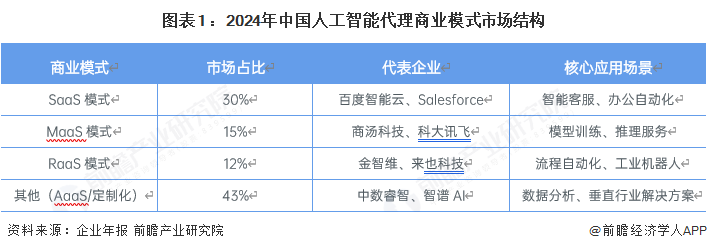
Core Viewpoint - The Chinese AI agent industry has established a "SaaS-MaaS-RaaS" tripartite business model, driven by technology, policy, and ecosystem factors, accelerating the commercialization of a trillion-level market through regional differentiated competition [1]. Business Model Summary - The AI agent industry in China can be categorized into three main models based on service form, deployment method, and application scenario: - **SaaS Model**: Dominates the market with a 30% share, driven by the demand for standardized intelligent tools. It operates on a subscription basis, focusing on efficiency improvement through basic subscription fees and value-added services [3][12]. - **MaaS Model**: Fastest growth at 15%, reflecting the acceleration of model-as-a-service commercialization. It relies on computational power and model innovation for customer acquisition, with significant cost advantages, such as SenseTime's model inference cost being 60% lower than the industry average [3][8]. - **RaaS Model**: Accounts for 12% of the market, focusing on human-machine collaborative automation in sectors like manufacturing and finance, with notable improvements in operational efficiency [3][8]. Market Dynamics - The AI agent industry is experiencing a competitive race among innovation parks, with Shanghai's Xuhui District housing over 1,000 companies and offering substantial computational subsidies. SenseTime's generative AI revenue reached 2.4 billion yuan in 2024, constituting 63.7% of its total revenue [4]. - The industry is supported by policy initiatives, such as the Ministry of Industry and Information Technology promoting "AI + manufacturing" actions and various cities providing computational vouchers and project subsidies to foster ecosystem development [7][8]. Financial Metrics - **SaaS Model**: Average gross margin of 60%-80%, customer retention rate of 75%-90%, and annual customer spending between 50,000 to 500,000 yuan [11][12]. - **MaaS Model**: Average gross margin of 40%-60%, customer retention rate of 60%-75%, and annual customer spending between 100,000 to 2 million yuan [11][12]. - **RaaS Model**: Average gross margin of 30%-50%, customer retention rate of 50%-65%, and annual customer spending between 200,000 to 1 million yuan [11][12].




智通港股通占比异动统计|9月16日


智通财经网· 2025-09-16 00:43
Core Insights - The article highlights the changes in the Hong Kong Stock Connect holdings, with notable increases and decreases in ownership percentages for various companies [1][2]. Group 1: Increased Holdings - Heng Rui Medicine (01276) saw the largest increase in ownership percentage, rising by 1.49% to a total of 13.84% [2]. - Kanglong Chemical (03759) experienced a 1.35% increase, bringing its ownership to 60.51% [2]. - Zhaoyan New Drug (06127) increased by 1.27%, reaching a holding of 43.70% [2]. - Other companies with significant increases include Junshi Biosciences (01877) at +1.24% (59.08%) and China Pacific Insurance (02601) at +1.20% (44.16%) [2]. Group 2: Decreased Holdings - Shandong Molong (00568) had the largest decrease, with a drop of 1.99% to 57.67% [2]. - Yisou Technology (02550) decreased by 0.99%, now holding 37.95% [2]. - Nanjing Panda Electronics (00553) saw a reduction of 0.98%, bringing its ownership to 42.65% [2]. - Other notable decreases include Kailai Ying (06821) at -0.95% (43.35%) and Meizhong Jiahe (02453) at -0.95% (32.06%) [2]. Group 3: Five-Day Changes - In the last five trading days, China Merchants Energy (01138) had the highest increase in ownership, up by 6.19% to 65.63% [3]. - Shandong Molong (00568) also saw a significant increase of 3.74% [3]. - Other companies with notable increases include Zhongchu Innovation (03931) at +3.62% (10.35%) and Youbao Online (02429) at +3.33% (17.38%) [3]. Group 4: Twenty-Day Changes - Over the past twenty days, Anjiren Food (02648) experienced the largest increase, up by 12.29% to 20.54% [4]. - China Merchants Energy (01138) also saw a significant increase of 9.07% [4]. - Other companies with notable increases include Yimai Sunshine (02522) at +7.70% (43.02%) and Lens Technology (06613) at +7.56% (13.64%) [4].
10亿美金注资优必选,一条通往中东的“机器人新丝路”
3 6 Ke· 2025-09-16 00:37
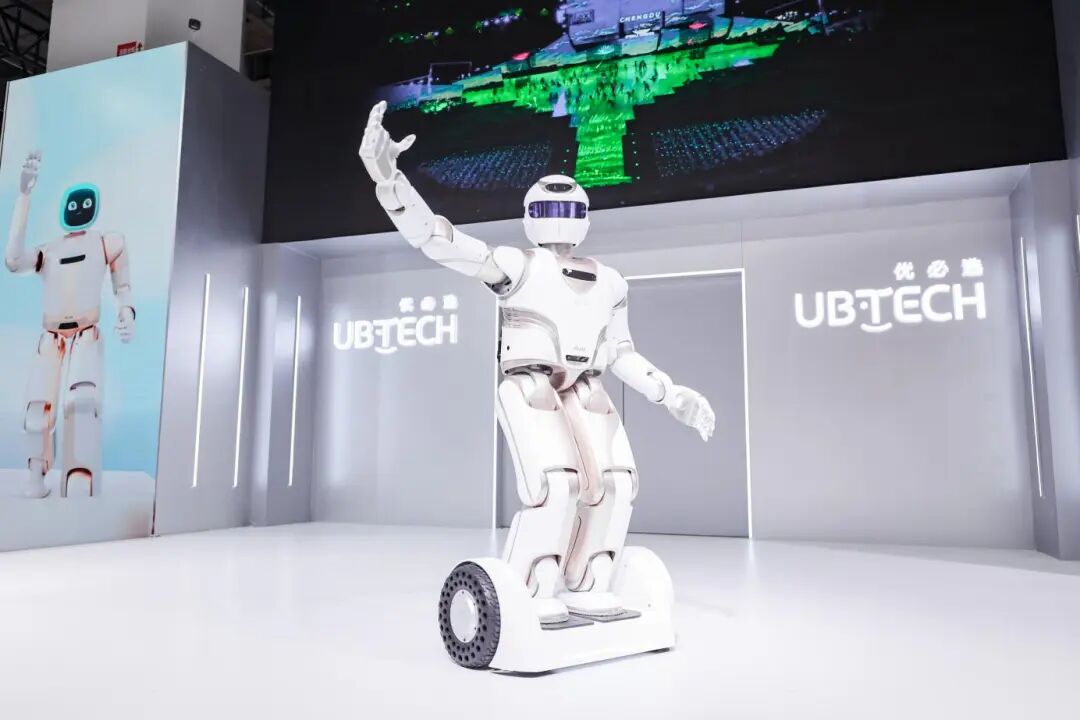
Core Insights - UBTECH, known as the "first humanoid robot stock," has secured a strategic partnership agreement worth $1 billion with Infini Capital, marking a significant financial milestone since its listing at the end of 2023 [1][3] - This partnership is not merely a financing deal but a strategic alliance aimed at addressing UBTECH's fundamental challenges, including ongoing substantial losses and cash burn [3][4] Group 1: Strategic Alliance and Financial Structure - The $1 billion agreement features a flexible capital support framework, allowing UBTECH to access funds through various financial instruments, including stock placements and convertible bonds [3][4] - This arrangement provides UBTECH with significant financial flexibility, enabling it to fund large-scale R&D, capacity expansion, and market positioning without resorting to dilutive financing [4][6] - Infini Capital's commitment to potentially increase its stake in UBTECH signals a long-term partnership rather than short-term speculation [4][6] Group 2: Investment Motivation and Market Expansion - Infini Capital aims to connect cutting-edge Chinese technology with substantial Middle Eastern capital, positioning itself as a key player in the Chinese AI industry [6][7] - The partnership will establish a joint venture to promote UBTECH's technology and products in the Middle East, creating a regional headquarters and a "super factory" for humanoid robots [6][7] - This strategic move opens up a new, capital-rich market for UBTECH while diversifying its production and innovation bases to mitigate geopolitical risks [6][7] Group 3: Financial Performance and Challenges - Despite revenue growth, UBTECH faces a significant financial challenge, with a net loss of 439 million RMB in the first half of 2025, although this is an improvement from the previous year's loss [9][11] - The company reported a 27.5% year-on-year increase in revenue, reaching 621 million RMB, but its business model has yet to achieve self-sustainability [9][11] - UBTECH's cash flow remains negative, with a net cash outflow of approximately 884 million RMB in 2024, highlighting the ongoing cash burn issue [13][14] Group 4: Industry Landscape and Competitive Position - The humanoid robotics sector is entering a critical phase, with government support in China driving industry growth and positioning UBTECH as a leader due to its advanced hardware technology [14][16] - UBTECH holds 2,790 authorized patents, providing a competitive edge in the development of humanoid robots, particularly in servo motor technology [14][16] - However, challenges remain, including competition from well-funded startups and tech giants, as well as the need for advancements in software capabilities [16][17]

本周,美联储利率决议来袭!港股科技继续抢跑,阿里巴巴再涨3%,港股互联网ETF(513770)逼近前高
Xin Lang Ji Jin· 2025-09-15 02:17
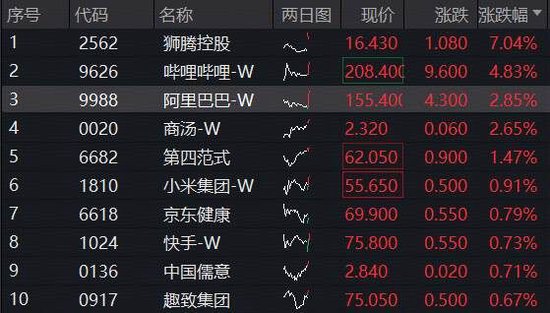
Group 1 - The Hong Kong stock market opened lower but rebounded, with major tech stocks like Alibaba-W and Bilibili-W seeing significant gains, indicating a positive trend in the tech sector [1] - The Hong Kong Internet ETF (513770) has shown strong performance, rising over 1% and nearing its historical high, with a total of 7 consecutive days of gains [2][4] - The upcoming Federal Reserve interest rate decision is expected to influence global liquidity, potentially benefiting high-growth tech stocks in Hong Kong [4] Group 2 - Alibaba's recent quarterly cloud revenue and capital expenditure exceeded market expectations, suggesting a shift in narrative from food delivery competition to AI, which could aid in valuation recovery for the sector [4] - The Hong Kong Internet ETF has seen significant capital inflow, with a net inflow of 7.9 billion yuan over the last week and a total of 28.26 billion yuan over the past 20 days [4] - The ETF's top holdings include Xiaomi Group-W, Tencent Holdings, Alibaba-W, and Meituan-W, which collectively account for 54.74% of the fund, highlighting the dominance of leading tech firms in the portfolio [6][7] Group 3 - The Hong Kong Internet ETF has surpassed 10 billion yuan in size, achieving a record high, with an average daily trading volume of nearly 600 million yuan [9] - The index that the ETF tracks has outperformed the Hang Seng Tech Index by over 10 percentage points, indicating strong market performance driven by AI [8]


第四范式(06682):营收大超预期,先知AI平台高速增长
Changjiang Securities· 2025-09-14 23:31
Investment Rating - The investment rating for the company is "Buy" and is maintained [9]. Core Insights - The company reported a significant revenue increase, achieving 2.626 billion yuan in H1 2025, representing a year-on-year growth of 40.7% [2][6]. - The gross profit reached 990 million yuan, with a growth of 25.3%, while the gross margin decreased by 4.61 percentage points to 37.71% [2][6]. - Research and development expenses amounted to 893 million yuan, up 5.1%, with an R&D expense ratio of 34.0%, down 11.5 percentage points [2][6]. - The enterprise AI platform, "Xian Zhi AI," generated 2.149 billion yuan in revenue, marking a 71.9% increase and accounting for 81.8% of total revenue [2][6]. Summary by Sections Revenue Performance - In H1 2025, the company achieved revenue of 2.626 billion yuan, a 40.7% increase year-on-year [2][6]. - The adjusted net loss was 44 million yuan, narrowing by 71.2% compared to the previous year [8]. AI Platform Growth - The "Xian Zhi AI" platform's revenue was 2.149 billion yuan, reflecting a 72% year-on-year growth, with its revenue share increasing from 67% to 81.8% [8]. - The average revenue per benchmark user reached 17.98 million yuan, up 56.6% year-on-year, indicating a significant increase in value derived from the platform [8]. Cost and Margin Analysis - The gross profit for H1 2025 was 990 million yuan, with a gross margin decline from 42.3% to 37.7% due to changes in revenue structure [8]. - The company’s sales, management, and R&D expenses were 189 million, 86 million, and 893 million yuan respectively, with R&D expense ratio decreasing significantly [8]. Future Outlook - The company is expected to benefit from the ongoing digital transformation across various industries in China, with projected revenues of 6.937 billion, 9.062 billion, and 11.797 billion yuan for 2025-2027, maintaining a compound growth rate of approximately 30% [8].
第四范式(6682.HK):业绩高增 AI驱动业务多领域拓展
Ge Long Hui· 2025-09-14 18:45
Core Viewpoint - The company has demonstrated significant revenue growth and a substantial reduction in losses in H1 2025, driven by its focus on "AI agent + world model" and continuous investment in R&D, positioning itself for further expansion in various industries through its "AI+X" strategy [1][2][3][4] Financial Performance - In H1 2025, the company achieved a revenue of 2.626 billion yuan, representing a year-on-year increase of 40.7% [2] - The adjusted net loss attributable to the parent company was 44 million yuan, narrowing by approximately 71.2% year-on-year [2] - R&D expenses for H1 2025 amounted to 893 million yuan, up 5.1% year-on-year, with a R&D expense ratio of 34.0%, down 11.5% year-on-year [2] Business Segmentation - The "Fourth Paradigm Prophet AI" platform generated revenue of 2.149 billion yuan in H1 2025, a year-on-year increase of 71.9%, accounting for 81.8% of total group revenue [3] - The SHIFT intelligent solutions business contributed 371 million yuan, approximately 14.1% of total revenue [3] - The Fourth Paradigm AIGS service business generated 106 million yuan, representing about 4.1% of total revenue [3] Strategic Initiatives - The company is actively exploring "AI+X" applications, particularly in the AI + energy storage sector, by launching a joint venture to optimize control of virtual power plants and enhance operational efficiency [4] - In the AI + stablecoin sector, the company is collaborating with leading brokerages to develop risk control and compliance solutions, ensuring the safety and stability of stablecoin assets [4]
人工智能步入业绩兑现阶段 基金仍看好估值提升潜力
Zheng Quan Shi Bao· 2025-09-14 18:10
Group 1 - Artificial Intelligence (AI) has become the core driver of public fund performance, shifting the focus of fund managers from static metrics like valuation and earnings to dynamic changes and future monetization potential [1][2] - As of September 14, 2023, nearly all top-performing funds have core positions in AI, with the best-performing fund, Yongying Technology Smart Selection, achieving nearly 190% returns this year, primarily due to its over-allocation in the AI industry chain [2] - Traditional funds are adjusting their strategies to include AI, as seen with Changsheng Urbanization Theme Fund, which has shifted from low-valuation sectors to heavy investments in AI, resulting in an 85% return this year [2] Group 2 - Major fund companies are making significant investments in AI companies despite their current unprofitability, as evidenced by the recent increase in holdings of Fourth Paradigm by Fuguo Fund, which now owns 6.37% of the company [3] - The AI sector is transitioning from a conceptual phase to a monetization phase, with increasing commercial orders indicating strong market demand and rapid revenue growth for key players [3][4] - AI companies like Jintai Holdings have attracted significant investments despite initial losses, demonstrating the market's recognition of their potential for future profitability [4] Group 3 - Fund managers are optimistic about the valuation potential of AI companies, with increasing orders and improved earnings expectations driving this sentiment [6][7] - The AI industry is expected to maintain high growth due to supportive policies and infrastructure development, with major companies in the computing power sector still showing attractive valuations for 2026 [7] - The rapid development of AI applications across various industries is anticipated to enhance the valuation potential of AI companies, driven by policy support and strong market demand [7]

甲骨文大涨催化国内AI产业链,阿里开源新架构模型
Zhong Guo Neng Yuan Wang· 2025-09-14 17:39
Core Insights - Oracle's RPO surged to $455 billion, a year-on-year increase of 359%, leading to a significant rise in stock price, indicating strong demand for AI infrastructure and computing power [1][2][4] - Oracle's Q1 total revenue reached $14.9 billion, with a year-on-year growth of 12%, and cloud revenue (IaaS + SaaS) was $7.2 billion, up 28% year-on-year [1] - The company anticipates cloud infrastructure revenue to increase by 77% in fiscal year 2026, reaching $18 billion [1] Group 1: Oracle's Performance - Oracle signed contracts worth billions with three different clients, contributing to the substantial increase in RPO [1] - The CEO of Oracle expects RPO to potentially exceed $500 billion in the coming months due to ongoing contract signings [1] Group 2: AI Infrastructure Demand - The increase in Oracle's RPO signals a robust demand for AI infrastructure and computing power, which is expected to catalyze related domestic AI industry stocks [2][4] - High demand is noted for computing hardware such as optical modules, servers, and PCBs, as well as data center infrastructure like power supplies and cooling systems [2] Group 3: Alibaba's Innovations - Alibaba has open-sourced a new architecture model, Qwen3-Next-80B-A3B, which reduces training costs by 90% and improves inference efficiency by ten times [3] - The new model features significant innovations in mixed attention mechanisms and high sparsity MoE, enhancing performance in long-context tasks [4]
