Shein

Search documents
小额包裹关税豁免倒计时 多国“停邮”美国
Bei Jing Shang Bao· 2025-08-27 16:36
Core Points - The U.S. government has suspended the tax exemption for imported packages valued at $800 or less, effective August 29, leading to a significant impact on global cross-border e-commerce and postal systems [1][2] - Multiple countries, including India, France, Italy, Sweden, Norway, Belgium, and Spain, have announced a halt on sending packages to the U.S. in response to this policy change [1] - The new tariff structure may impose $80, $160, or $200 duties on goods depending on the tariff rate of the exporting country [1] Group 1: Impact on Postal Services - Royal Mail in the UK has suspended services to the U.S. and will implement a new system that includes additional fees for U.S. customs clearance [1] - Deutsche Post's subsidiary, DHL, has also paused sending commercial goods and some private packages to the U.S., allowing only gifts valued under $100 to be sent under strict regulations [2] - Finland's postal service has suspended deliveries to the U.S. due to unclear tax payment methods and the lack of established systems among postal companies [2] Group 2: Industry Reactions - The European Postal Union has expressed concerns over the undefined core issues and processes related to the new U.S. regulations, warning that members may have to limit or suspend mail deliveries to the U.S. if solutions are not found [3] - Experts indicate that the uncertainty surrounding the new regulations has led to increased costs for businesses, including potential storage fees and the risk of goods being returned by U.S. customs [3][4] - The cancellation of the low-value tax exemption is expected to disrupt consumer habits in the U.S. and exacerbate issues of wealth disparity and inflation [4] Group 3: Broader Economic Implications - Approximately 48% of small packages sent to the U.S. go to the poorest areas, while 22% go to the wealthiest, indicating that the new policy could widen the economic gap [4] - The changes are likely to have a significant negative impact on small and micro enterprises that rely on cross-border e-commerce [4]
The U.S. tax de minimis exemption to end on Aug. 29th. Here’s what to know.
Yahoo Finance· 2025-08-26 23:30
Goods valued under $800 were permitted to enter the US duty-free under the so-called dimminimous exemption. That rule will end on August 29th. So retailers knew this was going to go away.They thought it was going to be another year or two and all of a sudden it's a quick end to any of that advantage. This has been a huge kind of end of a loophole for the retail industry when we think about categories like apparel and footwear in particular and any kind of small goods that might be shipping direct to consume ...


转让头部人形机器人公司股份;求购Open AI老股份额|资情留言板第168期
3 6 Ke· 2025-08-26 13:55
Group 1 - The article presents various asset trading opportunities, including the sale and purchase of shares in prominent companies and funds, aimed at connecting buyers and sellers in the market [1][19][20] - New offerings include the transfer of LP shares in leading humanoid robot companies with estimated valuations of approximately 39 billion and 25 billion respectively [1][3] - There are also requests for purchasing shares in companies like OpenAI, Xiaohongshu, and ByteDance, with estimated valuations ranging from 320 billion to 380 billion [3][4][5] Group 2 - The article highlights the demand for acquisitions in the medical device sector, specifically targeting profitable companies within Jiangsu province [5][6] - There is a focus on seeking acquisition targets in the small home appliance sector, with a valuation cap of 2 billion [6] - The article mentions the search for shares in various companies, including YuTree Technology and other leading firms in the humanoid robot sector, with valuations around 15 billion [7][29] Group 3 - The article outlines several asset transfer opportunities, including LP shares in companies like HuoLaLa and WoFei ChangKong Technology, with valuations subject to negotiation [7][8][9] - It also discusses the transfer of shares in the semiconductor industry, emphasizing a leading company with advanced production capabilities [10][11] - The article notes the ongoing interest in sectors such as quantum technology and AI, with specific funds and companies looking for investment opportunities [8][10][12]

European carriers pause some shipments to U.S. as they prepare for end of 'de minimis' exemption
CNBC· 2025-08-25 18:11
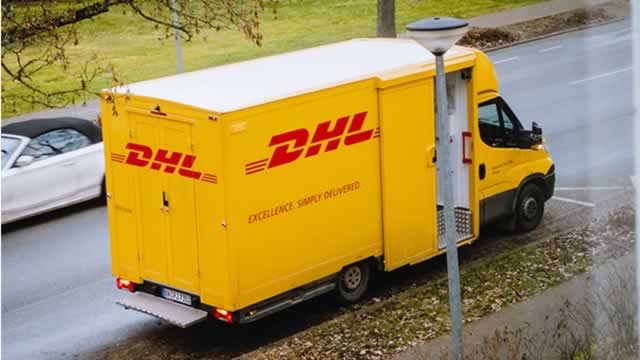
Group 1 - The de minimis exemption, allowing duty-free entry for shipments valued under $800, is set to end following President Trump's executive order, impacting postal carriers across Europe [2][3] - Major European postal services, including those in Germany, Spain, France, Belgium, Finland, Denmark, and others, are suspending shipments to the U.S. due to the inability to adapt their systems to the new customs requirements [4][5][6] - The suspension of shipments is expected to primarily affect smaller orders from American consumers purchasing from smaller European businesses, while larger retailers are less impacted as they typically do not rely on the de minimis exemption [8][9] Group 2 - DHL has announced it will no longer accept parcels destined for the U.S. due to unresolved questions regarding customs duties and data transmission to U.S. Customs and Border Protection [4] - Spain's national post office, Correos, indicated that it requires more time to adjust its systems to comply with the new requirements, leading to a suspension of shipments [5][6] - Finland's post office has stopped accepting all postal items bound for the U.S., including gifts and letters, due to airline refusals to transport these items [7]
谁在“半价”扫货中国核心资产?
3 6 Ke· 2025-08-25 07:28
Group 1 - The Chinese private equity secondary market (S market) is experiencing unprecedented growth, with RMB fund transaction volume reaching a record 77.3 billion yuan in the first half of 2025, a nearly 90% year-on-year increase [1] - A peculiar trading model known as "continuation funds" is becoming the main driving force behind this market, where fund managers sell star assets from old funds to newly established funds, often at prices 40-50% below their net asset value (NAV) [1][7] - The market is facing significant challenges, including a massive exit barrier and geopolitical risks leading to capital withdrawal, which has created a collective anxiety within the industry [1][6] Group 2 - The Chinese private equity market is encountering a "Great Wall of Exit," with only 100 companies successfully listed on the A-share IPO market in 2024, the lowest in a decade, and a total fundraising amount of 67.35 billion yuan, down 81% year-on-year [2] - The tightening of exit channels is exacerbated by the new regulations increasing profit thresholds for IPOs, leading to a significant backlog of projects that were expected to exit within 3-5 years but are now delayed [2][6] Group 3 - Globally, the private equity market is under severe pressure, with over $3 trillion in unexited assets, four times the amount from a decade ago, and a significant decline in cash returns to investors [3] - Major Canadian pension funds have announced a withdrawal from the Chinese private equity market, with CDPQ planning to sell a $2 billion portfolio of Chinese assets [3][4] Group 4 - Geopolitical factors have led many dollar funds to relocate their offices to Singapore or Hong Kong, shifting their focus from investing in China to investing in Asia [4] - The traditional investment chain of "dollar fundraising - VIE investment - US stock listing" has been disrupted, complicating the investment landscape for dollar funds in China [4] Group 5 - In the first half of 2025, RMB fund secondary transactions reached 77.3 billion yuan, with domestic general partners (GPs) accounting for 42% of the transaction volume, a 21 percentage point increase from 2022 [5] - RMB funds are becoming the most active players in the market, primarily supported by state-owned enterprises and government-guided funds, focusing on strategic industries like semiconductors and new energy vehicles [5] Group 6 - The dual pressures of the "Great Wall of Exit" and the "Dollar Retreat" are reshaping the Chinese private equity market, forcing the industry to seek new survival strategies through continuation funds and secondary transactions [6][14] - The continuation fund model allows GPs to sell assets from one fund to another, providing liquidity for private equity funds in need of cash [7][10] Group 7 - Many dollar funds are currently focused on liquidity recovery rather than new investments, leading to significant discounts on Chinese private equity assets, with quality assets being sold at 40-50% below NAV [8] - The supply-demand imbalance is distorting prices, with sellers eager to cash out and buyers demanding substantial discounts as risk compensation [8][9] Group 8 - The lack of regulatory oversight in China creates a trust crisis, as GPs can operate with minimal accountability, leading to potential conflicts of interest in continuation fund transactions [10][11] - The valuation system is fragmented, with different LPs applying varying valuation metrics, complicating the pricing and transparency of transactions [11][12] Group 9 - The Chinese private equity market is at a crossroads, with the number of transactions over $1 billion declining significantly, indicating a challenging environment for large exits [12][14] - If continuation funds can establish transparent rules, they may play a crucial role in revitalizing the $3 trillion of unexited assets in the market [13][14]
X @Bloomberg
Bloomberg· 2025-08-25 05:06
Temu y Shein disparan las compras en América Latina. México, Chile y otros suben impuestos a los paquetes para frenar el golpe a minoristas, pero los consumidores siguen eligiendo los precios bajos. https://t.co/fdnSjAzpBJ ...
Tariffs Still A Wildcard For Five Below As Growth Story Evolves, Says Analyst
Benzinga· 2025-08-22 17:07
Core Viewpoint - Five Below, Inc. is demonstrating signs of regaining momentum with stronger sales growth, robust same-store performance, and an accelerating store expansion strategy [1] Sales and Growth Projections - Analyst Joseph Feldman projects sales growth of approximately 20% to $994 million, driven by 30 new store openings, which represents an 11.3% unit growth [4] - For the second quarter of 2025, comps are expected to rise by 9.0%, surpassing FactSet's estimate of 8.6% [3] - The company is expected to benefit from a favorable comparison to last year's comp decline of 5.7% [4] Profitability and Margin Expectations - Feldman forecasts a contraction in operating margin of 19 basis points to 4.3%, with gross margin down 20 basis points to 32.5% due to tariff pressures [6] - SG&A expenses are expected to remain flat at 28.3%, as strong comps offset higher labor and incentive compensation costs [6] Strategic Focus and Market Position - Five Below is focusing on core customers, trend-right merchandising, and price-point adjustments, with most items priced in the $1–$5 range [5] - The company is likely to gain from the U.S. government's closure of the de minimis exemption loophole, which previously favored low-cost competitors [5] Analyst Ratings and Price Forecasts - Telsey Advisory Group reaffirmed a Market Perform rating and raised the 12-month price forecast by $16 to $144 [2] - Other analysts have also raised their price forecasts, with Citigroup increasing its forecast from $135 to $142, and Mizuho from $115 to $132 [7][8] - Loop Capital upgraded the stock from Hold to Buy, boosting its forecast from $130 to $165, the highest among the group [8]


对美“低价直邮+小额免税”时代终结,纺织外贸当如何应对?
Sou Hu Cai Jing· 2025-08-22 10:17
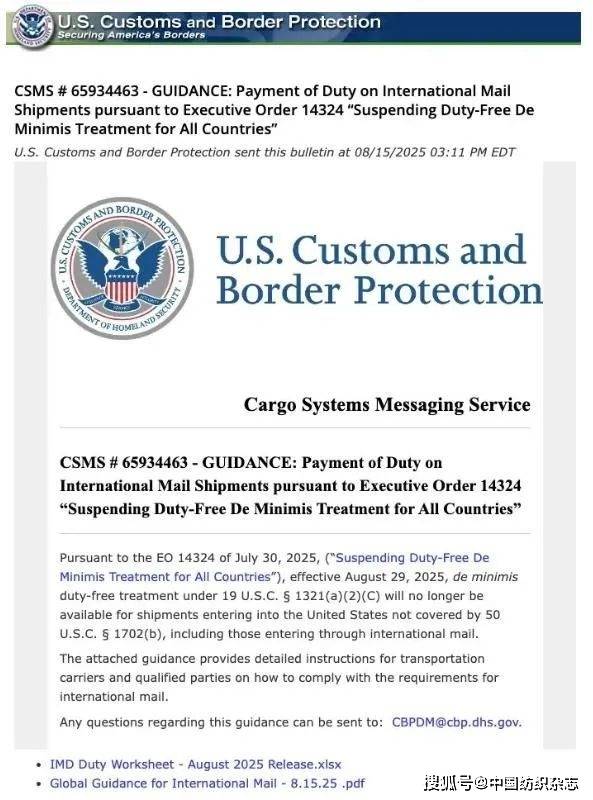
当地时间8月15日,美国海关和边境保护局(CBP)发布公告,根据2025年7月30日特朗普签署的第14324号行政命令("暂停所有国家的最低免税额待 遇"),8月29日起,美国正式取消针对所有国家的低价值商品免税待遇。 自2025年8月29日起,所有国家/地区通过邮递出口至美国的货物包裹不再享受免税待遇,必须通过标准海关申报程序进入美国,提交完整的进口文件,并 根据美国进口关税表(HTSUS)缴纳适用的关税,包括额外加征的关税。 税怎么交? 先说一下外贸人最关心的话题——新规生效后,低值商品寄到美国去,税该怎么交。 在2026年2月28日,有两种方法可以计税(以下详解),每个月只能选一种方法;在2026年2月28日之后,所有通过国际邮政网络运往美国的涵盖货物必须 使用从价关税法(方法1)计算关税。 方法1:从价关税法 按货物原产国有效IEEPA关税税率(对等关税、芬太尼关税),对每件应税包裹价值征收等额关税 中国商品的IEEPA有效税率为10%对等关税+20%芬太尼关税。 该方法需要填写《CBP国际邮件报关工作表》,如下所示: | CBP International Mail Duty Worksheet | ...
亚马逊Q2财报:零售巨头真正的生意不在“卖货”?
3 6 Ke· 2025-08-22 08:53
Core Insights - Amazon is transitioning from being labeled solely as a "retail company" to a diversified technology giant, with advertising, AWS, and seller services becoming the main profit drivers [1][14]. Group 1: Retail Business Performance - In Q2 2025, Amazon's online store sales grew by 11% year-over-year, reaching $61.5 billion, while physical store sales increased by 7% to $5.6 billion [4]. - Despite the growth in retail, its profit margins remain low due to intense price competition, making it less significant in terms of overall profitability [6][10]. - Competitors like Shein and Temu are impacting the U.S. market with low prices, increasing competitive pressure on Amazon's retail segment [7][8]. Group 2: Revenue Breakdown - Total revenue for Amazon reached $167.7 billion, a 13% year-over-year increase, with operating income at $19.17 billion, up 31% [9]. - AWS generated nearly $31 billion in revenue, growing 17.5% year-over-year, maintaining a significant market share in cloud services [12]. - Advertising revenue surged to $15.7 billion, marking a 23% increase, positioning Amazon as the third-largest digital advertising platform globally [11]. Group 3: Strategic Shifts - Amazon is focusing on rural and small-town markets, planning to expand same-day and next-day delivery services to over 4,000 locations by the end of the year [14]. - The company is investing over $4 billion by 2026 to enhance logistics and distribution networks in rural areas, aiming to establish a competitive edge in underserved markets [14]. Group 4: Future Outlook - The shift from retail to a mixed structure of low-margin retail and high-margin services is seen as essential for Amazon's long-term growth [12][14]. - The evolving business model reflects a transition from "selling goods" to "selling traffic" and "selling technology," indicating a profound structural transformation [14].

HeyGen与Manus:同为华人AI独角兽,为何命运截然不同?
Hu Xiu· 2025-08-22 03:53
Core Viewpoint - The article discusses the contrasting fates of two AI companies, HeyGen and Manus, highlighting how regulatory compliance and strategic decisions have led to HeyGen's success and Manus's struggles amid U.S. scrutiny [1][2][3]. Group 1: Company Backgrounds - HeyGen, founded by Chinese entrepreneurs, is an AI video generation platform that allows users to create professional videos quickly, supporting 175 languages and serving 85,000 global clients [3][4][26]. - Manus, also founded by Chinese entrepreneurs, operates in the AI space but has faced challenges due to U.S. regulatory investigations, particularly the Reverse CFIUS inquiry [1][2][22]. Group 2: Strategic Decisions and Compliance - HeyGen successfully relocated its headquarters from Shenzhen to Los Angeles in 2022 and completely divested from Chinese investors by 2023, effectively distancing itself from potential regulatory issues [20][23]. - Manus, in contrast, has retained its Chinese corporate structure and investors, which has drawn increased scrutiny from U.S. regulators, especially after its recent high-profile marketing efforts [25][28][29]. Group 3: Financial Trajectories - HeyGen raised approximately $9 million in seed funding from notable investors like Sequoia China and IDG Capital, followed by a $5.6 million round in 2023, leading to a valuation of $500 million [15][19][20]. - Manus's financial activities have been less clear, with its recent fundraising efforts occurring under the shadow of regulatory concerns, potentially limiting its growth prospects [25][28]. Group 4: Market Positioning and Risks - HeyGen has positioned itself as a "low-profile leader" in the AI video generation market, focusing on marketing and education applications, which appear to be less sensitive to regulatory scrutiny [26][27]. - Manus's high-profile marketing and attempts to enter the Chinese market have raised alarms among U.S. regulators, complicating its operational landscape and leading to mixed perceptions in both the U.S. and China [29][30]. Group 5: Lessons and Future Considerations - The experiences of HeyGen and Manus illustrate the importance of strategic positioning in the face of geopolitical tensions, emphasizing the need for companies to choose between markets rather than attempting to operate in both simultaneously [30][31]. - The article suggests that future AI entrepreneurs must carefully consider their corporate structures and compliance strategies to navigate the evolving regulatory landscape [36][37].