
微创医疗

Search documents
智通港股空仓持单统计|9月26日
智通财经网· 2025-09-26 10:33
Group 1 - The top three companies with the highest short positions as of September 19 are ZTE Corporation (00763) at 15.35%, COSCO Shipping Holdings (01919) at 14.10%, and CATL (03750) at 13.44% [1][2] - The companies with the largest absolute increase in short positions are China Education Holdings (00839) with an increase of 2.61%, Dongfang Electric (01072) with an increase of 2.06%, and Xiexin Technology (03800) also with an increase of 2.06% [1][2] - The companies with the largest absolute decrease in short positions are Hua Hong Semiconductor (01347) with a decrease of -2.52%, Chifeng Jilong Gold Mining (06693) with a decrease of -1.77%, and Laikai Pharmaceutical-B (02105) with a decrease of -1.72% [1][2] Group 2 - The latest short position data shows that ZTE Corporation maintained 116 million shares, COSCO Shipping Holdings had 406 million shares, and CATL had 20.95 million shares [2] - The companies with the largest increase in short positions include China Education Holdings, which rose from 3.73% to 6.33%, and Dongfang Electric, which rose from 7.34% to 9.40% [2] - The companies with the largest decrease in short positions include Hua Hong Semiconductor, which fell from 9.00% to 6.48%, and Chifeng Jilong Gold Mining, which fell from 3.30% to 1.53% [2][3]
搞完医药搞芯片!特朗普又来关税大棒,加征100%关税!午后多个板块跳水...
雪球· 2025-09-26 08:27
↑点击上面图片 加雪球核心交流群 午后跳水,三大指数震荡走跌,截至收盘, 沪指跌0.65% , 深成指跌1.76% , 创业板指跌2.60% 。 沪深两市成交额2.15万亿 , 较上一个交易日缩量2242亿, 全市场超3400只个股下跌 。 板块方面 , 风电 、 保险等板块涨幅居前 , 游戏 、 算力硬件 、 光刻机等板块跌幅居前。 港股也走低,恒生指数跌超1%,恒生科技指数跌近3%,小米集团、金山云跌超7%等。 特朗普,突发重磅! AI、半导体大跌 以AI为主线的科技股今天集体走弱,工业富联大跌5%,寒武纪跌超3%,立讯精密大跌超6%,瑞芯微、芯原股份、 领益智造、景旺电子等 跌超6 %。 9月26日午后,突然传来重磅消息。据路透社报道,消息人士称,特朗普政府正在考虑一项新的半导体政策,要求芯片公司在国内制造的半导体数 量与其客户从海外生产商进口的半导体数量相同,如果公司未能长期保持这种1:1的比例,将面临大约100%的关税。 美国商务部长霍华德·卢特尼克与半导体行业高管讨论了这一概念,理由是美国科技公司严重依赖海外芯片生产,容易受到多重因素影响,对经济 安全形成威胁。 知情人士表示,根据新制度,如果一家 ...


创新药受关税消息冲击,恒瑞医药拿下出海大单
Xin Lang Cai Jing· 2025-09-26 06:31
Core Viewpoint - The innovative drug sector experienced significant volatility due to tariff news, with the Hang Seng Pharmaceutical ETF (159892) dropping over 2% [1] Group 1: Market Impact - Major holdings such as MicroPort Medical, MicroPort Robotics, and others led the decline, while companies like 3SBio, Alibaba Health, and Zai Lab also saw notable drops [1] - The recent announcement of an overseas exclusive development and commercialization licensing agreement for Ruilong's Trastuzumab, valued at over $1.1 billion, highlights the growing international collaboration in the innovative drug sector [1] Group 2: Long-term Outlook - Since 2025, there has been a surge in large-scale overseas business development deals in the innovative drug sector, indicating increasing global recognition of China's innovative drug capabilities [1] - Leading companies are actively seeking partnerships with top global pharmaceutical firms to expedite the translation of research outcomes into marketable products [1] - While short-term export prospects may be affected by tariff changes, the long-term outlook remains strong due to technological advancements, a shift away from internal competition in the pharmaceutical industry, and breakthroughs in AI-driven drug development [1]

突发“黑天鹅”!刚刚,医药板块集体大跌!
天天基金网· 2025-09-26 05:13
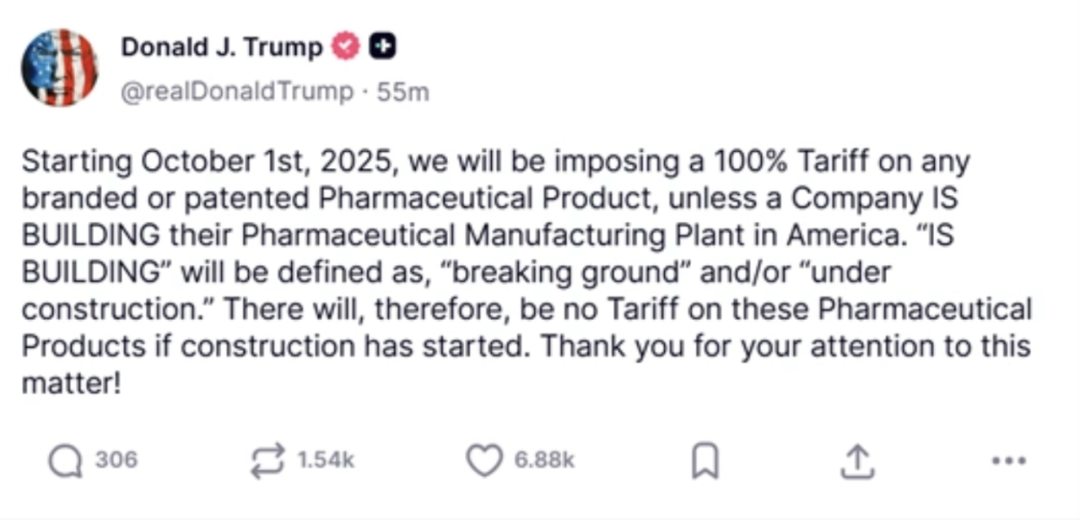
Group 1 - The article discusses the new tariffs announced by President Trump on various imported products, including a 25% tariff on heavy trucks, 50% on kitchen cabinets, 30% on furniture, and 100% on patented and branded drugs starting from October 1, 2025, unless companies build manufacturing plants in the U.S. [3][8][10] - The pharmaceutical sector in the Asia-Pacific market experienced a decline following the announcement, with the A-share pharmaceutical and biotechnology sector also showing a downward trend [4][6][10] - Specific indices related to weight-loss drugs, innovative drugs, and CROs saw significant declines, with the weight-loss drug index dropping by 1.56% and the innovative drug index by 1.48% [5][6] Group 2 - Individual stocks such as Sunflower and Aosaikang saw substantial declines, with Sunflower dropping over 12% and Aosaikang down by 9% [6][7] - The Hong Kong biotechnology index opened nearly 2% lower and continued to decline, with companies like MicroPort Medical and WuXi Biologics showing notable drops [7][10] - The article highlights that the high tariffs could increase costs and disrupt the drug supply chain, potentially putting patients at risk [9][10] Group 3 - The article mentions that major pharmaceutical companies like Johnson & Johnson and GlaxoSmithKline have announced plans to increase investments in the U.S. in response to the tariffs, with Johnson & Johnson planning to invest $55 billion [10] - The long-term implications of Trump's tariff policy could lead to higher drug costs for patients, as the high production costs in the U.S. may offset any benefits from the tariffs [10]

港股午评|恒生指数早盘跌0.65% 风电股逆市走高
智通财经网· 2025-09-26 04:09
Group 1 - The Hang Seng Index fell by 0.65%, down 171 points, closing at 26,312 points, while the Hang Seng Tech Index dropped by 1.04% [1] - Morgan Stanley upgraded the rating for China's wind power industry, suggesting a potential recovery following anti-involution efforts, leading to a rise in wind power stocks such as Goldwind Technology, which increased by 4.6% [1] - Domestic property stocks surged as cities in China optimized real estate policies to stimulate housing demand, with Longfor Group rising by 2.3%, Vanke Enterprises by 2.42%, and Country Garden by 3.5% [1] Group 2 - Huahong Semiconductor reached a new high with a 4.8% increase, following a recent announcement of a restructuring with Huali Microelectronics, and Goldman Sachs noted that the company is negotiating price increases with clients [1] - NetDragon surged over 13% as several of its games are set to launch overseas in the second half of the year, with core IP optimization expected to drive growth [1] Group 3 - Boleton saw a rise of over 20% after signing a strategic cooperation agreement with a mining construction group to advance intelligent development in mine transportation [2] - Lakai Pharmaceuticals increased by over 9% after completing a placement that raised approximately HKD 577 million, intended for the development of its ActRII product portfolio [2] - XPeng Motors rose by over 6% after announcing its entry into five European countries, with the first batch of new cars rolling off the production line at its Austrian factory [2] Group 4 - Xiaomi Group fell by over 5% following the official release of its 17 series smartphones, starting at a price of HKD 4,499 [3] Group 5 - China Everbright Holdings retreated by over 13% after a cumulative increase of over 37% in the previous two trading days [4] - The MicroPort group saw declines across the board, with MicroPort Medical dropping 6.8% due to a major shareholder's discounted sell-off, totaling over HKD 1.1 billion [4]
突发“黑天鹅”!刚刚,这一板块集体下跌
Mei Ri Jing Ji Xin Wen· 2025-09-26 03:36
Group 1 - President Trump announced new tariffs on various imported products, effective October 1, including a 25% tariff on heavy trucks, 50% on kitchen cabinets and related materials, 30% on imported furniture, and 100% on patented and branded drugs [1] - The tariffs on drugs will only be waived if companies are building pharmaceutical factories in the U.S., with "building" defined as breaking ground or being under construction [1] - The pharmaceutical industry is warned that high tariffs may increase costs and disrupt drug supply chains, potentially putting patients at risk [7] Group 2 - The U.S. has a high dependency on imported drugs, with 70% of its pharmaceutical supply coming from abroad, prompting the administration to encourage domestic production through tariffs [7] - Major pharmaceutical companies like Johnson & Johnson, GlaxoSmithKline, and Eli Lilly have announced plans to increase investments in U.S. production, with Johnson & Johnson committing $55 billion [7] - The long-term implications of the tariff policy may lead to increased drug costs for patients, as domestic production costs in the U.S. are significantly higher than in other countries [7][8]


微创系全线走低 微创医疗遭股东大冢折价减持 合计套现超11亿港元
Zhi Tong Cai Jing· 2025-09-26 02:33
Core Viewpoint - The shares of MicroPort group companies have declined significantly, with MicroPort Medical (00853) down 6.8% to HKD 12.59, MicroPort Robotics-B (02252) down 5.29% to HKD 26.52, MicroPort NeuroScience (02172) down 4.46% to HKD 12.21, and HeartLink Medical-B (02160) down 2.34% to HKD 1.25 due to a planned share reduction by major shareholder Otsuka [1] Group 1: Shareholder Actions - Otsuka plans to reduce its holdings by 92.3 million shares at a price range of HKD 12.44 to HKD 12.71 per share, representing a discount of 5.99% to 7.98% compared to the closing price on September 25 of HKD 13.52 [1] - The total cash raised from this share reduction is estimated to be between HKD 11.48 billion and HKD 11.73 billion [1] - There were significant pre-market transactions involving 92.3 million shares at a price of HKD 12.58 per share, amounting to approximately HKD 11.61 billion [1] Group 2: Analyst Insights - Morgan Stanley's recent report indicates that MicroPort Medical faces ongoing domestic regulatory challenges, but it has strong export momentum in surgical robotics, cardiovascular, and vascular intervention businesses [1] - The company is expected to achieve breakeven by 2026, as the obligations related to cardiac rhythm management (CRM) have been resolved and Otsuka has completed its exit [1] - Morgan Stanley has raised the target price for MicroPort Medical from HKD 8.6 to HKD 16, which corresponds to a projected price-to-earnings ratio of approximately 20 times for 2027, while maintaining a "market perform" rating [1]
港股异动 | 微创系全线走低 微创医疗(00853)遭股东大冢折价减持 合计套现超11亿港元
智通财经网· 2025-09-26 02:32
消息面上,昨日晚间有媒体报道称,微创医疗股东Otsuka(大冢)计划减持9230万股,每股作价12.44- 12.71港元,较9月25日收盘价13.52元折让5.99-7.98%。合计套现11.48-11.73亿港元。值得注意的是,微 创医疗今日盘前现多宗大手成交,涉及9232.37万股,每股作价12.58港元,涉资约11.61亿港元。 智通财经APP获悉,微创系全线走低,截至发稿,微创医疗(00853)跌6.8%,报12.59港元;微创机器人- B(02252)跌5.29%,报26.52港元;微创脑科学(02172)跌4.46%,报12.21港元;心通医疗-B(02160)跌 2.34%,报1.25港元。 摩根士丹利近期发布研报称,微创医疗面临持续的国内监管挑战,但在手术机械人、心血管和血管介入 业务的出口动能强劲,预期2026年有望实现收支平衡;又因心律管理(CRM)义务已解决,主要股东 Otsuka已完成撤出,因此将该股目标价由原先8.6港元上调至16港元,相当于预测2027年市盈率约20 倍。维持"与大市同步"评级。 ...
手术机器人专家交流
2025-09-26 02:29
Summary of Surgical Robot Conference Call Industry Overview - The conference focused on the domestic surgical robot industry, particularly advancements in remote systems enabled by 5G technology, and the challenges faced in rural areas due to weak network infrastructure [1][11]. Key Points and Arguments Development and Challenges - Domestic surgical robots have achieved high clinical reliability, but issues such as motor joint failures, fogging of lenses, sensor signal loss, and cable problems persist. Future improvements should include redundant sensors, enhanced anti-interference designs, and more durable cables [1][13]. - The lifespan of surgical robots is significantly influenced by the performance of the robotic arms, with manufacturers providing varying lifespan estimates (5-10 years). Regular replacement of parts is necessary to maintain precision, with imported motor reducers having longer lifespans compared to domestic ones [1][14]. Technical Innovations - The fifth-generation Da Vinci surgical robot has made significant advancements in force feedback systems and computational power, improving clinical performance and reducing learning time for novice surgeons [2][10]. - The development of single-port surgical robots presents unique challenges in mechanical design and hardware layout, requiring integration of multiple drive systems into a single module [16][17]. Market Dynamics - The surgical robot market is characterized by reliance on imported core components, particularly high-end servo motor systems from Japan, Germany, and the USA. Domestic suppliers are gradually developing but still lag in performance and reliability [8][12]. - Companies like Micro-Invasive Medical and Kando Medical are innovating in the market, with Kando focusing on reusable consumables to lower costs and Micro-Invasive leading in remote surgery capabilities [1][16]. Additional Important Insights - The reliability of domestic surgical robots in clinical use is generally high, with low failure rates reported. However, common issues such as motor joint failures and sensor signal loss need to be addressed through improved design and testing [13][14]. - The maintenance costs for surgical robots are relatively high due to the complexity of the equipment and the need for regular part replacements and checks [14]. - The integration of augmented reality (AR) technology and enhanced visual feedback could improve the operability of surgical robots, providing opportunities for domestic companies to catch up with international standards [4][10]. Conclusion - The domestic surgical robot industry is evolving with significant advancements in technology and design, but challenges remain in reliability, maintenance costs, and competition with established international brands. Continued innovation and investment in infrastructure are essential for future growth and market penetration [1][11][12].

医疗器械研究框架深度解析
2025-09-26 02:29
Summary of Key Points from the Conference Call Industry Overview - The Chinese medical device market is expected to reach a scale of 1.875 trillion yuan by 2025, with a compound annual growth rate (CAGR) exceeding 10% over the past decade [1][5] - The ratio of drug to medical device spending in China is approximately 2.9, significantly higher than the global average of 1.4, indicating substantial growth potential in the market [5][6] Core Insights and Arguments - The domestic medical device industry is benefiting from advancements in underlying technologies and the maturation of supporting industrial chains, with significant clusters forming in regions like the Pearl River Delta and Yangtze River Delta [2] - Domestic medical devices are gradually overcoming technical barriers, particularly in emerging fields such as surgical robots and brain-machine interfaces, which require core components like industrial control computers and flexible electrodes [3][4] - The implementation of centralized procurement policies is exerting pressure on the valuations of medical device companies by lowering factory prices, which may impact market size expectations but could also increase surgical penetration rates [1][9][10] - The national new infrastructure policy is expected to drive a 25% increase in equipment investment in seven key areas by 2027, with a CAGR of about 7%, benefiting sectors like medical imaging and surgical robots [1][12] Challenges and Opportunities - The penetration of medical devices in grassroots markets faces challenges such as high skill requirements for doctors and insufficient hospital hardware conditions [7] - The internationalization of the medical device industry is evident, with a shift from original design manufacturing (ODM) to self-owned brands, leading to increased overseas revenue and profit contributions for many companies [3][29][30] - Companies need to focus on two core prices: factory price and terminal price, to effectively respond to the challenges posed by centralized procurement policies [9][10] Market Dynamics - The medical device industry has maintained significant growth since the implementation of national centralized procurement policies in 2020, with double-digit growth rates [11] - The competitive landscape is relatively fragmented, with leading companies often achieving market shares of 30% to 40% in stable conditions [11] - The medical device and consumables payment models differ significantly, with devices typically funded by hospitals or local government, while consumables require direct payment from patients or insurance [15] Technological Advancements - Domestic companies have made notable progress in medical device technology, with some products in fields like electrophysiology matching or exceeding foreign counterparts [25] - The valve intervention field is expanding, with developments from simple repairs to complete valve replacements [26] - In the surgical robot sector, domestic companies are increasingly challenging imported products, achieving comparable performance in key areas [28] Conclusion - The Chinese medical device market presents significant growth opportunities driven by technological advancements, supportive government policies, and increasing domestic demand. However, companies must navigate challenges related to pricing strategies and market penetration while capitalizing on internationalization trends to enhance their competitive positioning.