
雷鸟创新

Search documents
博士眼镜:上半年净利润5603.34万元 同比增长6.97%
Zheng Quan Shi Bao Wang· 2025-08-27 10:48
Core Viewpoint - The company, 博士眼镜, reported a revenue of 686 million yuan for the first half of 2025, reflecting a year-on-year growth of 14.22%, and a net profit attributable to shareholders of 56.03 million yuan, which is a 6.97% increase compared to the previous year [1] Financial Performance - The company's operating revenue for the first half of 2025 reached 686 million yuan, marking a 14.22% increase year-on-year [1] - The net profit attributable to shareholders was 56.03 million yuan, showing a growth of 6.97% year-on-year [1] - Basic earnings per share stood at 0.25 yuan [1] Strategic Partnerships - The company has established collaborations with leading smart glasses manufacturers including 星纪魅族, 雷鸟创新, XREAL, 界环, 李未可, 小米mijia, and 雷神科技 [1] - The revenue from the company's smart glasses lens fitting services is currently minimal and will not significantly impact the company's operations in the short term [1]

2025年中国AI眼镜行业研究报告
艾瑞咨询· 2025-08-27 00:04
Core Viewpoint - The AI glasses industry is on the verge of a significant breakthrough, potentially marking the next "iPhone moment" in technology, where AI glasses could redefine user interaction with the world and enhance daily life experiences [2][5]. AI Glasses Definition and Classification - AI glasses are innovative wearable devices that integrate artificial intelligence with traditional eyewear, enhancing functionality and practicality. They can be categorized into five types based on integrated technologies, each serving different user needs and improving efficiency and experience [6][8][10][12]. Market Growth and Projections - The global shipment of AI glasses is expected to reach 20 million units by 2028, driven by rapid advancements in AI and AR technologies. The market is anticipated to see explosive growth starting in 2025, with significant contributions from various brands entering the AI glasses sector [14][19]. Industry Landscape and Key Players - Major companies are entering the AI glasses market, focusing on integrating AI models with AR technology to create lightweight and versatile products. Notable players include Bose, Huawei, and Meta, each offering distinct AI glasses tailored for different applications [19][20][22][23]. Consumer Awareness and Market Potential - Consumer awareness of AI glasses is growing, with 61% of surveyed individuals either having purchased or planning to purchase smart glasses. The acceptance of AI functionality in glasses is notably high, with a preference for products priced between 2000-3000 RMB [27][30][32]. User Preferences and Purchase Behavior - Users show a strong interest in AI glasses, particularly in mid-range price products. Functionality, comfort, and multi-modal communication are key factors influencing purchasing decisions. Users are also inclined towards products that offer a seamless integration of various features [36][38][40]. Supply Chain and Technological Advancements - The AI glasses market is experiencing a shift towards domestic production and technological innovation, with over 60% of core components being sourced locally. This trend is expected to enhance product availability and affordability, making AI glasses more accessible to consumers [44][45]. Retail and Marketing Strategies - Effective retail strategies, including experiential marketing and online-offline integration, are crucial for driving sales in the AI glasses market. Companies are focusing on creating engaging customer experiences to facilitate product adoption [47][49].


AI时代,这家国产存储企业悄然崛起,备受关注
市值风云· 2025-08-24 10:08
Core Viewpoint - The article emphasizes the rapid expansion of the storage market driven by AI, highlighting the significant growth in sales and profits of major storage companies like SK Hynix and Micron, and the strategic positioning of Bawei Storage in advanced packaging and storage solutions [3][4][5]. Group 1: Market Dynamics - AI is accelerating the expansion of the storage market, with major tech companies increasing their capital expenditures in AI infrastructure [3]. - In Q2, SK Hynix's sales grew by 35% year-on-year to 22 trillion KRW, and Micron's revenue increased by 38% to $8.05 billion, with Micron's net profit doubling [3][4]. - The demand for high-performance, large-capacity storage is rising due to AI applications in PCs, smartphones, and other devices [5]. Group 2: Bawei Storage's Performance - Bawei Storage reported a 13.7% year-on-year revenue growth in the first half of the year, with Q2 revenue increasing by 38.2% year-on-year and 53.5% quarter-on-quarter [6][16]. - The gross profit margin for Bawei Storage improved significantly, with Q2 sales gross margin rising by 11.7 percentage points [6][16]. - Embedded storage remains a key focus, accounting for 58.4% of total revenue, with a 4.9% growth in the first half of the year [20][21]. Group 3: Advanced Packaging Technology - Bawei Storage is focusing on advanced packaging technology, which is crucial for enhancing memory communication bandwidth in the AI era [8][12]. - The company is developing a wafer-level advanced packaging project with a total investment of 3.09 billion CNY, expected to be operational in the second half of the year [13][14]. - The advanced packaging techniques, such as FOMS and CMC, are designed to meet the high-density interconnection and data transmission needs of AI applications [15][14]. Group 4: Competitive Positioning - Bawei Storage has established partnerships with major clients in various sectors, including AI, smartphones, and PCs, enhancing its market position [26][32]. - The company is positioned as the only domestic provider with both storage and wafer-level advanced packaging capabilities, which strengthens its competitive edge [39]. - The rise of domestic storage companies, such as Changxin Technology, is expected to benefit Bawei Storage by reducing raw material costs and enhancing collaboration [38][39].


2025上半年AR智能眼镜出货量显著:雷鸟创新、XREAL、星纪魅族前三
Feng Huang Wang· 2025-08-20 02:50
Core Insights - The online retail volume of smart devices in Chinese living rooms is projected to reach 35.231 million units in the first half of 2025, representing a year-on-year increase of 8.4% [1] - The total retail sales value is expected to hit 52.98 billion yuan, reflecting a year-on-year growth of 12.2% [1] Market Performance - Demand for large-screen devices, specifically smart projectors and smart TVs, is currently weak [1] - The VR market is experiencing sluggish consumption due to technological limitations and a lack of content, while AR products have shown significant improvements in portability, practicality, and cost-effectiveness [1] - The AR market is led by companies such as Thunder Innovation, XREAL, Starry Sky Meizu, VITURE, and Rokid [1] Product Launches - Xiaomi has officially launched its highly anticipated AI glasses on June 26, with the electrochromic model selling out quickly, and projected sales for 2025 are estimated at 300,000 units [1]
机构预测:2025年国内消费级XR整体销量同比增长6.5% 主要受AR设备带动
Feng Huang Wang· 2025-08-19 09:47
Core Insights - The domestic XR consumer market in China is experiencing a significant divergence, with VR device sales declining while AR device sales are growing rapidly [1] VR Market - In the first half of 2025, domestic consumer-grade VR device sales reached only 75,000 units, marking the lowest sales for the same period in nearly three years [2] - The decline is attributed to insufficient investment in the domestic VR content ecosystem and a lack of major new product releases [2] - The market share is relatively stable, with PICO leading at 46%, followed by Meta at 28%, and Goovis at 7% [2] - Major VR manufacturers are focusing on cost control and ecosystem integration to maintain their core market shares [2] - Fast LCD screens regained an 87% market share in VR devices, while Micro OLED screens remain primarily in high-end products [2] AR Market - In contrast to VR, domestic consumer-grade AR device sales reached 186,000 units in the first half of 2025, showing a year-on-year growth of 35% and a quarter-on-quarter growth of 28% [3] - This growth is driven by the continuous release of new AR glasses and government subsidies combined with promotional events like the "618" e-commerce festival [3] - The AR market is becoming increasingly competitive, with Thunder Innovation leading at 35% market share, followed by XREAL at 22% and Xingji Meizu in third place [3] - Micro OLED screens dominate the AR device market with an 87% share, while domestic screen manufacturer Visionary Technology has increased its market share by 30 percentage points through partnerships [3] - The market share for waveguide technology remains stable at 13%, with companies like Kunyou Optoelectronics and Zhige Technology reducing costs and enhancing product features [3] Annual Forecast - CINNO Research predicts that the overall sales of domestic consumer-grade XR devices will reach 606,000 units in 2025, representing a year-on-year growth of 6.5%, primarily driven by the continued strength of AR devices [4]
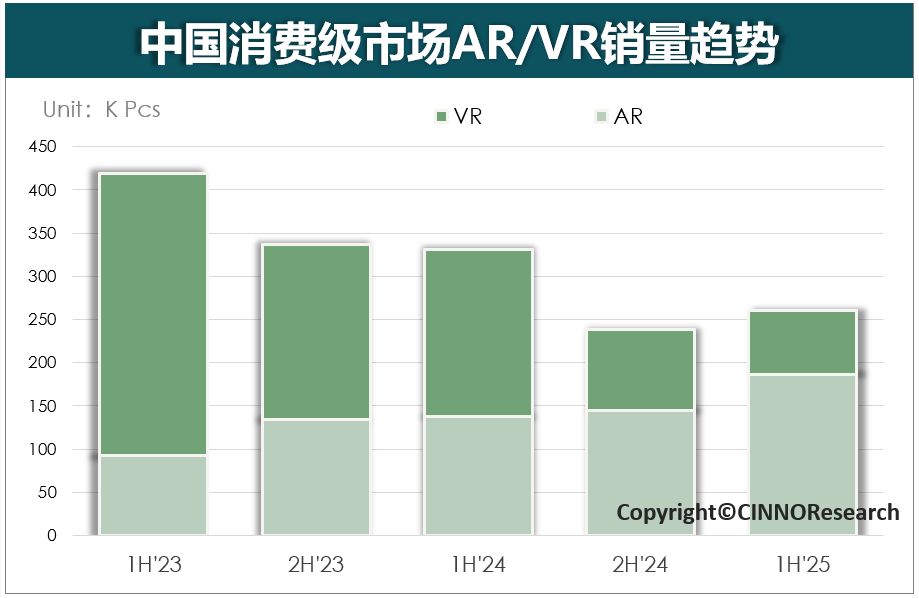
1H’25国内消费级XR市场销量26.1万台,全年预期同比增长6.5%
CINNO Research· 2025-08-19 06:37
Core Viewpoint - The Chinese consumer-grade XR market is experiencing structural differentiation in the first half of 2025, with the AR market continuing to grow while the VR market remains in a prolonged slump due to a lack of content ecosystem and new product releases [2][5]. Market Performance - In the first half of 2025, the overall sales volume of the domestic XR consumer market reached 261,000 units, representing a 9% increase quarter-on-quarter but a 21% decline year-on-year [5]. - The domestic consumer-grade VR market is in a downturn, with VR device sales at 75,000 units, marking a three-year low, primarily due to insufficient investment in VR content and no major new product launches in the first half of the year [5]. - In contrast, the domestic consumer-grade AR device sales reached 186,000 units, showing a 35% year-on-year increase and a 28% quarter-on-quarter increase, driven by new AR glasses releases, government subsidies, and promotional events [5]. - The forecast for the entire year predicts a total of 606,000 units sold in the domestic consumer-grade XR market, a 6.5% increase compared to the previous year, mainly propelled by AR devices [5]. Brand Trends - In the VR device market, the brand landscape remains stable, with PICO holding a 46% market share, followed by Meta at 28% and Goovis at 7%. Despite the market downturn, leading manufacturers maintain their shares through cost control and ecosystem integration [6]. - The AR device market is becoming increasingly competitive, with Thunderbird Innovation leading with a 35% market share, followed by XREAL at 22%. The success of these brands is attributed to multi-dimensional strategic layouts [6][7]. Technology Trends - In the VR device market, Fast LCD screen sales share has rebounded to 87%, while Micro OLED screens remain primarily in high-end products [8]. - In the AR device market, Micro OLED screen sales share is at 87%, with Sony dominating the market. Domestic screen manufacturers like Visionary Technology have seen a 30 percentage point increase in sales share due to deep collaborations with brands like Thunderbird [8]. - Waveguide technology maintains a stable sales share of 13%, with significant technological breakthroughs allowing manufacturers to reduce costs by 40% and introduce products with a field of view exceeding 50 degrees [8]. Investment and Financing Situation - In the first half of 2025, there were 37 financing deals globally in the XR sector, amounting to 44.5 billion yuan, a decrease of 34 deals compared to the previous year but an increase of 33.5 billion yuan in total amount, indicating a trend of capital concentration towards leading projects [9]. - The investment and financing landscape in AR/VR is characterized by four major trends: capital centralization, core technology focus, ecological scene development, and regional clustering [9]. - The shift in capital from speculative concepts to substantial technological breakthroughs and commercialization is evident, with domestic breakthroughs in core components like Micro LED and silicon-based OLED expected to reshape the global supply chain [9].

CINNO Research:上半年中国XR消费级市场整体销量达26.1万台 环比增长9%
智通财经网· 2025-08-19 06:29
Core Insights - The Chinese consumer-grade XR market is experiencing structural differentiation in the first half of 2025, with the AR market continuing to grow while the VR market remains sluggish due to a lack of content ecosystem and new product releases [1] XR Market Overview - In the first half of 2025, the overall XR sales reached 261,000 units, representing a 9% quarter-on-quarter growth, primarily driven by the launch of new AR glasses [1] - The domestic consumer-grade VR market is in a downturn, with VR device sales at 75,000 units, marking a three-year low, attributed to insufficient investment in VR content and no major new product launches [3] - Conversely, the domestic consumer-grade AR device sales reached 186,000 units, showing a 35% year-on-year increase and a 28% quarter-on-quarter increase, supported by new product launches and government subsidies [3] - The forecast for the entire year predicts a total of 606,000 units sold in the domestic consumer-grade XR market, a 6.5% increase compared to the previous year, mainly driven by AR devices [3] Brand Trends - In the VR device market, the brand landscape remains stable, with PICO holding a 46% market share, followed by Meta at 28% and Goovis at 7%. Despite market challenges, leading manufacturers maintain their shares through cost control and ecosystem integration [4] - In the AR device market, competition is intensifying, with Thunderbird Innovation leading at 35% market share, followed by XREAL at 22%. Starry Sky Meizu ranks third due to effective policy adaptation and a comprehensive marketing strategy [4] Technology Trends - In the VR device market, Fast LCD screen sales share has rebounded to 87%, while Micro OLED screens remain focused on high-end products [5] - In the AR device market, Micro OLED screens account for 87% of sales, with Sony dominating the market. Domestic manufacturers like Visionary Technology have seen a 30 percentage point increase in market share through deep collaborations [5] - Waveguide technology maintains a stable 13% sales share, with significant breakthroughs allowing manufacturers to reduce costs by 40% and introduce products with a field of view exceeding 50 degrees [5] Investment and Financing Situation - In the first half of 2025, there were 37 global XR financing deals amounting to 44.5 billion yuan, a decrease of 34 deals compared to the previous year, but with an increase of 33.5 billion yuan in total funding, indicating a trend of capital concentration towards leading projects [7] - The AR/VR investment landscape is characterized by four trends: capital centralization, core technology focus, ecological scene development, and regional clustering [7] - The shift from speculative investment to substantial technological breakthroughs and commercialization is evident, with domestic advancements in Micro LED and silicon-based OLED becoming key factors in reshaping the global supply chain [7]
重构智能穿戴支付方式,AI眼镜将成下一个超级入口
Xuan Gu Bao· 2025-08-17 15:29
Group 1 - The core viewpoint of the article highlights the strategic partnership between Thunderbird Innovation and Ant Group to develop innovative digital payment solutions for the global market, integrating AI and AR glasses technology into local life, mobile payments, and cross-border consumption scenarios [1] - The Thunderbird X3 Pro, an AI glasses device that supports "Alipay tap," allows users to complete the payment process by simply looking at the Alipay blue ring or QR code, making it suitable for high-frequency cross-border consumption scenarios such as travel, shopping, and transportation [1] - The collaboration aims to explore deeper applications of AI and AR glasses in life services, including functionalities like QR code pickup, QR code biking, utility payments, and physical price comparison [1] Group 2 - According to Counterpoint's report, the international smart glasses market saw a year-on-year shipment growth of 110% in the first half of 2025, driven by strong demand for Ray-Ban Meta smart glasses and the entry of new brands like Xiaomi and RayNeo [1] - The artificial intelligence glasses segment experienced an annual growth rate exceeding 250%, significantly outpacing the overall market growth [1] - Companies such as GoerTek and Crystal Optoelectronics are identified as potential beneficiaries in the consumer electronics sector, particularly as smart glasses emerge as a "dark horse" in the market this year [1]
第一批买AI眼镜的人,已退货
虎嗅APP· 2025-08-16 13:54
Core Viewpoint - The rapid rise and subsequent decline of AI glasses in the market highlight the gap between consumer expectations and actual product performance, leading to significant return rates and negative feedback from users [5][12][28]. Group 1: Market Performance - Xiaomi AI glasses sold nearly 50,000 units within three days of launch, indicating strong initial demand [14]. - The overall market for smart glasses in China is projected to reach 2.907 million units in 2023, with multiple brands entering the competition [14]. - Despite the initial sales success, a wave of returns has emerged due to poor user experiences, with some estimates suggesting return rates could be as high as 40% to 50% [28][30]. Group 2: User Experience Issues - Users reported significant issues with the AI glasses, including connectivity problems, subpar audio and video quality, and heavy weight, leading to discomfort [8][14][15]. - Specific complaints included delayed translation features, poor photo quality, and awkward design that caused discomfort during extended use [10][11][15]. - The AI glasses' functionality, such as smart recognition and translation, often failed to meet user expectations, resulting in frustration and dissatisfaction [11][15]. Group 3: Competitive Landscape - Major tech companies like Huawei, Alibaba, and Baidu are entering the AI glasses market, intensifying competition [12][22]. - The market has seen a surge in new products, with over ten new models launched in the first half of the year, but many have faced similar criticism regarding performance [12][14]. - The entry of companies like Flash Technology, which offered a lower-priced model, did not prevent negative feedback regarding product quality and functionality [22][23]. Group 4: Historical Context - The history of smart glasses dates back to Google's launch of Google Glass in 2012, which ultimately failed due to high costs and privacy concerns [18][20]. - The market saw a resurgence in 2023 with Meta's collaboration with Ray-Ban, which successfully integrated AI features while focusing on style and comfort [21][22]. - The current landscape is characterized by a rush of companies attempting to capitalize on the AI glasses trend, but many are struggling with product quality and consumer acceptance [28].


看一眼就付钱!AI眼镜开启新支付革命,何时走出智能手机叙事框架
Hua Xia Shi Bao· 2025-08-15 16:38
Core Insights - The article discusses the evolution of payment methods in the context of AI and AR glasses, highlighting a new feature called "Look and Pay" introduced by Thunder Innovation in collaboration with Ant Group [1][2] - The integration of payment functionality is seen as a crucial step in connecting various scenarios and making smart glasses more relevant in daily life, although it is not expected to lead to a significant sales increase on its own [1][2][5] Payment Functionality - Thunder Innovation's AI glasses, Thunder X3 Pro, are the first globally to support "Look and Pay" with Alipay, allowing users to complete payments by simply looking at a payment code [2][3] - The payment feature will be expanded to other models, including Thunder V3 and V3 Slim, aiming to enhance market penetration of AI and AR glasses [2] - Rokid has also launched a similar payment feature with its smart glasses, allowing users to make payments through voice commands, indicating a trend among various companies to adopt this functionality [3][5] Market Dynamics - The entry of major players like Apple, Xiaomi, and Alibaba into the AR space is viewed positively by companies like Rokid, as it helps in market education and user awareness [4] - Despite the competition, companies see collaboration with large firms as beneficial for overall market growth rather than direct competition [4] Consumer Adoption Challenges - The current offerings of AI glasses do not meet the broader needs of consumers, as payment functionality alone is not a decisive factor for purchase; overall user experience, comfort, and diverse applications are critical [5][6] - The payment feature is considered an enhancement rather than a core driver of consumer interest, with companies emphasizing the need for a comprehensive ecosystem of services [6][9] Future Outlook - AI glasses are seen as potential successors to smartphones, but they currently rely heavily on smartphone connectivity and functionality [7][8] - Companies believe that the unique advantages of AI glasses, such as integrated health monitoring and advanced AI capabilities, could eventually lead to a shift in consumer behavior, although this transition is not expected to happen quickly [9][10] - IDC forecasts that by 2025, the shipment of smart glasses in China will reach 2.75 million units, a significant increase but still a fraction of smartphone shipments, indicating a long road ahead for widespread adoption [10]
