
天弘基金

Search documents
部分宽基指数依旧看多,后市或震荡向上:【金工周报】(20260112-20260116)-20260118
Huachuang Securities· 2026-01-18 11:43
Quantitative Models and Construction Methods 1. Model Name: Volume Model - **Construction Idea**: The model uses trading volume data to predict market trends - **Construction Process**: The model analyzes the trading volume of various broad-based indices to determine market sentiment. If the trading volume increases significantly, it indicates a bullish trend - **Evaluation**: The model is effective in capturing short-term market movements based on trading volume[1][14] 2. Model Name: Feature Longhu Board Institution Model - **Construction Idea**: This model uses institutional trading data from the Longhu Board to predict market trends - **Construction Process**: The model tracks the trading activities of institutions listed on the Longhu Board. A higher level of institutional buying indicates a bullish trend - **Evaluation**: The model is useful for understanding the impact of institutional trading on market trends[1][14] 3. Model Name: Feature Volume Model - **Construction Idea**: Similar to the Volume Model, this model uses specific volume features to predict market trends - **Construction Process**: The model analyzes specific volume features such as spikes or drops in trading volume to determine market sentiment - **Evaluation**: The model provides additional insights by focusing on specific volume features rather than overall volume[1][14] 4. Model Name: Intelligent Algorithm Model (CSI 300 and CSI 500) - **Construction Idea**: The model uses machine learning algorithms to predict market trends for the CSI 300 and CSI 500 indices - **Construction Process**: The model employs various machine learning techniques to analyze historical data and predict future trends for the CSI 300 and CSI 500 indices - **Evaluation**: The model is effective in capturing complex patterns and trends in the market using advanced algorithms[1][14] 5. Model Name: Limit Up and Down Model - **Construction Idea**: The model uses the frequency of limit up and down events to predict market trends - **Construction Process**: The model tracks the number of stocks hitting their daily limit up or down to gauge market sentiment. A higher number of limit up events indicates a bullish trend - **Evaluation**: The model is useful for capturing extreme market movements and sentiment[1][15] 6. Model Name: Up and Down Return Difference Model - **Construction Idea**: The model uses the difference between upward and downward returns to predict market trends - **Construction Process**: The model calculates the difference between the returns of stocks moving up and those moving down. A positive difference indicates a bullish trend - **Evaluation**: The model provides a balanced view of market sentiment by considering both upward and downward movements[1][15] 7. Model Name: Calendar Effect Model - **Construction Idea**: The model uses calendar-based patterns to predict market trends - **Construction Process**: The model analyzes historical data to identify recurring patterns based on the calendar, such as monthly or quarterly trends - **Evaluation**: The model is useful for capturing seasonal trends and patterns in the market[1][15] 8. Model Name: Long-term Momentum Model - **Construction Idea**: The model uses long-term momentum to predict market trends - **Construction Process**: The model tracks the long-term momentum of stocks to determine market sentiment. A positive momentum indicates a bullish trend - **Evaluation**: The model is effective in capturing long-term trends and movements in the market[1][16] 9. Model Name: Comprehensive Weapon V3 Model - **Construction Idea**: The model combines multiple indicators and models to provide a comprehensive market prediction - **Construction Process**: The model integrates various short-term, medium-term, and long-term models to generate a comprehensive market outlook - **Evaluation**: The model provides a holistic view of the market by combining multiple indicators and models[1][17] 10. Model Name: Comprehensive National Certificate 2000 Model - **Construction Idea**: Similar to the Comprehensive Weapon V3 Model, this model focuses on the National Certificate 2000 index - **Construction Process**: The model integrates various indicators and models specifically for the National Certificate 2000 index - **Evaluation**: The model is effective in providing a comprehensive outlook for the National Certificate 2000 index[1][17] Model Backtesting Results - **Volume Model**: All broad-based indices are bullish[1][14] - **Feature Longhu Board Institution Model**: Bullish[1][14] - **Feature Volume Model**: Bullish[1][14] - **Intelligent Algorithm Model (CSI 300)**: Bullish[1][14] - **Intelligent Algorithm Model (CSI 500)**: Bullish[1][14] - **Limit Up and Down Model**: Bullish[1][15] - **Up and Down Return Difference Model**: All broad-based indices are bullish[1][15] - **Calendar Effect Model**: Neutral[1][15] - **Long-term Momentum Model**: Neutral[1][16] - **Comprehensive Weapon V3 Model**: Bullish[1][17] - **Comprehensive National Certificate 2000 Model**: Bullish[1][17]
最新!个人养老金基金再扩容
Zhong Guo Ji Jin Bao· 2026-01-18 05:20
Core Viewpoint - The personal pension fund list in China has expanded, with 7 new products added, bringing the total to 309 funds as of the end of last year [1][3]. Group 1: Fund Expansion - The latest list of personal pension funds includes 309 products, an increase of 7 from the end of the third quarter last year [3]. - The newly added products consist of ordinary index funds, enhanced index funds, stable pension target funds, and target date funds [3]. Group 2: Sales Institutions - The number of sales institutions for personal pension funds remains unchanged at 52 [3]. - Securities companies lead with 25 institutions, followed by commercial banks with 19, and independent fund sales institutions with 8 [3]. Group 3: Performance and Scale - The personal pension funds have seen significant performance and scale growth, with an average net value growth rate of 17.54% for 279 funds that have been established for over a year [5]. - As of the end of the third quarter of 2025, the total scale of personal pension fund Y shares reached 15.107 billion yuan, marking a 65.32% increase from the end of 2024 [5]. Group 4: Industry Insights - Public funds are recognized as pioneers in the personal pension business and play a crucial role in the personal pension ecosystem [6]. - The industry is expected to enhance product diversity, demonstrate long-term investment value, and foster collaborative efforts among market participants to promote effective operation of personal pensions [6].
ETF市场跟踪与配置周报-20260117
Xiangcai Securities· 2026-01-17 12:21
Report Industry Investment Rating No relevant content provided. Core Views - PB-ROE framework's ETF rotation strategy recommends next week to focus on the communication, agriculture, forestry, animal husbandry, and transportation industries, corresponding to their industry ETFs; the ETF redemption sentiment indicator model suggests focusing on the Science and Technology Innovation 50 ETF, SSE 50 ETF, Medical ETF, Photovoltaic ETF, and Robot ETF [9][40] - Combining PB and ROE for industry configuration may be a better choice; the third quadrant's high PB high ROE and the fifth quadrant's low PB medium ROE are key focus areas; combining the third and fifth quadrants to construct a comprehensive PB-ROE strategy has an annualized return of 11.93% and an annualized excess return of 13.22% [32][33] Summary by Directory 1. Recent Market Overview (January 12 - January 16, 2026) - Index performance: Shanghai Composite Index closed at 4101.91, down 0.45% for the week; Shenzhen Component Index closed at 14281.08, up 1.14%; ChiNext Index closed at 3361.02, up 1.00%; Beijing Stock Exchange 50 closed at 1548.33, up 1.58%; Hang Seng Index closed at 26844.96, up 2.34%. The average daily trading volume of the Shanghai and Shenzhen stock markets was 34250.96 billion yuan, and the total trading volume for the week was 17.13 trillion yuan [12] - Industry performance: Among 31 Shenwan primary industries, 13 industries rose and 18 fell. The top three gainers were computer (up 3.82%), electronics (up 3.77%), and non-ferrous metals (up 3.03%); the top three losers were national defense and military industry (down 4.92%), real estate (down 3.52%), and agriculture, forestry, animal husbandry, and fishery (down 3.27%) [5][12] - Main funds: Main funds had net outflows for 5 trading days and no net inflows, with a total net outflow of 2752.39 billion yuan for the week. The industries with more net inflows were banks, public utilities, and coal; the industries with more net outflows were national defense and military industry, power equipment, and computer [5][13] 2. Recent ETF Market Performance (January 12 - January 16, 2026) - Overall situation: As of January 16, 2026, there were 1411 ETFs in the Shanghai and Shenzhen stock markets, with a total asset management scale of 60766.01 billion yuan. There were 1101 equity ETFs (38892.41 billion yuan), 53 bond ETFs (7479.66 billion yuan), 27 money market ETFs (1529.88 billion yuan), 17 commodity ETFs (2751.84 billion yuan), 207 cross-border ETFs (10070.46 billion yuan), and 6 unlisted ETFs (41.76 billion yuan) [20] - Newly listed and established ETFs: 8 ETFs were newly listed, all equity ETFs; 7 ETFs were newly established, with a total issuance scale of 51.24 billion yuan [21] - Equity ETFs: The median weekly increase or decrease was 0.59%. Science and technology semiconductor ETFs and semiconductor equipment ETFs performed well, with the Science and Technology Semiconductor ETF Peng Hua rising the most at 12.46%; aerospace and high-end equipment ETFs performed poorly, with the Aerospace ETF falling the most at 6.88%. The average weekly share change was a decrease of 19.4716 million shares. Software ETFs and media ETFs had more share increases, while the Science and Technology Innovation 50 ETF and CSI 300 ETF had more share decreases [24] - Bond ETFs: The median weekly increase or decrease of 53 bond ETFs was 0.12%. The convertible bond ETF had the highest increase of 0.91%, while the science and technology innovation bond ETF had the highest decrease of 0.00%. As of January 16, 2026, the Haifutong CSI Short-term Financing ETF had the largest scale of 631.50 billion yuan [27] - Cross-border ETFs: The median weekly increase or decrease was 1.18%. The China-South Korea Semiconductor ETF and Hong Kong Stock Connect Internet ETF had the highest increases, with the China-South Korea Semiconductor ETF rising 6.11%; the Hong Kong Securities ETF and Nasdaq Biotechnology ETF had the highest decreases, with the Hong Kong Securities ETF falling 2.28%. Since the beginning of the year, the median increase or decrease was 3.82%, with the China-South Korea Semiconductor ETF and Hong Kong Medical ETF having higher increases, and the Nasdaq ETF and Nasdaq Technology ETF having higher decreases [29] 3. PB-ROE Framework's ETF Rotation Strategy Tracking - Factor effectiveness: PB factor and PB quantile factor show certain stratification ability, and PB quantile factor is more effective; ROE factor's effectiveness declined after 2018; using ROE factor is better than ROE quantile factor; expected ROE factor is better than expected ROE year-on-year factor. Combining PB and ROE for industry configuration may be a better choice [32] - Key quadrants: The third quadrant's high PB high ROE and the fifth quadrant's low PB medium ROE are key focus areas. From 2017 to February 2024, the compound annualized excess returns of the third and fifth quadrant portfolios were 4.27% and 1.55% respectively [32] - Strategy improvement: After supplementing the PB-ROE framework with four dimensions, the annualized excess returns of the third and fifth quadrant strategies were 4.78% and 3.94% respectively. Combining the two strategies, the annualized return was 11.93% and the annualized excess return was 13.22% [33] - Recent performance: This week, the strategy focused on the communication, agriculture, forestry, animal husbandry, and transportation industries, with a cumulative return of -0.86%, and an excess return of -0.29% compared to the CSI 300 Index [8][34] - Performance since 2023: The cumulative return was 26.03%, with an excess return of 3.81% compared to the CSI 300 Index [8][36] - Performance since 2022: The cumulative return was 7.77%, with an excess return of 11.99% compared to the CSI 300 Index [39] 4. Investment Recommendations - PB-ROE framework: Focus on the communication, agriculture, forestry, animal husbandry, and transportation industries next week, corresponding to their industry ETFs [9][40] - ETF redemption sentiment indicator model: Focus on the Science and Technology Innovation 50 ETF, SSE 50 ETF, Medical ETF, Photovoltaic ETF, and Robot ETF next week [9][40]
全球生物医药行业“春晚”落幕,创新药ETF天弘(517380)盘中成交额超2200万元,近10日累计“吸金”近3亿元
2 1 Shi Ji Jing Ji Bao Dao· 2026-01-16 05:47
消息面上,据媒体消息,第44届摩根大通医疗健康大会(JPM2026)于1月12日至15日在美国旧金山召 开,此次会议聚焦生物技术、生物制药、AI+医药等六大领域。作为全球生物医药行业的"春晚",每年 1月举办的JPM大会是全球医药行业最重要的投资与交易窗口之一,可一睹全球医药生物产业发展的最 新动态。 中泰证券认为,多重因素推动下,医药板块中CRO、CDMO需求端呈逐步恢复态势,叠加过去三年供 给端持续出清,板块有望迎来盈利与估值同时提升的"戴维斯双击"。 中信建投证券表示,中国医药产业已迈入"创新兑现+全球布局"的关键阶段,人口与内需基数、全产业 链制造能力构成核心支撑,企业积极探索多元化的出海路径。展望2026年,可以重点关注创新商业化、 全球化突破、政策优化带来的新增量及行业并购整合的机遇。 (文章来源:21世纪经济报道) 1月16日,市场早盘高开回落,三大指数集体翻绿。 相关ETF方面,创新药ETF天弘(517380)截至午间收盘成交额超2200万元。 资金流向方面,截至1月15日,该ETF近10个交易日累计净流入额近3亿元。 创新药ETF天弘(517380)为全市场唯一一只跟踪恒生沪港深创新药精选5 ...
中国卫星股价跌5.52%,天弘基金旗下1只基金重仓,持有41.82万股浮亏损失246.74万元
Xin Lang Cai Jing· 2026-01-16 03:06
Group 1 - The core point of the news is that China Satellite experienced a decline of 5.52%, with its stock price at 100.93 yuan per share and a trading volume of 7.756 billion yuan, resulting in a total market capitalization of 119.349 billion yuan [1] - China Satellite, officially known as China Dongfanghong Satellite Co., Ltd., is located in Haidian District, Beijing, and was established on August 21, 1997, with its listing date on September 8, 1997 [1] - The company's main business involves aerospace manufacturing and satellite applications, with revenue composition being 97.01% from aerospace manufacturing and satellite applications, 1.71% from other sources, and 1.28% from leasing income [1] Group 2 - Tianhong Fund has a significant holding in China Satellite, with its Tianhong Guozheng Aerospace Industry ETF (159241) holding 418,200 shares, accounting for 3.12% of the fund's net value, making it the eighth-largest holding [2] - The Tianhong Guozheng Aerospace Industry ETF (159241) was established on May 21, 2025, with a current size of 496 million yuan and a year-to-date return of 9.2%, ranking 1282 out of 5531 in its category [2] - The fund manager, Sha Chuan, has a tenure of 8 years and 1 day, managing assets totaling 27.853 billion yuan, with the best return during his tenure being 148.88% and the worst being -69.41% [2]

亚马逊低地球轨道卫星即将发射升空!航空航天ETF天弘(159241)高开震荡,近5日净流入2.16亿元,卫星全产业链有望提前步入“盈利兑现期”
Sou Hu Cai Jing· 2026-01-16 03:01
Core Insights - The Aerospace ETF Tianhong (159241) has shown active trading with a turnover of 10.95% and a transaction volume of 877.23 million yuan, while the CN5082 index tracking the aerospace industry has decreased by 1.99% [1] - Over the past six months, the Aerospace ETF Tianhong has experienced a significant growth of 411 million yuan [1] - In the last five trading days, the ETF has attracted a total inflow of 216 million yuan, with a net inflow rate exceeding 35% [1] Product Highlights - The Aerospace ETF Tianhong closely tracks the CN5082 index, which encompasses sectors such as aerospace equipment, military electronics, and satellite internet, focusing on high-tech barriers and strong R&D attributes [1] Hot Events - Amazon's low Earth orbit satellite is scheduled for launch on February 12 by Arianespace [1] - By the end of 2024, Amazon plans to deploy over 200 satellites in low Earth orbit, with the core goal of establishing a satellite constellation of over 3,200 satellites to provide network connectivity [2] Institutional Views - Open Source Securities believes that low Earth orbit satellite constellations have become a new battleground for major powers, with the satellite industry market space aiming for trillions, and significant growth potential expected in the low Earth orbit satellite market over the next decade [3]


国家电网“十五五”投资额或达4万亿元,电网设备主题指数强势涨超5%
Xin Lang Cai Jing· 2026-01-16 02:31
Group 1 - The core viewpoint of the news is that the investment in China's State Grid during the 14th Five-Year Plan is expected to increase significantly, with a projected investment of 4 trillion RMB during the 15th Five-Year Plan, representing a 40% growth compared to the previous plan [1][2] - The State Grid aims to support the national carbon reduction goals by increasing the annual installed capacity of renewable energy by approximately 20 million kilowatts and achieving a 25% share of non-fossil energy consumption [1] - The demand for power equipment is anticipated to enter a prosperous cycle driven by the rapid development of AI and continuous investment in grid construction [2] Group 2 - The investment scale for the Southern Grid during the 15th Five-Year Plan is expected to reach around 1 trillion RMB, indicating an annual investment of approximately 1 trillion RMB for the entire country's grid [2] - The expected investment amounts for 2026 are projected to be 700 billion RMB for the State Grid and 189 billion RMB for the Southern Grid, reflecting year-on-year growth rates of 7.6% and 8.0%, respectively [2] - The Tianhong CSI Grid Equipment Theme Index closely tracks the performance of 80 listed companies involved in ultra-high voltage and smart grid construction, making it a valuable investment option for those looking to benefit from AI computing power development [2]
马斯克:三年内星舰发射频率将超过每小时一次!航空航天ETF天弘(159241)近5日吸金近2.2亿元净流入率超35%,超跌反弹一触即发!
Sou Hu Cai Jing· 2026-01-16 02:10
Core Insights - The Aerospace ETF Tianhong (159241) has seen an active trading volume with a turnover of 15.07% and a transaction value of 1.24 billion yuan as of January 15, 2026, despite the CN5082 index declining by 3.69% [1] - The ETF has experienced a significant growth of 4.11 billion yuan in scale over the past six months, indicating strong investor interest [1] - In the last five trading days, the ETF attracted a total of 2.16 billion yuan in net inflows, with a net inflow rate exceeding 35% [1] Product Highlights - The Aerospace ETF Tianhong (159241) focuses on military aerospace sectors, covering leading companies in fighter jets, transport aircraft, helicopters, aircraft engines, missiles, satellites, and radar, aligning with the "integrated aerospace" strategic direction [1] Hot Events - Elon Musk announced that SpaceX aims to achieve a launch frequency of over once per hour within three years, with a target of producing 10,000 Starship spacecraft annually [1] - The U.S. has approved SpaceX's request to deploy 7,500 second-generation Starlink satellites, which would increase the total number of operational Starlink satellites globally to 15,000 [1] Institutional Views - According to Caitong Securities, satellite frequency resources have become a national strategic priority, with a "first-come, first-served" mechanism accelerating network formation. The competition for frequency resources is intensifying, as evidenced by the strong entry of national teams like China Star Network and the Wireless Radio Innovation Institute [2]
债市乱纪元元年,优秀固收类基金的表现盘点
Sou Hu Cai Jing· 2026-01-15 23:01
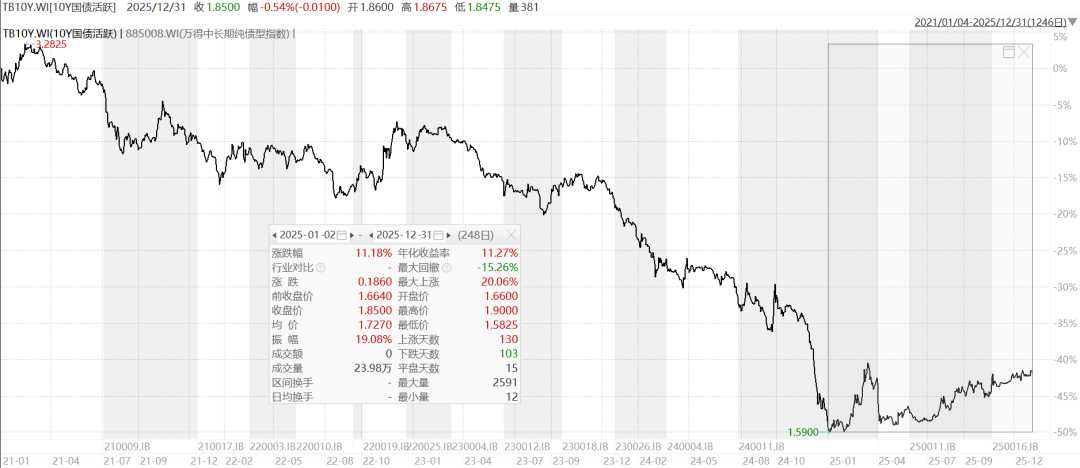
本文盘点一下2025年固收类基金的整体表现,并公示2025年固收类TOP50榜单的表现。 来源:零城投资 2025年固收类市场回顾 去年我们的总结文章就提到了,2024年是债牛,但是2025年将难以维系。 正如我们去年预测的那样,2025年长期国债收益率开始剧烈波动,十年期国债收益率上半年在底部来回震荡,从1.59%震荡回升至1.85%。 下图为近5年10年期国债收益率走势。(截至2025-12-31,数据来源:Wind,下同) 我也在过去一年的文章中反复提示,债市的黄金时代已经结束,进入乱纪元,天天"收蛋"的欢乐时光已结束。 如果说2024年是久期越长的债基收益越好,那么2025年基本上反过来了,中长期纯债基金的表现甚至不如短债基金,回撤也明显更大。 短债基金的收益率也并不比货币基金好多少,债市的夏普比和卡玛比全面下滑——这意味着乱纪元。 | 指数名称 | 年化收益率 | 最大回撤 | | --- | --- | --- | | (代表该类别平均水平) | | | | 万得中长期纯债型指数 | 0.86% | -0.88% | | 万得短期纯债型基金指数_ | 1.44% | -0.24% | | 万得货币 ...
全市场首只千亿元级黄金ETF亮相
Zheng Quan Ri Bao· 2026-01-15 16:48
Group 1 - The core point of the news is the emergence of the first gold ETF in the market to surpass 100 billion yuan, specifically the Huaan Gold ETF, which reached a scale of 100.76 billion yuan as of January 14 [1] - Since 2025, the Huaan Gold ETF has experienced rapid growth, increasing from 28.68 billion yuan at the beginning of 2025 to 93.99 billion yuan by the end of that year, with a growth of over 65 billion yuan [1] - The price of gold has been on the rise, with the London spot gold price breaking the 4,600 USD/ounce mark for the first time on January 12, and reaching a historical high of 4,643 USD/ounce on January 14 [1] Group 2 - In addition to the Huaan Gold ETF, there are other significant gold ETFs, including Bosera Gold ETF, E Fund Gold ETF, Guotai Gold ETF, and Huaxia Gold ETF, each with scales exceeding 40 billion yuan, all showing growth of over 10 billion yuan since early 2025 [2] - Other gold-related funds have also seen growth, such as the Yongying Gold Stock ETF, which increased from 1.65 billion yuan at the beginning of 2025 to 14.32 billion yuan by January 14, 2026 [2] Group 3 - Industry insiders view gold ETFs and linked funds as efficient and low-cost tools for ordinary investors to allocate gold [3] - Gold is highlighted as a core asset for hedging inflation risks and optimizing asset portfolios in the medium to long term, although investors are advised to be cautious of short-term market sentiment [3] - It is recommended that investors maintain a gold allocation of 10% to 20% in their portfolios to effectively optimize their investment mix [3]