
太阳纸业

Search documents
造纸板块11月12日跌0.27%,景兴纸业领跌,主力资金净流出2.41亿元
Zheng Xing Xing Ye Ri Bao· 2025-11-12 08:42
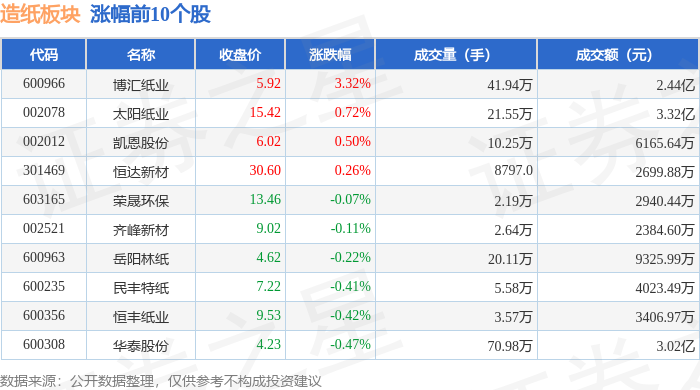
Market Overview - The paper sector experienced a decline of 0.27% on November 12, with Jingxing Paper leading the drop [1] - The Shanghai Composite Index closed at 4000.14, down 0.07%, while the Shenzhen Component Index closed at 13240.62, down 0.36% [1] Individual Stock Performance - Notable gainers included Bohui Paper, which rose by 3.32% to a closing price of 5.92, with a trading volume of 419,400 shares and a transaction value of 244 million yuan [1] - Other gainers included Sun Paper with a 0.72% increase, closing at 15.42, and Kain Co. with a 0.50% increase, closing at 6.02 [1] - Decliners included Zhi Xing Paper, which fell by 3.28% to 5.89, and Yibin Paper, down 1.90% to 23.18 [2] Capital Flow Analysis - The paper sector saw a net outflow of 241 million yuan from institutional investors, while retail investors contributed a net inflow of 261 million yuan [2][3] - The data indicates that while institutional investors withdrew funds, retail investors were actively buying into the sector [2][3] Detailed Capital Flow for Selected Stocks - Bohui Paper had a net inflow of 31.14 million yuan from institutional investors, while it faced a net outflow of 33.86 million yuan from retail investors [3] - Hengfeng Paper experienced a small net inflow of 1.52 million yuan from institutional investors, with retail investors contributing a net inflow of 273,600 yuan [3] - Other stocks like Kain Co. and Huawang Technology saw significant net outflows from institutional investors, indicating a cautious sentiment among larger players [3]





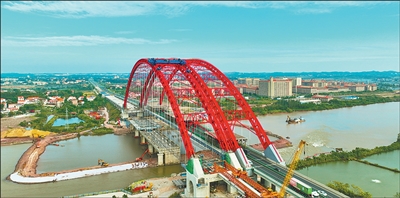
历经三年多建设 平陆运河雄姿初现——一河激活北部湾(产经观察·收官之际看工程)
Ren Min Ri Bao· 2025-11-11 22:46
Core Viewpoint - The construction of the Pinglu Canal is a significant infrastructure project aimed at enhancing transportation and trade capabilities for Guangxi and the southwestern region of China, facilitating direct access to the sea and international markets [1][3]. Geographic Perspective - The Pinglu Canal connects various waterways in Guangxi, allowing goods from the region to reach the sea and access ASEAN and global markets. It links to the Xijiang shipping trunk line and is designed to accommodate 5,000-ton vessels [2]. Development Philosophy - The project addresses historical transportation limitations in Guangxi, which has struggled with a lack of direct waterways to the sea. The canal is part of national strategies to enhance the North Bay Economic Zone and improve regional logistics [3]. Economic Benefits - The canal is expected to significantly reduce shipping distances, saving over 5.2 billion yuan in annual freight costs by shortening inland shipping routes by more than 560 kilometers compared to routes through Guangzhou [4]. Project Scale - The Pinglu Canal includes a 134.2-kilometer waterway, three dual-line ship locks, and 27 newly constructed or renovated bridges, representing a substantial engineering undertaking [5]. Construction Challenges - The project faces complex environmental and resource constraints, requiring innovative construction methods to ensure safety, low carbon emissions, and efficiency [6]. Progress Metrics - The total earthwork excavation for the project is approximately 315 million cubic meters, equivalent to nearly three times the excavation volume of the Three Gorges Dam. Concrete pouring for the locks is about 5.84 million cubic meters, enough to fill over 2,300 standard swimming pools [7]. Water Resource Management - The canal requires approximately 1 billion cubic meters of water annually to support 5,000-ton vessels, with water sourced from the Xijiang River to meet this demand without affecting the Pearl River's flow [8][9]. Industrial Development - The Pinglu Canal is expected to stimulate economic growth by attracting key industrial projects, such as a lithium carbonate production facility and a major paper industry project, thereby enhancing cargo availability for the canal [11]. Infrastructure Upgrades - To maximize the canal's shipping efficiency, upgrades to port facilities and inland waterways are essential, including enhancements to the existing infrastructure at Nanning Port to accommodate larger vessels [11].
一河激活北部湾(产经观察·收官之际看工程)
Ren Min Ri Bao· 2025-11-11 22:40
Core Viewpoint - The Pinglu Canal, a significant infrastructure project in Guangxi, aims to enhance transportation and trade by connecting inland waterways to the sea, facilitating access to ASEAN and global markets. This project is seen as a strategic initiative to overcome geographical limitations and improve the economic landscape of the region [1][3]. Geographic Perspective - The Pinglu Canal connects various waterways in Guangxi, allowing for direct maritime access to the Beibu Gulf and beyond. It links with the Xijiang shipping trunk line, enabling 5,000-ton vessels to reach the sea directly, thus enhancing trade routes for the southwestern region [2][3]. Development Philosophy - The construction of the Pinglu Canal reflects a shift in development philosophy, addressing the historical challenges of transporting goods from the western regions to the coast. The project is part of a broader national strategy to develop the Beibu Gulf Economic Zone and improve transportation infrastructure [3][5]. Project Scale and Complexity - The Pinglu Canal project includes a 134.2-kilometer waterway, three dual-line ship locks, and 27 bridges. It is designed to meet modern shipping needs while addressing environmental and resource constraints, making it a complex engineering endeavor [6][7]. Water Resource Management - The project requires significant water resources, with an estimated annual need of 1 billion cubic meters to support the 5,000-ton vessel navigation. Water will be sourced from the Xijiang River, ensuring that the flow to the Pearl River is not adversely affected [7][9]. Economic Impact - The Pinglu Canal is expected to significantly reduce shipping costs, saving over 5.2 billion yuan annually by shortening the inland shipping distance by more than 560 kilometers compared to routes through Guangzhou [5][11]. The project is anticipated to stimulate local industries and attract investment, contributing to the development of an economic belt along the canal [11][12]. Infrastructure Development - To maximize the canal's shipping efficiency, there is a need for upgrades to existing port facilities and inland waterways. For instance, the Nanning Port is undergoing enhancements to accommodate the increased shipping capacity of the Pinglu Canal [11][12].
造纸行业11月“涨”声一片 成本上升与需求扩张共振
Zheng Quan Shi Bao· 2025-11-11 17:48
Group 1 - The domestic paper industry is experiencing a price increase trend, particularly in the packaging paper sector, driven by leading companies and downstream demand [1] - Companies like Shanying International have initiated price hikes for products such as corrugated paper, with increases ranging from 30 to 100 yuan per ton, while other firms like Nine Dragons Paper have followed suit [1] - The recent "Double Eleven" shopping festival has boosted packaging demand, leading to a rise in order volumes for packaging paper, indicating a gradual recovery in the paper industry [1] Group 2 - The paper industry is transitioning towards "high-end, international, and green" development, with leading companies optimizing their production capacity to alleviate profit margin pressures caused by low-price competition [2] - Major companies are implementing strategies such as the establishment of integrated supply chains, with Shanying Huazhong Paper planning a chemical pulp project and Yibin Paper focusing on bamboo pulp for eco-friendly packaging [2] - The tightening of environmental regulations is expected to increase waste paper costs, intensifying competition among smaller paper companies, which will focus on cost control, technological upgrades, and supply chain integration [2]
造纸行业11月“涨”声一片 成本与需求迎共振
Zheng Quan Shi Bao Wang· 2025-11-11 10:52
Group 1 - The domestic paper industry is experiencing a price increase trend, particularly in the packaging paper sector, driven by leading companies and downstream demand [1] - Companies like Shanying Paper have initiated price hikes for products such as corrugated paper, with increases ranging from 30 to 100 yuan per ton, while core products in Guangdong and Zhejiang have seen a rise of 50 yuan per ton [1] - The price of packaging paper is supported by increased demand from events like "Double Eleven," with a notable rise in order volumes for boxboard, corrugated paper, and white card paper [1] Group 2 - The paper industry is transitioning towards "high-end, international, and green" production, alleviating profit margin pressures caused by low-price competition among small enterprises [2] - Major companies are focusing on raw material control and environmental packaging advantages, with projects like Shanying's chemical pulp production and Yibin Paper's bamboo pulp molding [2] - Analysts are optimistic about the cyclical recovery of the paper sector, with expectations of continued price increases for raw paper and improved profitability during peak seasons [2]
太阳纸业:公司生产的造纸用木浆主要为自用
Zheng Quan Ri Bao Wang· 2025-11-10 13:45
Core Viewpoint - The company primarily uses the wood pulp produced for its own paper manufacturing, while all of its dissolving pulp products are sold externally [1] Group 1 - The company, Sun Paper Industry, indicated that the wood pulp produced is mainly for self-use [1] - The dissolving pulp products are entirely exported [1]
太阳纸业(002078.SZ):公司生产的纸浆暂没有相关申请计划。
Ge Long Hui· 2025-11-10 10:57
Core Viewpoint - The company primarily produces wood pulp for its own use, while all of its dissolving pulp products are sold externally. There are currently no plans for related applications regarding pulp production [1]. Group 1 - The company produces wood pulp mainly for self-use [1] - All dissolving pulp products are sold externally [1] - There are no current plans for pulp production applications [1]
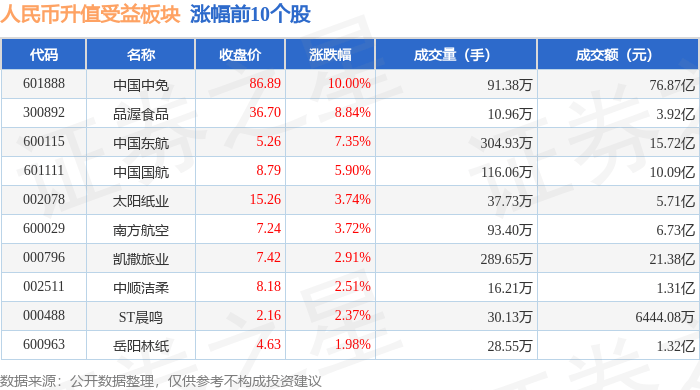
人民币升值受益板块11月10日涨3.62%,中国中免领涨,主力资金净流入8.76亿元
Sou Hu Cai Jing· 2025-11-10 09:04
Core Insights - The appreciation of the Renminbi has led to a significant increase in the related sectors, with a 3.62% rise in the Renminbi appreciation beneficiary sector on the previous trading day [1] - Major stocks benefiting from the Renminbi appreciation include China Duty Free Group, which surged by 10% [1] Market Performance - The Shanghai Composite Index closed at 4018.6, up 0.53%, while the Shenzhen Component Index closed at 13427.61, up 0.18% [1] - Key stocks and their performance include: - China Duty Free Group (601888): Closed at 86.89, up 10.00% with a trading volume of 913,800 shares and a transaction value of 7.687 billion [1] - Pinwa Food (300892): Closed at 36.70, up 8.84% with a trading volume of 109,600 shares and a transaction value of 392 million [1] - China Eastern Airlines (600115): Closed at 5.26, up 7.35% with a trading volume of 3,049,300 shares and a transaction value of 1.572 billion [1] Capital Flow - The Renminbi appreciation beneficiary sector saw a net inflow of 876 million in main funds, while retail investors experienced a net outflow of 392 million [2][3] - Specific stock capital flows include: - China Duty Free Group: Main funds net inflow of 113.8 million, retail net outflow of 45.2 million [3] - Sun Paper (002078): Main funds net inflow of 85.86 million, retail net outflow of 52.24 million [3] - China National Airlines (601111): Main funds net inflow of 28.98 million, retail net outflow of 57.41 million [3]
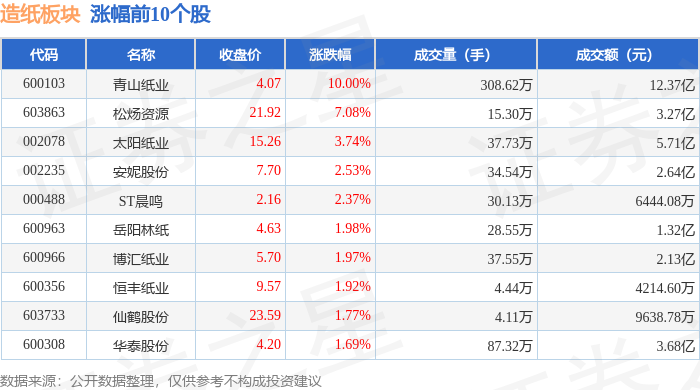
造纸板块11月10日涨2.41%,青山纸业领涨,主力资金净流入5.77亿元
Zheng Xing Xing Ye Ri Bao· 2025-11-10 08:48
| 代码 | 名称 | 收盘价 | 涨跌幅 | 成交量(手) | 成交额(元) | | --- | --- | --- | --- | --- | --- | | 600103 | 青山纸业 | 4.07 | 10.00% | 308.62万 | 12.37亿 | | 603863 | 松炀资源 | 21.92 | 7.08% | 15.30万 | 3.27亿 | | 002078 | 太阳纸业 | 15.26 | 3.74% | 37.73万 | 5.71亿 | | 002235 | 安妮股份 | 7.70 | 2.53% | - 34.54万 | 2.64亿 | | 000488 | ST晨鸣 | 2.16 | 2.37% | 30.13万 | 6444.08万 | | 600963 | 岳阳林纸 | 4.63 | 1.98% | 28.55万 | 1.32亿 | | 600966 | 博汇纸业 | 5.70 | 1.97% | 37.55万 | 2.13亿 | | 600356 | 恒丰纸业 | 9.57 | 1.92% | 4.44万 | 4214.60万 | | 603733 | 仙鶴股份 | 23 ...

行业ETF配置模型2025年超额14.4%
GOLDEN SUN SECURITIES· 2025-11-10 03:43
Quantitative Models and Construction Methods 1. Model Name: Industry Mainline Model (Relative Strength Index, RSI) - **Model Construction Idea**: This model identifies leading industries by calculating their relative strength (RS) based on historical price performance. Industries with RS > 90% are considered potential leaders for the year [10] - **Model Construction Process**: 1. Use 29 first-level industry indices as the investment universe [10] 2. Calculate the price change over the past 20, 40, and 60 trading days for each industry index [10] 3. Rank the price changes for each period and normalize the rankings to obtain RS_20, RS_40, and RS_60 [10] 4. Compute the average of the three rankings to derive the final relative strength index: $ RS = (RS_{20} + RS_{40} + RS_{60}) / 3 $ where RS_20, RS_40, and RS_60 represent the normalized rankings of price changes over 20, 40, and 60 trading days, respectively [10] - **Model Evaluation**: The model successfully identified leading industries in 2024, such as coal, banking, and AI-related sectors, which showed strong performance during the year [10][12] 2. Model Name: Industry Rotation Model (Prosperity-Trend-Crowding Framework) - **Model Construction Idea**: This model combines three dimensions—prosperity, trend, and crowding—to recommend industry allocations. It includes two sub-strategies: "Strong Trend-Low Crowding" and "High Prosperity-Strong Trend" [7][15] - **Model Construction Process**: 1. Define prosperity as the core metric, supplemented by trend and crowding dimensions [15] 2. For the "High Prosperity-Strong Trend" strategy, focus on industries with high prosperity and strong trends while avoiding highly crowded industries [15] 3. For the "Strong Trend-Low Crowding" strategy, prioritize industries with strong trends and low crowding while avoiding low-prosperity industries [15] 4. Allocate weights to industries based on the framework, e.g., November 2025 allocation: Basic Chemicals (18%), Media (16%), Agriculture (12%), Light Manufacturing (12%), Computers (12%), Home Appliances (9%), Real Estate (9%), Retail (6%), New Energy (4%), Coal (3%) [7][15] - **Model Evaluation**: The model demonstrated strong performance, with an annualized excess return of 13.7% and an IR of 1.5. It also showed a high monthly win rate of 67% [15][22] 3. Model Name: Left-Side Inventory Reversal Model - **Model Construction Idea**: This model identifies industries in a recovery phase from distress by analyzing inventory levels and analyst expectations. It aims to capture reversal opportunities in industries with low inventory pressure and potential for restocking [29] - **Model Construction Process**: 1. Focus on industries experiencing current or past distress with signs of recovery [29] 2. Identify industries with low inventory pressure and restocking potential [29] 3. Incorporate analyst long-term positive outlooks for these industries [29] - **Model Evaluation**: The model achieved an absolute return of 27.9% and an excess return of 7.5% relative to equal-weighted industry benchmarks in 2025 (up to October) [29] --- Model Backtesting Results 1. Industry Mainline Model (RSI) - Annualized excess return: Not explicitly stated - IR: Not explicitly stated - Maximum drawdown: Not explicitly stated - Monthly win rate: Not explicitly stated - 2024 performance: Identified leading industries such as coal, banking, and AI, which showed strong performance during the year [10][12] 2. Industry Rotation Model (Prosperity-Trend-Crowding Framework) - Annualized excess return: 13.7% [15] - IR: 1.5 [15] - Maximum drawdown: -8.0% [15] - Monthly win rate: 67% [15] - 2023 excess return: 7.3% [15] - 2024 excess return: 5.7% [15] - 2025 excess return (up to October): 2.0% [15] 3. Left-Side Inventory Reversal Model - Annualized excess return: Not explicitly stated - IR: Not explicitly stated - Maximum drawdown: Not explicitly stated - Monthly win rate: Not explicitly stated - 2023 performance: Absolute return of 13.4%, excess return of 17.0% [29] - 2024 performance: Absolute return of 26.5%, excess return of 15.4% [29] - 2025 performance (up to October): Absolute return of 27.9%, excess return of 7.5% [29]