汇丰银行

Search documents
金市持续高位震荡 黄金还能火多久?
Xin Hua Cai Jing· 2025-07-08 12:36
Core Viewpoint - The gold market is experiencing high volatility and mixed opinions regarding its future trajectory, particularly for the second half of 2025, influenced by geopolitical factors, central bank policies, and economic data [1][5][7]. Group 1: Current Market Conditions - Gold prices have shown a significant upward trend earlier this year but have entered a phase of fluctuation since mid-June, with current prices around $3,330 per ounce [1][3]. - As of July 8, 2023, COMEX gold futures were reported at $3,343 per ounce, while London spot gold was at $3,333 per ounce [1]. Group 2: Influencing Factors - Short-term factors supporting gold prices include expectations of Federal Reserve rate cuts, geopolitical uncertainties, and central bank gold purchases [3][5]. - Conversely, potential downward pressures include technical resistance, increased speculative trading, and weak physical demand [3][7]. Group 3: Central Bank Demand - A recent survey indicated that nearly 43% of central banks plan to increase their gold reserves in the next year, with 95% expecting continued gold accumulation [5][6]. - China's gold reserves increased to approximately 2,298.55 tons as of June, marking the eighth consecutive month of accumulation [6]. Group 4: Economic Data and Predictions - U.S. economic data and market expectations regarding Federal Reserve rate cuts are critical in determining gold price movements [7]. - Analysts from Goldman Sachs and Citigroup express concerns that the anticipated rate cuts may lead to a decrease in gold prices, with Citigroup predicting a drop to between $2,500 and $2,700 per ounce by Q2 2026 [7][8]. Group 5: Long-term Outlook - Despite short-term fluctuations, there is a long-term optimistic view on gold's value as a hedge against currency devaluation and inflation, supported by ongoing central bank purchases and a low-interest-rate environment [8].

西班牙桑坦德银行深圳分行获批筹建,外资金融版图再扩容
Nan Fang Du Shi Bao· 2025-07-08 12:00
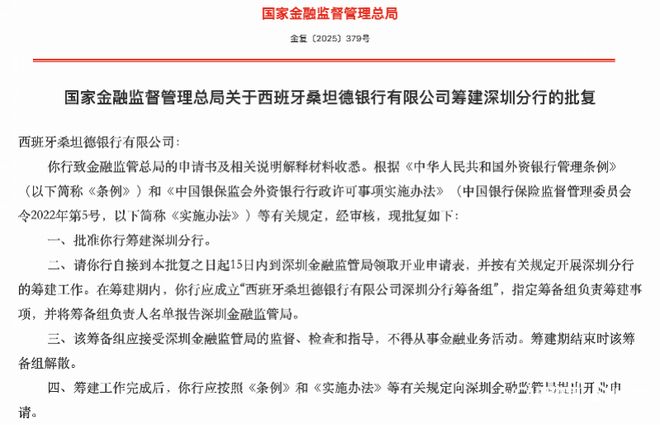
Group 1 - The core point of the news is the approval of Banco Santander to establish a branch in Shenzhen, marking its third presence in China after Shanghai and Beijing, and reflecting the ongoing expansion of foreign financial institutions in the region [1][4][10] - Banco Santander, as Spain's largest commercial bank, has a significant global presence with total assets of €1.8 trillion and annual revenue of €61.876 billion as of the end of 2024 [1][4] - The establishment of the Shenzhen branch aligns with China's financial opening policies, which have seen over 50 measures introduced since 2018 to facilitate foreign investment in the banking sector [4][9] Group 2 - Shenzhen has become a hub for foreign banks, with 38 institutions having total assets exceeding 400 billion RMB, ranking among the top in the country [5][6] - The historical context of foreign banks in Shenzhen dates back to 1982, with significant milestones including the establishment of the first foreign bank and the introduction of various international banking giants [5][6] - Recent developments indicate a trend of foreign banks increasing their presence in Shenzhen, supported by favorable policies and the city's strong economic performance [6][9] Group 3 - Foreign banks in Shenzhen are actively participating in cross-border financing and settlement, with significant contributions to the "Cross-Border Wealth Management Connect" pilot program [7] - These banks are also supporting Chinese enterprises in their global expansion efforts, leveraging their international networks to provide comprehensive services [7][8] - In the green finance sector, foreign banks are involved in innovative practices, such as ESG-linked loans and sustainable bond issuance, contributing to Shenzhen's green development initiatives [8] Group 4 - Shenzhen's favorable business environment, recognized as one of the best in the country, has attracted a significant number of foreign enterprises, with a 21.7% increase in newly established foreign companies in 2024 [9][10] - The city continues to enhance its policies to attract foreign investment, with new measures introduced to optimize the international business environment [9][10] - The ongoing development of foreign financial institutions in Shenzhen reflects China's commitment to high-level financial openness and a mutually beneficial financial development framework [10]

深圳外资银行,再添新成员
Zhong Guo Ji Jin Bao· 2025-07-08 11:33
Group 1 - Santander Bank has received approval to establish a branch in Shenzhen, marking the establishment of a new European-funded bank in the region [1] - Santander Bank, founded in 1857, is the largest commercial bank in Spain and a globally significant bank, with total assets of €1.8 trillion and a net profit of €13.744 billion as of the end of 2024 [1] - The establishment of the new branch signals foreign investors' confidence in the Chinese economy and the Guangdong-Hong Kong-Macao Greater Bay Area market [1] Group 2 - China has been actively expanding high-level financial openness, implementing over 50 measures since 2018 to attract foreign investment and improve the business environment [2] - Recent policies have removed foreign ownership limits in various financial sectors, allowing foreign institutions to enjoy national treatment and expand their business scope [2] Group 3 - Shenzhen is a key destination for foreign financial institutions, with over 35 foreign banks operating in the city, holding total assets exceeding 400 billion yuan [3][7] - The presence of foreign banks in Shenzhen has significantly contributed to the development of the local financial industry, enhancing management practices and technological innovation [7][10] Group 4 - Foreign banks in Shenzhen have been actively involved in cross-border financing and settlement, with nine banks participating in the "Cross-Border Wealth Management Connect" pilot program [8] - These banks have facilitated cross-border investment channels and improved efficiency in corporate account opening and credit approval processes [8][9] Group 5 - Foreign banks are supporting Chinese enterprises in their global expansion by providing a range of financial services, including credit, bond issuance, and risk management [9] - They are also assisting in building supply chains and connecting with local governments and service providers in foreign markets [9] Group 6 - Foreign banks are playing a significant role in promoting green finance in Shenzhen, participating in various sustainable finance initiatives and projects [10] - They are collaborating with local governments to issue offshore RMB bonds, including green bonds and social responsibility bonds, to support urban development and sustainability [10]
深圳外资银行,再添新成员!
中国基金报· 2025-07-08 11:20
Core Viewpoint - The approval for Banco Santander to establish a branch in Shenzhen signals foreign investors' confidence in the Chinese economy and the Guangdong-Hong Kong-Macao Greater Bay Area market [1] Group 1: Banco Santander's Expansion - Banco Santander, established in 1857, is Spain's largest commercial bank and a globally significant bank, with total assets reaching €1.8 trillion and net profit of €13.744 billion by the end of 2024 [1] - The bank has been actively expanding in China, having previously established branches in Shanghai and Beijing in 2008 and 2014, respectively [1] Group 2: Foreign Investment in China's Financial Sector - Since 2018, over 50 measures have been introduced to enhance foreign investment in China's financial sector, including the removal of foreign ownership limits in various financial services [2] - The recent notification from the financial regulatory authority further expands the business scope for foreign banks, encouraging more foreign institutions to invest in China [2] Group 3: Foreign Banks in Shenzhen - Shenzhen is a key destination for foreign financial institutions, with 35 foreign banks operating 5 legal entities and 33 branches, totaling over ¥400 billion in assets by the end of 2024 [8] - The presence of foreign banks has significantly contributed to the advancement of Shenzhen's financial industry, enhancing management practices and technological innovation [8] Group 4: Cross-Border Financial Services - Nine foreign banks in Shenzhen are participating in the "Cross-Border Wealth Management Connect" pilot program, facilitating cross-border investment for residents in the Greater Bay Area [9] - These banks are also involved in cross-border data verification and credit information sharing, improving efficiency in corporate financing processes [9] Group 5: Support for Chinese Enterprises Going Global - Foreign banks leverage their global resources to provide comprehensive financial services for Chinese enterprises expanding overseas, including credit, bond issuance, and risk management [11] - Collaborations between foreign banks and Chinese companies are evident in various international markets, such as Southeast Asia [11] Group 6: Green Finance Initiatives - Foreign banks in Shenzhen are actively participating in the green finance sector, supporting low-carbon transitions and sustainable development projects [13] - Initiatives include issuing offshore RMB bonds and facilitating ESG-linked loans, showcasing the banks' commitment to environmental sustainability [13]
警惕针对“海归”人才的四种论调 黄金板块艳压群雄年涨幅逾五成 “黄金再次货币化”驱动估值重塑 个股表现或分化 澳商业地产显著复苏
Sou Hu Cai Jing· 2025-07-07 12:56
Group 1 - The gold sector has outperformed others with an annual increase of over 50%, driven by a "re-monetization" of gold and a restructuring of global trade demand for physical assets [1][4] - In the ASX 500, 21 out of the top 50 performing companies are gold-related, with 8 out of the top 10 being gold stocks, indicating strong market interest in this sector [1][4] - The current gold price is influenced by global central bank purchases, ongoing geopolitical risks, and expectations of monetary easing, with COMEX gold futures trading at approximately $3,334 per ounce [3][4] Group 2 - The trend of "de-dollarization" in the global monetary system is still in its early stages, with gold entering a phase of "re-monetization" after a historical period of "de-monetization" [5][6] - The demand for gold and commodities is becoming more diverse and solid, as countries are less willing to concentrate their reserves in dollar assets [6] - Companies with clear gold resources and those entering the development phase are expected to see significant valuation reappraisal opportunities [6][8] Group 3 - Theta Gold Mines, a gold exploration and development company, is advancing its flagship project towards production, holding 6.1 million ounces of gold resources [7][8] - The average market value per ounce of gold resources for 15 companies is approximately AUD 429, while Theta Gold Mines' valuation is significantly lower at AUD 19.5 per ounce, indicating a potential undervaluation [8] - The overall performance of gold stocks is expected to diverge in the future, with companies that have strong management teams and solid capital structures likely to attract more market attention [6][8]

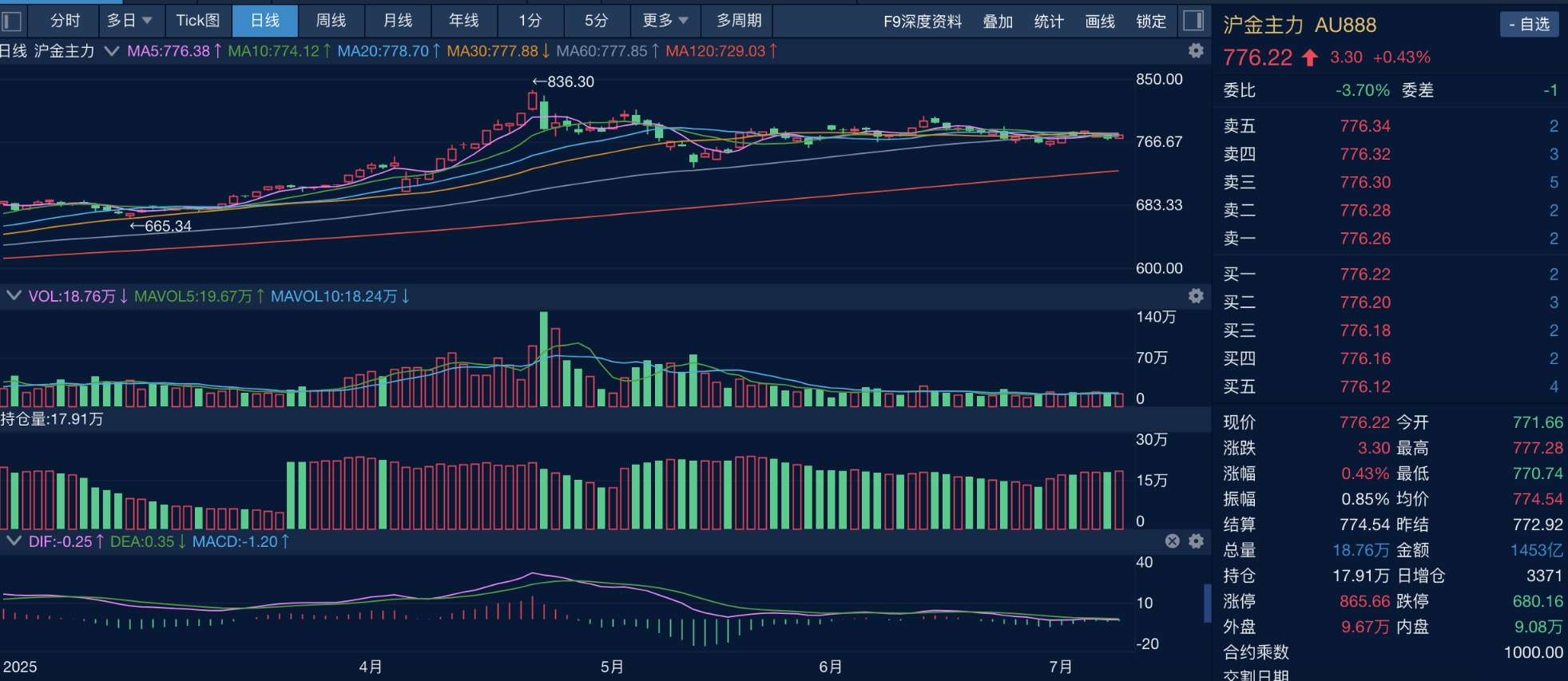
黄金当前不宜急进,易被套高位,建议观望等待
Sou Hu Cai Jing· 2025-07-07 03:06
Core Viewpoint - Gold prices are experiencing significant volatility, oscillating between 760 to 780 yuan in July, with a recent spike to 780 yuan followed by a drop to 770 yuan, raising concerns about market entry timing [1] Group 1: Market Dynamics - Key technical levels for gold are identified: 3250 USD as a critical support level, with potential declines to 3120 USD if breached; 3400 USD acts as a resistance level; and 3348 USD serves as an upper limit for rebounds [1] - Institutional views are divided: Goldman Sachs and UBS are bullish, predicting gold prices could reach 3500 USD by year-end, while the World Gold Council warns that strong US GDP growth could push prices down to 3000 USD [1] - Global central banks purchased a record 493 tons of gold in Q2, indicating a strong demand despite some countries like China pausing purchases [2] Group 2: Economic Indicators - Two major events impacting the market are highlighted: disappointing non-farm payroll data with only 147,000 new jobs and a drop in the unemployment rate to 4.1%, which led to a rise in the dollar and a corresponding drop in gold prices [2] - The geopolitical situation in the Middle East, particularly the conflict between Israel and Hezbollah, has not significantly affected gold prices unless a full-scale war occurs [2] Group 3: Investment Strategies - Retail investors are advised against blindly buying below 750 USD due to high risks, suggesting a "barbell strategy" of investing in physical gold while using options for hedging [2] - Investors should monitor three indicators: COMEX net long positions falling below 28%, the dollar rising above 105, and a ceasefire agreement in the Middle East, as any of these could trigger stop-loss actions [2]

外国投资人,开始“赞美”996
凤凰网财经· 2025-07-05 14:01
Core Viewpoint - The article discusses the evolving perception of the "996" work culture, highlighting a shift in Silicon Valley where some investors now advocate for it as a virtue, contrasting it with the previous criticism of such work practices [2][3][12]. Group 1: The Shift in Work Culture - The "996" work culture, once criticized as detrimental, is now being viewed positively by some Silicon Valley investors who prioritize investment in startups that adopt this model [2][3]. - Notable examples include the fintech company Bolt, which initially adopted a "4-day work week" but later reverted to more traditional work expectations, indicating a potential backlash against the "anti-involution" trend [12][13]. Group 2: Perspectives from Key Figures - Michael Moritz, a prominent Silicon Valley investor, previously acknowledged the "996" culture's harshness but recognized its role in fostering collective progress in business [3]. - Nik Storonsky, founder of Revolut, criticized European entrepreneurs for not working hard enough compared to their counterparts in the U.S. and China, suggesting that a lack of effort leads to inferior results [5][6]. Group 3: The Debate on Work-Life Balance - The article presents contrasting views on work-life balance, with some arguing that excessive focus on comfort in the workplace can undermine productivity and the fundamental principles of hard work [12]. - A survey by Antler revealed that a significant portion of startup founders work over 60 hours a week, indicating a culture of long hours in the entrepreneurial landscape [8]. Group 4: Mental Health Considerations - The discussion also touches on the mental health challenges faced by entrepreneurs, with a significant percentage reporting that the pressures of startup life negatively impact their well-being [14][16]. - The need for a balanced approach to work intensity and mental health is emphasized, suggesting that while hard work is essential, it should not come at the cost of personal health [16][17].

金融科技的未来引擎,蚂蚁国际用“区块链 + AI”重塑全球资金管理
Sou Hu Cai Jing· 2025-07-04 14:56
Core Insights - The digital asset sector has seen significant milestones since 2025, including the U.S. Senate passing the GENIUS Act and Hong Kong introducing regulations for stablecoins, indicating a growing institutional interest in digital assets [2] - The future of stablecoins and blockchain finance is driven not by speculative market activities but by a revolution in corporate treasury management, which is becoming a critical area for financial technology [3][17] - Ant International is positioning itself as a digital technology partner within regulatory frameworks, focusing on enhancing the resilience and inclusivity of financial systems rather than being a disruptor [17] Group 1: Market Developments - Major companies like SpaceX and Stripe are actively engaging with stablecoin payment platforms, highlighting the practical applications of stablecoins in global fund settlement [2] - Ant International is accelerating its investment in global treasury management, aiming to leverage AI, blockchain, and stablecoin innovations for large-scale applications [2][3] - The anticipated cost savings from tokenized cross-border payments could exceed $50 billion for enterprises by 2030, driven by the need for efficient treasury management solutions [7][12] Group 2: Challenges in Treasury Management - Companies face significant challenges in cross-border payments, including high transaction costs and delays due to complex processes and centralized infrastructures [3][4] - Inefficient foreign exchange management strategies can lead to additional costs of 1.5% to 3% for enterprises, particularly affecting small and medium-sized businesses in emerging markets [4] Group 3: Technological Innovations - Ant International's Whale platform is designed to facilitate real-time, secure fund management across different financial institutions, significantly reducing settlement times from days to seconds [13] - The integration of AI with blockchain technology is transforming corporate treasury operations, enabling data-driven decision-making and enhancing cash flow management [15][18] - The AI-driven foreign exchange demand forecasting model, named "Falcon," achieves over 90% accuracy in predicting cash flow and foreign exchange exposure, allowing companies to optimize their financial strategies [15] Group 4: Regulatory Engagement - Ant International is actively participating in regulatory innovation initiatives in Singapore and Hong Kong, positioning itself as a key player in the evolving digital asset landscape [16][17] - The collaboration with major banks and financial institutions to implement the Whale platform demonstrates the growing acceptance of blockchain technology in global financial services [17]