凯赛生物

Search documents
工信部正式发布!凯赛/睿嘉康/丰原/圣泉/一诺生物/利夫/国生/微构/聚维元创/白银赛诺/京博中聚等上榜
合成生物学与绿色生物制造· 2026-02-07 06:11
全球政策进展 | 工信部、非粮 【SynBioCon】 获 悉,2月5日, 工业和信息化部办公厅、农业农村部办公厅 正式公布了 《 关于开展非粮生物基材料产业创新发展典型案例推荐工 作的通知 》,共计 35项。 【SynBioCon】 曾第一 时间报道: 工信部又发文!35项非粮生物制造典型案例上榜,这些企业值得关注! 共有 25家 企业相关技术入选 关键技术 创新 典型案例,分别是 山东埃尔派粉体 、 睿嘉康生物 、 博兴新材料、黑龙江博能绿色能源、 安徽丰原生物 、 山东一诺生物质 、 新乡化纤 、 上海德福伦 、 阳谷华泰 、宁夏滨泽新能源、 济南圣泉集团 、 利夫生物 、 浩森生物 、 京博中聚 、 天润和生物 、 中科国生 、万华禾香板、 聚维元创 、山东益得来生物、聊城金歌合成材料、 安徽雪龙新 材料、龙都天仁、黑龙江省秸乐农业、 海伦国投 、 白银 赛诺 。 共有 7 家 企业(8项案例)技术入选 应用场景拓展 典型案例,分别是 凯赛生物 、潍坊欣龙生物、 苏州聚维元创 、 安徽丰原生物 (2项)、 旭川化 学 、 北京微构工场 、 深圳光华伟业 。 共有 2处 开发区入 选 特色集聚区培育 典 ...


一号文件从“三向”部署农业创新,合成生物赛道火热
合成生物学与绿色生物制造· 2026-02-04 10:55
Core Viewpoint - The article discusses the key deployments in the 2023 Central Document No. 1, focusing on agricultural modernization through technological innovation and the development of new productive forces in agriculture [5][6][7]. Group 1: Key Deployments in Agricultural Technology Innovation - The document emphasizes strengthening integrated innovation by enhancing the overall effectiveness of the agricultural technology innovation system, promoting enterprise-led innovation, and focusing on key areas such as seeds and agricultural machinery [5]. - It highlights the expansion of application scenarios through modern information technology and biotechnology, showcasing the significant role of agricultural drones and artificial intelligence in transforming agricultural practices [6]. - The document stresses the importance of promoting the transformation of agricultural technology achievements to address practical issues faced by farmers, ensuring that innovations reach rural areas effectively [7]. Group 2: Agricultural Bio-Manufacturing Paths Worth Noting - The article identifies high-value utilization of agricultural by-products, such as straw, as a key focus, indicating a shift from mere utilization to profitable applications [8]. - It discusses the potential of synthetic biology to enhance agricultural productivity by producing essential proteins and bio-fertilizers, thereby reducing reliance on chemical fertilizers [10]. - The development of new agricultural applications, including biodegradable materials and bio-pesticides, is highlighted as a means to promote green transformation in agriculture [11]. Group 3: Market Overview of Agricultural Bio-Manufacturing - As of February 9, 2025, there are 161 companies in the A-share market related to the "synthetic biology" concept, with a total market value of approximately 1.69 trillion yuan, averaging 10.5 billion yuan per company [15]. - The agricultural bio-manufacturing sector includes around 20 companies focusing on areas such as animal vaccines and feed additives, indicating a gradual industrial application of synthetic biology in agriculture [17]. - Key companies in this sector are noted for their focus on replacing feed, plant breeding, bio-pesticides, and precision farming, showcasing the diverse applications of synthetic biology in agriculture [17].



生态环境部推进PVC行业无汞化转型,原油价格走强
Huaan Securities· 2026-02-02 11:11
Investment Rating - The industry investment rating is "Overweight" [2] Core Insights - The chemical sector is experiencing a dual drive of cyclical recovery and growth, with a focus on organic silicon, PTA, polyester filament, caprolactam, spandex, vitamins, sweeteners, refrigerants, and phosphorus chemicals [5][6] - The organic silicon industry is entering a recovery phase, with new applications becoming the core growth engine. From 2019 to 2024, domestic DMC capacity is rapidly expanding, leading to temporary oversupply and continuous price declines. However, by 2025, no new capacity is expected, and demand from emerging sectors like new energy vehicles and photovoltaics is maintaining high growth [5][6] - The PTA and polyester filament industry is moving towards a new prosperity cycle as the capacity expansion phase is nearing its end, with new capacity mainly concentrated in leading enterprises [6] - The refrigerant market is entering a high prosperity cycle due to quota policies and stable demand growth from the heat pump and cold chain markets [7] - The synthetic biology sector is expected to see explosive demand growth as fossil-based materials face disruptive challenges, with a focus on energy-efficient products [8] - OLED technology is accelerating its penetration into larger displays, supported by government policies promoting the new display industry [9] - The demand for electronic chemicals is increasing due to the rapid development of the semiconductor industry, particularly in China, where the market is heavily reliant on imports [11] Summary by Sections Industry Performance - The chemical sector's overall performance ranked 12th with a decline of 0.86% during the week of January 26 to January 30, 2026 [20] - The top three performing sectors were oil and petrochemicals (7.95%), communications (5.83%), and coal (3.68%) [20] Key Industry Dynamics - The Ministry of Ecology and Environment is promoting the mercury-free transformation of the PVC industry, focusing on the development of mercury-free catalysts [36] - Recent geopolitical tensions in the Middle East have led to increased oil prices, with WTI crude averaging $61.33 per barrel, up 2.39% from the previous week [36]
凯赛生物今日大宗交易折价成交19.7万股,成交额916.44万元
Xin Lang Cai Jing· 2026-02-02 09:41
Group 1 - On February 2, Kaisa Bio executed a block trade of 197,000 shares, with a transaction value of 9.1644 million yuan, accounting for 1.57% of the total trading volume for the day [1] - The transaction price was 46.52 yuan, which represents a discount of 13.26% compared to the market closing price of 53.63 yuan [1]

科创50日内跌幅达2.01%
Mei Ri Jing Ji Xin Wen· 2026-02-02 02:45
(文章来源:每日经济新闻) 每经AI快讯,2月2日,科创50日内跌幅达2.01%。成分股中,佰维存储跌7.87%,晶合集成跌5.49%,盛 科通信跌5.46%,凯赛生物跌5.30%。 ...
2026,国家级母基金这样投
母基金研究中心· 2026-01-30 09:36
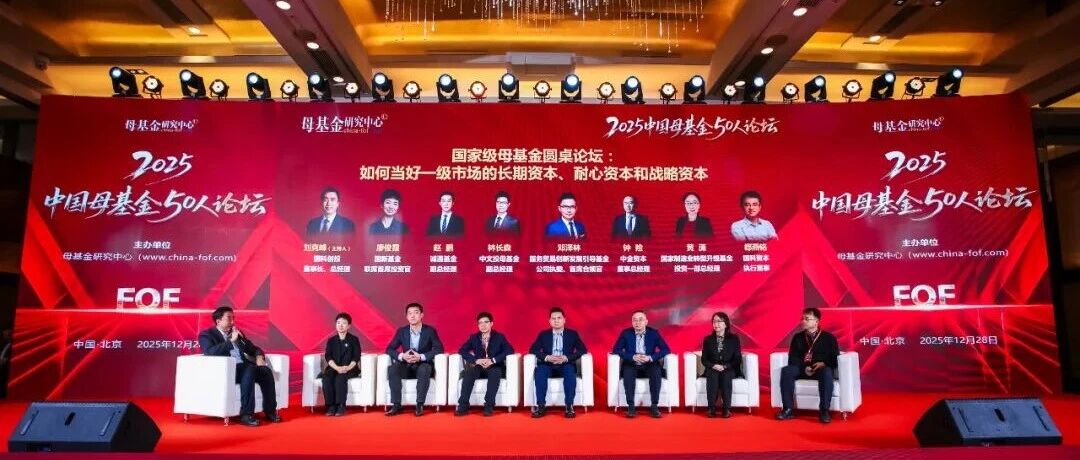
围绕 "战略资本"超越财务回报的产业使命,嘉宾们分享了各自机构通过资本纽带与生态网络带 动社会资本、服务国家战略的具体实践。 国新基金联席首席投资官廖俊霞介绍,基金投资作为中国国新开展国有资本运营的重要抓手, 以落实国家战略为导向,以服务央企为本位,支持央企科技创新、改革发展。经过 1 0余 年的 探索发展逐步形成了以国新基金管理公司为统一管理平台,涵盖国风投基金、央企战新基金、 国新创投基金等基金在内的,系列化布局、差异化定位、协同化发展、市场化运作的基金布 局。通过基金 方式 实现了国有资本 的 7倍放大效应, 其绝大部分投资 集中于战新领域。 2 0 2 5年1 2月2 8日,2 0 2 5第七届中国母基金5 0人论坛在京召开。本届论坛由母基金研究中心 (www. c h i n a -f o f. c om)主办,汇聚了来自政府部门、行业协会、国内主流母基金、保险资 管、银行AIC、知名投资机构、产业集团及学术界的3 0 0余位代表,为中国母基金行业建言献 策。 在国家级母基金圆桌论坛 "如何当好一级市场的长期资本、耐心资本和战略资本"中,国科创投 董事长、总经理刘克峰担任主持人,与嘉宾国新基金联席首 ...
化工出口迎拐点,亚非拉打开增长空间;关注化工行业ETF易方达(516570),一键打包能化龙头
Sou Hu Cai Jing· 2026-01-29 02:46
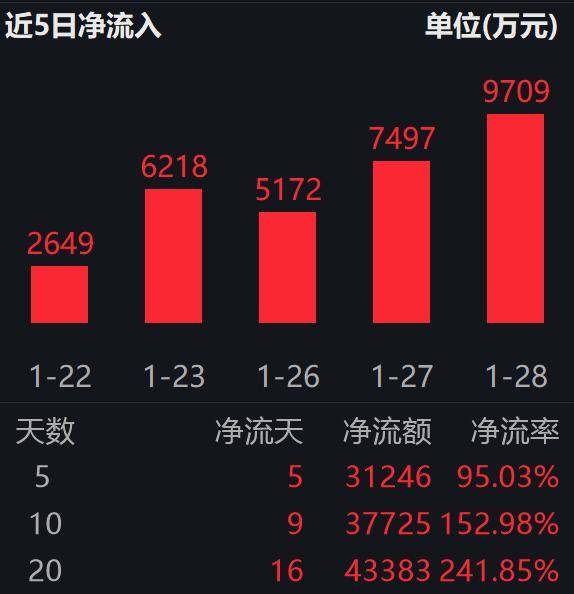
截至9:55,中证石化产业指数(H11057)涨0.27%,成分股中,三棵树涨超6%,凯赛生物涨超3%,荣 盛石化、上海石化、中国海油涨超2%。 化工行业ETF易方达(516570)跟踪中证石化产业指数,备受资金青睐。数据显示,该基金连续5日获 资金净流入,合计超3.1亿,近20日资金净流入超4.3亿。 化工行业ETF易方达(516570)覆盖"三桶油",一键打包化工产业龙头,管理费率+托管费率合计仅 0.2%/年,助力投资者低成本布局传统能源产业机会。 易方达中证石化产业ETF联接A(020104.OF) 易方达中证石化产业ETF联接C(020105.OF) 2025年化工品出口增长明显,越来越多的化工品海外敞口超过20%,逐渐摆脱了国内地产的拖累,走出 开工率拐点。中国信贷+美国库存的二元需求结构,需要转变为中国+美国+亚非拉的三元需求结构。去 年中国高速增长的PVC、TDI等产品主要都是流向亚非拉,尤其是东南亚。 中银证券指出,"反内卷"等持续催化,关注供需格局持续向好子行业。一是炼化、聚酯、染料、有机 硅、农药等子行业产品价格处于低位,供给格局集中,部分子行业已通过自律、联合减产等方式维持价 格秩序。 ...
行业聚焦:全球纺织业螯合剂行业头部生产商市场份额及排名调查(附龙头企业介绍)
QYResearch· 2026-01-27 02:43
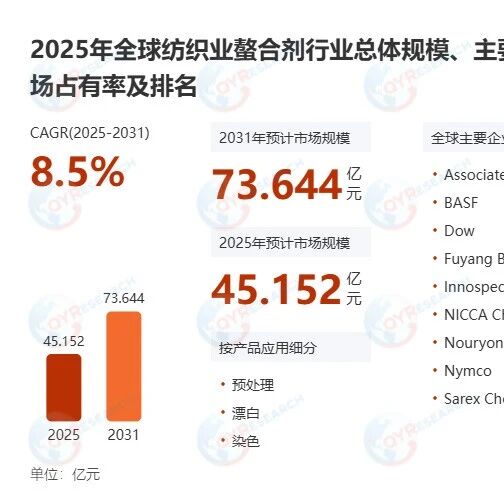
Core Viewpoint - The textile industry chelating agents are essential for improving product quality and sustainability by preventing metal ion reactions that can damage fibers and equipment, thus enhancing the efficiency and environmental compliance of textile production processes [2][3]. Product Range - The product range of textile chelating agents has evolved from traditional inorganic salts to a diverse family of fine chemicals, including: - Traditional inorganic chelating agents (e.g., polyphosphates) are widely used for general water treatment due to their low cost and high stability. - Organic carboxylic acid chelating agents (e.g., EDTA, NTA) dominate high-end dyeing processes but face environmental concerns. - Bio-based and green chelating agents (e.g., gluconates, chitosan derivatives) are rapidly emerging in response to sustainable textile policies. - Multifunctional composite chelating agents integrate dispersion, buffering, and anti-redeposition capabilities to meet integrated dyeing and finishing process needs [2]. Application Scope - Textile chelating agents serve as an "invisible engine" throughout the textile production process: - In the pre-treatment stage, they integrate calcium and magnesium ions to prevent hard water precipitation, enhancing desizing and refining efficiency. - During bleaching and dyeing, they stabilize oxidants and dye activity, ensuring color uniformity and reproducibility. - In post-treatment and water treatment, they inhibit metal ion catalysis that leads to fiber damage and reduce heavy metal loads in wastewater [3]. Market Overview - According to QYResearch, the global textile chelating agents market is projected to reach USD 1.16 billion by 2032, with a compound annual growth rate (CAGR) of 8.4% over the coming years [4]. Market Structure - Major manufacturers in the global textile chelating agents market include BASF, Dow, Nouryon, Innospec, and NICCA Chemical, with the top five companies holding approximately 59.0% market share by 2025 [6]. - The top three chemical giants (BASF, Dow, Nouryon) collectively account for over 40% of the market share, leveraging their global supply chains, R&D capabilities, and brand influence to dominate the high-end market [8]. Competitive Landscape - The competitive landscape shows that specialized manufacturers like Innospec and NICCA Chemical maintain stable shares in niche markets through application technology services and regional channels. - Asian companies (e.g., Fuyang Biotech, Taihe Chem, Yuanlian Chemical) leverage cost advantages and localized services to compete effectively in the mid-to-low-end market [8]. Industry Trends - The textile chelating agents market is transitioning from traditional functional additives to green, high-performance, and systematic solutions. The focus is shifting towards developing new molecular structures that are biodegradable, low-toxicity, and multifunctional to meet stringent environmental regulations [18]. - The application scenarios are deepening, with products extending beyond core processes to include textile recycling, wastewater treatment, and functional finishing, thus elevating their value from mere process aids to strategic materials that ensure supply chain compliance and resource efficiency [18]. Development Opportunities - The market faces structural constraints, primarily the challenge of balancing the technology and economics of green alternatives. The development and production costs of biodegradable or low-toxicity chelating agents are significantly higher than traditional products, which poses a challenge for cost-sensitive textile manufacturers [19]. - Additionally, the lack of unified industry standards and certification systems complicates product development and market entry, as different regions have varying definitions and compliance requirements for "environmentally friendly" and "biodegradable" [19]. Development Barriers - The market's growth is hindered by the cost-performance balance challenge in the green transition. The raw material costs and synthesis complexity of eco-friendly chelating agents are significantly higher than traditional products, leading to slow penetration of green products in cost-sensitive markets [20]. - Furthermore, traditional chelating agents (e.g., EDTA, phosphates) have established market inertia due to their stable performance and mature technology, making it difficult for new products to gain traction [20].

基础化工行业周报:五部门出台零碳工厂建设意见,美国拟敲定年度生物燃料配额
Huaan Securities· 2026-01-26 00:24
Investment Rating - The industry investment rating is "Overweight" [2] Core Insights - The chemical industry is experiencing a dual drive of cyclical recovery and growth, with a focus on organic silicon, PTA, polyester filament, caprolactam, spandex, vitamins, sweeteners, refrigerants, and phosphorus chemicals [5][6] - The organic silicon industry is entering a recovery phase, driven by new applications in sectors like new energy vehicles and photovoltaics, with significant improvements in supply-demand dynamics expected [5][6] - The PTA/polyester filament industry is seeing a reduction in capacity expansion, leading to a new cycle of prosperity due to improved domestic and external demand [6] - The refrigerant market is entering a high prosperity cycle due to quota policies and stable demand growth from sectors like heat pumps and cold chain logistics [7] - The synthetic biology sector is poised for explosive growth as fossil-based materials face disruptive challenges, with a focus on energy efficiency and carbon tax costs [8] - OLED technology is rapidly penetrating various markets, supported by government policies aimed at fostering the new display industry [9] - The demand for high-frequency and low-loss electronic resins is increasing due to the rise of AI infrastructure and low-orbit satellite communications [10] - The electronic chemicals sector is benefiting from the expansion of wafer production capacity, with increasing demand for key materials in the semiconductor industry [11] Summary by Sections Industry Performance - The chemical sector ranked 4th in overall performance with a weekly increase of 7.29%, outperforming the Shanghai Composite Index by 6.45 percentage points [20][21] Key Industry Dynamics - The Ministry of Industry and Information Technology has issued guidelines for zero-carbon factory construction, aiming to establish a benchmark by 2027 across various industries [35] - The U.S. government plans to finalize the annual biofuel blending quota, maintaining high growth targets for the biofuel industry [35]
五部门出台零碳工厂建设意见,美国拟敲定年度生物燃料配额
Huaan Securities· 2026-01-25 13:33
Investment Rating - Industry Rating: Overweight [2] Core Insights - The chemical industry is experiencing a dual drive of cyclical recovery and growth, with a recommendation to focus on sectors such as organic silicon, PTA, polyester filament, caprolactam, spandex, vitamins, sweeteners, refrigerants, and phosphorus chemicals [5][6] - The organic silicon industry is entering a recovery phase, with new applications becoming key growth drivers. From 2019 to 2024, domestic DMC capacity is expected to expand rapidly, leading to a temporary oversupply and price decline. However, by 2025, no new capacity is anticipated, and demand from emerging sectors like new energy vehicles and photovoltaics is expected to maintain high growth [5][6] - The PTA/polyester filament industry is approaching a turning point, with capacity expansion cycles nearing their end. The demand side is expected to continue growing, supported by improved external demand due to easing trade tensions [6] - Refrigerants are entering a high prosperity cycle due to quota policies that will reduce supply while demand remains stable, driven by market expansion in Southeast Asia and the development of heat pumps and cold chain markets [7] - The synthetic biology sector is poised for significant growth as fossil-based materials face disruptive challenges, with a focus on energy-efficient products and the potential for bio-based materials to see explosive demand [8] - OLED technology is rapidly penetrating various markets, with government policies supporting the development of new display industries and accelerating the localization of key materials and equipment [9] - The demand for electronic chemicals is increasing due to the rapid growth of the semiconductor industry, particularly in China, where the market is heavily reliant on imports [11] Summary by Sections Industry Performance - The chemical sector ranked 4th in overall performance for the week of January 19-23, 2026, with a gain of 7.29%, outperforming the Shanghai Composite Index by 6.45 percentage points [5][20] - The top-performing sub-sectors included textile chemical products (13.10%), nitrogen fertilizers (10.58%), and other chemical raw materials (10.09%) [21] Key Company Dynamics - The top three gaining companies for the week were Jianghua Micro (46.41%), Jiuding New Materials (28.47%), and Hongbaoli (26.73%) [26] - The companies in focus for potential investment include KaiSai Biological, Huaheng Biological, and other leading firms in synthetic biology and electronic chemicals [8][11][32] Industry Developments - The Ministry of Industry and Information Technology has issued guidelines for the construction of zero-carbon factories, aiming to establish a benchmark by 2027 across various sectors [35] - The U.S. government plans to finalize the 2026 biofuel blending quotas, maintaining high growth targets while addressing industry concerns [35]