
淘宝天猫

Search documents
AI驱动体验升级 消费走向理性多元
Zhong Guo Zheng Quan Bao· 2025-11-11 20:10
Core Insights - The 2025 "Double Eleven" shopping festival showcases a competitive landscape among e-commerce platforms, focusing on user experience rather than just sales volume [1][2] - The event reflects a significant shift in consumer behavior towards rational purchasing, diverse experiences, and service-oriented consumption [1][4] Sales Performance - In the first hour of sales, 80 brands on Taobao and Tmall surpassed 100 million in transactions, with over 30,000 brands doubling their sales compared to last year [2] - Douyin e-commerce saw a 500% year-on-year increase in live-stream sales, with over 41,000 merchants participating [2] - The travel sector also thrived, with Fliggy's vacation product sales exceeding 1.6 million items, indicating a shift towards service-oriented purchases [1][2] Promotional Strategies - E-commerce platforms adopted straightforward discount strategies, with Taobao Tmall emphasizing direct price reductions and Douyin offering various discount options [1][2] - This approach reflects a keen understanding of consumer demand for transparency and value [1][2] Technological Advancements - Taobao Tmall positioned this year's event as the first "Double Eleven" fully powered by AI, enhancing traffic distribution and product recommendations [3] - JD leveraged its "super supply chain" and AI capabilities, achieving a 3.2 times increase in usage across 1,800 scenarios [3] - Instant retail emerged as a focal point, with platforms expanding their service boundaries and integrating local merchants into the sales ecosystem [3] Consumer Trends - The event highlighted a shift in consumption structure, with new brands and categories gaining traction, indicating a move towards niche markets and personalized products [4][5] - Health-conscious products and diverse travel experiences are on the rise, reflecting a broader understanding of consumer health and lifestyle preferences [5] - Membership economies are becoming increasingly valuable, with high-value users driving platform growth and shifting focus from traffic to deep user engagement [5]

双11期间二选一?京东、抖音、美的回应
新华网财经· 2025-10-30 03:35
Core Insights - Recent rumors suggest that JD.com has implemented a high-pressure pricing strategy during the Double 11 shopping festival, with claims that Midea Group was fined 5 million yuan for pricing issues [1] - JD.com clarified that these rumors stem from its requirement that prices on its platform must not exceed those on other platforms, aimed at maintaining competitive pricing [1] - JD.com's sales data indicates strong performance for Midea air conditioners during the Double 11 event, with multiple products topping sales charts [1] Group 1: JD.com Pricing Strategy - JD.com has been accused of imposing fines on brands like Midea for pricing discrepancies, with a reported fine of 5 million yuan [1] - The company stated that its pricing policy is designed to ensure competitive pricing on its platform, particularly in light of competition from platforms like Douyin [1] - An insider from Midea Group refuted the claims of fines, labeling them as false information [1] Group 2: Double 11 Sales Performance - This year marks the 17th year of the Double 11 event, with new trends emerging such as a shift away from "lowest price" promotions and a focus on AI technology integration [4] - Tmall reported significant sales figures, with 9 imported brands achieving over 100 million yuan in sales and 927 brands seeing sales double year-on-year [4] - Xiaohongshu reported a 77% increase in the number of buyers within the first 48 hours of Double 11, with sales exceeding 1 million yuan for 155% more products compared to last year [4] - Douyin's first-day sales data showed a 75% increase in the number of merchants, with brands achieving 800% growth in sales over 100 million yuan [4] Group 3: JD.com Financial Performance - JD.com reported a revenue of 356.7 billion yuan for Q2 2025, marking a 22.4% year-on-year increase, the highest growth rate in three years [5] - The core retail business generated 310.1 billion yuan in revenue, with a 20.6% growth rate and an operating profit of 13.9 billion yuan, achieving a record operating margin of 4.5% for any major promotional quarter [5]



辟谣“美的被罚”“二选一”后,京东再回应:相关谣言系与抖音的价格竞争引发
Mei Ri Jing Ji Xin Wen· 2025-10-29 12:20
Core Viewpoint - Recent rumors regarding JD.com imposing a fine of 5 million yuan on Midea Group due to pricing issues and allegations of "choose one from two" practices have been denied by JD.com, attributing the rumors to competitive pricing dynamics with Douyin live streams [1][2]. Group 1: Pricing Strategy - JD.com requires that prices on its platform cannot exceed those on other platforms, aiming to ensure competitive pricing for consumers and enhance sales [2]. - The concept of "choose one from two" is misrepresented, as JD.com clarifies that it does not impose such restrictions on merchants [2]. Group 2: Market Competition - JD.com is adapting its promotional strategies for the upcoming Double Eleven shopping festival, directly linking it to the recent National Day and Mid-Autumn Festival holidays, while simplifying promotional methods [2]. - Competing platforms like Taobao and Tmall are focusing on large consumption strategies and AI technology integration in e-commerce, indicating a shift in competitive tactics across the industry [2].
吴晓波频道AI Day:双十一破局,锁定AI电商风暴眼
吴晓波频道· 2025-10-26 00:21
Core Insights - The penetration rate of generative AI applications in China has surpassed 36.5%, indicating that over one-third of the population has interacted with AI tools like Doubao, Deepseek, and Wenxin Yiyan [2][3] - The rapid growth in user base, with an increase of 266 million users compared to the end of 2024, highlights the transformative impact of AI on the business landscape [2] AI Day Initiative - The launch of Hangzhou AI Day aims to empower participants to effectively utilize AI tools and become "AI natives" [5][20] - Each session will focus on a cutting-edge topic, including "AI + Finance," "AI + Content Generation," and "AI + Healthcare," fostering communication between future AI users [5][6] E-commerce Sector Transformation - E-commerce is one of the fastest industries to respond to the AI wave, with platforms like Taobao and Tmall announcing the full implementation of AI for the upcoming Double 11 shopping festival [7][8] - AI tools are reshaping consumer shopping experiences, with applications like "AI Universal Search" and "AI Help Me Choose" enhancing product discovery and selection [10][11] Efficiency Gains for Merchants - AI is driving a significant efficiency transformation for merchants, with early results showing double-digit growth in active users and return on investment (ROI) during promotional events [12][13] - AI tools are optimizing service processes, as seen with JD's AI assistant improving conversion rates for pre-sale consultations by 37% [13] Broader Industry Implications - The changes in the e-commerce sector reflect a broader evolution across various industries, including healthcare, manufacturing, and education, driven by advancements in computing power and algorithms [14][15] - The event will feature industry leaders discussing the practical applications of AI in e-commerce, aiming to help small and medium enterprises overcome challenges in customer acquisition and sourcing [17][18]
人工智能“身兼多职” 中国“双11”购物节升级
Zhong Guo Xin Wen Wang· 2025-10-19 09:03
Core Insights - The integration of artificial intelligence (AI) in China's "Double 11" shopping festival is transforming e-commerce operations and enhancing decision-making capabilities for brands [1][2][3] - Major e-commerce platforms are leveraging AI to improve user experience, operational efficiency, and cost savings for merchants [1][2][3] Group 1: AI Applications in E-commerce - AI is being utilized as a decision-making tool for brands, significantly enhancing business operations and creating new growth opportunities [1] - Tmall has increased its computational power by 40 times, improving the accuracy of product recommendations and boosting purchase efficiency by 25% [1] - Brands can achieve full-chain AI integration on Tmall, covering various operational aspects and saving merchants hundreds of billions of RMB [1] Group 2: Consumer Experience Enhancement - AI serves as a shopping assistant for consumers, improving the overall shopping experience and logistics satisfaction [2] - Tmall's AI-driven "Smart Benefit Engine" has increased the conversion rate of its 50 billion RMB consumer vouchers by 15% [2] - New AI shopping applications, such as "AI Universal Search," have been launched to meet diverse shopping needs on Tmall [2] Group 3: Logistics and Operational Efficiency - JD Logistics has made significant investments in AI technologies, enhancing delivery efficiency by nearly 20% through the use of intelligent devices [3] - AI technology is permeating the entire e-commerce business chain, improving efficiency in content generation, intelligent recommendations, customer service, supply chain management, and logistics fulfillment [3] - The industry is transitioning from a "traffic-driven" model to an "intelligent-driven" model as AI technologies accelerate their implementation [3]
第四波国补资金来了 叠加天猫双11家电家装3C数码打5折 今晚8点开卖
Guan Cha Zhe Wang· 2025-10-15 04:05
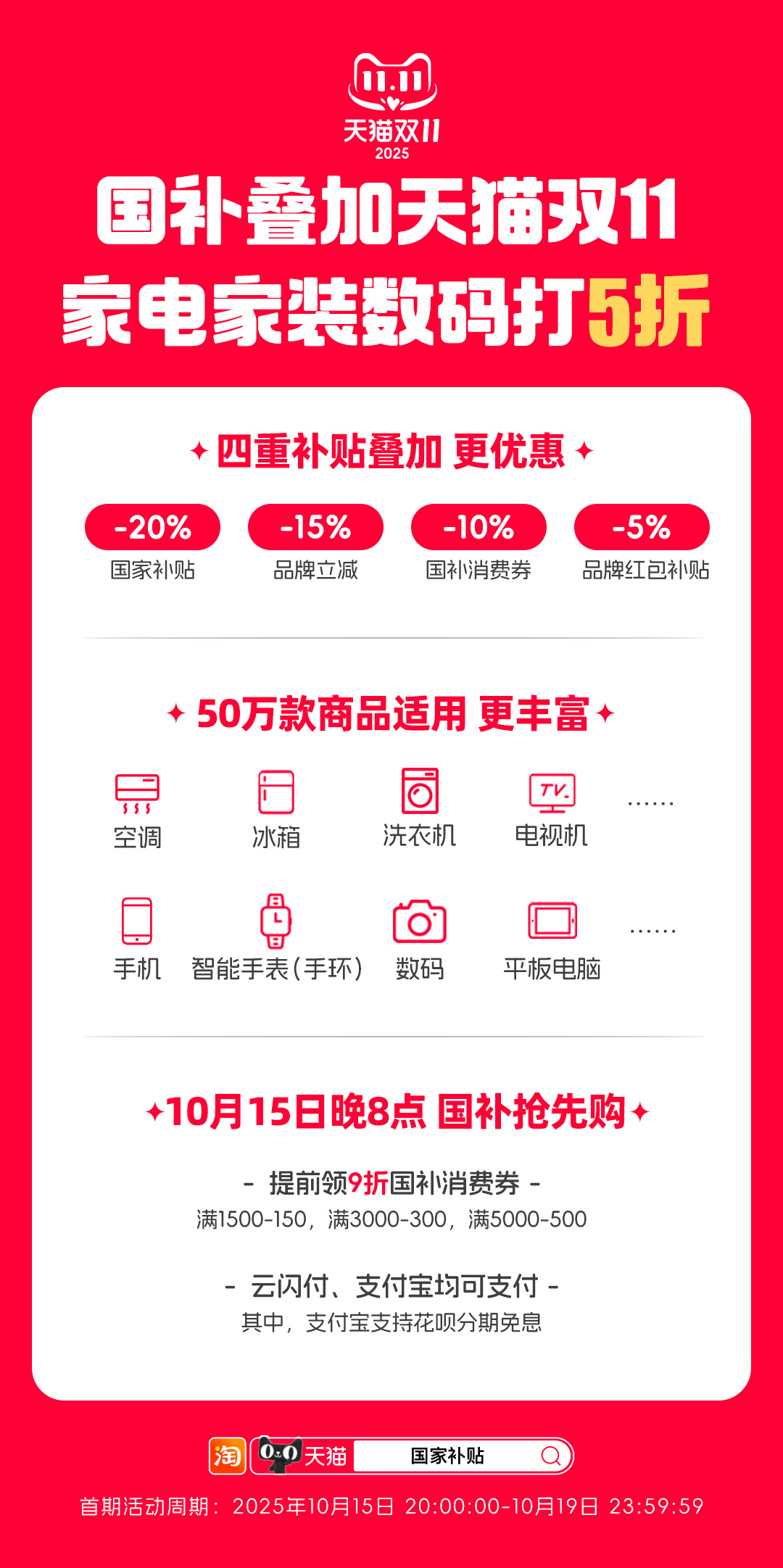
2025年第四波国补资金重磅落地,今晚8点,天猫双11国补5折开卖! 记者获悉,今年天猫双11,超3700个品类,9000个品牌商家,50万款品牌商品参与国补,覆盖家电、家装、家居、3C数码等全品类,支持双11优惠与国补 叠加,补贴商品数量较618翻倍,是全年优惠力度最大、规模最大的一次国补换新消费! 据悉,多款苹果产品参与国补,最新款苹果iPhone17,直接补贴500元!华为Pura80Ultra多重补贴后直降2400元!海尔一级能效燃气热水器K70A,原价6999 元,双11叠国补仅2959.2元,打42折!小米巨省电1.5匹空调,原价2899元,双11叠国补到手价1379元,打48折! | | 商品名 | 日常参考价 国补叠加 | | | --- | --- | --- | --- | | NEW | 四天 iPhone17 | 5999 | 5499 | | | (256G) | | | | | 华为 Pura 80 Ultra | 9999 | 7599 | | NEW | ூ门子 极浄魔盒3.0 | 9999 | 4552 | | | 洗碗机 | | | | NEW | 海尔 云溪4.0pro ...




为了“爽购”,今年双11大厂集体“延时”
3 6 Ke· 2025-10-13 12:48
Core Insights - The duration of the "Double 11" shopping festival has been extended, with major e-commerce platforms starting their promotions earlier and lasting longer than in previous years [2][4][11]. Group 1: E-commerce Platforms' Strategies - JD.com announced the start of its "Double 11" promotions on October 9, extending the event until November 14, marking an earlier and longer promotional period [2]. - Other platforms like Douyin and Kuaishou have also begun their "Double 11" promotions earlier, with Douyin starting on October 9 and Kuaishou on October 7 [3]. - Taobao and Tmall will officially kick off their "Double 11" promotions on October 15, indicating a trend among major e-commerce platforms to transform "Double 11" from a single-day event into a month-long promotional period [4]. Group 2: Changes in Consumer Behavior - Consumers have shifted their purchasing habits, no longer waiting for "Double 11" to buy discounted items, but rather looking for deals throughout the promotional period [5][6]. - Many consumers express a more relaxed attitude towards "Double 11," treating it as just another promotional event rather than a major shopping occasion [7][9]. Group 3: Market Dynamics - The competitive landscape among e-commerce platforms has led to a normalization of promotional events, diluting the significance of "Double 11" as a unique shopping festival [4][9]. - The frequency of promotional events throughout the year has increased, with various sales events now occurring regularly, which has reduced the urgency associated with "Double 11" [9][12]. Group 4: Simplification and Innovation in Promotions - This year's "Double 11" is characterized by a return to simpler, more direct discount strategies, with platforms like JD.com and Douyin focusing on straightforward price reductions [13][14]. - New promotional strategies have been introduced, such as JD.com's themed night markets and Douyin's content-driven promotional activities, aimed at enhancing consumer engagement [15][17]. Group 5: Instant Retail and Future Outlook - Instant retail is emerging as a significant battleground for "Double 11," with platforms like Taobao Flash Sale launching initiatives to attract consumers [19]. - The overall sentiment in the industry suggests that "Double 11" may not replicate its past digital success, but extending its duration and diversifying promotional strategies are seen as essential for maintaining its relevance [19].

强制补贴、“二选一”、设置不合理规则……平台竞争不能“薅商户羊毛”
Ren Min Ri Bao· 2025-10-13 02:31
Core Viewpoint - The article highlights the issues faced by merchants in the platform economy, including forced subsidies, unreasonable rules, and the impact on industry health and merchant rights [1][2][3] Merchant Complaints - Merchants report being forced to participate in subsidy programs without prior notice, leading to financial losses [2][3] - Specific examples include merchants being required to subsidize customer discounts, sometimes below cost, which can lead to a decline in product quality [2][3] - Instances of merchants being unknowingly enrolled in promotional activities have been documented, raising concerns about transparency [2][3] Platform Practices - Some platforms are accused of coercing merchants into exclusive agreements, limiting their ability to operate on multiple platforms, which may violate antitrust laws [3][4] - The presence of intermediaries and aggressive sales tactics by platform representatives can lead to unfair practices against merchants [4][5] Industry Regulations - Regulatory bodies have previously penalized platforms for monopolistic behaviors, yet issues persist, indicating a need for stricter enforcement [3][10] - Recent regulatory changes aim to prevent platforms from forcing merchants to sell below cost and to ensure fair competition [10][11] Flow Anxiety and Cost Pressures - Merchants experience "flow anxiety," feeling pressured to invest heavily in advertising and promotions to remain competitive, which can detract from product quality [7][9] - The reliance on paid promotions creates a cycle of increasing costs without guaranteed returns, leading to a detrimental impact on smaller merchants [7][9] Recommendations for Improvement - Experts suggest that platforms need to enhance rules and innovate regulations to create a healthier market environment for merchants [9][11] - Proposed measures include establishing better communication channels between platforms and merchants, as well as creating a fairer system for managing promotional activities [11]
平台竞争,不能“薅商户羊毛”(金台视线)
Ren Min Ri Bao· 2025-10-12 22:10
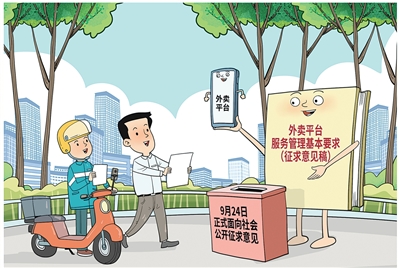
Core Viewpoint - The platform economy, as a vital part of the digital economy, is facing challenges where merchants report unfair practices by platforms, such as forced subsidies and unreasonable rules, which harm both merchant interests and industry health [1][2]. Merchant Complaints - Merchants have reported being forced into subsidy programs without prior notice, leading to situations where they must provide discounts that reduce their profits below cost [2][3]. - Specific examples include a merchant who discovered he was unknowingly participating in a subsidy program, resulting in significant financial losses [2]. - Another merchant faced pressure to choose between platforms, indicating a "choose one" scenario that could violate antitrust laws [4]. Regulatory Environment - The National Market Regulatory Administration has been drafting guidelines to address these issues, with a focus on fair practices in the food delivery sector [4][10]. - Previous actions against platforms for monopolistic behavior highlight ongoing regulatory scrutiny, with calls for compliance with e-commerce laws [10]. Industry Practices - Some platforms employ tactics that indirectly force merchants into unfavorable agreements, such as requiring exclusive contracts that limit competition [4][5]. - The existence of "price adjustment assistants" on platforms allows for unilateral changes to merchant pricing without consent, raising concerns about transparency and fairness [5][10]. Flow Anxiety and Competition - Merchants experience "flow anxiety," feeling pressured to invest heavily in advertising and promotions to remain competitive, which can lead to reduced product quality [7][8]. - The competitive landscape is skewed, where larger merchants can outspend smaller ones on advertising, creating an uneven playing field [8][9]. Recommendations for Improvement - Experts suggest that platforms need to enhance rules and innovate regulations to create a healthier market environment, focusing on fair treatment of merchants [9][10]. - Proposed measures include establishing mechanisms for merchant representation and feedback, as well as creating a more transparent system for flow distribution [12].
豆包上线未成年人模式;电商将成为小红书一级入口|未来商业早参
Mei Ri Jing Ji Xin Wen· 2025-08-26 23:16
Group 1 - E-commerce will become a primary entry point for Xiaohongshu, with the "Market" option added to the main interface, enhancing user shopping experience and integrating content with e-commerce resources [1] - Hema NB achieved approximately 8 billion yuan in revenue in the first half of the year, showing double-digit growth compared to the same period last year, with nearly 300 stores now, indicating strong market acceptance and demand in the fresh retail sector [2] - Taobao Tmall's book industry signed a cooperation agreement with the National Library of China to introduce standard cataloging data, which will improve data accuracy and support the digital transformation of the book industry [3] Group 2 - Doubao App launched a minor mode that defaults to disabling certain features like video display and third-party browsing, reflecting the company's commitment to creating a safer online environment for minors [4]