
锦波生物

Search documents
经济越来越差,这八大行业越赚爆!
创业家· 2026-02-17 09:22
Core Insights - The article discusses how certain industries are thriving despite a general perception of economic downturn, highlighting eight key sectors that present significant business opportunities in a low-desire society [3][4]. Group 1: Key Industries - **Second-Hand Economy**: The second-hand luxury market in Japan, represented by companies like Daikokuya, has seen a surge in revenue. In China, platforms like Hongbulin and Panghu are experiencing similar growth, indicating a shift in consumer spending towards second-hand goods [6][7][8][9]. - **Pet Economy**: With declining birth rates, young people are spending more on pets, leading to significant growth in pet food and healthcare products. Companies like Inaba in Japan and Guobao in China are capitalizing on this trend [11][12][14][15]. - **Adult Care Products**: The adult diaper market in Japan has surpassed $10 billion, indicating a growing demand for adult care products in China, with companies like Kexin poised for growth [16][17][18]. - **Health Food and Beverages**: The rise in health consciousness has led to increased demand for sugar-free beverages and functional drinks, with brands like Dongfang Shuye and Jianchun gaining traction in China [21][22]. - **Beauty Economy**: The demand for beauty products, including collagen supplements and at-home beauty devices, is on the rise, with companies like Jinbo Bio and U like seeing significant sales growth [23][25]. - **Outdoor Recreation**: The outdoor equipment market is booming, with brands like Kailas and Camel experiencing rapid sales growth as consumers seek leisure activities [25][26][27]. - **Emotional Economy**: Products that provide emotional comfort, such as low-alcohol beverages and lifestyle brands, are gaining popularity, reflecting a dual consumer behavior of frugality and indulgence [28][29][30]. - **Convenience Economy**: The demand for convenience foods and smart home appliances is increasing as younger generations spend less time cooking. Brands like Anjijia and Kewotai are seeing steady growth [33][35][36]. Group 2: Market Trends - The article emphasizes that the current economic climate, often viewed as a "winter," presents opportunities for those willing to invest in counter-cyclical sectors [39]. - It suggests that the key to success in a low-desire society is to identify and capitalize on emerging trends and consumer needs, rather than retreating from the market [39].


整个社会都在喊没钱了,为什么这些公司反而年赚百亿?
创业家· 2026-02-13 10:10
Core Insights - The article discusses how certain industries are thriving despite a general perception of economic downturn, highlighting eight key sectors that present significant business opportunities in a low-desire society [3][4]. Group 1: Key Industries - **Second-Hand Economy**: The second-hand luxury market in Japan, represented by companies like Daikokuya, has seen a surge in revenue. In China, platforms like Hongbulin and Panghu are experiencing similar growth, indicating a shift in consumer spending towards second-hand goods [6][7][8][9]. - **Pet Economy**: With a decline in birth rates, young consumers are increasingly spending on pets, leading to significant growth in pet food and healthcare products. Companies like Inaba in Japan and Guobao in China are capitalizing on this trend [12][13][15][16]. - **Adult Care Products**: The adult diaper market in Japan has surpassed $10 billion, showcasing the potential of the aging population as a lucrative market segment [17][18][19]. - **Health Food and Beverages**: Changing demographics and rising health awareness have led to the growth of sugar-free beverages and functional foods in both Japan and China, with brands like Suntory and Dongpeng gaining traction [21][22]. - **Beauty and Aesthetic Products**: The demand for beauty products, including collagen supplements and at-home beauty devices, remains strong, indicating that consumers prioritize personal care even in economic downturns [23][24][26]. - **Outdoor Recreation**: Companies in the outdoor equipment sector, such as Snow Peak in Japan and various Chinese brands, are benefiting from increased interest in outdoor activities as a form of stress relief [29][31][32]. - **Convenience Economy**: The rise of frozen foods and smart home appliances reflects a shift towards convenience, with brands like Anjijia and Kewell seeing steady growth as consumers seek time-saving solutions [39][40][42]. - **Lazy Economy**: The trend of reduced cooking time among younger generations has led to a preference for ready-to-eat meals and smart appliances that automate household tasks, indicating a shift in consumer priorities [39][40][42]. Group 2: Market Dynamics - The article emphasizes that even in a low-desire economy, there are significant opportunities for those willing to invest in counter-cyclical sectors. Companies that can identify and act on these opportunities are likely to emerge as winners [44].



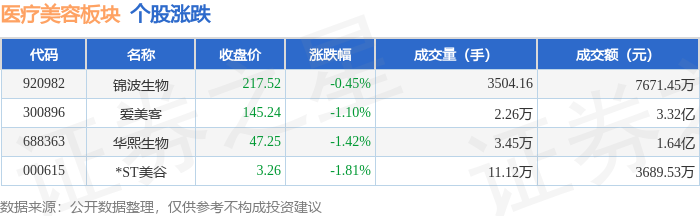
医疗美容板块2月13日跌1.27%,*ST美谷领跌,主力资金净流出5591.6万元
Sou Hu Cai Jing· 2026-02-13 09:05
Market Overview - The medical beauty sector experienced a decline of 1.27% on February 13, with *ST Meigu leading the drop [1] - The Shanghai Composite Index closed at 4082.07, down 1.26%, while the Shenzhen Component Index closed at 14100.19, down 1.28% [1] Stock Performance - Key stocks in the medical beauty sector showed the following performance: - Jinbo Biological (920982) closed at 217.52, down 0.45% with a trading volume of 3504.16 and a transaction amount of 76.71 million [1] - Aimeike (300896) closed at 145.24, down 1.10% with a trading volume of 22,600 and a transaction amount of 3.32 billion [1] - Huaxi Biological (688363) closed at 47.25, down 1.42% with a trading volume of 34,500 and a transaction amount of 164 million [1] - *ST Meigu (000615) closed at 3.26, down 1.81% with a trading volume of 111,200 and a transaction amount of 36.89 million [1] Capital Flow - The medical beauty sector saw a net outflow of 55.91 million from main funds, while retail investors contributed a net inflow of 21.01 million [1] - Detailed capital flow for key stocks includes: - *ST Meigu: Main funds net outflow of 3.25 million, retail net inflow of 1.37 million [2] - Jinbo Biological: Main funds net outflow of 10.75 million, retail net outflow of 1.08 million [2] - Huaxi Biological: Main funds net outflow of 13.55 million, retail net inflow of 12.55 million [2] - Aimeike: Main funds net outflow of 39.11 million, retail net inflow of 7.09 million [2]


北交所投资框架工具书:北交所市场大消费投资框架及核心标的的梳理-20260213
Hua Yuan Zheng Quan· 2026-02-13 03:34
Consumption Trends - The emotional economy market in China is expected to exceed 20 trillion yuan in 2024, with a projected CAGR of 14% from 2025 to 2029[3][60]. - The beauty consumption market is projected to reach nearly 370 billion yuan by 2025, with the retail sales of cosmetics in China estimated at 465.3 billion yuan in 2025, reflecting a year-on-year growth of 5.1%[5][51]. - The health food market is anticipated to reach 720.3 billion yuan by 2029, driven by increasing health awareness and aging population[5]. Policy and Market Dynamics - The Chinese government has prioritized boosting consumption as a key task for 2025, with policies supporting consumption upgrades and equipment renewal[5][9]. - Changing consumer behavior emphasizes emotional value, health, and personalized consumption, indicating a shift towards emotional and social fulfillment in purchasing decisions[5][9]. Key Industry Insights - The maternal and infant food market is projected to reach approximately 55.91 billion yuan in 2024, with the number of maternal and infant chain stores increasing from 21,000 in 2019 to 32,000 in 2024[5]. - The pet economy is expected to grow significantly, with the market size reaching 701.3 billion yuan in 2024, reflecting an 18% year-on-year increase[58]. Investment Opportunities - Companies in the North Exchange related to beauty consumption include Jinbo Biological, Bawei Co., and Vicky Technology, which are positioned to benefit from the ongoing growth in the beauty sector[5][52]. - The health food sector includes leading brands like Kangbiter and Yizhi Konjac, which are well-placed to capitalize on the rising demand for health-oriented products[5].
经济越来越差,这八大行业越赚爆!
创业家· 2026-02-12 10:52
Core Insights - The article emphasizes that despite the prevailing narrative of economic hardship, certain industries are thriving and generating substantial profits, particularly in the context of Japan's "lost 30 years" and its implications for various sectors [3]. Group 1: Economic Trends and Opportunities - The concept of a "low-desire society" does not equate to a lack of opportunities, as there are still significant business prospects available [4]. - The article identifies "consumption stratification" and "demand migration" as the largest commercial opportunities in the current market [5]. - As consumers shift away from purchasing homes and luxury goods, money is flowing into the second-hand economy, with notable growth in Japan's second-hand luxury market represented by companies like Daikokuya [6]. - In China, platforms like Hongbulin and Panghu are experiencing significant business growth in the second-hand market [7]. Group 2: Emerging Consumer Trends - The article highlights the rise of the pet economy, noting that while young people may not be having children, they are willing to spend on premium pet products [11]. - Companies like Inaba in Japan and Guobao (Zhongchong) in China are seeing strong stock performance due to the growing demand for pet food and related services [12]. - The adult care market is also expanding, with Japan's adult diaper market surpassing $10 billion, indicating a significant growth potential for similar products in China [16][18]. - Health-conscious food and beverage products are gaining traction, with brands like Suntory and Meiji seeing substantial growth due to changing population demographics and rising health awareness [21]. Group 3: Lifestyle and Emotional Spending - The "beauty economy" is thriving, with products like collagen supplements and home beauty devices achieving significant sales, indicating that consumers prioritize beauty even in challenging economic times [23]. - Outdoor leisure activities are becoming popular, with brands like Snow Peak in Japan and various Chinese outdoor brands experiencing rapid sales growth [25][26]. - The emotional economy is also on the rise, with brands like Labubu and Rio catering to consumers' desires for emotional fulfillment and experiences [28][29]. - The "lazy economy" reflects a trend where younger generations prefer convenience, leading to increased demand for frozen foods and smart home appliances that save time [33][35]. Group 4: Market Resilience and Strategic Insights - The article argues that the current economic climate, often perceived as a "winter," presents opportunities for those willing to invest in counter-cyclical sectors [39]. - Companies that can identify and capitalize on these emerging trends are likely to emerge as winners in the low-desire era, as time-saving solutions may hold more commercial value than cost-saving measures [36].

北交所2026年1月定期报告:北证50延续调整,成分股2025年业绩承压
金融街证券· 2026-02-12 10:30
Market Overview - As of January 31, 2026, the total number of listed companies on the Beijing Stock Exchange (BSE) is 292, with a total market capitalization of CNY 936.30 billion, averaging CNY 32.07 billion per company[8] - The number of listed companies increased by 4 from the previous month, and the total market capitalization rose by 7.69% month-on-month[8] Index Performance - The BSE 50 Index closed at 1531.55 points at the end of January, reflecting a month-on-month increase of 6.33%, outperforming the CSI 300 Index (+1.65%) and the ChiNext Index (+4.47%) but underperforming the STAR 50 Index (+12.29%) and the Wind Micro-Cap Index (+10.58%)[15][16] - The BSE Specialized and New Index recorded a month-on-month increase of 6.06%, which is lower than several comparable indices[15][16] Valuation Metrics - As of January 31, 2026, the PE (TTM, excluding negatives) for the BSE 50 Index is 45.96 times, while the BSE Specialized and New Index stands at 67.10 times, indicating a higher valuation for the latter[18] - The BSE 50 Index ranks third in PE (TTM, excluding negatives) among comparable indices, higher than the CSI 300 Index (13.50 times) and the ChiNext Index (39.26 times) but lower than the STAR 50 Index (84.13 times) and the Wind Micro-Cap Index (59.20 times)[19] Liquidity Analysis - The trading volume for the BSE 50 Index in January was CNY 607.27 billion, while the BSE Specialized and New Index had a trading volume of CNY 192.70 billion, both lower than other broad-based indices[27] - The average turnover rate for the BSE 50 Index was 64.45%, lower than the ChiNext Index (89.74%) but higher than the CSI 300 Index (18.26%)[27] Sector Performance - Among seven key sectors, only the automotive sector had a negative average price change in January, while the power equipment, basic chemicals, and computer sectors showed positive average price changes of 11.82%, 7.43%, and 5.51%, respectively[35] - The average PE (TTM, excluding negatives) for the computer and electronics sectors was notably high at 122.40 times and 71.81 times, respectively, while other sectors ranged from 33.68 times to 44.88 times[37] Individual Stock Highlights - The top five performing stocks in January were Liancheng CNC (+130.47%), Liujin Technology (+94.94%), Yinen Power (+77.70%), Keli Co. (+77.40%), and Meibang Technology (+67.45%) with significant price increases[41] - Conversely, the bottom five stocks were Kema Materials (-34.72%), *ST Yunchuang (-29.63%), Henghe Co. (-28.18%), Jinhao Medical (-27.85%), and Tianming Technology (-26.67%) with substantial declines[41]
中国化妆品市场月报(1月)-20260211
青眼情报· 2026-02-11 11:05
▶ 国家统计局:统计局:2025 年全年化妆品类零售额 4653 亿元,同比增长 5.1%。 出品方: 青眼情报 化妆品行业月报由青眼情报出品,每月 15 日发布。报告聚焦上一个月美妆行业动态, 内容涵盖中国美妆行业重大事件(包括本土及外资头部企业动态、渠道平台变革、产业园 及峰会等)、相关政策法规,以及行业资本事件(融资、并购、上市退市情况)、新品介 绍及新原料备案/注册情况,旨在为行业从业者提供全面及时的资讯参考。 一、 中国化妆品市场零售数据 中国化妆品市场月报(1 月) ► 朝云拟最高 4.5 亿元收购河北康达 100%股权,旨在进一步提升该集团在家 居护理品类在北方区域的市场竞争力。 ► 毛戈平与路威凯腾签订战略合作框架协议,双方将共同组建专注于全球高端 美妆领域的股权投资基金。 ► 锦波生物向养生堂定向发行股票的注册申请获批,本次发行股票的募资金额 不超过 20 亿元。 该战略投资落地,养生堂系将成为锦波生物第二大股东。 ► 中国化工企业天津利安隆集团在马来西亚投资约 21.7 亿元建设化妆品化工 研发中心及现代化生产工厂。 本土头部企业大事件 1. 投融资 ► 嘉亨家化控股股东曾本生向杭州拼便宜 ...
医疗美容板块2月11日跌0.02%,锦波生物领跌,主力资金净流出1547.45万元
Sou Hu Cai Jing· 2026-02-11 08:51
Core Viewpoint - The medical beauty sector experienced a slight decline of 0.02% on February 11, with Jinbo Biological leading the drop [1] Market Performance - The Shanghai Composite Index closed at 4131.98, up by 0.09% - The Shenzhen Component Index closed at 14160.93, down by 0.35% [1] Capital Flow - The medical beauty sector saw a net outflow of 15.47 million yuan from major funds - Retail investors contributed a net inflow of 8.68 million yuan, while speculative funds saw a net inflow of 6.79 million yuan [1]

合成生物学周报:工信部公布35例非粮生物基材料,阿洛酮糖应用有望迎来爆发
Huaan Securities· 2026-02-10 13:30
Investment Rating - The industry rating is "Overweight" [3] Core Insights - The report highlights the ongoing active research in life sciences and the rapid integration of biotechnology into economic and social development, providing innovative solutions to major challenges such as health, climate change, resource security, and food security. The National Development and Reform Commission has issued the "14th Five-Year Plan for the Development of the Bioeconomy," indicating a trillion-yuan market potential in the bioeconomy sector [3][4]. Industry Performance - The Huazhong Synthetic Biology Index increased by 0.11% to 1278.44 during the week of February 2-6, 2026, outperforming the Shanghai Composite Index by 1.39 percentage points and the ChiNext Index by 3.40 percentage points [4]. - The report notes that the synthetic biology sector is experiencing a policy dividend, with Shenzhen proposing up to 100 million yuan in support for R&D efforts in the field [8]. Company Developments - Beijing Huaguan Bio completed a multi-hundred million yuan C-round financing to enhance its R&D and production capabilities in the pharmaceutical and health sectors [32]. - Dejin Bio secured several million yuan in A-round financing to advance its recombinant botulinum toxin clinical research and international expansion [33]. - The report mentions that Impossible Foods is leveraging technology to reshape the plant protein market [11]. Market Dynamics - The report indicates that the synthetic biology sector is witnessing a surge in financing, with nearly a hundred companies completing new funding rounds since 2025 [31]. - The top five companies in the synthetic biology sector by stock performance during the week were Pingtan Development (+12%), Jinbo Bio (+12%), Huaxi Bio (+12%), Shandong Heda (+10%), and Yaxiang Co. (+10%) [17]. Policy and Regulatory Developments - The Ministry of Industry and Information Technology announced 35 examples of non-grain bio-based materials, marking a significant step towards establishing a new green development framework [7]. - The National Health Commission approved 22 new food items, including a significant breakthrough in domestic human milk oligosaccharides (HMOs) production [7]. Research and Innovation - Tsinghua University has initiated a national key R&D project focused on the intelligent design principles of efficient microbial chassis cells, aiming for breakthroughs in both fundamental theory and application demonstration [9]. - The report highlights the strategic cooperation between Tianjin University and China National Petroleum Corporation to expand efforts in synthetic biology and related fields [9].


合成生物学周报:工信部公布35例非粮生物基材料,阿洛酮糖应用有望迎来爆发-20260210
Huaan Securities· 2026-02-10 10:50
Investment Rating - The industry investment rating is "Overweight" [3] Core Insights - The report highlights the ongoing active research in life sciences and the accelerating integration of biotechnology into economic and social development, providing new solutions to major challenges such as health, climate change, resource security, and food security. The National Development and Reform Commission has issued the "14th Five-Year Plan for the Development of the Bioeconomy," indicating a trillion-yuan market potential in the bioeconomy sector [3][7]. Industry Performance - The Huazhong Synthetic Biology Index increased by 0.11% to 1278.44 during the week of February 2-6, 2026, outperforming the Shanghai Composite Index by 1.39 percentage points and the ChiNext Index by 3.40 percentage points [4][14]. - The report notes that the synthetic biology sector is experiencing a policy dividend, with Shenzhen proposing up to 100 million yuan in support for R&D efforts in the field [8]. Company Developments - Beijing Huaguan Bio completed a multi-hundred million yuan C-round financing to focus on new product development in the pharmaceutical and health sectors [31]. - Dejin Bio secured several million yuan in A-round financing to advance its recombinant botulinum toxin clinical research and international expansion [33]. - The report mentions that Impossible Foods is leveraging technology to drive market expansion and reshape plant-based protein [11]. Market Dynamics - The report indicates that the synthetic biology sector is witnessing a surge in financing, with nearly a hundred companies completing new rounds of financing since 2025 [31]. - The top five companies in the synthetic biology sector by stock performance during the week were Pingtan Development (+12%), Jinbo Bio (+12%), Huaxi Bio (+12%), Shandong Heda (+10%), and Yaxiang Co. (+10%) [17][21]. Policy and Regulatory Updates - The Ministry of Industry and Information Technology announced 35 examples of non-grain bio-based materials, marking a significant step towards building a new green development pattern [7]. - The National Health Commission approved 22 new food products, including a significant breakthrough in domestic human milk oligosaccharides (HMOs) technology [7]. Research and Innovation - Tsinghua University has initiated a national key R&D project focused on the intelligent design principles of efficient microbial chassis cells, aiming for breakthroughs in both fundamental theory and application demonstration [9]. - The report highlights the strategic cooperation between Tianjin University and China National Petroleum Corporation to expand in synthetic biology and other fields [9].