中石科技

Search documents
中金公司:Rubin或推动微通道液冷技术应用,液冷通胀逻辑再强化
中金· 2025-09-28 14:57
Investment Rating - The report does not explicitly state an investment rating for the industry or specific companies Core Insights - The rapid development of generative AI is driving an increase in computing power demand, leading to higher chip power consumption, with NVIDIA's next-generation Rubin/Rubin ultra chips potentially exceeding 2000W [6] - Current single-phase cooling solutions may struggle to meet the cooling demands of the next-generation Rubin series chips, prompting a shift towards more efficient cooling technologies such as microchannel water cooling plates (MLCP) [6][8] - The microchannel cooling technology offers significant advantages over traditional cooling methods, including lower thermal resistance, larger heat exchange area, and higher flow rates, making it suitable for high heat density scenarios [20][22] Summary by Sections Cooling Technology Overview - Traditional single-phase cooling solutions face limitations in thermal resistance and cooling efficiency, particularly for high power demands of 1500-2000W [8][21] - Microchannel cooling technology integrates cooling components to reduce thermal resistance and improve heat transfer efficiency, with flow channels designed at the micron level [19][22] Market Dynamics - The microchannel cooling market is characterized by three main types of companies: startups specializing in microchannel technology, traditional cooling solution providers, and companies focused on cover plates [26][28] - The transition to microchannel cooling may create opportunities for domestic suppliers, especially if existing suppliers cannot meet the new product iteration pace or quality requirements [30] Challenges and Opportunities - The manufacturing complexity of microchannel cooling plates requires advanced production techniques, which may increase costs by 3-5 times compared to existing cooling solutions [36] - The report highlights potential risks, including slower-than-expected capital expenditure in computing power and competition from alternative cooling technologies [38]


Rubin或推动微通道液冷技术应用,液冷通胀逻辑再强化
2025-09-26 02:28
Summary of Key Points from Conference Call Industry Overview - The conference call discusses the liquid cooling technology industry, particularly focusing on microchannel liquid cooling solutions and their application in the AIDC hardware sector. The technology is experiencing significant growth and investment opportunities, especially in the context of domestic computing power chip manufacturers adopting liquid cooling solutions, such as Alibaba's recent ultra-node initiative [1][2]. Core Insights and Arguments - **Market Potential**: The liquid cooling market is expected to reach nearly 100 billion by 2026, driven by the increasing demand for NV and ASIC cooling solutions. The technology's evolution and price inflation will continue to expand market size [1][3]. - **Inflationary Attributes**: Liquid cooling technology is characterized by its inflationary nature, primarily driven by the increasing computing power and energy consumption of chips, necessitating advanced cooling solutions. The transition from single-phase cooling plates to microchannel designs is projected to enhance value by approximately 20% [2][5]. - **Decision Chain Changes**: The decision-making chain in the liquid cooling sector has evolved, with more participants, including server ODM manufacturers and power supply companies, entering the market. This shift presents opportunities for domestic suppliers to collaborate and produce under private labels [4][6]. - **Microchannel Technology Development**: Microchannel liquid cooling technology is rapidly advancing, with major players like NVIDIA and Microsoft pushing its adoption. The anticipated power requirements for next-generation chips, such as the Ruping Ultra, are expected to exceed 2000 watts, challenging existing cooling solutions [5][6]. Additional Important Insights - **Challenges in Microchannel Technology**: Despite its advantages, microchannel technology faces challenges such as complex manufacturing processes, high pump capacity requirements, and stringent water quality standards. These factors necessitate synchronized product iterations across the entire liquid cooling system [10][12]. - **Opportunities for Domestic Suppliers**: The transition to microchannel solutions may create new opportunities for domestic suppliers, especially if existing suppliers cannot keep pace with product iterations or quality standards. Startups with innovative technologies may also require ODM partnerships to scale production [14][15]. - **Potential Growth Areas**: Several types of companies within the domestic liquid cooling supply chain show promise for growth, including traditional cooling module manufacturers and companies specializing in chip cover plates. These firms are already integrating microchannel cooling solutions into their offerings [15][16]. - **Future Trends**: The development of microchannel liquid cooling systems is expected to enhance overall liquid cooling management logic, despite current production challenges. The anticipated increase in value and demand for advanced cooling solutions indicates a growing market for innovative technologies [17].
东海证券晨会纪要-20250926
Donghai Securities· 2025-09-26 02:03
Group 1: Industry Insights - The price of third-generation refrigerants continues to rise, indicating a sustained high level of industry prosperity. The supply of refrigerants is constrained by quotas, coupled with increased downstream demand, significantly optimizing the supply-demand balance. Prices for R32, R134a, and R125 have increased by 44.19%, 22.35%, and 8.33% respectively as of September 19, 2025 [5][6][7] - In the basic chemical industry, the supply-side is expected to undergo structural optimization. Domestic policies frequently emphasize supply-side requirements, while rising raw material costs and capacity exits in Europe and the U.S. have created uncertainties in overseas chemical supply. China's chemical industry is poised to fill gaps in the international supply chain due to its competitive advantages [7][8] - The food additive industry is expected to expand due to new consumption trends and supportive regulations promoting health. Companies focusing on technology and product differentiation are likely to benefit, with key players identified as Bailong Chuangyuan and Jinhai Industrial [8] Group 2: Company Analysis - Juxing Technology (002444) has established a global multi-tier sales channel through mergers and acquisitions, enhancing its manufacturing capabilities. In the first half of 2025, the company achieved a revenue of 7.027 billion yuan, a year-on-year increase of 4.87%, and a net profit of 1.273 billion yuan, up 6.63% year-on-year. The U.S. and Europe accounted for 65.00% and 25.66% of its revenue respectively [10][11][12] - The tools industry is maturing, with stable long-term demand driven by active housing markets and industrial production expansion. The global tools market is projected to reach $67.3 billion by 2026, with a CAGR of approximately 4% from 2024 to 2026. Smart electric tools are expected to drive growth in the sector [11][12] - Juxing Technology is actively advancing its globalization strategy, having established a logistics and distribution system across China, the U.S., and Europe, along with 23 manufacturing bases worldwide. The company is investing in new facilities in Vietnam and Thailand to enhance its supply chain flexibility [12]
基础化工行业周报(2025/9/15-2025/9/21):三代制冷剂价格持续上行,行业有望维持高景气-20250923
Donghai Securities· 2025-09-23 11:08
Investment Rating - The report gives an "Overweight" rating for the chemical industry [1] Core Viewpoints - The supply side is expected to undergo structural optimization, with a focus on selecting elastic and advantageous sectors. Domestic policies frequently emphasize supply-side requirements, while rising raw material costs and capacity exits in Europe and the U.S. have impacted overseas chemical companies. In the long term, China's chemical industry has a clear competitive advantage, with significant cost benefits and technological advancements, allowing Chinese companies to fill gaps in the international supply chain [6][16] Summary by Sections 1. Industry News and Event Commentary - Prices of third-generation refrigerants continue to rise, indicating a high level of industry prosperity. The supply of refrigerants is constrained by quotas, and increased downstream demand has significantly optimized the supply-demand balance. Prices for R32, R134a, and R125 have increased by 44.19%, 22.35%, and 8.33% respectively this year. Major refrigerant producers have seen substantial profit growth, with companies like Juhua Co., Sanmei Co., and Yonghe Co. reporting net profit increases of 145.84%, 159.22%, and 140.82% year-on-year in the first half of 2025 [15][8] 2. Chemical Sector Weekly Performance - For the week of September 15-21, 2025, the CSI 300 index fell by 0.44%, while the Shenwan Chemical Index dropped by 1.33%, underperforming the market by 0.89 percentage points. The Shenwan Oil and Petrochemical Index decreased by 1.99%, also underperforming the market [18][21] 3. Key Product Price Trends - The top price increases for the week included butyl acrylate (3.86%), bisphenol A (3.75%), and phenol (3.31%). Conversely, the largest price declines were seen in nitric acid (-3.11%), liquid ammonia (-2.71%), and caustic soda (-2.44%) [29][31]


中石科技股价跌5.13%,广发基金旗下1只基金位居十大流通股东,持有111.05万股浮亏损失254.3万元
Xin Lang Cai Jing· 2025-09-23 02:48
Company Overview - Zhongshi Technology, established on April 10, 1997, and listed on December 27, 2017, is located in Beijing Economic and Technological Development Zone. The company specializes in the research, design, production, sales, and technical services of thermal materials, EMI shielding materials, and power filters. The main business revenue composition is 98.05% from thermal materials and 1.95% from other supplementary products [1]. Stock Performance - On September 23, Zhongshi Technology's stock fell by 5.13%, trading at 42.37 CNY per share, with a transaction volume of 820 million CNY and a turnover rate of 9.20%. The total market capitalization is 12.69 billion CNY [1]. Shareholder Information - Among the top ten circulating shareholders of Zhongshi Technology, one fund under GF Fund ranks as a significant shareholder. The GF Multi-Dimensional Emerging Stock Fund (003745) entered the top ten circulating shareholders in the second quarter, holding 1.1105 million shares, which accounts for 0.55% of the circulating shares. The estimated floating loss today is approximately 2.543 million CNY [2]. Fund Performance - The GF Multi-Dimensional Emerging Stock Fund (003745), managed by Zhou Zhishuo, has a total asset scale of 18.32 billion CNY. Year-to-date, the fund has achieved a return of 41.13%, ranking 1022 out of 4220 in its category. Over the past year, the return is 78.19%, ranking 1041 out of 3814, and since inception, the return is 108.82% [2].

石油与化工指数多数下跌(9月15日至19日)
Zhong Guo Hua Gong Bao· 2025-09-23 02:38
Group 1: Chemical Sector Performance - The chemical raw materials index decreased by 1.21%, while the chemical machinery index increased by 2.90% [1] - The pharmaceutical index fell by 1.36%, and the pesticide and fertilizer index dropped by 2.50% [1] - The oil processing index declined by 2.22%, the oil extraction index decreased by 3.17%, and the oil trading index fell by 1.46% [1] Group 2: Oil Prices - As of September 19, the WTI crude oil futures settled at $62.68 per barrel, down 0.02% from September 12 [1] - The Brent crude oil futures settled at $66.68 per barrel, down 0.46% from the previous Friday [1] Group 3: Petrochemical Product Price Changes - The top five petrochemical products with price increases were liquid chlorine (up 22.93%), isooctyl acrylate (up 7.47%), acrylic acid (up 5.04%), calcium carbide (up 4.94%), and MMA (up 4.51%) [1] - The top five petrochemical products with price decreases were vitamin E (down 10.00%), epichlorohydrin (down 6.44%), sulfuric acid (down 4.94%), p-nitrochlorobenzene (down 4.62%), and dichloromethane (down 3.64%) [1] Group 4: Capital Market Performance of Chemical Companies - The top five performing listed chemical companies were Kaimete Gas (up 28.62%), Hongda Explosive (up 22.93%), Sanwei Co. (up 22.53%), Zhongshi Technology (up 21.57%), and Jinghua New Materials (up 18.94%) [2] - The bottom five performing listed chemical companies were Runyang Technology (down 11.48%), Lafang Cosmetics (down 10.43%), Wankai New Materials (down 10.42%), Jiaao Environmental Protection (down 10.25%), and Shilong Industrial (down 9.41%) [2]



端侧硬件场景丰富,产业链有望迎高增机遇
Orient Securities· 2025-09-22 11:03
Investment Rating - The industry investment rating is "Positive (Maintain)" [5] Core Viewpoints - The smart terminal market is expected to flourish, driven by the recovery in iPhone sales and the entry of large model manufacturers like Open AI, which will accelerate innovation in smart terminal categories and forms [3][8] - The iPhone 17 series has shown strong sales performance, with a fourfold increase in trade-in sales compared to the previous year, indicating a positive outlook for the supply chain [8] - Open AI's entry into AI hardware terminals is expected to enrich the product ecosystem, benefiting existing supply chain companies like Luxshare Precision and GoerTek [8] Summary by Sections Investment Suggestions and Targets - The report recommends buying shares of several companies in the AI supply chain, including Luxshare Precision (002475), Lens Technology (300433), and GoerTek (002241) among others [3] Industry Dynamics - The report highlights the potential for rapid growth in the AI hardware terminal market, with Open AI planning to launch its first device by late 2026 or early 2027, which will include various innovative products [8] - The report notes that the iPhone 17 series has prompted Apple to increase production capacity, reflecting strong market demand and potential for supply chain growth [8] - Meta's recent launch of multiple AI & AR glasses indicates a growing market for AR technology, suggesting a shift from accessory to independent smart terminal status for wearable devices [8]



近100家散热材料企业榜单:谁在为你的iPhone和AI服务器“降温”?
材料汇· 2025-09-20 15:52
Core Viewpoint - The article emphasizes the growing importance of thermal management solutions in the electronics industry, driven by advancements in high-end smartphones, AI computing demands, and the increasing power density of electric vehicle control systems. The thermal materials industry is rapidly evolving, showcasing a vibrant ecosystem of domestic companies and innovative technologies [2]. Group 1: Listed Companies - Feirongda (300602) is a leading expert in electromagnetic shielding and thermal management solutions, providing a complete product chain including thermal conductive materials, graphite films, and liquid cooling plates. The company serves major clients like Huawei and BYD in the communication and new energy sectors [3][5]. - Siquan New Materials (301489) focuses on thermal management materials, offering a comprehensive range of products such as graphite heat dissipation films and modules. The company has notable clients including Xiaomi and Google [18][20]. - Suzhou Tianmai (301626) is recognized for its comprehensive thermal management solutions, with products like thermal interface materials and heat pipes, serving major clients in the telecommunications and new energy vehicle sectors [22][23]. - Zhongshi Technology (300684) specializes in high-performance synthetic graphite thermal solutions, becoming a core supplier for top global consumer electronics brands like Apple. The company reported a revenue of 1.566 billion in 2024, with a 24.51% year-on-year increase [26][28]. - Lingyi Zhi Zao (002600) provides intelligent manufacturing services, with thermal management business revenue reaching 4.107 billion in 2024, reflecting a 9.20% increase from the previous year [30][34]. - AAC Technologies (02018) reported a significant growth of 40.1% in its thermal business, achieving a revenue of 326 million in 2024, and holds over 50% market share in the domestic flagship smartphone thermal market [35]. - Shuo Beid (300322) offers thermal products and reported a revenue of 1.86 billion in 2024, with a 12.37% increase from the previous year [36]. Group 2: Financial Performance - Feirongda's 2024 revenue reached 5.03 billion, with a net profit of 173 million, reflecting a 15.76% year-on-year growth [17]. - Siquan New Materials achieved a revenue of 656 million in 2024, marking a 51.10% increase compared to the previous year [21]. - Suzhou Tianmai reported a revenue of 943 million in 2024, with a slight increase of 1.62% year-on-year [25]. - Zhongshi Technology's revenue for 2024 was 1.566 billion, showing a 24.51% increase from 2023 [29]. - Lingyi Zhi Zao's total revenue for 2024 was 442 billion, with a 29.56% increase from the previous year [34]. - AAC Technologies' thermal business revenue reached 326 million in 2024, reflecting a 40.1% growth [35]. - Shuo Beid's revenue for 2024 was 1.857 billion, with a 12.37% increase from the previous year [36].



iPhone 17 Pro“弃钛从铝”:散热革命背后的VC均热管崛起(附投资逻辑)
材料汇· 2025-09-18 13:20
Core Viewpoint - The decision by Apple to switch from titanium alloy to aluminum alloy for the iPhone 17 Pro highlights a significant shift in the consumer electronics industry, emphasizing the importance of heat dissipation performance in high-end device design [3][4]. Group 1: Analysis of iPhone 17 Pro's Material Change - The core contradiction of "abandoning titanium for aluminum" lies in the trade-off between heat dissipation performance and high-end feel [5]. - Titanium alloy, while known for its strength-to-weight ratio and premium feel, has a thermal conductivity that is only 1/30th that of aluminum alloy, which has become a bottleneck for device performance as chip power increases [7]. - The new iPhone 17 Pro, utilizing 6061 aerospace aluminum and a 0.3mm ultra-thin laser-welded VC heat spreader, maintains a body temperature of 41.3°C after 30 minutes of 4K video recording, a reduction of 7.4°C compared to the previous titanium model [8][9]. - In high-performance gaming scenarios, frame rate fluctuations decreased from 15 frames to just 2 frames, significantly enhancing user experience [9]. - The aluminum and VC heat spreader combination improves heat conduction efficiency by 20 times compared to the titanium model, indicating that heat dissipation performance is now a critical metric for flagship devices [9]. Group 2: Heat Dissipation Performance Comparison - A comparative analysis of heat dissipation performance between iPhone 17 Pro and iPhone 16 Pro shows significant improvements across various metrics: - 4K recording temperature: 41.3°C (iPhone 17 Pro) vs. 48.7°C (iPhone 16 Pro), a difference of -15.2% [10]. - Frame rate fluctuation during gaming: 2 frames (iPhone 17 Pro) vs. 15 frames (iPhone 16 Pro), a difference of -86.7% [10]. - Continuous performance under full load: 40 minutes without throttling (iPhone 17 Pro) vs. 22 minutes with a 30% throttle (iPhone 16 Pro), an improvement of +81.8% [10]. - Maximum charging temperature: 38.5°C (iPhone 17 Pro) vs. 44.2°C (iPhone 16 Pro), a difference of -12.9% [10]. Group 3: Overview of the Heat Dissipation Materials Market - The global thermal interface materials (TIM) market is expected to grow at a compound annual growth rate (CAGR) of over 10%, potentially reaching approximately $7.5 billion by 2036 [15]. - The VC heat spreader is rapidly penetrating the high-end consumer electronics market, with its penetration rate in high-end smartphones projected to increase from 35% in 2023 to 62% by 2025 [17]. - The cost of thermal modules in smartphones has risen from 3.5% of the bill of materials (BOM) in 2020 to an expected 5.8% by 2025, indicating that heat dissipation systems are becoming a significant component of smartphone production costs [17]. Group 4: Evolution of Heat Dissipation Materials - The development of heat dissipation materials can be categorized into three main stages: passive heat dissipation, active heat dissipation, and smart heat dissipation [25]. - Traditional heat dissipation materials include metals like aluminum and copper, which are widely used due to their excellent thermal conductivity [26]. - Emerging materials such as graphite and phase change materials (PCM) are gaining traction due to their high thermal conductivity and efficiency in heat management applications [29][30]. - Advanced technologies like microchannel cooling and immersion cooling are being explored for high-power applications, showcasing the ongoing evolution in heat management solutions [31][32].


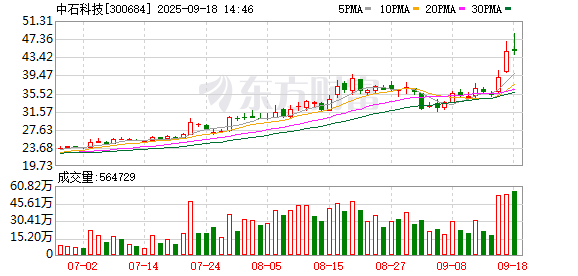
中石科技成交额创上市以来新高
Zheng Quan Shi Bao Wang· 2025-09-18 06:46
Group 1 - The trading volume of Zhongshi Technology reached 2.347 billion yuan, marking a new high since its listing [2] - The latest stock price increased by 0.22%, with a turnover rate of 24.95% [2] - The previous trading day's total transaction volume was 2.343 billion yuan [2] Group 2 - Beijing Zhongshi Weiye Technology Co., Ltd. was established on April 10, 1997 [2] - The registered capital of the company is approximately 2.995 billion yuan [2]