小米汽车

Search documents
车市迎来“最强十月”:新能源品牌集体破纪录,年终大战提前打响
Tai Mei Ti A P P· 2025-11-03 23:57
Core Insights - The Chinese automotive market is experiencing a significant boost in demand, particularly in the new energy vehicle (NEV) sector, driven by policy incentives and recovering consumer confidence [2][12][13] - Leading companies like Leap Motor, NIO, and XPeng are achieving record sales, while Li Auto faces a decline in deliveries, highlighting a competitive landscape [3][4][9] Company Performance - Leap Motor achieved a record delivery of 70,289 units in October, marking an 84% year-on-year increase, and has delivered over 466,000 units from January to October [3] - NIO surpassed 40,000 units in deliveries for the first time, with a 92.6% year-on-year growth, driven by its multi-brand strategy [4] - XPeng maintained a steady performance with 42,013 units delivered in October, nearly doubling its total deliveries compared to the previous year [5] - Xiaomi's automotive division reported over 29,000 units delivered in the first ten months of 2025, with expectations to meet its annual target ahead of schedule [5] Market Trends - The overall automotive market in October saw substantial growth, attributed to seasonal demand and consumer anticipation of policy changes regarding NEV purchase tax [12][13] - Companies are implementing "cross-year delivery tax subsidy plans" to alleviate consumer concerns about potential tax increases in 2026 [12][13] Competitive Landscape - Li Auto reported a decline in deliveries, with 31,767 units in October, a 6.4% decrease from the previous month and a 38.25% year-on-year drop [9] - The competitive pressure on Li Auto is increasing as new entrants and established brands enhance their offerings, particularly in the extended-range electric vehicle segment [9][11] Future Outlook - The upcoming months are expected to see intensified competition as companies aim to meet year-end sales targets, with promotional efforts likely to increase [13]


零跑八连冠,理想降四成,长城前十月销量完成率不足三成,车企年末冲刺各显神通
Guo Ji Jin Rong Bao· 2025-11-03 15:56
Core Insights - In October, new energy vehicle manufacturers NIO, Xpeng, Leapmotor, and Xiaomi all achieved monthly deliveries exceeding 40,000 units, with Leapmotor leading at 70,000 units, setting a new record for monthly deliveries among new forces [1][2]. Group 1: Leapmotor Performance - Leapmotor achieved a record monthly delivery of 71,000 units in October, marking an over 84% increase year-on-year [2]. - The company has shown consistent growth, with monthly deliveries increasing from over 30,000 in March to 67,000 in September [2]. - Leapmotor's product strategy includes the launch of high-end models and a diverse product matrix to cover multiple market segments [2][4]. Group 2: Other New Energy Vehicle Manufacturers - Xpeng delivered 42,000 units in October, a historical high, with a cumulative delivery of 355,000 units from January to October, reflecting a 190% year-on-year increase [5]. - NIO's October deliveries reached 40,400 units, a 92.59% increase year-on-year, supported by the new ES8 model [5]. - Xiaomi reported over 40,000 units delivered in October, although safety incidents have raised concerns about future sales [5]. Group 3: Traditional Automakers - BYD sold 442,000 new energy vehicles in October, with a month-on-month growth of 11.5%, although the growth rate is slowing [6]. - Geely achieved sales of 307,100 units in October, with a year-on-year increase of 35%, marking its first month surpassing 300,000 units [7]. - Chery's overall sales reached 281,000 units in October, with new energy vehicle sales exceeding 110,000 units, a historical high [10]. Group 4: Market Competition - The competition among automakers is intensifying as the year approaches its end, with companies ramping up efforts to boost sales [12].
零跑八连冠 理想降四成 长城前十月销量完成率不足三成 车企年末冲刺各显神通
Guo Ji Jin Rong Bao· 2025-11-03 15:50
Group 1: New Energy Vehicle Sales Performance - In October, Li Auto's sales dropped to 32,000 units, a nearly 40% year-on-year decline, following a recall of over 10,000 units of the 2024 Li MEGA model due to safety concerns [2] - NIO delivered 40,400 vehicles in October, marking a 92.59% year-on-year increase, with the new ES8 contributing significantly to this growth [2] - Xpeng Motors achieved a record high of 42,000 deliveries in October, with a cumulative total of 355,000 units from January to October, reflecting a 190% year-on-year growth [2] - Leap Motor led the new energy vehicle segment with 71,000 deliveries in October, a remarkable 84% increase compared to the same month last year [1] Group 2: Traditional Automakers' Performance - BYD sold 442,000 new energy vehicles in October, showing an 11.5% month-on-month increase, although the growth rate is slowing [3] - Geely achieved sales of 307,100 vehicles in October, with a 12% month-on-month increase and a 35% year-on-year increase, marking its first month surpassing 300,000 units [4] - Chery Group reported total sales of 281,000 vehicles in October, with new energy vehicle sales exceeding 110,000 units, a historical high with a 54.7% year-on-year growth [4] Group 3: Market Trends and Future Outlook - Leap Motor's chairman expressed confidence in significant sales growth in 2026, with a strategic plan in place for the next five years [1] - The automotive industry is entering a competitive phase as companies prepare for the final two months of the year, with many aiming to meet their annual sales targets [5] - Changan Automobile reported total sales of 278,000 vehicles in October, with new energy vehicle sales reaching 119,000 units, a 36% year-on-year increase [5]


安全是汽车业的生命线
第一财经· 2025-11-03 15:14
Core Viewpoint - The article discusses the recall of 11,411 units of the Li Auto MEGA 2024 model due to a fire incident, emphasizing the importance of safety in the automotive industry, particularly for electric vehicles [2][4]. Group 1: Incident Overview - Li Auto announced a recall starting November 7, 2025, for MEGA 2024 models produced between February 18, 2024, and December 27, 2024, totaling 11,411 vehicles [2]. - A fire incident occurred on October 23, where a Li Auto MEGA spontaneously ignited during normal operation, leading to a total loss of the vehicle [2]. - The company identified that the coolant used in the affected vehicles had insufficient anti-corrosion properties, which could lead to battery overheating and other failures under specific conditions [2]. Group 2: Safety Concerns - The incident serves as a reminder of the critical nature of safety in the automotive industry, especially as electric vehicles become more prevalent [4]. - There is a growing concern regarding the frequency of safety issues in the electric vehicle sector, with other companies like Xiaomi also facing scrutiny for safety-related problems [4]. Group 3: Industry Challenges - Several key issues were identified that contribute to safety lapses in the automotive industry: - A lack of respect for safety among some electric vehicle manufacturers, who often prioritize comfort and performance over basic safety requirements [5]. - The recall system in China is seen as needing improvement, with many recalls initiated only after regulatory intervention [5]. - Cross-industry entrants into the automotive market may lack the inherent safety culture traditionally found in established automotive companies [5]. - Consumer protection mechanisms require modernization to better safeguard consumer rights in the face of automotive failures [5]. Group 4: Regulatory and Market Response - The Chinese government has been proactive in establishing safety regulations, as seen with the recent draft for mandatory safety standards for hidden car door handles [6]. - There is a need for regulatory frameworks to keep pace with rapid technological advancements in the automotive sector, ensuring consumer rights are protected effectively [6]. - The article advocates for enhanced market self-regulation and the establishment of mechanisms for consumer rights protection, including collective litigation and evidence-sharing systems [7].
10月新势力销量爆发:零跑首破7万辆,小米稳超4万辆,理想猛跌38%
2 1 Shi Ji Jing Ji Bao Dao· 2025-11-03 14:40
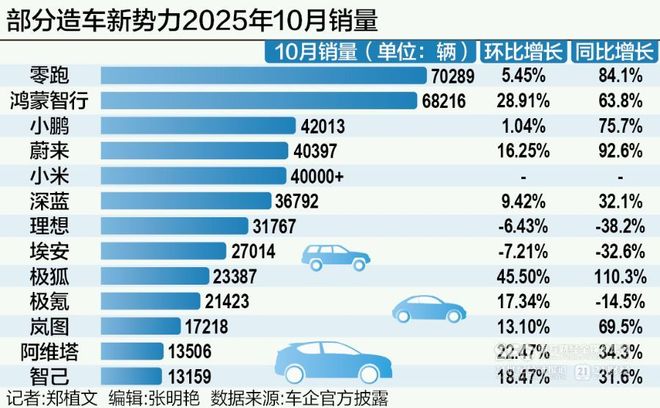
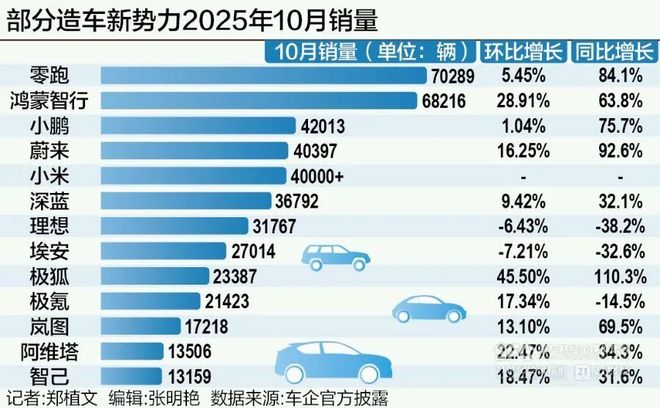
Core Insights - The new energy vehicle market is experiencing a significant recovery, with most brands reporting both year-on-year and month-on-month sales growth during October, traditionally a peak sales season [1][3]. Sales Performance - Leading the sales chart, Leap Motor achieved a record monthly delivery of 70,289 units, marking an 84.1% increase year-on-year and a 5.45% month-on-month growth [2][6]. - Homtruck followed closely with 68,216 units delivered, reflecting a 63.8% year-on-year increase and a substantial 28.91% month-on-month growth [2][7]. - Xiaopeng and Xiaomi both maintained monthly deliveries above 40,000 units, with Xiaopeng achieving 42,013 units (75.7% year-on-year growth) and Xiaomi exceeding 40,000 units [4][8]. - NIO delivered 40,397 units, a 92.6% increase year-on-year, with its sub-brand contributing significantly to this growth [8][9]. - In contrast, Li Auto faced challenges, delivering 31,767 units, which represented a 38.2% year-on-year decline [7]. Market Dynamics - The market is undergoing structural adjustments, with traditional leaders like "Wei Xiaoli" being challenged by new entrants like Leap Motor, which is adopting a "technology for all" strategy [6][12]. - The second-tier brands, such as Extreme Fox and Lantu, are showing significant growth, with Extreme Fox's deliveries soaring by 110.3% year-on-year [4][11]. - The competitive landscape is shifting, with brands needing to focus on technology development, supply chain management, and cost optimization to maintain their market positions [12]. Strategic Initiatives - Leap Motor's success is attributed to its effective implementation of the LEAP 3.5 technology architecture, allowing for cost control while maintaining product performance [6]. - Li Auto is currently facing a transition period, adjusting its annual sales target downwards due to competitive pressures and production challenges [7]. - Xiaopeng's growth is supported by its product iteration strategy and the introduction of self-developed technology, such as the Turing chip [8]. - NIO's multi-brand strategy is beginning to show results, expanding its consumer base and enhancing its battery swap network [9]. Future Outlook - The competitive environment is expected to intensify as the penetration rate of new energy vehicles continues to rise, posing challenges for brands that have not achieved scalable profitability or lack core technological advantages [12].
10月新势力销量爆发:零跑首破7万辆,小米稳超4万辆,理想猛跌38%
21世纪经济报道· 2025-11-03 14:29
Core Viewpoint - The new energy vehicle market is experiencing a structural adjustment, with traditional leaders being challenged by emerging players like Leap Motor, while established brands like Li Auto face declining sales [3][6][7]. Sales Performance - In October, several new car manufacturers reported impressive sales figures, with most brands achieving both year-on-year and month-on-month growth, indicating a recovery in market demand [1]. - Leap Motor led the sales with 70,289 units, marking an 84.1% year-on-year increase and a historical high [5][6]. - Other notable performers included Hongmeng Zhixing with 68,216 units (63.8% year-on-year growth), NIO with 40,397 units (92.6% year-on-year growth), and Xiaopeng with 42,013 units (75.7% year-on-year growth) [2][5][8][9]. Market Dynamics - The traditional market structure represented by "Wei Xia Li" is being disrupted, with Leap Motor's "technology for all" strategy showing strong momentum [3][6]. - Li Auto experienced a decline in sales, delivering 31,767 units, a 38.2% year-on-year drop, and has revised its annual sales target downwards [7]. - The competitive landscape is intensifying, with brands like Extreme Fox and Lantu showing significant growth, with year-on-year increases of 110.3% and 69.5%, respectively [5][11]. Strategic Insights - Leap Motor's success is attributed to its effective "technology for all" strategy, which includes cost control and a strong global presence, having entered over 30 countries [6]. - Li Auto's challenges stem from increased competition in the extended-range vehicle market and a recent recall affecting its brand image [7]. - Xiaopeng's growth is driven by precise product iteration and the introduction of self-developed technology, while Xiaomi faces production capacity constraints despite high demand [8][9]. Emerging Trends - The second-tier brands are leveraging differentiated strategies and product positioning to achieve rapid growth, as seen with Extreme Fox's successful entry into the entry-level electric vehicle market [11]. - The market is evolving towards a focus on comprehensive strengths, including technology development, supply chain management, and cost optimization, rather than relying solely on product advantages [12][13].

从理想MEGA到小米SU7:召回为何难解车主心头之惑?
Di Yi Cai Jing· 2025-11-03 13:32
Core Viewpoint - Recent recall events in the automotive industry highlight the varying responses of companies to safety issues, with Li Auto and Xiaomi facing public scrutiny for their handling of recalls following safety incidents [2][3][4] Group 1: Recall Events - Li Auto recalled over 10,000 units of the 2024 MEGA model on October 31, while Xiaomi recalled over 110,000 units of the Xiaomi SU7 standard version on September 19 [2] - Li Auto's recall was initiated proactively one week after a fire incident, whereas Xiaomi's recall occurred nearly six months later, following an investigation [2][3] Group 2: Public Perception and Response - Both companies faced criticism for downplaying the severity of the issues, with Li Auto's proactive recall failing to fully alleviate customer concerns [3] - Xiaomi's recall was described as an "OTA recall," which blurred the seriousness of the situation and led to negative public sentiment [3][4] Group 3: Consumer Expectations - The market exhibits a "zero tolerance" attitude towards automotive safety risks, with consumers demanding immediate action from companies upon discovering safety issues [4] - There is a call for companies to establish robust internal accident analysis systems to shift from reactive to proactive safety management [4] Group 4: Regulatory Actions - Regulatory bodies are emphasizing the need for improved transparency and accountability in the automotive industry, with plans to enhance oversight of new energy vehicles [5] - The National Market Supervision Administration is working on innovative recall regulations and safety reporting systems to ensure consumer safety [5]
发现安全隐患,车企都应第一时间主动召回
第一财经· 2025-11-03 13:12
Core Viewpoint - The article discusses two significant recall events in the automotive industry involving Li Auto and Xiaomi, highlighting the differences in their responses to safety incidents and the implications for consumer trust and corporate responsibility [3][4][5]. Group 1: Recall Events - On October 31, Li Auto recalled over 10,000 units of the 2024 MEGA model due to insufficient corrosion resistance in the coolant [3]. - Xiaomi recalled over 110,000 units of the Xiaomi SU7 standard version electric vehicle on September 19, following safety concerns related to the vehicle's auxiliary driving system [4]. - The recalls were triggered by serious safety incidents, with Li Auto's proactive recall occurring a week after an accident, while Xiaomi's recall was a reactive measure taken nearly six months later [3][4]. Group 2: Public Perception and Corporate Responsibility - Both companies faced criticism for downplaying the severity of the issues, with Li Auto's proactive recall failing to fully alleviate consumer concerns due to prior reports of insulation faults in the 2024 models [4][5]. - Xiaomi's characterization of the recall as an "OTA recall" blurred the seriousness of the situation, leading to significant backlash and questioning of their commitment to safety [5]. - The article emphasizes the market's zero-tolerance attitude towards automotive safety risks, urging companies to act swiftly and transparently in addressing safety issues [5]. Group 3: Regulatory and Industry Implications - There are calls for Xiaomi to initiate a proactive recall to eliminate safety hazards, reflecting a growing demand for accountability in the industry [7]. - Regulatory bodies are taking steps to enhance oversight of the electric vehicle sector, including the establishment of a more transparent recall system and the implementation of new safety reporting requirements [7]. - The article advocates for a shift in corporate safety management from reactive to proactive measures, emphasizing the importance of consumer safety and corporate social responsibility in the evolving automotive landscape [6][7].
一财社论:安全是汽车业的生死符
Di Yi Cai Jing· 2025-11-03 12:53
Core Viewpoint - The proactive recall by Li Auto reflects a commitment to corporate reputation and basic business ethics, emphasizing the importance of safety in the automotive industry [1][2][6] Group 1: Incident Overview - Li Auto announced a recall of 11,411 units of the 2024 MEGA model due to a fire incident that occurred on October 23, 2023, which resulted in the vehicle being completely destroyed [1] - The fire was attributed to insufficient corrosion resistance of the coolant used in the vehicles, which could lead to battery overheating and potential failure [1] Group 2: Industry Implications - The incident serves as a warning to all automotive manufacturers about the critical importance of safety, especially in the rapidly growing electric vehicle sector [2] - There is a noted trend of increasing safety issues within the new energy vehicle market, with other companies like Xiaomi also facing scrutiny over safety concerns [2] Group 3: Regulatory and Systemic Issues - The current recall system in China is seen as needing improvement, as many recalls are initiated only after regulatory intervention rather than voluntary action by companies [3] - The automotive industry is experiencing challenges due to cross-industry entrants lacking a strong safety culture, which can compromise overall safety standards [3] Group 4: Consumer Protection and Legal Framework - There is a call for enhanced consumer rights protection mechanisms to ensure that consumers are not passive recipients of safety risks, especially in the context of intelligent connected new energy vehicles [3][5] - The need for a more robust legal framework, including collective litigation and compensation mechanisms, is emphasized to better protect consumer interests [5]
造车新势力格局生变:零跑持续领跑,第二梯队加速突围
2 1 Shi Ji Jing Ji Bao Dao· 2025-11-03 12:45
Core Viewpoint - The new energy vehicle market is experiencing significant growth, with most brands reporting both year-on-year and month-on-month sales increases, indicating a recovery in market demand [2] Group 1: Sales Performance - Leap Motor leads the market with a record monthly delivery of 70,289 units, achieving a year-on-year growth of 84.1% [2][4] - Hongmeng Zhixing follows closely with 68,216 units delivered, marking a month-on-month increase of 28.91% and a year-on-year increase of 63.8% [2] - Xiaopeng and Xiaomi both maintain over 40,000 units in monthly deliveries, while NIO joins the "40,000 club" for the first time with 40,397 units, reflecting a year-on-year growth of 92.6% [2][6] - Second-tier brands like Jihu and Lantu show significant growth, with year-on-year increases of 110.3% and 69.5%, respectively [2][8] Group 2: Market Dynamics - The traditional market structure represented by "Wei Xiaoli" is being disrupted, with Leap Motor's "technology for all" strategy gaining momentum [2][9] - Li Auto faces challenges with a month-on-month decline of 6.4% and a year-on-year drop of 38.2%, adjusting its annual sales target down from 700,000 to 640,000 units [3][4] - The competitive landscape is shifting, with brands needing to focus on technology development, supply chain management, and cost optimization to maintain their positions [9] Group 3: Strategic Insights - Leap Motor's strategy includes a price reduction for its B10 model to around 120,000 yuan, targeting mainstream consumers effectively [3] - Xiaopeng's growth is attributed to its precise product iteration strategy, with new models like MONA M03 and P7+ successfully penetrating the market [5] - NIO's multi-brand strategy is beginning to show results, with its sub-brand contributing significantly to overall sales [6] Group 4: Second-Tier Brands - Jihu's explosive growth in October, with 23,387 units delivered, is driven by the launch of its A0-class model, which offers competitive pricing and features [7] - Other second-tier brands like Zeekr, Avita, and Zhiji also report steady month-on-month growth, indicating a robust competitive response [7][8]