新能源汽车购置税政策调整

Search documents
2026年3月橡胶策略报告-20260302
Guang Da Qi Huo· 2026-03-02 11:50
Report Industry Investment Rating - Not provided in the document Core Viewpoints - In 2026, the global natural rubber market is expected to be in short supply for the sixth consecutive year due to increased consumption driven by the growth of the automotive industry in emerging and developed economies. The supply of natural rubber will enter a low - production season in March, while the downstream demand for tires is expected to see strong repair momentum in March, which will support the rubber price. It is predicted that the rubber price will show a strong and volatile trend in March. For butadiene rubber, although there are more maintenance plans in March and downstream demand is supportive, the inventory level suppresses the price, and it is expected to show a volatile and slightly strong trend [109][110]. Summary by Directory 1. Price - **Futures price**: From January 30 to February 27, 2026, the RU main contract increased by 795 yuan/ton, the NR main contract increased by 530 yuan/ton, and the BR main contract decreased by 760 yuan/ton [5]. - **Basis**: During the same period, the RU main contract basis increased by 5 yuan/ton, the NR main contract basis increased by 74 yuan/ton, and the BR main contract basis increased by 360 yuan/ton [7]. - **Monthly spread**: The RU - NR spread on February 27, 2026 was 3303 yuan/ton, with a month - on - month increase of 244 yuan/ton and a year - on - year increase of 829 yuan/ton [12]. - **Price difference between natural rubber and synthetic rubber**: The price difference between natural rubber and synthetic rubber has fallen from a high level, but the substitution effect of synthetic rubber still exists [17]. - **Processing profit**: The processing profit of Thai standard rubber on February 26, 2026 was - 115.15 US dollars/ton, with a month - on - month decrease of 140.81 US dollars/ton and a year - on - year decrease of 151.68 US dollars/ton [18]. - **Production cost and profit of butadiene rubber**: On February 26, 2026, the production cost of butadiene rubber was 13006 yuan/ton, with a month - on - month decrease of 412 yuan/ton and a year - on - year decrease of 824 yuan/ton; the production profit was - 6 yuan/ton, with a month - on - month increase of 412 yuan/ton and a year - on - year decrease of 76 yuan/ton [21]. 2. Supply - **Global natural rubber production**: In 2025, the global natural rubber production increased by 1.4%, and it is expected to increase by 2.4% to 15.2 million tons in 2026. The overall demand in 2026 is expected to increase by 1.7% to 15.6 million tons [25]. - **Production in major producing areas**: In March, Southeast Asian main producing areas enter the low - production season. The production in major producing areas such as Thailand, Indonesia, Malaysia, and Vietnam has maintained a relatively stable trend [29][33]. - **Export volume**: The cumulative year - on - year increase in the export volume of major producing countries has declined. For example, Thailand's natural rubber and mixed rubber exports in January 2026 decreased by 10% year - on - year [39]. - **China's import volume**: China's natural rubber import volume has increased year - on - year. In December 2025, the import volume of natural rubber and mixed rubber was 803,400 tons, with a month - on - month increase of 24.8% and a year - on - year increase of 25.4% [45]. - **Butadiene supply**: In March, the supply pressure of butadiene increases. The capacity utilization rate of butadiene on February 27, 2026 was 76.25%, with a month - on - month increase of 4.99% and a year - on - year increase of 0.03%. There are new production capacity plans in 2026 and 2027, and there are also many equipment maintenance plans [49][52][54]. - **Butadiene rubber production**: In January 2026, the production of butadiene rubber was 149,933 tons, with a month - on - month increase of 6313 tons and a year - on - year increase of 20,067 tons. There are many equipment maintenance plans in 2026, mainly concentrated in the second and third quarters [57][60][61]. - **Butadiene rubber import and export**: In December 2025, the import volume of butadiene rubber was 29,123 tons, with a month - on - month increase of 4.3% and a year - on - year increase of 5.0%; the export volume was 27,971 tons, with a month - on - month increase of 3.7% and a year - on - year increase of 20.1% [62]. 3. Demand - **Automobile policy**: The implementation details of the subsidy for replacing old cars with new ones in 2026 have been released. The policy for new energy vehicles to be exempted from vehicle purchase tax has partially retreated since January 1, 2026. In January 2026, the domestic passenger car retail volume decreased year - on - year, but the export market reached a record high [67]. - **Tire start - up**: In March, tire start - up recovers. The average start - up rate of all - steel tires in February was 36.31%, a decrease of 25.33 percentage points compared with January; the average start - up rate of semi - steel tires was 45.26%, a decrease of 26.55 percentage points compared with January [69]. - **Tire export**: The export demand for tires has weakened. In 2025, China's rubber tire export volume reached 9.65 million tons, a year - on - year increase of 3.6% [76]. - **Automobile production and sales**: The production and sales of automobiles have steadily advanced. The demand for heavy - duty trucks has stabilized and strengthened [77][78]. 4. Inventory - **Qingdao natural rubber inventory**: As of February 6, 2026, the bonded inventory was 106,900 tons, the general trade inventory was 502,400 tons, and the total inventory was 609,300 tons, with an increase of 1200 tons, 16,900 tons, and 18,100 tons respectively compared with January 30 [82]. - **Exchange inventory of natural rubber and No. 20 rubber**: As of February 27, the natural rubber warehouse receipt was 114,470 tons, and the exchange total inventory was 124,980 tons; the No. 20 rubber warehouse receipt was 50,601 tons, and the exchange total inventory was 52,416 tons [85]. - **Butadiene rubber inventory**: As of February 27, 2026, the domestic butadiene rubber inventory was 53,500 tons [87]. 5. Position - **RU main contract total position**: The total position of the RU main contract shows certain fluctuations [90]. - **NR and BR positions**: On February 27, 2026, the total position of natural rubber was 238,035 hands, the total position of No. 20 rubber was 105,322 hands, and the total position of BR was 107,736 hands. Compared with January 30, the position of natural rubber increased by 13,819 hands, the position of No. 20 rubber decreased by 534 hands, and the position of BR decreased by 46,960 hands [92]. 6. Options - **Natural rubber options**: Include historical volatility, historical volatility cone, and the put - call ratio of option trading volume and position [96][100]. - **Butadiene rubber options**: Include historical volatility, historical volatility cone, and the put - call ratio of option trading volume and position [102][105].
1月车市销量同比下降3.2% 新能源汽车仅增长0.1%
Jing Ji Guan Cha Wang· 2026-02-11 13:44
Industry Overview - In January 2026, China's automotive sales reached 2.346 million units, a month-on-month decline of 28.3% and a year-on-year decrease of 3.2% [2] - Passenger car sales totaled 1.988 million units, with a month-on-month drop of 30.2% and a year-on-year decline of 6.8% [2] - New energy vehicle (NEV) sales were 945,000 units, showing a slight year-on-year growth of 0.1%, but the growth rate has significantly slowed compared to previous years [2] New Energy Vehicles - NEVs accounted for only 40.3% of total new car sales in January [2] - Among NEV categories, production and sales of three types showed varying degrees of decline compared to the previous month, while pure electric vehicles experienced slight growth [2] - The decline in NEV sales is attributed to changes in tax policies, with the exemption being reduced to half starting January 1, 2026, increasing purchase costs [2] Commercial Vehicles - The commercial vehicle market performed well, with production and sales reaching 388,000 and 359,000 units respectively, marking year-on-year increases of 29.9% and 23.5% [3] - Truck production and sales saw rapid growth across all categories, while bus production slightly increased and sales slightly decreased [3] Exports - In January, vehicle exports continued to show strong growth, totaling 681,000 units, a year-on-year increase of 44.9% [3] - NEV exports were particularly notable, with 302,000 units exported, representing a year-on-year growth of 100% [3] Market Share and Brand Performance - Chinese brand passenger car sales fell to 1.329 million units, a year-on-year decrease of 8.9%, resulting in a market share of 66.9%, down 1.5 percentage points from the previous year [3] - Among major foreign brands, five key brands experienced double-digit declines compared to the previous month, while American brands saw double-digit growth year-on-year [3] Company Performance - The top ten automotive companies sold 1.962 million units in January, accounting for 83.6% of total automotive sales [4] - Companies such as SAIC Motor, Geely, Dongfeng, GAC Group, and Great Wall Motors reported varying degrees of sales growth compared to the previous year [4] Future Outlook - The China Automotive Industry Association anticipates a stabilization in market demand due to a series of government policies aimed at supporting consumer and business needs [4] - Policies related to vehicle scrappage and trade-in programs are expected to be implemented smoothly, further stimulating market activity [4]

乘联分会秘书长崔东树:1月新车平均降价3.7万元
Di Yi Cai Jing· 2026-02-08 21:42
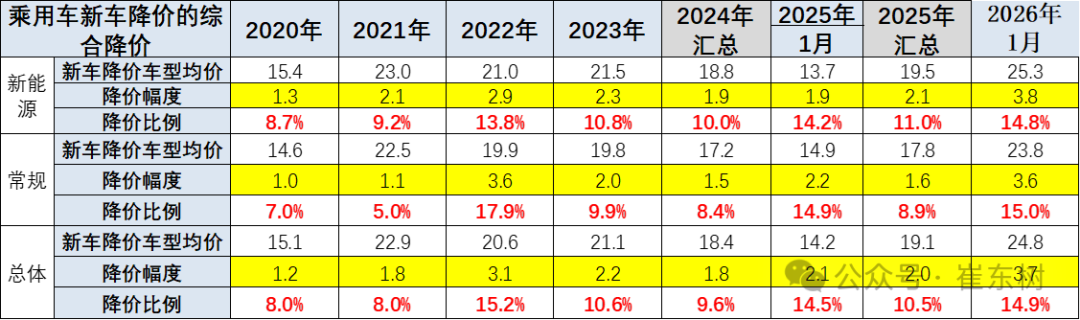
Core Insights - The overall passenger car market in January 2026 saw a significant price reduction, with an average price of 248,000 yuan for new cars, and an average discount of 37,000 yuan, marking a 14.9% overall price drop compared to previous months [1][3] - The price reduction for new energy vehicles (NEVs) averaged 253,000 yuan, with a discount of 38,000 yuan, representing a 14.8% decrease, while conventional fuel vehicles averaged 238,000 yuan with a 36,000 yuan discount, reflecting a 15% drop [1][2] Price Reduction Trends - In January 2026, the overall price drop for new cars was 14.9%, which is an increase of 2.5 percentage points month-over-month and 0.4 percentage points year-over-year [1] - The average price reduction for NEVs in January 2026 exceeded the annual average of the past six years, which was 13.8% in 2022, indicating a notable shift in pricing strategies [1][3] Market Dynamics - The price reduction trend included both fuel and electric vehicles, with 17 new models seeing price cuts, an increase of 9 models compared to the same period last year [2] - The adjustment in the new energy vehicle purchase tax policy is identified as a direct driver behind the price cuts, leading to a more realistic pricing structure for consumers [3] Specific Model Insights - The BMW I3 electric vehicle saw the largest price cut of 75,900 yuan, a 21.4% reduction, while the BMW X1 electric model had a 71,900 yuan discount, equating to a 24% drop [3] - Among fuel vehicles, the BMW 3 Series had a price reduction of 50,000 yuan, representing a 19.3% decrease, while the Honda HR-V experienced the largest drop of 75,900 yuan, with a 31.3% reduction [3]

最新数据:1月新车平均降价3.7万元
第一财经· 2026-02-08 14:41
Core Viewpoint - The article highlights a significant price reduction trend in the Chinese passenger car market, particularly in January 2026, with both new energy vehicles (NEVs) and conventional fuel vehicles experiencing notable price drops, driven by changes in tax policies and market dynamics [3][5]. Summary by Sections Overall Market Trends - In January 2026, the average price of new cars that were discounted in the passenger car market was 248,000 yuan, with an average price reduction of 37,000 yuan, representing a decline of 14.9% [3]. - The price reduction in January 2026 was higher than the average reduction of 10.5% observed throughout 2025, indicating a significant increase in discounting activity [3]. New Energy Vehicles (NEVs) - The average price of discounted NEVs in January 2026 was 253,000 yuan, with an average reduction of 38,000 yuan, translating to a 14.8% decrease [3][4]. - The price reduction for NEVs in January 2026 exceeded the annual average reduction of 13.8% from 2020 to 2025, marking a notable shift in pricing strategies [3][4]. Conventional Fuel Vehicles - The average price of discounted conventional fuel vehicles in January 2026 was 238,000 yuan, with an average reduction of 36,000 yuan, resulting in a 15% decrease [3][4]. - The price reduction for conventional fuel vehicles also showed a significant increase compared to previous years, with a 15% reduction in January 2026 compared to an average of 14.9% in 2025 [3][4]. Market Dynamics and Influences - The recent wave of price reductions is attributed to the adjustment of the new energy vehicle purchase tax policy, which has led to a surge in discounted models and a return to more realistic pricing [5]. - The luxury car segment is undergoing a significant price restructuring, with several high-end models experiencing substantial price cuts [5]. - Notable examples include the BMW i3, which saw a price drop of 75,900 yuan (21.4%), and the BMW X1, which was reduced by 71,900 yuan (24%) [5].

崔东树:1月新车平均降价3.7万元
Di Yi Cai Jing· 2026-02-08 14:08
Core Insights - The average price reduction for new cars in January 2026 reached 14.9%, with an average price of 248,000 yuan for reduced models, marking a significant increase from the previous year's average reduction of 10.5% [1][2] - The price reduction for new energy vehicles (NEVs) averaged 25.3 million yuan, with a reduction of 3.8 million yuan, representing a 14.8% decrease, while conventional fuel vehicles saw an average price of 238,000 yuan with a reduction of 3.6 million yuan, equating to a 15% decrease [1][2] - The current price reduction for NEVs exceeds the annual average of the past six years, even surpassing the highest reduction year of 2022, which had an average reduction of 13.8% [1][2] Price Reduction Details - In January 2026, 17 new car models were reduced in price, an increase of 9 models compared to the same period last year, including 10 fuel vehicles and 6 electric vehicles [2] - The most significant price drop among NEVs was the BMW I3, which saw a reduction of 75,900 yuan, or 21.4%, while the BMW X1 had a reduction of 71,900 yuan, or 24% [3] - Among fuel vehicles, the BMW 3 Series had a price reduction of 50,000 yuan, or 19.3%, while the Honda HR-V experienced the largest drop of 75,900 yuan, equating to a 31.3% decrease [3] Market Dynamics - The recent price reductions are attributed to adjustments in the new energy vehicle purchase tax policy, leading to a significant increase in the number of models with reduced prices [3] - The luxury car segment is undergoing a price restructuring, indicating a competitive shift in the high-end market [3]
乘用车行业月报:12月乘用车销量同环比下降,预计26年销量同比微增
GUOTAI HAITONG SECURITIES· 2026-01-25 07:45
Investment Rating - The report assigns an "Accumulate" rating for the automotive industry [22]. Core Insights - The report forecasts that the wholesale sales of passenger vehicles in China will reach 30.21 million units in 2026, reflecting a year-on-year increase of 1%. The sales of new energy passenger vehicles are expected to be approximately 16.85 million units, with a year-on-year growth of 10% [20][21]. - In December 2025, the wholesale sales of passenger vehicles in China were 2.814 million units, a decrease of 9% year-on-year and a decrease of 7% month-on-month. For the entire year of 2025, the wholesale sales reached 29.908 million units, an increase of 9% year-on-year [7][8]. Summary by Sections 1. Total Passenger Vehicle Sales - In December 2025, the total wholesale sales of passenger vehicles in China were 2.814 million units, down 9% year-on-year and down 7% month-on-month. The wholesale sales of new energy passenger vehicles were 156.3 thousand units, up 3% year-on-year and down 8% month-on-month. For the entire year of 2025, the wholesale sales of passenger vehicles were 29.908 million units, up 9% year-on-year, while new energy passenger vehicle sales reached 1.5319 million units, up 25% year-on-year [7][8]. 2. Key Automotive Companies' December Sales - **BYD**: In December, BYD delivered 420 thousand vehicles, down 18% year-on-year and down 12% month-on-month. The overseas sales reached 132 thousand units, up 130% year-on-year [8][9]. - **Geely**: In December, Geely delivered 237 thousand vehicles, up 13% year-on-year. The 2026 sales target is set at 3.45 million units, a 14% increase from 2025 [10]. - **Changan**: In December, Changan delivered 257 thousand vehicles, down 19% year-on-year. The 2026 sales target is 3.3 million units, a 13% increase from 2025 [12]. - **Great Wall Motors**: In December, Great Wall Motors delivered 124 thousand vehicles, down 8% year-on-year. The company launched the "Guiyuan Platform" globally [13][14]. - **Li Auto**: In December, Li Auto delivered 44 thousand vehicles, down 24% year-on-year. The OTA 8.2 version was fully pushed [15]. - **Leap Motor**: In December, Leap Motor delivered 60 thousand vehicles, up 42% year-on-year. The 2026 sales target is set at 1 million units [16][17]. - **Xpeng Motors**: In December, Xpeng Motors delivered 38 thousand vehicles, achieving double growth year-on-year and month-on-month. The 2025 total deliveries reached 429 thousand units, up 126% year-on-year [18][19]. 3. Policy Impact and Market Outlook - The report notes that the effectiveness of the old-for-new vehicle policy is expected to diminish, with a projected total of over 11.5 million vehicles replaced in 2025, of which nearly 60% are new energy vehicles. The new policy for 2026 will shift from fixed subsidies to a "proportional subsidy + cap" model [20]. - The report anticipates that the reduction in new energy vehicle purchase tax incentives will lead to a more competitive market, pushing the industry towards higher performance and efficiency standards [21].



【新能源篇】新的一年开始了,各家的销售情况都怎么样?
车fans· 2026-01-19 01:06
Core Viewpoint - The current market is experiencing a significant decline in customer traffic and orders compared to the previous month, primarily due to the reduction of purchase tax subsidies and the lack of new government funding for 2026, leading to a cautious market sentiment [1][10]. Group 1: Market Conditions - Customer traffic and orders have sharply decreased, with many stores reporting single-digit order numbers and a general lack of high-intent customers [1][12]. - The New Year's holiday saw minimal customer engagement, with many potential buyers still in the consideration phase and not making decisive purchases [5][17]. - The introduction of new policies, such as a 12,000 yuan purchase tax subsidy, has not significantly improved the situation, as actual costs remain higher than last year [2][10]. Group 2: Consumer Behavior - Customers are exhibiting a strong wait-and-see attitude, largely influenced by the anticipation of new models and subsidy policies [4][19]. - Many customers who considered purchasing at the end of last year are now hesitant due to increased costs and the uncertainty surrounding new government incentives [8][10]. - The majority of customers are not in a hurry to buy, with many expressing a desire to wait for better deals or new model releases [9][15]. Group 3: Competitive Landscape - The market is seeing increased competition among electric vehicle brands, with some customers considering switching back to traditional fuel vehicles due to the new purchase tax on electric cars [10][19]. - Brands like Xiaopeng and Zeekr are gaining attention for their new models, but overall customer interest remains subdued [8][14]. - The introduction of new models and policies by competitors is expected to influence customer decisions, with many waiting for clearer signals from manufacturers [15][22].

开年车市实探:宝马有车型官降30万,多品牌补贴购置税,小米销售坐收新SU7“天使单”
Xin Lang Cai Jing· 2026-01-09 08:27
Group 1: Market Dynamics - The competition among car manufacturers has intensified at the beginning of the year, with various promotional activities launched to attract consumers due to new policies like halving the new energy vehicle purchase tax and adjusting national subsidies [1][8] - Multiple car companies, including Tesla and Xiaomi, have introduced new financial policies and promotional offers to stimulate sales, indicating a proactive response to market dynamics [2][4] Group 2: Price Adjustments - BMW has adjusted the suggested retail prices of over 30 models, with the largest price drop being 301,000 yuan for the i7 M70L, reducing its price from 1,899,000 yuan to 1,598,000 yuan [2][3] - The price reduction for the iX1 eDrive25L is 24%, dropping from 299,900 yuan to 228,000 yuan, reflecting BMW's strategy to respond to market conditions [2] Group 3: Consumer Incentives - Tesla has launched a limited-time long-term purchase plan, offering low monthly payments for Model 3 and Model Y, with a down payment starting at 79,900 yuan and monthly payments as low as 1,918 yuan [4][5] - Xiaomi's new financial policy for the YU7 includes a 3-year interest-free option, with a down payment starting at 74,900 yuan and monthly payments from 4,961 yuan [5] Group 4: New Product Launches - Xiaomi has announced the new generation SU7, with a starting pre-sale price of 229,900 yuan, and plans to deliver the vehicle in April 2026 [6] - XPeng Motors is set to launch the new P7+ and G7 models, with the G7 achieving a comprehensive range of over 1,100 kilometers in cold conditions [7] Group 5: Policy Impact - The recent policy changes, including the adjustment of the new energy vehicle purchase tax from full exemption to a 50% reduction, are expected to increase consumer costs and influence purchasing decisions [3][8] - The government has introduced a 15,000 yuan subsidy for vehicle purchases completed before January 18, further incentivizing consumers [4]
多家车企密集降价促销!
新华网财经· 2026-01-08 14:40
Core Viewpoint - Multiple automakers are launching aggressive discount promotions to counter the impact of the new energy vehicle purchase tax adjustments set for 2026 [6] Group 1: Promotions and Discounts - Tesla China has introduced purchase incentives for the Model 3/Y/Y L, including a "7-year ultra-low interest" financing option with a minimum down payment of 79,900 yuan and monthly payments starting at 1,918 yuan [2] - GAC Group announced promotional activities for its self-owned brands, offering a maximum of 70,000 yuan in "government-enterprise subsidies" for models like GAC Trumpchi [2] - NIO's Firefly brand is providing benefits such as a 2,000 yuan purchase tax subsidy and rewards for repeat buyers [3] - Xiaomi is offering various promotions for its YU7 and SU7 Ultra models, including a 3-year interest-free option and a limited-time purchase benefit of 48,000 yuan [3] - BMW has initiated a broad price adjustment across 31 models, with the iX1 seeing a price drop from 299,900 yuan to 228,000 yuan, a reduction of 24% [3] - Volvo is promoting its new XC70 with a direct purchase tax subsidy of 14,000 yuan and additional purchase benefits [3] - Wuling Motors is providing full purchase tax subsidies for several new energy models, along with up to 8,000 yuan in trade-in subsidies and 5,000 yuan in limited-time financial interest subsidies [4] - Traditional automakers like Dongfeng, Chery, and FAW-Volkswagen are also rolling out new year discount promotions for select brands or models [5] Group 2: Market Outlook - The automotive industry anticipates that the increase in purchase tax for new energy vehicles will negatively impact sales, with predictions of a significant market decline in the first quarter of 2026 [6] - However, the early introduction of vehicle scrappage and trade-in subsidies has shifted industry sentiment to a more optimistic outlook, suggesting that the market may continue to grow in 2026 [7] - The China Automobile Dealers Association forecasts a strong start to January 2026, driven by pent-up demand from the end of 2025 and pre-holiday purchasing activity [7]


特斯拉、小米、宝马等车企密集降价促销应对购置税调整
Cai Jing Wang· 2026-01-08 12:03
Group 1 - Multiple car manufacturers are launching price reduction promotions to respond to the impact of the new energy vehicle purchase tax [1][2] - Tesla China has introduced purchase incentives for Model 3/Y/Y L, including a "7-year ultra-low interest" financing plan with a minimum down payment of 79,900 yuan and monthly payments starting at 1,918 yuan [1] - GAC Group announced promotional activities for its self-owned brands, including limited-time purchase tax guarantees and additional subsidies for trade-ins or scrappage [1] - Xiaomi Auto is offering various promotions for its models YU7 and SU7 Ultra, with a "3-year 0% interest" option and a minimum down payment of 74,900 yuan [1] - BMW has initiated a significant official price adjustment for 31 models, with the highest reduction for the iX1, dropping from 299,900 yuan to 228,000 yuan, a decrease of 24% [1] - Volvo is promoting its new XC70 model with a limited-time offer that includes a direct purchase tax subsidy of 14,000 yuan [1] Group 2 - Wuling Motors announced full purchase tax subsidies for several new energy models, along with trade-in subsidies up to 8,000 yuan and limited-time financial interest subsidies up to 5,000 yuan [2] - Traditional car manufacturers such as Dongfeng, Chery, Deep Blue, FAW-Volkswagen, and GAC Toyota are also launching new year price reduction promotions for certain brands or models [2]