
平煤股份

Search documents
11月4日上证资源(000068)指数跌2%,成份股中金黄金(600489)领跌
Sou Hu Cai Jing· 2025-11-04 09:47
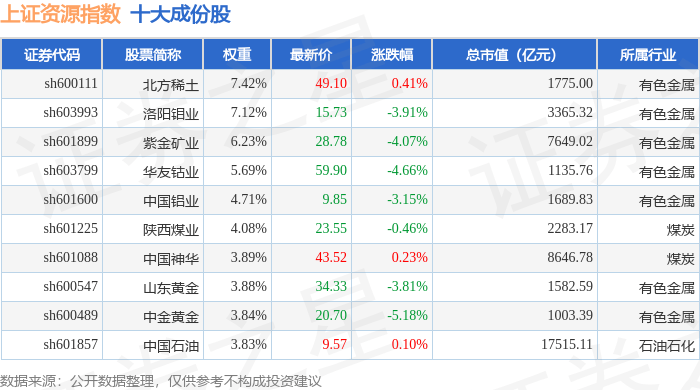
Market Overview - The Shanghai Resource Index (000068) closed at 3753.88 points, down 2.0%, with a trading volume of 56.362 billion yuan and a turnover rate of 0.77% [1] - Among the index constituents, 9 stocks rose while 36 fell, with Fangda Carbon leading the gainers at 2.37% and Zhongjin Gold leading the decliners at 5.18% [1] Key Constituents - The top ten constituents of the Shanghai Resource Index are detailed, with North Rare Earth holding the highest weight at 7.42% and a market cap of 177.5 billion yuan [1] - Other notable constituents include Zijin Mining with a market cap of 764.902 billion yuan and China Shenhua with a market cap of 864.678 billion yuan [1] Capital Flow - The net outflow of main funds from the index constituents totaled 5.047 billion yuan, while retail investors saw a net inflow of 4.462 billion yuan [1] - Specific stocks such as Fangda Carbon experienced a net inflow of 95.7325 million yuan from main funds, while China Shenhua had a net inflow of 67.0535 million yuan [2] ETF Performance - The Gold Stock ETF (product code: 159562) tracks the CSI Hong Kong Gold Industry Stock Index and has seen a decline of 3.10% over the past five days, with a P/E ratio of 23.23 times [4] - The ETF's latest share count is 1.26 billion, with an increase of 9 million shares, but it experienced a net outflow of 57.747 million yuan from main funds [4]


煤炭开采板块11月4日涨0.02%,大有能源领涨,主力资金净流出2.34亿元
Zheng Xing Xing Ye Ri Bao· 2025-11-04 08:48
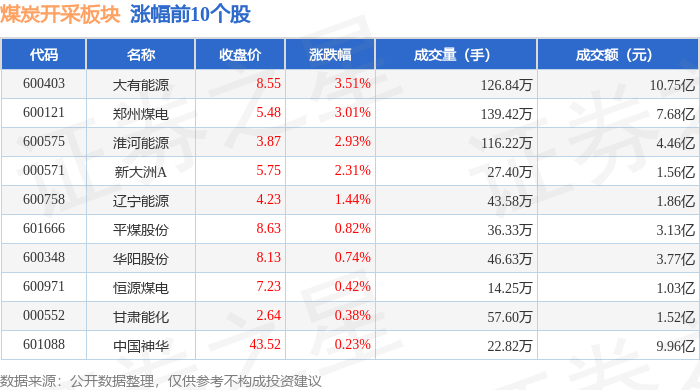
Core Insights - The coal mining sector experienced a slight increase of 0.02% on November 4, with Dayou Energy leading the gains [1] - The Shanghai Composite Index closed at 3960.19, down 0.41%, while the Shenzhen Component Index closed at 13175.22, down 1.71% [1] Coal Mining Sector Performance - Dayou Energy (600403) closed at 8.55, up 3.51% with a trading volume of 1.2684 million shares and a transaction value of 1.075 billion [1] - Zhengzhou Coal Electricity (600121) closed at 5.48, up 3.01%, with a trading volume of 1.3942 million shares and a transaction value of 768 million [1] - Huaihe Energy (600575) closed at 3.87, up 2.93%, with a trading volume of 1.1622 million shares and a transaction value of 446 million [1] - The overall coal mining sector saw a net outflow of 234 million from main funds, while retail investors contributed a net inflow of 121 million [2][3] Fund Flow Analysis - China Shenhua (601088) had a main fund net inflow of 67.05 million, but also saw net outflows from retail investors totaling 38.75 million [3] - The main fund net inflow for Zhongmei Energy (601898) was 56.14 million, with a retail net outflow of 72.97 million [3] - Huaihe Energy (600575) experienced a main fund net inflow of 29.67 million, while retail investors had a net outflow of 28.12 million [3]


600735,直线“天地板”!此前6连涨停
Zheng Quan Shi Bao· 2025-11-04 03:51
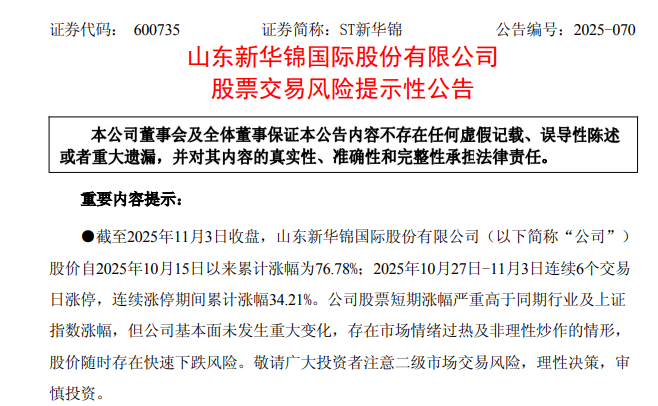
Market Overview - The A-share market opened lower on November 4, with the Shanghai Composite Index and ChiNext Index turning positive by the time of reporting [1] - In the market, sectors such as semiconductors, media and entertainment, and gas supply showed strength, while sectors like non-ferrous metals, pharmaceuticals, and brokerages experienced pullbacks [2] Banking Sector - Bank stocks continued their upward trend, with Shanghai Bank rising over 2%, and other banks such as Chongqing Bank, CITIC Bank, Agricultural Bank of China, China Merchants Bank, Qilu Bank, and Postal Savings Bank of China all increasing by more than 1% [2] Individual Stocks - ST Xinhua Jin (600735) saw its stock price hit the daily limit down at one point, with a trading volume of nearly 300 million yuan. The stock had previously experienced six consecutive trading days of limit-up, with a cumulative increase of 34.21%, significantly higher than the industry and Shanghai Composite Index during the same period. The company’s fundamentals have not changed significantly, indicating potential market overheating and irrational speculation, leading to a risk of rapid price decline [3] Hong Kong Market - The Hang Seng Index and Hang Seng Tech Index showed positive performance. However, the non-ferrous metals sector weakened, with Zijin Mining falling over 1%. Baidu Group rose over 5%, Tencent Holdings increased by over 1%, and SMIC rose over 3%, while companies like Innovent Biologics and Li Auto saw declines of nearly 2% and over 1%, respectively [6] Power Equipment Sector - The power equipment sector saw an initial surge, with Sanbian Technology hitting the daily limit up, followed by gains in companies like New Special Electric, TBEA, Jinpan Technology, Wangbian Electric, Siyuan Electric, Jiangsu Huachen, Zhongneng Electric, and Kelu Electronics [7] Coal Industry - The coal mining and processing sector experienced fluctuations but trended upward, with Antai Group hitting the daily limit up for two consecutive days. Other companies like Yunmei Energy, Zhengzhou Coal Electricity, Liaoning Energy, Jinkong Coal Industry, and Pingmei Shenma also saw gains. The significant rise in thermal coal prices in the second half of the year, coupled with tightening supply-side policies and increased winter heating demand, has improved the industry’s fundamentals. As a result, coal companies reported a notable recovery in third-quarter profits [9] Company Announcements - Tiancheng Holdings in Hong Kong saw a surge of over 80% upon resuming trading, although the gains moderated by the time of reporting. The company announced a revised placement price of HKD 0.121 per share, up from HKD 0.1, for a maximum of 60 million shares [10][11] - Superstar Legend experienced a near 8% increase at the start of trading, following an announcement of a sales contract with ADATA Technology for the procurement of 1,000 quadruped robots, totaling over RMB 20 million [12]

突发!600735,直线“天地板”!此前6连涨停
Zheng Quan Shi Bao Wang· 2025-11-04 03:40
Market Overview - The A-share market opened lower on November 4, with the Shanghai Composite Index and ChiNext Index turning positive by the time of reporting [1] - The semiconductor, media and entertainment, and gas supply and heating sectors showed strength, while non-ferrous metals, pharmaceuticals, and brokerage sectors experienced pullbacks [2] Banking Sector - Bank stocks continued their upward trend, with Shanghai Bank rising over 2% and several other banks including Chongqing Bank, CITIC Bank, Agricultural Bank of China, China Merchants Bank, Qilu Bank, and Postal Savings Bank of China rising over 1% [2] Individual Stocks - ST Xinhua Jin (600735) saw its stock price hit the daily limit down, with a trading volume of nearly 300 million yuan. The stock had previously experienced six consecutive trading days of limit-up, with a cumulative increase of 34.21%, significantly higher than the industry and Shanghai Composite Index during the same period. The company’s fundamentals have not changed significantly, indicating potential market overheating and irrational speculation, leading to a risk of rapid price decline [3] Electric Power Equipment Sector - The electric power equipment sector saw initial gains, with Sanbian Technology hitting the daily limit up, followed by other companies such as New Special Electric, TBEA, and Jiangsu Huachen also rising [6] - Microsoft CEO Satya Nadella highlighted that the current issue in the AI industry is not excess computing power but rather a lack of sufficient electricity to support all GPU operations, emphasizing the need for infrastructure development near power sources [6] Coal Mining Sector - The coal mining and processing sector experienced fluctuations but generally trended upwards, with Antai Group hitting the daily limit up for two consecutive days. Other companies like Yunmei Energy and Zhengzhou Coal Electricity also saw gains [6] - The significant rise in thermal coal prices in the second half of the year, coupled with tightening supply-side policies and increased winter heating demand, has improved the industry’s fundamentals, leading to a notable recovery in third-quarter profits for coal companies [6] Hong Kong Market - In the Hong Kong market, the Hang Seng Index and Hang Seng Tech Index showed positive performance. However, the non-ferrous metals sector weakened, with Zijin Mining falling over 1%. Baidu Group rose over 5%, Tencent Holdings increased over 1%, and SMIC rose over 3% [5] Company Announcements - Tiancheng Holdings announced a significant increase of over 80% upon resuming trading, although the gains moderated by the time of reporting. The company revised the placement price of its shares from 0.1 HKD to 0.121 HKD after further negotiations [7] - Superstar Legend saw a nearly 8% increase at the beginning of trading, following the announcement of a sales contract with ADATA Technology for the procurement of 1,000 quadruped robots, totaling over 20 million RMB [7]
供需共振拉高动力煤价,第三季度业绩回暖催涨煤炭板块
Zheng Quan Shi Bao Wang· 2025-11-04 00:37
Group 1 - The core viewpoint of the article highlights a significant increase in thermal coal prices in the second half of the year, driven by tightening supply-side policies and rising winter heating demand, leading to an improvement in the industry's fundamentals [1] - In the third quarter, 37 listed coal companies achieved a total net profit attributable to shareholders of 29.942 billion yuan, representing a quarter-on-quarter increase of 22.83% [1] - Notable individual company performances include Shanxi Coking Coal, Suneng Holdings, and Hengyuan Coal Power turning losses into profits, while eight companies, including Jiangxi Tungsten and Meijin Energy, reduced their losses [1] Group 2 - The proportion of companies reporting profit increases exceeded 60%, with 12 companies, including Jizhong Energy and Huayang Co., showing quarter-on-quarter profit growth [1] - The willingness to distribute dividends in the coal industry has been increasing, with 15 stocks having a latest dividend yield exceeding 3%, accounting for over 40% of the total [1] - Jizhong Energy, Pingmei Shenma, and Hengyuan Coal Power lead in dividend yield, with rates of 9.74%, 6.67%, and 6.53% respectively [1]
煤炭行业2025年三季报综述:煤价筑底反转,权益震荡修复
Changjiang Securities· 2025-11-03 23:30
Investment Rating - The report maintains a "Positive" investment rating for the coal industry [13]. Core Insights - The coal price has bottomed out and is showing signs of recovery, leading to improved earnings for the coal sector in Q3 2025. The sector's revenue and profit have improved on a quarter-on-quarter basis despite a year-on-year decline [5][29]. - The report highlights that the domestic coal supply is being constrained due to production checks, while demand is gradually improving, particularly in the power sector, which is expected to support coal prices in the upcoming quarters [6][30]. Summary by Sections Industry Overview - In the first three quarters of 2025, the coal sector achieved a revenue of CNY 849.4 billion, down 18.2% year-on-year, and a net profit of CNY 82.05 billion, down 29.4% year-on-year. In Q3 2025, the sector's revenue was CNY 300.86 billion, down 11.4% year-on-year but up 11.8% quarter-on-quarter, with a net profit of CNY 29.29 billion, down 24.6% year-on-year but up 21.4% quarter-on-quarter [5][6]. Thermal Coal - The thermal coal segment reported a revenue of CNY 677.3 billion in the first three quarters of 2025, down 16% year-on-year. In Q3 2025, the revenue was CNY 242.4 billion, down 7% year-on-year but up 13% quarter-on-quarter. The average price for Qinhuangdao Shanxi-produced thermal coal (Q5500) in Q3 was CNY 672 per ton, down 21% year-on-year but up 6% quarter-on-quarter [6][29]. Coking Coal - The coking coal segment saw a revenue of CNY 125.8 billion in the first three quarters of 2025, down 29% year-on-year. In Q3 2025, the revenue was CNY 42.7 billion, down 28% year-on-year but up 7% quarter-on-quarter. The average price for coking coal at Jing Tang Port was CNY 1,562 per ton, down 18% year-on-year but up 19% quarter-on-quarter [7][29]. Investment Recommendations - The report suggests focusing on the recovery opportunities in the coal sector, emphasizing companies with low price-to-book ratios and dividends. Key recommendations include Yanzhou Coal Mining Company, Electric Power Investment Corporation, and New Hope Liuhe Company for their growth potential and stability [8].
供需共振拉高动力煤价 第三季度业绩回暖催涨煤炭板块
Zheng Quan Shi Bao· 2025-11-03 17:44
Core Insights - The coal prices have significantly increased in the second half of the year, driven by supply-side policies and rising winter heating demand, leading to an improvement in the industry's fundamentals [1][2]. Price Trends - In the second half of the year, coal prices have cumulatively risen over 20%, with specific prices reported as follows: Qinhuangdao port Q4500 at 588 CNY/ton, Q5000 at 678 CNY/ton, and Q5500 at 770 CNY/ton, reflecting increases of 21.24%, 23.27%, and 23.99% respectively since July [2]. - The latest price for coking coal in North China reached 1581.25 CNY/ton, marking a 12.44% increase since mid-September [2]. Supply Dynamics - The primary driver of the recent coal price increase is a contraction in supply, initiated by the National Energy Administration's policy to check overproduction in the coal industry [2]. - A total of 22 central safety production assessment teams will conduct annual inspections across 31 provinces and regions starting November 2025 [2]. Demand Factors - As winter approaches, coal demand for heating and electricity is expected to rise, particularly in northern regions where centralized heating is being activated [3]. - The International Energy Agency (IEA) projects a modest recovery in global coal demand, with a 0.2% year-on-year increase expected in 2025, primarily driven by the electricity sector [3]. Industry Outlook - The coal industry is anticipated to enter a new upward cycle due to ongoing policy support for transformation and upgrades, as evidenced by the Henan provincial government's action plan for the coal sector [4]. - The plan includes optimizing resource allocation, enhancing equipment technology, and increasing the share of intelligent coal mines to 65% [4]. Financial Performance - The third-quarter profits of coal companies have rebounded significantly, with a total net profit of 299.42 billion CNY reported by 37 listed coal companies, reflecting a 22.83% quarter-on-quarter increase [5]. - Companies such as Shanxi Coking Coal and Sunan Co. reported a turnaround in profitability, while over 60% of companies showed improved earnings [5]. Dividend Trends - The coal sector has shown a growing willingness to distribute dividends, with 15 companies having a dividend yield exceeding 3%, representing over 40% of the total [5]. - Jizhong Energy leads with a dividend yield of 9.74%, followed by Pingmei Shenma and Hengyuan Coal Power at 6.67% and 6.53% respectively [5]. Company Highlights - Jizhong Energy reported the highest quarter-on-quarter profit growth of 102.69%, achieving a net profit of 0.59 billion CNY [6]. - The company has a long-standing commitment to cash dividends, having distributed a total of 190.15 billion CNY since its listing [6].




【立方债市通】财政部债务管理司来了/南阳严惩企业恶意逃废债行为/河南一区县级城投公司拟首次发债
Sou Hu Cai Jing· 2025-11-03 13:14
Group 1: Government Debt Management - The Ministry of Finance has established a Debt Management Division, which includes six departments, with Li Dawei appointed as the director [1] - The main responsibilities of the Debt Management Division include formulating national and local government debt balance limit plans, managing government internal debt issuance and repayment, and enhancing government debt monitoring and regulation [1] Group 2: Monetary Policy and Market Operations - The central bank conducted a 783 billion yuan reverse repurchase operation on November 3, with a net withdrawal of 2,590 billion yuan for the day [3] - Short-term Shibor rates have collectively declined, with the overnight rate down by 0.5 basis points to 1.316% [3] Group 3: Corporate Debt Issuance - The Zhumadian Urban Construction Investment Group plans to issue 34 billion yuan in medium-term notes and corporate bonds [8][9] - Pingdingshan Tianan Coal Industry Co., Ltd. successfully issued 10 billion yuan in technology innovation bonds at an interest rate of 2.82% [11] - Henan Water Investment Group completed the issuance of 11 billion yuan in medium-term notes at an interest rate of 1.88% [12] - Nanyang's Wancheng District Urban Construction Investment Co., Ltd. plans to issue 10 billion yuan in bonds to support small and micro enterprises [13][14] - Zhumadian Urban Construction Investment Group completed the issuance of 4.25 billion yuan in corporate bonds, with two varieties having different terms and interest rates [16] Group 4: Corporate Restructuring and Risk Management - Weifang Binhai Investment Development Co., Ltd. plans to absorb and merge with Weifang Binhai Construction Group, which will be dissolved [17] - Suzhou Wuzhong Urban Investment Group is undergoing a restructuring process involving the transfer of equity stakes among various subsidiaries [18] Group 5: Market Outlook and Analysis - Huatai Fixed Income suggests that the bond market will face significant challenges in the coming year, with expectations of a return to nominal GDP growth [22] - CITIC Securities indicates that the risk of rising bond yields is limited, forecasting a general government bond issuance scale of around 1 trillion yuan in November [23]
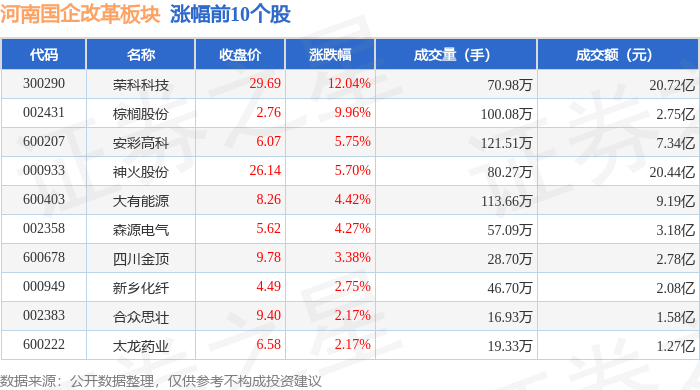
河南国企改革板块11月3日涨3.16%,荣科科技领涨,主力资金净流出1.04亿元


Sou Hu Cai Jing· 2025-11-03 09:11
Market Performance - The Henan state-owned enterprise reform sector rose by 3.16% compared to the previous trading day, with Rongke Technology leading the gains [1] - The Shanghai Composite Index closed at 3976.52, up 0.55%, while the Shenzhen Component Index closed at 13404.06, up 0.19% [1] Individual Stock Performance - Rongke Technology (300290) closed at 29.69, with a significant increase of 12.04%, trading volume of 709,800 shares, and a transaction value of 2.072 billion [1] - Other notable performers included: - Biaojian Co. (002431) with a closing price of 2.76, up 9.96% [1] - Ankai High-Tech (600207) at 6.07, up 5.75% [1] - Shenhuo Co. (000933) at 26.14, up 5.70% [1] Capital Flow Analysis - The Henan state-owned enterprise reform sector experienced a net outflow of 104 million from institutional investors, while retail investors saw a net inflow of 87.89 million [2] - The sector's overall capital flow indicates a mixed sentiment among different investor types [2] Detailed Capital Flow for Selected Stocks - Biaojian Co. (002431) had a net inflow of 86.30 million from institutional investors, but a net outflow of 45.69 million from speculative funds [3] - Sichuan Jinding (600678) saw a net inflow of 41.59 million from institutional investors, with a net outflow of 8.52 million from speculative funds [3] - Other stocks like New乡化纤 (000949) and 合众思壮 (002383) also showed varied capital flows, indicating differing investor confidence [3]
平煤股份(601666):Q3业绩承压,静待集团重组赋能
INDUSTRIAL SECURITIES· 2025-11-02 12:11
Investment Rating - The investment rating for the company is "Buy" (maintained) [1] Core Views - The company reported a significant decline in revenue and net profit for the first three quarters of 2025, with revenue of 14.82 billion yuan, down 36.5% year-on-year, and a net profit of 280 million yuan, down 86.3% year-on-year [2][3] - The company's coal business faced challenges with a decrease in both sales volume and price, leading to a coal gross margin of 20.1%, down 10.4 percentage points year-on-year [2][3] - A strategic restructuring with the controlling shareholder is expected to optimize regional resource allocation and enhance pricing power in the domestic coking coal market [3] Summary by Sections Financial Performance - For Q3 2025, the company achieved a revenue of 4.696 billion yuan, a decrease of 33.0% year-on-year, and a net profit of 22 million yuan, down 96.6% year-on-year [2][3] - The average coal price per ton was 723 yuan, down 29.9% year-on-year, while the cost per ton was 578 yuan, down 19.5% year-on-year [2][3] Production and Sales - In Q3 2025, the company produced 5.12 million tons of raw coal, a decrease of 25.3% year-on-year, but saw an increase in self-produced coal sales by 10.4% year-on-year [3] - The total coal sales volume for Q3 was 6.44 million tons, with a significant quarter-on-quarter increase of 18.8% [3] Profit Forecast and Investment Strategy - The company is expected to see net profits of 446 million yuan, 495 million yuan, and 570 million yuan for 2025, 2026, and 2027 respectively, with corresponding EPS of 0.18, 0.20, and 0.23 yuan [4] - The price-to-earnings ratio (PE) is projected to be 47.0, 42.4, and 36.8 for the years 2025, 2026, and 2027 respectively [4]