国泰基金

Search documents
调研速递|国能日新接待国泰基金等14家机构 功率预测业务服务电站超5000家 储能交易服务成增长新引擎
Xin Lang Cai Jing· 2026-01-20 11:20
Core Insights - The company, Guoneng Rixin Technology Co., Ltd., is actively engaging with institutional investors to discuss its business progress, particularly in power forecasting and independent energy storage operations [1] Group 1: Power Forecasting Business - The company is experiencing significant growth in its power forecasting business, driven by the rapid increase in new energy installations and the introduction of management requirements for distributed power plants [2] - As of mid-2025, the company is servicing 5,461 new energy power plants, and the overall expansion is expected to meet projections, with specific customer numbers to be disclosed in the 2025 annual report [2] Group 2: Independent Energy Storage Operations - The independent energy storage power trading model is evolving, with multiple revenue streams such as power trading, ancillary services, and capacity price compensation becoming viable [3] - The company is developing a core data-driven power market forecasting system to support energy storage operations, providing critical information for peak and valley price capture and price trend predictions [3] Group 3: Core Advantages in Energy Storage Trading - The company emphasizes its competitive edge in energy storage trading through three main aspects: decision-making support using extensive market data, precise intelligent control with proprietary energy management systems, and comprehensive operational support for client revenue [4] Group 4: Challenges for Electricity Retail Companies - The company identifies three major challenges faced by electricity retail companies in a market-oriented environment: increased price volatility, stricter policy requirements, and intensified competition leading to reduced profit margins [5] - To address these challenges, the company is transitioning from traditional manual analysis to a scientific quantitative analysis model, providing comprehensive technical support to retail companies [5] Group 5: Policy Impact on the Storage Industry - Recent policy changes, such as the cancellation of fixed time-of-use pricing, are reshaping the energy storage industry, increasing the demand for third-party management services as profitability shifts to market-driven pricing [6] - The company plans to leverage its predictive capabilities and AI algorithms to offer trading forecasts, strategy recommendations, and asset management services in response to these policy changes [6] Group 6: Future of Electricity Trading Business - The company anticipates significant growth in its electricity trading business as market reforms deepen, creating diverse demands for decision-making support and management services [7] - Compared to traditional business models, the electricity trading sector offers a broader user base and higher service value, indicating substantial market potential [7][8]

国能日新:接受国泰基金等投资者调研
Mei Ri Jing Ji Xin Wen· 2026-01-20 11:13
(记者 王瀚黎) 每经AI快讯,国能日新发布公告称,2026年1月20日,国能日新接受国泰基金等投资者调研,公司董事 会秘书赵楠、证券事务代表池雨坤参与接待,并回答了投资者提出的问题。 每经头条(nbdtoutiao)——"一周干完一年的活",一款AI编程工具让硅谷程序员集体"上瘾"!科技公 司CEO:一辈子钻研的技能被它一次性解决,让人兴奋又恐惧 ...
A股重磅!宽基ETF连续出现净赎回,有“巨无霸”份额回落至“924”行情之前,多只科创、创业板系ETF份额缩水,发生了啥?
Jin Rong Jie· 2026-01-20 08:57
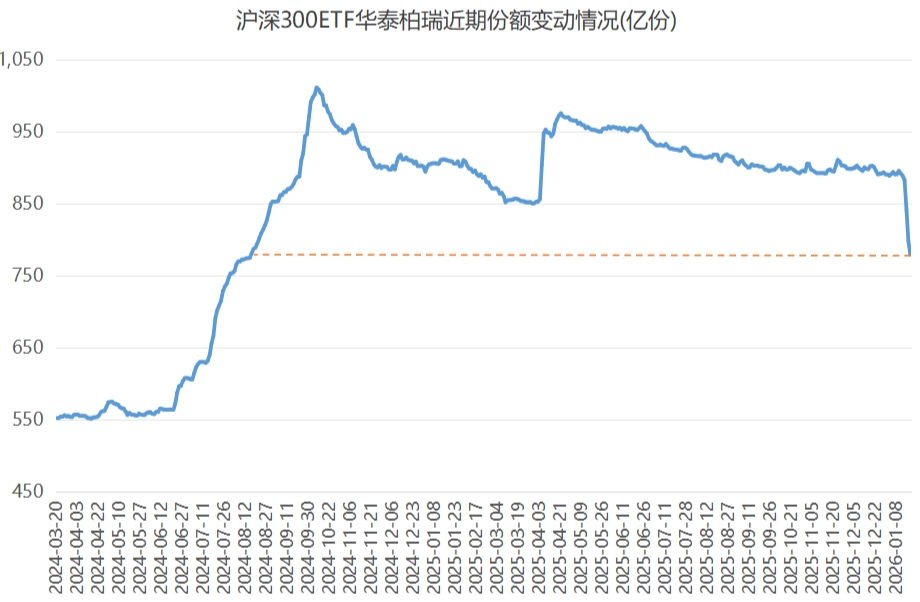
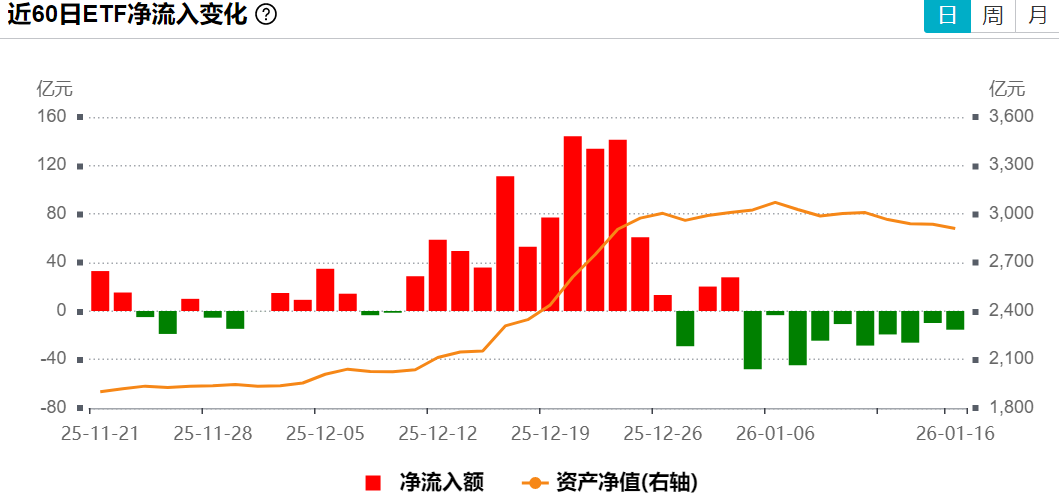
Group 1 - Recent net redemptions in A-share broad-based ETFs have drawn market attention, with significant outflows recorded on January 15 and 16, totaling 687 billion and 863 billion respectively, marking the highest single-day outflows in history [1] - As of January 19, four out of six major broad-based ETFs saw their shares decline by over 10% in the last three trading days, with the largest, Huatai-PB CSI 300 ETF, dropping to 778.63 billion shares, a scale of approximately 369.2 billion, the lowest since August 2024 [1] - The ChiNext and STAR Market ETFs also experienced significant declines, with the E Fund STAR 50 ETF and E Fund ChiNext ETF seeing share reductions of 34.55% and 20.22% respectively [3] Group 2 - In contrast to the outflows from broad-based ETFs, certain commodity, cross-border, and narrow-based ETFs attracted significant inflows, with the Southern Nonferrous ETF being the only product to receive over 10 billion in net inflows, totaling 100.87 billion, driven by rising base metal prices [3] - Other ETFs such as Yongying Satellite ETF, Harvest Software ETF, and GF Media ETF also received net inflows exceeding 6 billion [3] - According to CITIC Securities, the impact of ETF redemptions on individual stocks was significant, with main board, ChiNext, and STAR Market stocks experiencing sell-offs of 946 billion, 334 billion, and 265 billion respectively during the peak outflow days [3] Group 3 - Regulatory measures have been implemented to cool down the market following rapid price increases and overheated sentiment, including raising the minimum margin requirement for margin trading from 80% to 100% [5][6] - The China Securities Regulatory Commission emphasized the need for comprehensive market monitoring and timely counter-cyclical adjustments to maintain market stability and prevent excessive volatility [6] - There are differing views on the long-term outlook for A-shares, with some analysts suggesting the potential for a slow bull market due to reforms, while others remain skeptical about escaping historical volatility patterns [7]






创业板50指数ETF今日合计成交额28.56亿元,环比增加42.44%
Zheng Quan Shi Bao Wang· 2026-01-20 08:54
Core Viewpoint - The trading volume of the ChiNext 50 Index ETF reached 2.856 billion yuan today, marking an increase of 851 million yuan from the previous trading day, with a growth rate of 42.44% [1] Trading Volume Summary - The Huazhang ChiNext 50 ETF (159949) had a trading volume of 2.223 billion yuan today, an increase of 661 million yuan from the previous day, with a growth rate of 42.28% [1] - The Chuang 50 ETF (159681) recorded a trading volume of 247 million yuan, up by 149 million yuan from the previous day, with a significant growth rate of 151.94% [1] - The Invesco Great Wall ChiNext 50 ETF (159682) had a trading volume of 293 million yuan, increasing by 31.1 million yuan from the previous day, with a growth rate of 11.86% [1] Market Performance Summary - As of market close, the ChiNext 50 Index (399673) fell by 2.00%, while the average decline of related ETFs tracking the ChiNext 50 Index was 1.97% [1] - The ETFs with the largest declines today included the Huatai-PB ChiNext 50 ETF (159383) and the Wanji ChiNext 50 ETF (159372), which fell by 2.09% and 2.07% respectively [1] Detailed Trading Data - The trading data for various ChiNext 50 ETFs shows significant increases in trading volume for several funds, with the Chuang 50 ETF (159681) and the Chuang 50 ETF ICBC (159370) leading with increases of 151.94% and 145.14% respectively [1]
“不争气”的中证A500
Hu Xiu· 2026-01-20 07:05
Core Viewpoint - The China Securities A500 ETF experienced a dramatic increase in scale at the end of 2025, with nearly 100 billion net inflow in December, but has since faced rapid outflows in 2026, dropping below 300 billion in total scale [1][3]. Fund Flow and Market Dynamics - The surge in A500 ETF's scale was primarily driven by expectations of options being introduced in Q1 2026, leading to intense competition among major public funds for "options eligibility" [3]. - Following the quarter-end, there was a significant outflow of funds, indicating that the initial inflow was not based on the investment value of A500 but rather to secure "thank you fees" from fund companies [3][4]. Performance Comparison - The A500 ETF, launched in October 2024, has not yet demonstrated a significant challenge to the dominant CSI 300 ETF, with its scale being less than a quarter of the CSI 300 ETF [4][9]. - In terms of investment value, the CSI 300 is more value-stable, while the A500 is more growth-oriented, particularly performing better in a tech bull market [6][7]. Historical Performance - Over the past three years, during the bear market of 2023 and 2024, the CSI 300 outperformed the A500 slightly, with returns of -11.38% and 14.68% for the CSI 300 compared to -11.42% and 12.98% for the A500 [8]. - In a growth-style bull market in 2025, the A500 showed a return of 22.43%, outperforming the CSI 300's 17.66% [8]. Institutional Investment Behavior - The lack of significant investment from state-owned funds in the A500 ETF is attributed to its timing and the established preference for the CSI 300 ETF, which has a more extensive operational history and familiarity [12][13]. - Institutional investors, including insurance and pension funds, have not heavily allocated to the A500 ETF, primarily due to its smaller scale and lack of derivative tools compared to the CSI 300 ETF [14][15]. Competitive Landscape - The A500 ETF has formed a competitive "3+2" tier structure among fund companies, with top players like Huatai-PineBridge and Southern Asset Management leading in scale [18][19]. - Future competition may hinge on the qualification for options, which could create a significant advantage for leading products, potentially widening the gap with other funds [20][21]. Future Outlook - In the short to medium term (1-2 years), the A500 ETF is unlikely to surpass the CSI 300 ETF in scale due to the absence of large-scale buying from state-owned funds [16]. - However, in the long term (5-10 years), the A500 ETF may have the potential to compete with the CSI 300 ETF as it aligns more closely with new economic growth sectors, provided it develops a robust ecosystem and derivative tools [17].
泰祥股份股价跌5.09%,国泰基金旗下1只基金重仓,持有1600股浮亏损失2624元
Xin Lang Cai Jing· 2026-01-20 06:54
1月20日,泰祥股份跌5.09%,截至发稿,报30.59元/股,成交4635.68万元,换手率3.07%,总市值30.56 亿元。 资料显示,十堰市泰祥实业股份有限公司位于湖北省十堰市经济开发区吉林路258号,成立日期1997年7 月29日,上市日期2022年8月11日,公司主营业务涉及公司专注于汽车零部件的研发、制造与销售,致力 成长为符合国际一流标准的动力及传动系统核心零部件的全球供应商。主营业务收入构成为:铝铸件制 品55.59%,主轴承盖34.66%,差速器壳7.48%,材料2.11%,模具0.11%,房租0.04%,支架0.00%,其 他0.00%。 国泰聚智量化选股混合发起A(023386)基金经理为吴可凡。 截至发稿,吴可凡累计任职时间2年229天,现任基金资产总规模20.92亿元,任职期间最佳基金回报 91.4%, 任职期间最差基金回报-17.64%。 风险提示:市场有风险,投资需谨慎。本文为AI大模型自动发布,任何在本文出现的信息(包括但不 限于个股、评论、预测、图表、指标、理论、任何形式的表述等)均只作为参考,不构成个人投资建 议。 责任编辑:小浪快报 从基金十大重仓股角度 数据显示,国泰 ...

债券ETF资金持续流出 | 债券ETF跟踪
Xin Lang Cai Jing· 2026-01-20 06:39
Fund Flow - As of January 16, 2026, bond ETFs experienced a net outflow of 16.512 billion yuan over the past week, with interest rate, credit, and convertible bond ETFs seeing net outflows of 5.307 billion yuan, 14.018 billion yuan, and a net inflow of 2.814 billion yuan respectively [21][24] - Since 2025, cumulative net inflows for interest rate, credit, and convertible bond ETFs have reached 60.615 billion yuan, 487.023 billion yuan, and 25.964 billion yuan respectively, totaling 573.603 billion yuan [21][24] Index Performance - The China Bond New Comprehensive Index rose by 0.18% over the past week, while short-term pure bond and medium-to-long-term pure bond funds increased by 0.02% and 0.05% respectively [19][24] - The CSI AAA Sci-Tech Bond Index and the Shanghai Benchmark Market Company Bond Index both increased by 0.11% [19][24] Net Value Performance - Various types of bond ETFs generally saw an increase in net value, with the 30-year government bond ETF from Bosera rising by 0.37%, and the government bond ETF from Huaxia increasing by 0.31% [23][24] - Convertible bond ETFs and the Shanghai Convertible Bond ETF rose by 1.05% and 0.68% respectively [23][24] Credit Bond ETF and Sci-Tech Bond ETF Performance - As of January 16, 2026, the median unit net value for credit bond ETFs and sci-tech bond ETFs was 1.0128 and 1.0010, with increases of 0.09% and 0.07% respectively [25][32] - The Dachen credit bond ETF performed relatively well, increasing by 0.10% [25][32] Duration Tracking of Credit Bond ETFs - As of January 16, 2026, the holding durations for short-term bond ETFs, corporate bond ETFs, and urban investment bond ETFs were 0.34 years, 1.56 years, and 2.13 years respectively [32][34] - For market-making credit bond ETFs, the median holding durations for products tracking the Shanghai and Shenzhen market-making corporate bonds were 3.58 years and 2.80 years respectively [32][34]

净流出,超400亿元
Zhong Guo Ji Jin Bao· 2026-01-20 06:37
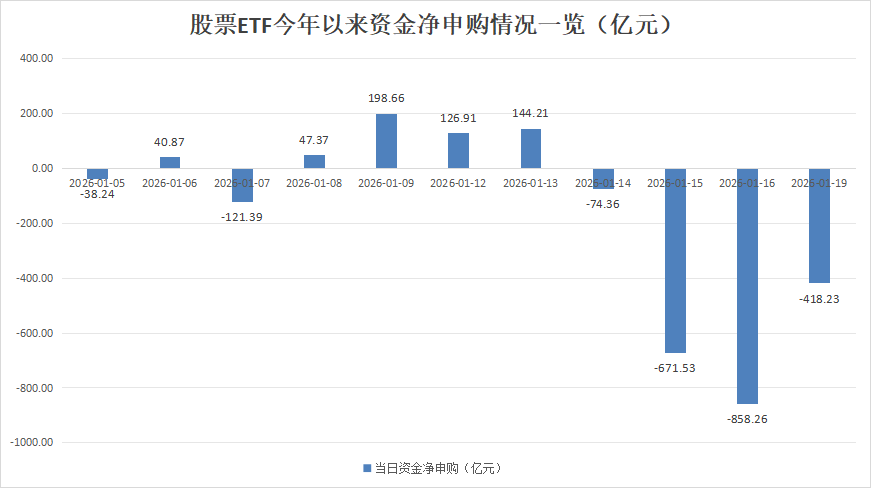
Core Viewpoint - The stock ETF market continues to show a trend of significant capital outflow, indicating a cooling effect on the A-share market amidst recent volatility [1][2][10]. Group 1: Market Overview - On January 19, the A-share market experienced a net outflow of over 400 billion yuan from stock ETFs, marking the third consecutive day of significant outflows [1][2]. - The total scale of all stock ETFs reached 4.61 trillion yuan, with a net outflow of 418.23 billion yuan on the same day [2][4]. - The overall trading volume in the two markets decreased to 2.73 trillion yuan, with a relatively weak performance from large-cap stocks [2]. Group 2: ETF Performance - Industry and commodity ETFs saw net inflows of 155.04 billion yuan and 22.44 billion yuan, respectively, while broad-based ETFs experienced a net outflow of 586.07 billion yuan [4]. - The largest outflows were observed in the four major Hu-Shen 300 ETFs, which collectively saw over 300 billion yuan in net outflows [5][8]. - Specific ETFs such as the Huaxia Electric Grid Equipment ETF led the inflows with over 25 billion yuan, while the Hu-Shen 300 ETFs faced significant outflows, with individual ETFs seeing net outflows exceeding 50 billion yuan [6][8]. Group 3: Fund Management Insights - Major fund companies like E Fund and Huaxia Fund reported continued inflows in certain ETFs, with E Fund's Robot ETF reaching a historical high of 174 billion yuan [4][6]. - The market is characterized by a resilient overall performance, with active trading and significant inflows into industry-themed ETFs supported by strong fundamentals [10].
净流出,超400亿元!
Zhong Guo Ji Jin Bao· 2026-01-20 06:22
Core Viewpoint - The stock ETF market experienced significant net outflows, exceeding 400 billion yuan on January 19, marking the third consecutive day of substantial outflows, totaling over 1.9 trillion yuan in the past three trading days [1][2]. Group 1: Market Performance - The A-share market continued its volatile trend, with the Shanghai Composite Index rising by 0.29% to 4114.00 points, while the CSI 300 Index increased by 0.05% [2]. - Trading volume in the Shanghai and Shenzhen markets decreased to 2.73 trillion yuan, with weaker performance from large-cap stocks and stronger performance from growth-style sectors [2]. Group 2: ETF Fund Flows - The total scale of all stock ETFs (including cross-border ETFs) reached 4.61 trillion yuan, with a net outflow of 418.23 billion yuan on January 19 [2]. - Industry and commodity ETFs saw net inflows of 155.04 billion yuan and 22.44 billion yuan, respectively, while broad-based ETFs experienced net outflows of 586.07 billion yuan, leading to a decrease in their scale by 694.95 billion yuan [4]. Group 3: Specific ETF Performance - The top net inflows were observed in industry ETFs, with the Huaxia Electric Grid Equipment ETF leading at over 25 billion yuan, followed by the Penghua Chemical ETF with over 11 billion yuan [6]. - Four major CSI 300 ETFs collectively saw net outflows exceeding 300 billion yuan, with the Southern CSI 1000 ETF experiencing over 50 billion yuan in outflows [5][6]. Group 4: Market Sentiment and Outlook - Analysts noted that the recent net outflows from broad-based ETFs have contributed to a cooling effect on the previously hot market, aiding in the stable operation of the A-share market [7]. - The market is expected to maintain a volatile pattern in the short term, with potential support from funds adjusting their positions, while long-term sentiment remains optimistic [7].
净流出,超400亿元!
中国基金报· 2026-01-20 06:19
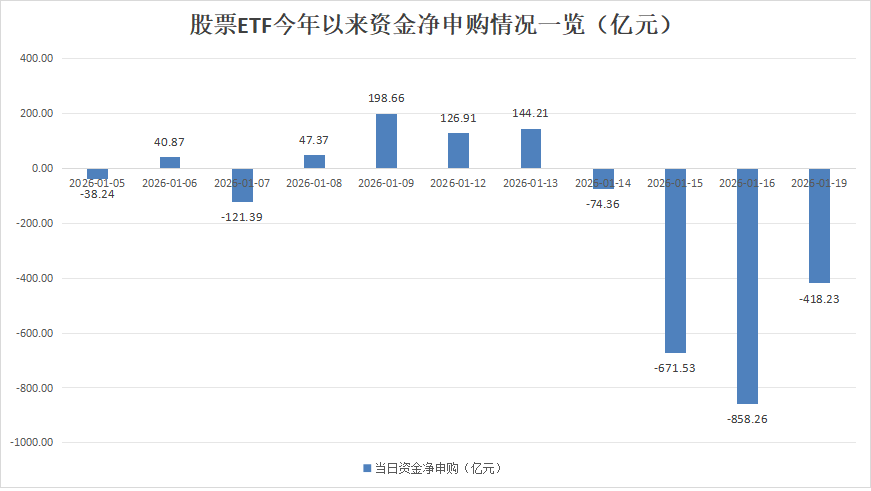
Core Viewpoint - The stock ETF market in China has experienced significant net outflows, with over 400 billion yuan withdrawn on January 19, marking the third consecutive day of substantial outflows, totaling over 1.9 trillion yuan in the past three trading days [2][5]. Group 1: Market Overview - On January 19, the A-share market continued its volatile trend, with the Shanghai Composite Index rising by 0.29% to 4114.00 points, while the CSI 300 Index increased by 0.05%. However, trading volume decreased to 2.73 trillion yuan, indicating weaker performance among large-cap stocks [5]. - The total scale of all stock ETFs (including cross-border ETFs) reached 4.61 trillion yuan as of January 19, with a net outflow of 418.23 billion yuan on that day [5]. Group 2: ETF Performance - Industry and commodity ETFs saw net inflows, with industry theme ETFs and commodity ETFs attracting 155.04 billion yuan and 22.44 billion yuan, respectively. In contrast, broad-based ETFs experienced net outflows totaling 586.07 billion yuan, with a decrease in scale of 694.95 billion yuan [7]. - Specific ETFs tracking the electric grid equipment index saw the highest net inflow of 25.83 billion yuan, while those tracking the CSI 300 index faced the largest net outflow of 306.94 billion yuan [7]. Group 3: Fund Company Insights - Major fund companies like E Fund and Huaxia Fund reported continued net inflows in certain ETFs. For instance, E Fund's robotics ETF saw a net inflow of 4.2 billion yuan, reaching a record high of 174 billion yuan [8]. - Huaxia Fund's electric grid equipment ETF and non-ferrous metals ETF also led in net inflows, with 25.83 billion yuan and 6.01 billion yuan, respectively [8]. Group 4: Outflow Analysis - The top ten ETFs with the largest net outflows were all broad-based ETFs, with four major CSI 300 ETFs collectively experiencing over 300 billion yuan in outflows. Other broad-based ETFs like the CSI 1000 ETF and the SSE 50 ETF also reported significant outflows [12]. - The net outflow from the top ten ETFs included notable amounts such as 55.64 billion yuan from the CSI 300 ETF managed by E Fund and 89.82 billion yuan from another CSI 300 ETF managed by Huatai-PB [13]. Group 5: Market Sentiment and Future Outlook - Industry experts suggest that the recent outflows from broad-based ETFs have contributed to cooling the initially heated market, which may help stabilize the A-share market. The overall market remains resilient, with active trading and continued inflows into industry theme ETFs supported by strong fundamentals [14]. - The market is expected to maintain a volatile pattern in the short term, with potential support from funds adjusting their positions, while the long-term outlook remains optimistic [14].