青岛银行

Search documents
青岛银行济宁分行:“链”上发力,精准滴灌机械制造产业
Qi Lu Wan Bao· 2025-12-09 05:57
Core Viewpoint - The Qingdao Bank Jining Branch is actively enhancing financial support for the mechanical manufacturing industry in Jining through a structured financial empowerment initiative, aiming to inject strong financial momentum into the local industrial economy [1][7]. Group 1: Mechanism and Structure - The Qingdao Bank Jining Branch has established a leadership group to coordinate resources across various departments, creating a comprehensive service system for the mechanical manufacturing sector [2]. - A pre-approval mechanism for loans has been implemented to improve service efficiency, significantly reducing approval times for manufacturing enterprises [2]. - The bank has incorporated metrics such as loan volume and the number of serviced enterprises into performance evaluations to encourage staff engagement in financial services [2]. Group 2: Government and Enterprise Collaboration - The bank is deepening collaboration with government and industry associations to broaden service channels and better understand the financing needs of local technology manufacturing enterprises [3]. - Innovative cooperation models between the bank and government entities have been developed to lower financing thresholds and costs for enterprises [3]. Group 3: Financial Product Innovation - The Qingdao Bank Jining Branch has launched specialized financial products like "Kechuang Fast Loan" and "Kechuang Easy Loan" to meet the diverse financing needs of different manufacturing enterprises [4]. - "Kechuang Fast Loan" supports technology transformation for innovative enterprises using a comprehensive credit evaluation system, while "Kechuang Easy Loan" targets small and micro technology enterprises with simplified application processes [4]. Group 4: Personalized Service - A specialized financial service team has been formed to provide tailored financial solutions to manufacturing enterprises, ensuring a deep understanding of their operational and financial situations [5]. - The bank successfully provided a customized financing solution of 50 million yuan to a fluid control enterprise, addressing its cash flow challenges and supporting its supply chain [5][6]. Group 5: Service Outcomes - As of the end of Q3 2025, the bank's loans to the manufacturing sector reached nearly 500 million yuan, with funds directed towards emerging industries such as high-end equipment manufacturing and new materials [7]. - The financial services align with Jining's strategic focus on industrial economic growth and innovation, contributing to the city's ambitious economic goals [7].
2026年银行股投资策略展望
2025-12-08 15:36
Summary of Key Points from the Conference Call Industry Overview - The conference call focuses on the banking sector in China, specifically the investment strategy outlook for 2026, with an expected macroeconomic growth rate of approximately 4.8% and a moderately loose monetary environment, which may alleviate pressure on banks' interest margins [1][3][4]. Core Insights and Arguments - **Revenue and Profit Growth**: It is anticipated that the revenue and profit growth for commercial banks will improve to around 2.7%-3% in 2026, primarily due to a narrowing decline in interest margins and a recovery in net interest income [1][5]. - **Banking Sector Dynamics**: State-owned banks and city commercial banks are expected to maintain strong asset expansion momentum, with total asset growth remaining above 10%, particularly in economically robust regions like Sichuan, Chongqing, Shandong, and Shanghai [1][6]. - **Performance of Different Bank Types**: Smaller banks are projected to have better interest margin resilience compared to large state-owned banks. Notable city commercial banks such as Nanjing Bank, Chengdu Bank, and Chongqing Bank are expected to outperform the overall listed banks due to strong loan organization capabilities and capital adequacy [1][7]. - **Non-Interest Income Trends**: Non-interest income is expected to show negative growth, but fee income is projected to maintain positive growth due to the development of capital markets and the fading impact of fee reductions. Overall revenue growth is expected to rise from 1.2% in 2025 to nearly 3% in 2026 [1][8]. Additional Important Insights - **Credit Cost Expectations**: The credit cost ratio is expected to slightly decline in 2026, with improvements in corporate business but ongoing pressures in the retail sector. The stabilization of the real estate market is crucial for maintaining healthy asset quality in corporate loans [1][9]. - **Profit Release Potential**: Banks with high provisions and low non-performing loans have significant profit release potential. State-owned banks generally have lower non-performing loan generation rates, while quality city commercial banks are also expected to perform well [1][10]. - **Market Sentiment and Investment Strategy**: The current active shareholding in bank stocks is at a historical low of 1.5%, indicating that pessimistic sentiment has been fully priced in. This could make high-dividend bank stocks attractive as risk-free rates decline [2][12]. - **Investment Focus**: Investors should pay attention to the risk-free rate and risk appetite. With the expected decline in government bond yields, high-dividend assets are likely to remain favored by insurance companies [13]. - **Stock Selection Criteria**: Stock selection should focus on large financial institutions as beta plays and smaller institutions with high ROE potential as alpha plays. Key risks include unexpected downturns in real estate, macroeconomic slowdowns, and potential financial sanctions [15]. Conclusion - The banking sector in China is poised for a recovery in 2026, with expected improvements in revenue and profit growth driven by a supportive macroeconomic environment and favorable regulatory conditions. Investors are encouraged to consider the current market dynamics and select stocks that align with the anticipated trends in the banking industry.
中小银行没有躺平
Xin Lang Cai Jing· 2025-12-08 12:19
Core Viewpoint - The banking industry, particularly small and medium-sized banks, is facing unprecedented operational pressures, with net interest margins declining to historical lows and non-performing loan ratios increasing, prompting a search for strategic solutions among industry leaders [1][3][4]. Group 1: Current Challenges - The net interest margin for commercial banks has dropped to 1.42%, with city commercial banks and rural commercial banks at 1.37% and 1.58% respectively [1][10]. - 11% of city commercial banks are classified as "red zone" high-risk institutions, with rural cooperative institutions and village banks facing even higher risk proportions [3][12]. - The total non-performing loan balance reached 3.5 trillion yuan, increasing by 883 billion yuan from the previous quarter, with a non-performing loan ratio of 1.52% [3][12]. Group 2: Performance Disparities - Among A-share listed banks, city commercial banks are outperforming, with 14 out of 17 reporting revenue growth and 16 reporting net profit growth [4][13]. - Chongqing Bank showed significant performance, achieving a revenue of 11.74 billion yuan and a net profit of 4.879 billion yuan, both up by over 10% year-on-year [4][13]. - In contrast, many joint-stock banks reported declines in both revenue and net profit, with Ping An Bank's revenue down by 9.8% [4][13]. Group 3: Strategic Responses - Differentiated competition is emphasized as crucial for survival, with banks sharing experiences on integrating into regional economies and cultures [6][14]. - The focus on "guarding the fundamentals" while innovating through digital empowerment is highlighted as essential for rural commercial banks [6][14]. - A customer-centric approach with precise industrial financial layouts is recommended for sustainable differentiation in a low-interest-rate environment [6][14]. Group 4: Technological Empowerment - Technology is identified as a key tool for small and medium-sized banks to enhance competitiveness, with funding cost gaps narrowing significantly [7][16]. - Investment in technology, particularly artificial intelligence, is increasing, with banks allocating 6% to 8% of revenue to tech R&D [7][16]. - Successful AI applications in banking have already shown significant impacts, such as a loan growth of over 50 million yuan from an AI marketing project [7][16]. Group 5: Retail Transformation and Wealth Management - Retail banking and wealth management are becoming critical areas for transformation, with many city commercial banks reporting retail asset management growth exceeding 10% [8][17]. - Jilin Bank emphasizes that strengthening retail business can significantly enhance profitability and reduce risk [8][17]. - The development of pension finance is seen as a new opportunity, with specific strategies tailored to local demographics [8][17].


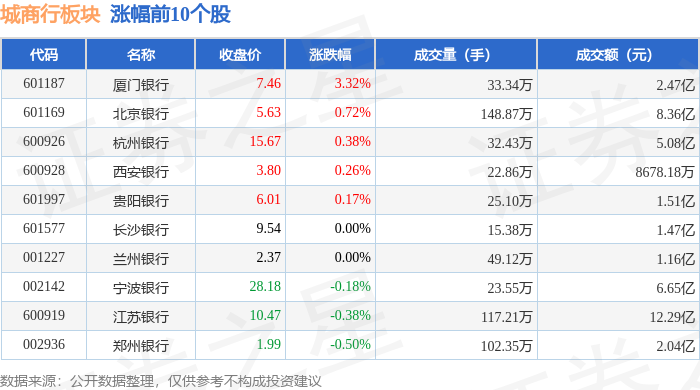
城商行板块12月8日跌0.31%,上海银行领跌,主力资金净流入1.29亿元
Zheng Xing Xing Ye Ri Bao· 2025-12-08 09:09
Group 1 - The city commercial bank sector experienced a decline of 0.31% on December 8, with Shanghai Bank leading the drop [1] - The Shanghai Composite Index closed at 3924.08, up 0.54%, while the Shenzhen Component Index closed at 13329.99, up 1.39% [1] - Key individual stock performances in the city commercial bank sector included Xiamen Bank rising by 3.32% and Shanghai Bank falling by 1.43% [1][2] Group 2 - The net inflow of main funds into the city commercial bank sector was 129 million yuan, while retail investors saw a net outflow of 156 million yuan [2] - The table of fund flows indicated that Jiangsu Bank had a net outflow of 56.86 million yuan from main funds, while Hangzhou Bank had a net inflow of 49.79 million yuan [3] - The overall trend showed that retail investors were withdrawing funds from several banks, with notable outflows from Suzhou Bank and Qingdao Bank [3]



百年金库焕新颜 半岛小记者解锁金融研学新体验
Sou Hu Cai Jing· 2025-12-08 07:16
Core Insights - The event organized by the Peninsula Junior Reporter Group at the Qingdao Bank's renovated old vault provided a unique financial knowledge experience for children, combining historical exploration, practical activities, and in-depth interviews [1][15] Group 1: Historical Context - The venue features historical artifacts such as the old vault door, vintage financial documents, and old currencies, showcasing the century-long history of Qingdao Bank [4] - Children learned about the evolution of the banking industry from the Republican era to modern financial technology, making abstract financial concepts tangible through historical stories and exhibits [4] Group 2: Interactive Learning - In the fun experience area, children participated in activities like "panning for gold," which allowed them to experience the joy of labor and achievement through hands-on practice [7] - The "murder mystery" role-playing segment encouraged teamwork and logical thinking as children worked together to solve puzzles based on historical clues and exhibit details [7] Group 3: Interview Segment - During the interview session, children asked insightful questions about balancing historical preservation with modern experiences and future educational activities aimed at youth [11] - The staff provided detailed answers, enriching the children's knowledge and enhancing their communication and adaptability skills [11] Group 4: Overall Impact - The event broke away from traditional educational methods, making financial knowledge accessible and engaging through immersive experiences, thus stimulating children's interest in learning [15] - The Peninsula Junior Reporter Group plans to continue exploring diverse educational scenarios to provide children with a rich and varied growth platform [15]

银行业周度追踪2025年第48周:保险长钱入市,聚焦红利与科创-20251208
Changjiang Securities· 2025-12-08 05:32
Investment Rating - The report maintains a "Positive" investment rating for the banking sector [10] Core Insights - The banking sector has experienced a third consecutive week of decline, primarily due to a rebound in market risk appetite, leading to the outflow of previously defensive capital. The bond market has also adjusted, affecting investment returns. Despite short-term style changes, the report remains optimistic about the revaluation direction of bank stocks, particularly favoring large banks like Bank of Communications and China Merchants Bank, as well as leading city commercial banks such as Nanjing Bank, Jiangsu Bank, and Hangzhou Bank [2][7] - Recent adjustments in insurance risk factors encourage long-term allocations towards low volatility dividend stocks and technology innovation sectors. The National Financial Regulatory Administration has lowered risk factors for certain indices, which is expected to enhance the solvency of insurance companies and promote long-term investments in quality equity assets [4][39] Summary by Sections Market Performance - The banking index fell by 1.1% this week, underperforming the CSI 300 and ChiNext indices by 2.3% and 2.9% respectively. The average dividend yield for the six major state-owned banks in A-shares rose to 3.85%, with a 200 basis point spread over the 10-year government bond yield. H-shares maintain a 5% average dividend yield, with a 23% discount compared to A-shares [7][20][26] Credit Growth - As of the end of October 2025, credit growth across various regions remains differentiated, with major provinces like Jiangsu, Zhejiang, Shandong, Sichuan, and Anhui maintaining growth rates above 8%. Sichuan leads with a growth rate of 10.8%. Corporate loans continue to be the main growth driver, with Jiangsu and Sichuan showing growth rates of 13.6% and 13.3% respectively [6][34] Insurance Capital Allocation - Insurance capital is in a continuous process of increasing allocations to bank stocks, particularly during the third quarter adjustment period. The report outlines three core strategies for capital allocation: large insurance funds strategically investing in state-owned banks and leading city commercial banks, and smaller insurance companies seeking long-term equity investment opportunities in smaller banks [5][39]


中小银行应持续探索特色化 与差异化发展新路径
Jin Rong Shi Bao· 2025-12-08 02:10
Group 1: Core Perspectives - The "14th Five-Year Plan" emphasizes accelerating the construction of a financial powerhouse, with a focus on the effective implementation of key areas such as technology finance and green finance [1][2] - The financial sector's strength is not only measured by its own prosperity but by its ability to efficiently serve critical development areas outlined in the "14th Five-Year Plan," including industrial development, technological innovation, and rural revitalization [2][3] Group 2: Policy Analysis - The "14th Five-Year Plan" provides fundamental guidelines for financial work, including the development of technology finance, green finance, and enhancing the adaptability of capital market systems [2][3] - Financial services must align with the strategic goals of the "14th Five-Year Plan," ensuring that financial resources are effectively injected into key areas of national development [2] Group 3: Industry Practices - Recent efforts in financial management have led to positive outcomes in areas such as credit, bond, and equity market reforms, although challenges remain in the adaptability and sustainability of financial services [3][4] - The current financing structure in China is predominantly indirect, which poses challenges for supporting technological innovation; direct financing needs to be expanded to meet the demands of tech enterprises [3] Group 4: Risk Control Framework - The development of green finance faces challenges in converting social externalities into economic effects, with current measures like carbon markets needing broader application and more flexible policies [4] - Middle-sized banks must enhance their specialized capabilities to meet the complex and diverse needs of clients in technology innovation and green finance [5][6] Group 5: Digital Transformation - Banks are urged to accelerate digital transformation while prioritizing the enhancement of risk management capabilities to effectively address the risks associated with emerging business models [8][9] - A focus on first repayment sources and the development of a risk pricing mechanism based on customer value is essential for improving risk management in new economic sectors [9]
银行业2026年度策略
2025-12-08 00:41
Summary of the Conference Call on the Banking Industry Strategy for 2026 Industry Overview - The conference call focuses on the banking industry, particularly the outlook for 2026 and the valuation of bank stocks [1][2]. Key Points and Arguments 1. Valuation Improvement - 2026 is expected to be a critical year for the valuation of bank stocks, with a significant narrowing of interest margin decline anticipated to enhance bank performance, especially for large banks [1][4]. - The net interest margin (NIM) and return on equity (ROE) are expected to move in tandem, with improvements in NIM likely to drive price-to-book (PB) valuations higher [1][4]. 2. Domestic and International Valuation Discrepancies - There is a notable valuation disparity between domestic banks and those in the US and Japan, with domestic and some European banks being undervalued [5]. - Historical data suggests that banks perform well during inflationary periods and economic recoveries, even achieving excess returns post-risk exposure [5]. 3. External Environment and Recovery - The current domestic environment is stable but lacks clear signs of recovery. Drawing from experiences in the US and Japan, banks can achieve excess returns after risk clearance [6]. - Large banks like Agricultural Bank of China have room for PB improvement, supported by ongoing insurance fund purchases, despite short-term impacts from indices and geopolitical events [6]. 4. Non-Interest Income and Profit Growth - The performance of the bond market is expected to have a limited impact on future earnings expectations. Non-interest income for listed banks is under pressure in 2025 but is projected to stabilize and improve in 2026 [7]. - The overall profit growth is expected to remain steady, benefiting from positive factors related to net interest margin [7]. 5. Timing for Investment - Historical data indicates that bank stocks typically show significant excess returns in the first and fourth quarters, particularly in December and January [9]. - City commercial banks are highlighted as having substantial investment value due to their low valuations and stable profit expectations [3][9]. 6. Future Changes and Turning Points - 2026 is anticipated to be a turning point for the banking industry, with stabilized interest margins and no significant deterioration in mortgage loan delinquency rates [12]. - The current trend of declining bad debt rates suggests a favorable outlook for bank stocks in the coming years [12][14]. 7. Real Estate Market Impact - Despite falling property prices, mortgage asset quality has not significantly deteriorated, indicating a potential easing of related risks in 2026 [13]. 8. Factors Influencing Bank Stock Performance - Short-term performance may be influenced by systemic weaknesses in other sectors, with a more favorable outlook if policies become more proactive in 2026 [11]. - The allocation of insurance funds and the performance of cyclical industries are also critical factors to monitor [11]. 9. Long-Term Prospects for City Commercial Banks - High-quality city commercial banks are expected to outperform large banks, with potential returns of approximately five times over the next three to five years [24]. - These banks, such as Hangzhou Bank and Jiangsu Bank, are characterized by low price-to-earnings ratios and stable profit growth [24]. 10. Investment Selection Criteria - In the current market environment, emphasis should be placed on high-quality city commercial banks due to their profit growth potential and better asset quality [25]. - Large commercial banks are also worth considering, but individual assessments of their investment value are necessary [25]. Other Important Considerations - The overall non-performing loan ratio is expected to remain stable in 2026, with some banks potentially seeing declines [16]. - The growth rate of bank scale is anticipated to slow down compared to 2025, reflecting a long-term downward trend in China's economic growth [16]. - Fee income and investment returns are projected to stabilize and improve in 2026, although investment returns may not reach 2025 levels [17]. This summary encapsulates the key insights and projections regarding the banking industry as discussed in the conference call, providing a comprehensive overview of the anticipated trends and investment opportunities for 2026.
银行业周报(20251201-20251207):数字人民币定位有望晋级,支付领域大有可为-20251207
Huachuang Securities· 2025-12-07 11:45
Investment Rating - The report maintains a "Recommended" investment rating for the banking sector, indicating a positive outlook for the industry in the near term [1]. Core Insights - The positioning of the digital RMB is expected to advance, with significant potential in the payment sector. The People's Bank of China (PBOC) is working on optimizing the management system for digital RMB, which may evolve from a cash-like payment instrument (M0) to broader monetary categories (M1, M2) [2][8]. - Infrastructure development for digital RMB is progressing, with the establishment of international and operational centers in Shanghai and Beijing, respectively. As of September 2025, the cumulative transaction amount in pilot areas reached 14.2 trillion yuan, with 2.25 billion personal wallets opened [3][8]. - The banking sector is expected to see a systematic recovery in valuations in 2026, transitioning from a defensive to a growth-oriented investment logic. Key investment themes include high dividend yields and low valuations, particularly as risk-free interest rates decline [9]. Summary by Sections Industry Overview - The banking sector comprises 42 listed companies with a total market capitalization of approximately 1.15 trillion yuan, representing 13.04% of the market [4]. - The average daily trading volume for A-shares was 10,583.60 billion yuan, reflecting a 0.65% increase from the previous week [8]. Performance Metrics - The absolute performance of the banking sector over the past month is 5.0%, with a relative performance of 2.8% compared to the benchmark [5]. - The report highlights that the banking index underperformed the CSI 300 index by 2.46 percentage points during the week [8]. Investment Recommendations - The report suggests focusing on three main investment lines: 1. State-owned banks and major commercial banks like China Merchants Bank. 2. Quality joint-stock banks and city commercial banks with improving net interest margins and credit costs. 3. City commercial banks benefiting from regional policies and showing significant performance potential [9]. - Specific banks recommended for investment include China Merchants Bank, CITIC Bank, and several city commercial banks such as Chengdu Bank and Chongqing Bank [9][10].


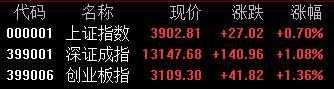
A股收评:午后拉升!沪指重回3900点,创业板指涨1.36%
Ge Long Hui A P P· 2025-12-05 07:31
Market Performance - The A-share market saw a collective rise in the three major indices, with the Shanghai Composite Index up 0.7% to 3902 points, the Shenzhen Component Index up 1.08%, and the ChiNext Index up 1.36% [1][2] - The total market turnover reached 1.74 trillion yuan, an increase of 177.3 billion yuan compared to the previous trading day, with nearly 4400 stocks rising [1] Insurance Sector - The insurance sector experienced significant gains, with China Pacific Insurance rising over 6.85%, Ping An Insurance up nearly 6%, and China Life Insurance up nearly 5% [4][5] - Morgan Stanley added Ping An Insurance to its core recommended list and raised its target price for Ping An's H-shares to 89 HKD and A-shares to 85 CNY, maintaining an industry top pick rating [4] Gold Sector - Gold-related stocks saw substantial increases, with companies like Xiaocheng Technology rising over 14% and Nankun Group hitting the daily limit [5][6] - The expectation of interest rate cuts by the Federal Reserve has strengthened predictions for gold prices, with the World Gold Council forecasting a potential increase of 15%-30% by 2026 due to declining U.S. Treasury yields and heightened geopolitical risks [5] Commercial Aerospace Sector - The commercial aerospace sector saw multiple stocks hit the daily limit, including Lixing Co. and Hongxiang Co., with Lixing Co. rising 20.02% [10] - The "Qianfan Constellation" market cooperation was signed between Yanshin Satellite and Airbus, marking a significant step towards global application [9] Superconducting Sector - The superconducting sector experienced a surge, with stocks like Baosheng Co. and Xibu Materials hitting the daily limit [8] - A breakthrough in nickel-based high-temperature superconductors was reported by a research team led by Shandong University, with results published in the journal Nature [7] Rare Earth Sector - The rare earth sector saw gains, with Ningbo Yunsheng and Jinkeli Yongci hitting the daily limit [12] - The Chinese government has been conducting export control work on rare earth-related items, approving compliant export applications promptly [11]