
三生制药

Search documents
12月23日港股通创新药ETF工银(159217)遭净赎回2524.06万元
Xin Lang Cai Jing· 2025-12-24 02:50
Core Viewpoint - The Hong Kong Stock Connect Innovative Drug ETF (工银, 159217) experienced significant net redemptions, indicating a trend of outflows from this fund in recent trading days [1][2] Group 1: Fund Performance - On December 23, the fund faced net redemptions of 25.24 million yuan, ranking 7th in net outflows among cross-border ETFs [1] - Over the past 5 days, the fund saw net redemptions totaling 27.89 million yuan, ranking 11th in net outflows [1] - The fund's total assets under management as of December 23 were 5.078 billion yuan, down from 5.1 billion yuan the previous day, reflecting a 0.49% outflow relative to the prior day's size [1] Group 2: Fund Details - The fund was established on March 26, 2025, with an annual management fee of 0.40% and a custody fee of 0.07% [1] - The current fund managers are Liu Weilin and Jiao Wenlong, with returns of 32.75% and 51.30% respectively since their management began [2] Group 3: Holdings and Composition - Major holdings in the fund include companies such as BeiGene (10.84%), CanSino Biologics (10.77%), and Innovent Biologics (10.43%), with respective market values of 589 million yuan, 586 million yuan, and 567 million yuan [2] - The fund tracks the Hong Kong Stock Connect Innovative Drug Index (987018) [1][2] Group 4: Comparative Analysis - Other ETFs tracking the same index include Huatai-PineBridge, Southern, and Penghua, with varying sizes and liquidity metrics [2] - As of December 23, the fund's average daily trading volume over the last 20 trading days was 485 million yuan [2]
格林大华期货早盘提示:股指-20251224
Ge Lin Qi Huo· 2025-12-24 01:36
| 6、高盛认为中国 AI 模型与美国顶尖模型的差距已缩窄至 3-6 个月。此外研报认为 | | --- | | 字节跳动豆包手机助手等 AI 助手的推出,可能预示着移动应用流量格局的根本性 | | 改变。预计中国头部云服务商 2026 年资本开支将进一步攀升至 5000 亿元。 | | 7、字节跳动初步计划的 2026 年资本支出达 1600 亿元人民币,较今年的 1500 亿元 | | 有所增长。投资重点将集中在 AI 基础设施建设上,其中约一半资金将用于采购先 | | 进芯片以开发 AI 模型和应用。 | | 8、国际半导体产业协会(SEMI)日前发布报告显示,2025 年全球原始设备制造商 | | (OEM)的半导体制造设备总销售额预计达 1330 亿美元,同比增长 13.7%,创历史 | | 新高。预计 2026 年和 2027 年分别达到 1450 亿美元和 1560 亿美元。 | | 9、全国机器人租赁生态峰会暨"擎天租"平台发布会在上海举行。会上,智元机 | | 器人发布机器人租赁平台"擎天租",标志着具身智能行业将向生态化、服务化的 | | 租赁模式深度演进。 | | 10、GGII(高工产 ...
普华永道徐佳:中国创新药迎分水岭,量质转型呈分化格局
2 1 Shi Ji Jing Ji Bao Dao· 2025-12-23 13:01
Core Insights - China's contribution to global innovative drug development has significantly increased, with the number of innovative drugs in development now accounting for approximately 30% of the global total, up from 4.1% a decade ago [1] - The Chinese pharmaceutical industry has become the second largest globally, with several Chinese companies now among the top 25 pharmaceutical firms worldwide [1] - The industry is experiencing a "quantity and quality transformation," characterized by a divide between leading companies and smaller biotech firms, with business development (BD) transactions becoming a crucial cash flow source [1][2] Industry Growth and Trends - The scale of China's innovative drug research pipeline now represents about one-quarter of the global total, with approximately 3,000 clinical trials conducted annually, placing China among the top in the world [3] - The total amount of outbound licensing for domestic innovative drugs has surpassed $100 billion, doubling compared to 2024, indicating a significant increase in global recognition of Chinese pharmaceutical assets [3] - Major deals, such as the collaboration between Sangamo Therapeutics and Pfizer, have set new records for upfront payments, highlighting the growing value of Chinese biotech in the global market [4] Business Development Models - Various business development models are emerging as Chinese companies expand internationally, including the NewCo model and the Co-Co model, which allow for more flexible asset operations and shared development costs [6][7] - Early-stage biotech firms tend to prefer traditional models with upfront payments and milestone payments to secure cash flow, while more established companies are moving towards collaborative development models [7] Ecosystem and Policy Support - A complete ecosystem is essential for the sustainable development of China's innovative drugs, requiring collaboration across research, clinical transformation, regulatory upgrades, and payment innovations [8] - Recent policy changes, including the establishment of a commercial insurance directory for innovative drugs, aim to enhance payment mechanisms and support for high-value drugs [9][10] - The dual-directory approach in payment systems is expected to create new commercial opportunities, accelerating the approval process for new drugs and increasing sales for specialized treatments [9][10] Future Directions - The next growth areas for outbound licensing are anticipated to focus on ADC/dual antibody combination therapies, GLP-1 related targets in metabolic diseases, and localized processes for cell and gene therapies [5] - The industry is expected to see a diversification of business development models, with the Co-Co model becoming more prevalent among leading companies while still coexisting with traditional licensing models [6][7]
中国创新药迈入全球化临界点 云顶新耀擘画进阶新篇
2 1 Shi Ji Jing Ji Bao Dao· 2025-12-23 09:25
Core Insights - By 2025, China's innovative pharmaceutical industry is projected to be the second largest globally, with approximately 30% of new drugs in development being from China, and the total amount of licensing agreements for domestic innovative drugs exceeding $100 billion, doubling from 2024 [1] - The Economist highlights that Chinese innovative drugs are at a critical point of globalization, with significant increases in global market share for Chinese pharmaceutical companies, and stock prices of Chinese biotech firms outperforming their US counterparts [1] - The rapid development is attributed to a decade of regulatory reforms, an ecosystem fostering innovation, and the advantages of China's large population and manufacturing capabilities [1] Industry Challenges - Despite impressive growth, the total market capitalization of Chinese biotech companies is only 15% of their US counterparts, with upfront licensing fees typically two-thirds lower than global averages [1] - Some pharmaceutical companies struggle with commercialization capabilities, which limits their potential value realization [1] Value Restructuring - Leading innovative pharmaceutical companies are advancing towards the top of the global value chain, with firms like Kangfang Biotech transitioning from licensing revenue to self-driven commercialization [2] - Companies are focusing on both global product development and building scalable commercialization platforms, which is becoming a core strategy for Chinese biotech firms to evolve into biopharma [2] Global Innovation Landscape - Chinese pharmaceutical companies are shifting from being fast followers to first movers, evidenced by significant business development deals with major international firms [3] - The mRNA technology sector is also seeing growth, with multiple companies advancing clinical trials and product development [3] mRNA Technology Potential - The value of mRNA technology is becoming increasingly evident, with major collaborations and acquisitions highlighting its potential [4] - Companies are pursuing dual strategies of in-licensing and out-licensing innovative assets to establish a strong global presence [4] Commercialization Challenges - The approval rate for new drugs is low, with only about 5% of drugs entering clinical trials successfully reaching the market, and only 20% of those achieving profitability [6] - Successful commercialization is critical for innovative drug companies, as it provides funding for future research and development [7] Market Dynamics - The traditional division of labor in the biopharmaceutical industry is evolving, with biotech companies gaining more negotiating power and opportunities for commercialization [9] - The market is expected to consolidate around platform companies with revenues between $5 billion and $10 billion, with a focus on integrating commercial strategies for innovative drugs [9] Commercialization Strategies - Companies like Cloudtop New Horizon are establishing integrated commercialization systems to enhance product growth and are actively pursuing partnerships to expand their market reach [10] - The company plans to introduce 3-5 significant products annually and aims to achieve substantial revenue growth by 2030 [10] Industry Evolution - The Chinese innovative pharmaceutical industry is undergoing a comprehensive upgrade, reshaping its value structure and positioning itself as a key player in the global biopharmaceutical landscape [11] - This transformation is moving China from a follower to a significant contributor and standard-setter in global biopharmaceutical innovation [11]
中国创新药迈入全球化临界点,云顶新耀擘画进阶新篇
2 1 Shi Ji Jing Ji Bao Dao· 2025-12-23 09:23
Core Insights - By 2025, China's innovative pharmaceutical industry is projected to have a market size ranking second globally, with approximately 30% of innovative drugs in development worldwide [1] - The total amount of foreign licensing for domestic innovative drugs has surpassed $100 billion, doubling compared to 2024 [1] - The shift from a Western-dominated landscape in biopharmaceutical innovation is evident, as Chinese biotech companies have outperformed their U.S. counterparts in stock price growth over the past year [1] Industry Development - The past decade has seen significant reforms in drug regulation, fostering an ecosystem for innovation and facilitating capital flow, supported by China's large population and manufacturing capabilities [1] - Despite impressive growth, challenges remain, including the total market capitalization of Chinese biotech companies being less than 15% of their U.S. counterparts and lower upfront licensing fees [1] Commercialization Strategies - Leading innovative pharmaceutical companies are advancing towards the global value chain, with firms like Kangfang Biotech transitioning from licensing revenue to self-driven commercialization [2] - Companies are focusing on both global product development and establishing scalable commercialization platforms, which is becoming a core strategy for Chinese biotech firms [2] Global Competition - Chinese pharmaceutical companies are transitioning from "fast-followers" to "first movers," evidenced by significant business development deals with major international firms [3] - The emergence of mRNA technology is notable, with several Chinese companies making strides in this area, including clinical trials for mRNA-based vaccines [3][4] Market Dynamics - The commercialization of innovative drugs in China is accelerating, with 56 innovative drugs approved by the National Medical Products Administration in the first eight months of 2025 [6] - Successful commercialization is critical, as only about 5% of drugs entering clinical trials make it to market, and only 20% of those achieve profitability [6] Future Outlook - Companies like CloudTop are aiming to enhance their commercialization capabilities and expand their product pipelines significantly by 2030, with projected revenues exceeding 15 billion yuan [4][11] - The industry is expected to see a consolidation of platform companies with revenues between 5 billion to 10 billion yuan, indicating a shift in the commercialization landscape [9][10]
ETF盘中资讯 | 港股通创新药回暖,100%创新药研发标的“520880”摸高1.53%!石药集团领涨,创新药龙头集体跟进
Jin Rong Jie· 2025-12-23 02:50
Core Viewpoint - The Hong Kong Stock Connect innovative drug sector is experiencing a rebound, with significant trading activity and price increases among leading innovative drug companies, indicating a positive shift in market sentiment towards this sector [1][3]. Group 1: Market Performance - The Hong Kong Stock Connect innovative drug ETF (520880) reached a peak increase of 1.53% and traded over 140 million yuan during the session [1]. - Leading companies in the innovative drug sector, such as CSPC Pharmaceutical Group, recorded gains exceeding 5%, while others like 3SBio and Hengrui Medicine saw increases of over 2% [1]. Group 2: Investment Insights - Analysts from Zhongtai Securities noted that the current innovative drug market differs from the 2019-2021 period, as the sector is transitioning from narrative to actual performance, with trading volumes hitting new highs [1]. - Long-term support from domestic policies for innovative drugs is evident, with the introduction of commercial insurance directories enhancing payment capabilities [1][3]. - Changjiang Securities emphasized the emergence of a new policy support cycle for the pharmaceutical industry, particularly for innovative drugs, suggesting a focus on high-quality assets with strong overseas potential [3]. Group 3: ETF Characteristics - The Hong Kong Stock Connect innovative drug ETF (520880) is designed to track the Hang Seng Hong Kong Stock Connect Innovative Drug Select Index, which has three key advantages: it exclusively includes innovative drug companies, has a high concentration of leading firms, and employs risk control measures for less liquid stocks [3][4]. - The top ten holdings in the ETF account for over 72% of its weight, showcasing the dominance of leading innovative drug companies [4]. Group 4: Alternative Investment Options - For investors seeking to mitigate volatility while still focusing on innovative drugs, the only ETF in the market (562050) offers a mix of innovative and traditional Chinese medicine stocks, providing a balanced approach [4].



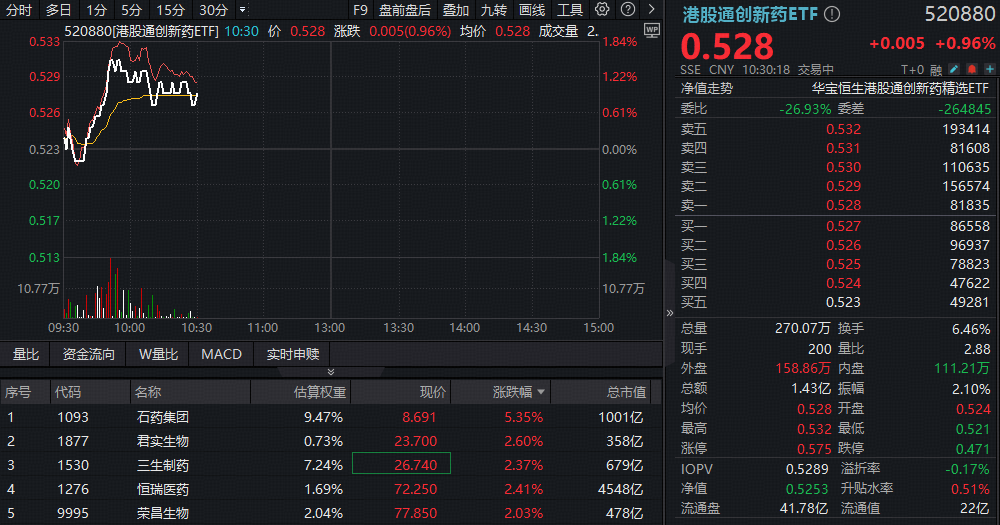
港股通创新药回暖,100%创新药研发标的“520880”摸高1.53%!石药集团领涨,创新药龙头集体跟进
Xin Lang Ji Jin· 2025-12-23 02:50
Core Viewpoint - The Hong Kong Stock Connect innovative drug sector is experiencing a rebound, with significant trading activity and price increases among leading innovative drug companies, indicating a shift in the market dynamics for innovative pharmaceuticals in China [1][3]. Group 1: Market Performance - On December 23, the Hong Kong Stock Connect innovative drug ETF (520880) reached a peak increase of 1.53% and recorded over 1.4 billion yuan in trading volume [1]. - Leading companies in the innovative drug sector, such as CSPC Pharmaceutical Group, saw stock price increases exceeding 5%, while others like 3SBio and Hengrui Medicine rose over 2% [1]. Group 2: Investment Insights - Analysts from Zhongtai Securities noted that the current innovative drug market differs from the 2019-2021 period, as it has transitioned from narrative to actual performance, with trading volumes hitting new highs, reflecting a leap in China's innovative capabilities [1]. - Changjiang Securities emphasized that the innovative drug sector is entering a new cycle of policy support, suggesting a focus on high-quality innovative drug assets with strong overseas potential [3]. Group 3: ETF Characteristics - The Hong Kong Stock Connect innovative drug ETF (520880) tracks the Hang Seng Hong Kong Stock Connect Innovative Drug Select Index, which has three unique advantages: it exclusively includes innovative drug companies, has a high concentration of leading firms (over 72% in the top ten), and employs measures to control risks associated with less liquid stocks [3][4]. - The ETF's current market price is close to its initial listing price, presenting a potential value opportunity for investors [3]. Group 4: Composition and Strategy - The top ten holdings of the Hong Kong Stock Connect innovative drug ETF account for 72.57% of the total weight, showcasing significant dominance by leading companies in the sector [4]. - For investors seeking to mitigate volatility while still focusing on innovative drugs, alternative ETFs that include a mix of traditional Chinese medicine and innovative drugs are available, providing a balanced investment approach [4].
12月22日港股通创新药ETF工银(159217)遭净赎回264.88万元
Xin Lang Cai Jing· 2025-12-23 02:24
Core Viewpoint - The Hong Kong Stock Connect Innovative Drug ETF (工银, 159217) experienced net redemptions of 2.6488 million yuan on December 22, 2025, indicating a trend of outflows from this ETF [1] Group 1: Fund Performance - As of December 22, 2025, the latest size of the Hong Kong Stock Connect Innovative Drug ETF (工银, 159217) is 5.1 billion yuan, down from 5.143 billion yuan the previous day, with a net outflow of 0.05% of the previous day's size [1] - Over the past 5 days, the fund has seen net redemptions totaling 2.6403 million yuan, ranking 36th out of 201 in cross-border ETF net outflows [1] - The fund's total size as of December 22, 2025, is 5.1 billion yuan with a total share count of 3.844 billion [1] Group 2: Liquidity and Trading Activity - The cumulative trading amount for the Hong Kong Stock Connect Innovative Drug ETF (工银, 159217) over the last 20 trading days is 9.864 billion yuan, with an average daily trading amount of 493 million yuan [2] - The current fund managers are Liu Weilin and Jiao Wenlong, with returns of 32.68% and 51.22% respectively since their management began [2] Group 3: Holdings and Major Stocks - The fund's major holdings include companies such as BeiGene (百济神州) at 10.84%, CanSino Biologics (康方生物) at 10.77%, and Innovent Biologics (信达生物) at 10.43%, among others [2] - The top holdings by market value include BeiGene with 589 million yuan, CanSino Biologics with 586 million yuan, and Innovent Biologics with 567 million yuan [2] Group 4: Comparative Analysis - Other ETFs tracking the same index include the Huatai-PineBridge Innovative Drug ETF (汇添富国证港股通创新药ETF, 159570) with a size of 22.563 billion yuan and an average daily trading amount of 1.795 billion yuan [2] - The Hong Kong Stock Connect Innovative Drug ETF (工银, 159217) ranks lower in size and trading volume compared to its peers, indicating potential competitive pressures [2]
大行评级丨招银国际:视医药板块回调为估值与预期的消化与再平衡 关注低估值个股机会
Ge Long Hui· 2025-12-23 02:22
Group 1 - The core viewpoint of the report is that the recent pullback in the pharmaceutical sector is primarily due to the digestion and rebalancing of valuations and expectations, which creates a better investment window for future opportunities [1] - Looking ahead to 2026, the trend of innovative drugs going overseas is expected to continue, with a focus on the clinical progress and data validation of pipelines that have already entered international markets [1] - The impact of the recently signed U.S. Biosecurity Act on Chinese CXO companies is anticipated to be limited, as it does not affect Medicaid and Medicare procurement and has clear definitions regarding related parties, along with the relatively small revenue contribution from U.S. administrative agencies to Chinese CXO firms [1] Group 2 - The industry outlook suggests a more conservative investment approach, emphasizing opportunities in undervalued stocks [1] - Recommended stocks for investment include 3SBio, Genscript Biotech, WuXi AppTec, and China National Pharmaceutical Group [1]

港股医药板块走强,港股创新药ETF(159567)早盘涨超1%
Mei Ri Jing Ji Xin Wen· 2025-12-23 02:17
Group 1 - The Hong Kong pharmaceutical sector showed a quick recovery after a slight dip, with companies like CSPC Pharmaceutical, 3SBio, Rongchang Biopharmaceutical, and Hengrui Medicine leading the gains [1] - The Hong Kong Innovative Drug ETF (159567) rose by 1.27% as of 9:59 AM, indicating a potential for a three-day winning streak, with a trading volume exceeding 290 million yuan [1] - Since the beginning of this month, the product's shares have increased by 58.7 million, with a cumulative net inflow of over 480 million yuan [1] Group 2 - The current innovative drug market differs from the period of 2019-2021, as the narrative of Chinese innovative drugs going global has transitioned into a phase of actual realization, with transaction amounts reaching new highs [1] - This reflects a leap in China's innovation capability from "quantity" to "quality," supported by continuous domestic policy initiatives that comprehensively back innovative drugs, including the introduction of a commercial insurance directory [1] - The Hong Kong Innovative Drug ETF (159567) tracks the National Index of Hong Kong Innovative Drugs, aiming to reflect the operational characteristics of listed companies in the innovative drug sector within the Hong Kong Stock Connect [1]