
中信保诚基金

Search documents
百万“实盘秀”精彩纷呈基金经理生动阐释逆向投资
Zhong Guo Zheng Quan Bao· 2025-08-06 21:09
Group 1 - Fund managers are actively sharing their real-time investment performance on platforms like Ant Wealth, engaging with investors frequently [1][4] - Yao Jiahong, a fund manager, reported a total investment of over 4.1 million yuan, achieving a cumulative return of 1.0583 million yuan, with significant daily gains [1][2] - Other fund managers, such as Ma Fang and Liang Xing, also showcase their investment strategies and returns, with Ma's cumulative earnings exceeding 600,000 yuan and Liang managing a diverse portfolio [2][3] Group 2 - The performance of quantitative funds has been notably strong, with some achieving returns over 40% this year, and specific funds like Guojin Quantitative Multi-Factor Stock yielding 29.92% year-to-date [5][6] - Market conditions are favorable for quantitative strategies, with daily trading volumes remaining above 1.5 trillion yuan, indicating a healthy market environment [6][7] - The small-cap style is expected to regain an advantage, as recent market adjustments may favor this segment, suggesting strategies like phased investment and profit-taking [7]
又一只,“限购”!
Zhong Guo Ji Jin Bao· 2025-08-06 05:44
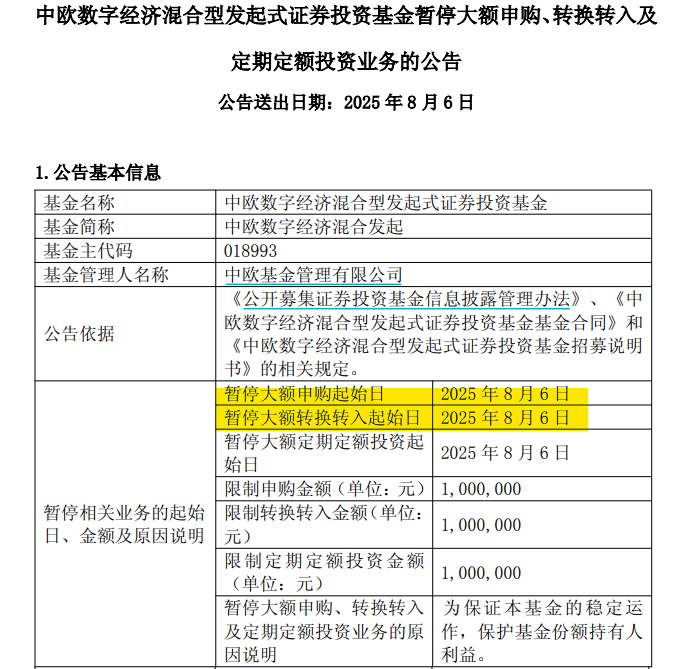
Group 1 - The core point of the article is that China Europe Digital Economy Mixed Fund has announced the suspension of large subscriptions over 1 million yuan to ensure stable fund operations and protect the interests of fund shareholders [1][2][4] - As of August 5, the fund has achieved over 150% performance in the past year, ranking 8th out of 4349 similar funds [1][4] - The fund manager, Feng Ludan, has a background in finance and has been managing public funds since October 2021 [5] Group 2 - The fund has seen a significant increase in shares, exceeding 900 million, which is more than a tenfold growth since the end of the first quarter [6] - The fund maintains a high allocation focusing on five core investment areas: AI infrastructure, AI applications, domestic AI supply chain, intelligent robotics, and intelligent driving [6] - The top holdings of the fund have shown substantial price increases this year, with stocks like Zhongji Xuchuang, Xinyi Sheng, and Shenghong Technology rising over 70%, 126%, and 365% respectively [6] Group 3 - The trend of limiting large subscriptions is not unique to this fund; several other high-performing funds have also implemented similar measures to control fund size and maintain investment strategy effectiveness [7][9] - The recent surge in performance among many funds has led to a wave of subscription suspensions, with nearly 30 active equity funds announcing such measures since July [8][9] - Industry insiders suggest that limiting subscriptions helps protect existing shareholders from potential losses due to market volatility and prevents dilution of returns for current investors [9]

又一只,“限购”!
中国基金报· 2025-08-06 05:39
Core Viewpoint - The China Europe Digital Economy Mixed Fund has announced a suspension of large subscriptions exceeding 1 million yuan to ensure stable fund operations and protect the interests of fund shareholders [2][5]. Fund Performance - The fund has achieved over 150% performance in the past year, ranking 8th out of 4349 similar funds [3][8]. - As of the second quarter, the fund's shares have surged to over 900 million, increasing more than tenfold compared to the end of the first quarter [8]. Market Context - The recent recovery in the equity market has led to a wave of "subscription limits" from high-performing actively managed funds [3][11]. - Multiple funds under China Europe have announced similar subscription limits this year, indicating a trend among top-performing funds to manage inflows [9][12]. Investment Strategy - The fund maintains a high allocation focusing on five core investment areas: AI infrastructure, AI applications, domestic AI supply chain, intelligent robotics and driving, and edge AI [8]. - Key stocks in the fund, such as Zhongji Xuchuang, Xinyi Sheng, and Shenghong Technology, have seen significant price increases of over 70%, 126%, and 365% respectively this year [8]. Industry Insights - Industry experts suggest that the trend of limiting subscriptions is primarily to control fund size and maintain the effectiveness of investment strategies [12]. - Limiting subscriptions also aims to protect existing shareholders from potential losses due to market volatility when new funds enter at high valuations [12].

又有绩优主动基金宣布限购
Zhong Zheng Wang· 2025-08-06 05:05
Group 1 - Central viewpoint: Several actively managed funds are implementing subscription limits to control product scale and protect existing investors' interests [1][2] - Zhongou Digital Economy Mixed Fund announced a subscription limit of 1 million yuan per day per account, with a return rate exceeding 150% in the past year [1] - Yongying Fund and GF Fund also announced similar subscription limits for their high-performing funds, with returns of over 65% and 147% respectively in the past year [1] Group 2 - Industry experts suggest that subscription limits help mitigate the "too big to turn" issue and prevent arbitrage activities involving suspended stocks [2] - Allianz Fund's research department anticipates that the current market fluctuations will not alter the upward trend, as the stock market enters a new value reassessment cycle [2] - There is an expectation of significant excess returns from quality technology assets in the third quarter [2]
利率债失去“免税光环” 存量券受青睐 资金配置或分流
Zhong Guo Zheng Quan Bao· 2025-08-06 00:42
Core Viewpoint - The Ministry of Finance and the State Taxation Administration announced that starting from August 8, 2025, interest income from newly issued government bonds, local government bonds, and financial bonds will be subject to value-added tax, leading to immediate market reactions and shifts in investment strategies [1][2]. Group 1: Market Reactions - Following the announcement, there was an initial spike in interest rates due to increased holding costs for new bonds, but this was quickly reversed as older bonds became more attractive due to their tax-exempt status, resulting in a drop in interest rates [1][2]. - The market experienced a "roller coaster" effect, with institutional funds quickly shifting their focus towards older bonds, altering the supply-demand dynamics [1][2]. Group 2: Impact on Bond Market - Institutions believe the tax adjustment will have a medium-term impact on the bond market, with a potential widening of the yield spread between new and old bonds, favoring the latter [2][3]. - Existing bonds are seen to have structural advantages over newly issued bonds due to the continued tax exemption, leading to a preference for older bonds among investors [2][3]. Group 3: Fund Allocation Shifts - The tax policy change is expected to lead to a reallocation of funds, with some investors moving from the bond market to equity markets, particularly towards stable dividend-paying stocks and credit bonds [3][4]. - Fund companies are adjusting their strategies, with some increasing their focus on "fixed income plus" products, including convertible bonds and REITs, to compensate for the anticipated decline in returns from pure bond assets [4].
债券增值税调整“激起千层浪”:投资端选项多元化 配置资金酝酿分流
Zhong Guo Zheng Quan Bao· 2025-08-06 00:03
Core Viewpoint - The Ministry of Finance and the State Taxation Administration announced the restoration of VAT on interest income from newly issued government bonds, local government bonds, and financial bonds starting from August 8, 2025, while existing bonds will remain exempt until maturity [1] Market Reaction - The announcement led to an immediate spike in bond yields due to increased holding costs for new bonds, followed by a rapid reversal as existing bonds became more attractive due to their tax-exempt status, resulting in a significant drop in yields [1] - The market experienced volatility as traders quickly shifted strategies, indicating a rapid change in sentiment [1] Institutional Insights - Institutions believe the tax adjustment will have a medium to short-term impact on the bond market, with a potential widening of the yield spread between new and existing bonds, leading to a buying spree for existing bonds [2][4] - The structural advantage of existing bonds over new issues is expected to influence investor behavior, with a preference for older bonds due to their tax benefits [2][3] Investment Strategy Adjustments - Fund companies are adjusting redemption limits for bond funds in response to the new tax policy, indicating a proactive approach to manage potential market fluctuations [4] - Institutions are exploring alternative investment strategies, including a shift towards credit bonds, REITs, and equities, as the attractiveness of newly issued bonds diminishes [5][7] Tax Implications - The new tax policy primarily affects interest income, while public funds retain their tax advantages on capital gains, potentially increasing demand for public funds over bank proprietary products [6] - The tax changes are expected to have a limited impact on the overall asset allocation of banks and insurance companies, which continue to view government bonds as essential components of their portfolios [7][8]
债券增值税调整“激起千层浪” 投资端选项多元化 配置资金酝酿分流
Zhong Guo Zheng Quan Bao· 2025-08-05 21:18
Core Viewpoint - The Ministry of Finance and the State Taxation Administration announced the restoration of VAT on interest income from newly issued government bonds, local government bonds, and financial bonds starting from August 8, 2025, while existing bonds will remain exempt until maturity, leading to significant market reactions and shifts in investment strategies [1][2][3]. Market Reaction - The announcement caused an immediate spike in bond yields due to increased holding costs for new bonds, followed by a rapid decline in yields as institutional investors rushed to acquire existing bonds benefiting from the tax exemption [1][2]. - The volatility in the bond market reflects a quick shift in investor sentiment, with many traders expressing concerns over the rapid changes in market dynamics [1]. Investment Strategy Shifts - Institutions are expected to favor existing bonds over new issues due to the tax advantages, potentially leading to a widening of the yield spread between old and new bonds and a surge in demand for existing bonds [2][4]. - The tax policy change is seen as providing more diverse strategic options for investors, with the bond market's performance likely influenced by fundamental economic conditions and monetary policy [2][4]. Impact on Credit Bonds and Other Assets - The restoration of VAT on interest income from government bonds diminishes their tax advantage over credit bonds, which may lead to a narrowing of credit spreads as the tax premium on credit bonds decreases [3][7]. - As the attractiveness of government bonds declines, some funds may shift towards credit bonds, equities, and other asset classes like REITs, indicating a potential reallocation of capital within the market [7][8]. Fund Management Adjustments - Fund companies are adjusting redemption limits for bond funds in response to the new tax policy, anticipating changes in investor behavior and market volatility [4][6]. - The overall impact on public funds is expected to be limited, with the potential for stable returns in bond and money market funds despite short-term fluctuations [4][6]. Long-term Outlook - The long-term effects of the tax policy change on the bond market are considered moderate, with expectations that the overall configuration of bond investments will remain stable, particularly for institutional investors who continue to view government bonds as essential components of their portfolios [7][8].
投资端选项多元化 配置资金酝酿分流
Zhong Guo Zheng Quan Bao· 2025-08-05 21:07
Core Viewpoint - The Ministry of Finance and the State Taxation Administration announced the restoration of VAT on interest income from newly issued government bonds, local government bonds, and financial bonds starting from August 8, 2025, while existing bonds will remain exempt until maturity [1] Group 1: Market Reaction - The announcement led to an immediate spike in bond yields due to increased holding costs for new bonds, followed by a sharp decline in yields as institutional investors rushed to buy existing bonds benefiting from tax exemptions [1] - The market experienced a rapid shift in sentiment, with traders expressing concerns over the volatility and quick changes in market dynamics [1] Group 2: Investment Strategies - Institutions believe the tax adjustment will have a neutral impact on the bond market in the medium to long term, with a potential widening of the yield spread between new and existing bonds, prompting a buying spree for existing bonds [2][3] - The adjustment may lead to a shift in investment strategies, with a preference for existing bonds due to their tax advantages, while new bonds may require higher coupon rates to attract investors [2][3] Group 3: Fund Management Adjustments - Fund companies are adjusting redemption limits for bond funds in response to the new tax policy, preparing for potential market volatility [3] - The tax changes are expected to increase the appeal of existing bonds, leading to a strategy of "long existing bonds, short new bonds" among investors [3] Group 4: Asset Allocation Shifts - The restoration of VAT on interest income from newly issued bonds may lead to a reallocation of funds from the bond market to equity markets and other asset classes, as the attractiveness of new bonds diminishes [4][5] - Some funds may flow into credit bonds, particularly those with strong credit ratings, as investors seek to optimize returns in light of the new tax burdens [5] Group 5: Long-term Outlook - Despite short-term volatility, the overall impact of the tax adjustment on the bond market is expected to be limited, with bond funds and money market funds likely to maintain stable yields [3][4] - The long-term demand for government bonds from banks and insurance companies is anticipated to remain strong, as these institutions continue to prioritize asset-liability matching and stable returns [5]
存量券受青睐 资金配置或分流
Zhong Guo Zheng Quan Bao· 2025-08-05 15:00
Core Viewpoint - The Ministry of Finance and the State Taxation Administration announced that starting from August 8, 2025, interest income from newly issued government bonds, local government bonds, and financial bonds will be subject to value-added tax, leading to immediate market reactions and shifts in investment strategies [1][2]. Group 1: Market Reactions - The announcement caused a spike in interest rates for new bonds due to increased holding costs, but this was followed by a reversal as older bonds became more attractive due to their tax-exempt status, resulting in a drop in interest rates [1][2]. - The market experienced a "roller coaster" effect, with initial volatility settling down as investors adjusted to the new information [1]. Group 2: Impact on Bond Market - Institutions believe the tax adjustment will have a neutral impact on the bond market in the medium term, but the differentiation between new and old bonds may widen the yield spread, favoring older bonds [2][3]. - Existing bonds are expected to retain structural advantages over newly issued bonds, as investors may prefer older bonds that remain tax-exempt, leading to a potential decline in the attractiveness of new bonds [2]. Group 3: Fund Allocation Shifts - The tax policy change is likely to lead to a shift in fund allocation, with some funds moving from the bond market to equity markets, particularly towards stable dividend-paying stocks and credit bonds [3][4]. - Fund managers are adjusting their strategies, with some focusing on "fixed income plus" products that include convertible bonds, REITs, and equities to compensate for the expected decline in returns from pure bond holdings [4].
存量券受青睐,资金配置或分流
Zhong Guo Zheng Quan Bao· 2025-08-05 14:56
Core Viewpoint - The Ministry of Finance and the State Taxation Administration announced that starting from August 8, 2025, interest income from newly issued government bonds, local government bonds, and financial bonds will be subject to value-added tax, leading to immediate market reactions and shifts in investment strategies [1][2]. Group 1: Market Reactions - The announcement caused a spike in interest rates for new bonds due to increased holding costs, but this was quickly reversed as older bonds became more attractive due to their tax-exempt status, resulting in a drop in interest rates [1][2]. - The market experienced a "roller coaster" effect, with initial volatility settling down as investors adjusted to the new information [1]. Group 2: Investment Strategies - Institutions believe the tax adjustment will have a neutral impact on the bond market in the medium term, but the differentiation between new and old bonds may widen the yield spread, favoring older bonds [2][3]. - Fund managers are adjusting their strategies, with a tendency to favor older bonds that retain their tax-exempt status, while new bonds may require higher coupon rates to attract investors [2][3]. Group 3: Fund Flow Dynamics - The tax policy change is expected to lead to a reallocation of funds, with some capital moving from the bond market to equity markets, particularly into stable dividend-paying sectors [3]. - There is a potential shift towards credit bonds, especially those with strong credit ratings, as investors seek to optimize returns in light of increased costs associated with new bonds [3]. Group 4: Future Investment Strategies - Some investment firms are planning to focus on "fixed income plus" products, including convertible bonds, REITs, and equities, to compensate for the expected decline in returns from traditional bond holdings [4].