
奥特维

Search documents
光伏设备板块高开,钧达股份、双良节能涨停
2 1 Shi Ji Jing Ji Bao Dao· 2026-01-23 01:43
南方财经1月23日电,光伏设备板块高开,钧达股份、双良节能涨停,迈为股份涨超10%,奥特维、连 城数控、高测股份、琏升科技、拉普拉斯跟涨。 ...




科创新能源ETF(588830)昨日收涨1.61%,光伏反内卷持续推进
Xin Lang Cai Jing· 2026-01-23 01:36
Group 1 - The core viewpoint of the news is that the Chinese government is pushing for a shift in the photovoltaic industry from "price competition" to "innovation-driven" competition to combat "involution" [1][2] - The National Energy Administration highlighted that the root cause of "involution" in the photovoltaic industry is the shift from competing on technology and innovation to competing on price and scale [1] - A recent procurement by Huadian for 8GW of high-efficiency modules showed that 75% of the components met the high-efficiency standard (conversion efficiency ≥ 23.8%), indicating that only leading companies can meet these requirements [1] Group 2 - Changjiang Electric Power New Energy noted that the recent statements from the State Administration for Market Regulation and Huadian's large-scale procurement of high-efficiency components suggest that self-discipline in the photovoltaic industry will continue to advance [2] - The basic expectations for traditional photovoltaic have weakened previously, but recent developments have restored these expectations, solidifying the bottom of both the fundamental and financial aspects [2] - The trend in the photovoltaic market will need to be monitored closely, especially around mid-year, as demand expectations shift [2] Group 3 - The Science and Innovation New Energy ETF closely tracks the Shanghai Stock Exchange Science and Technology Innovation Board New Energy Index, which includes 50 large-cap stocks in the photovoltaic, wind power, and new energy vehicle sectors [3] - As of December 31, 2025, the top ten weighted stocks in the index include JinkoSolar, First Solar, Trina Solar, and others, accounting for 46.84% of the total index weight [3] Group 4 - The Science and Innovation New Energy ETF (588830), the ChiNext New Energy ETF (159261), and the Photovoltaic ETF (159863) are mentioned as key investment vehicles in the sector [4]
苹果计划将Siri重塑为内置聊天机器人,科创综指ETF天弘(589860)录得两连阳,机构:AI大模型正推动多行业应用加速商业落地
2 1 Shi Ji Jing Ji Bao Dao· 2026-01-23 01:29
Group 1 - The A-share market saw all three major indices rise collectively, with the Shanghai Stock Exchange Science and Technology Innovation Board Composite Index increasing by 0.14% [1] - The Tianhong ETF tracking the Science and Technology Innovation Board Index recorded a slight increase, achieving two consecutive days of gains, with a trading volume of nearly 30 million yuan [1] - Key stocks in the Tianhong ETF included Tengjing Technology, Mingwei Electronics, and Qingyun Technology, all reaching the daily limit, while other stocks like Godewei and Aotwei saw significant increases of nearly 20% and over 14%, respectively [1] Group 2 - The Robot ETF closely tracks the China Securities Robot Index, with a focus on manufacturing and information transmission, software, and IT services [2] - Major holdings in the Robot ETF include Huichuan Technology, iFlytek, and Stone Technology, and it is supported by two off-market connection funds [2] - The AI industry is experiencing rapid commercialization, with applications in various sectors such as AI search, marketing, office work, and education, indicating a significant technological impact on industry development [2]


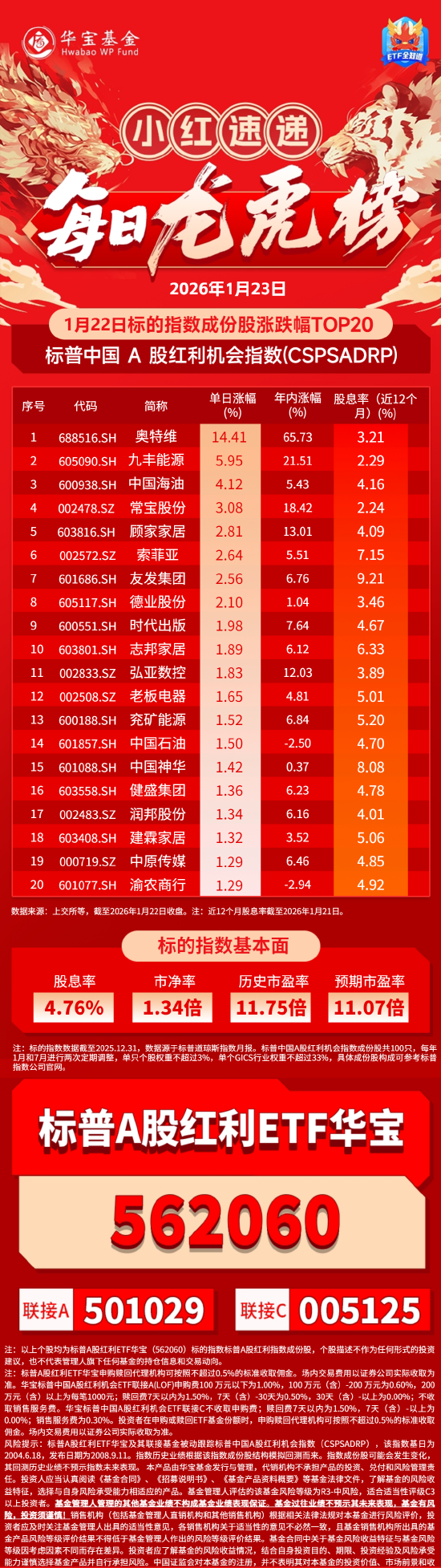
小红日报 | 奥特维收涨14.41%,标普A股红利ETF华宝(562060)标的指数上涨0.83%创新高
Xin Lang Cai Jing· 2026-01-23 01:16
Group 1 - The article highlights the top 20 stocks in the S&P China A-Share Dividend Opportunity Index (CSPSADRP) based on their daily and year-to-date performance as of January 22, 2026 [1][5] - The stock "奥特维" (code: 688516.SH) leads with a daily increase of 14.41% and a year-to-date increase of 65.73%, with a dividend yield of 3.21% [1][5] - Other notable performers include "九丰能源" (code: 605090.SH) with a daily increase of 5.95% and a year-to-date increase of 21.51%, and "中国海滩" (code: 600938.SH) with a daily increase of 4.12% and a year-to-date increase of 5.43% [1][5] Group 2 - The overall dividend yield for the index is reported at 4.76%, with a historical price-to-earnings (P/E) ratio of 11.75 times and an expected P/E ratio of 11.07 times [2] - The data indicates a positive trend in stock performance, with several companies showing significant year-to-date gains, suggesting a favorable investment environment [4][8]






光伏龙头企业“亏损潮”延续,专家:2026年三四月份有望迎来拐点
Hua Xia Shi Bao· 2026-01-22 09:35
Core Viewpoint - The photovoltaic industry is experiencing significant losses across all major segments, with a call for recovery and improvement in profitability by 2026, focusing on asset management and pricing power [2][11]. Group 1: Industry Performance - The photovoltaic sector is in a "dark moment," with all major segments, including silicon materials, wafers, cells, and modules, reporting losses [2]. - The overall performance of the industry is characterized by high inventory and weak demand, despite some signs of recovery in silicon material prices [3]. - The integrated companies face significant pressure, with a notable decline in profitability due to rising costs of key materials like silver paste [3][6]. Group 2: Company-Specific Insights - Daqo New Energy forecasts a net loss of 1 to 1.3 billion yuan for 2025, but with a reduced loss margin of 52.17% to 63.21% year-on-year due to improved operational efficiency [3]. - Longi Green Energy expects a net loss of 6 to 6.5 billion yuan, a reduction of over 2 billion yuan compared to the previous year, driven by increased production efficiency [5]. - Junda Co. anticipates a net loss of 1.5 to 1.2 billion yuan, significantly higher than the previous year's loss of 590 million yuan, citing supply-demand imbalance and price transmission issues [4]. Group 3: Component and Equipment Sector - Companies focusing on Bifacial (BC) modules, such as Aiko Solar, are seeing a significant reduction in losses, with expected losses narrowing from 5.319 billion yuan to between 1.9 billion and 1.2 billion yuan [5]. - The equipment sector, represented by Aotai Technology, is also facing declines, with expected revenue dropping by 26.71% to 30.50% year-on-year [8]. - Silver paste manufacturer Dike Co. is projected to shift from profit to loss, with expected losses of 200 to 300 million yuan due to rising silver prices [9]. Group 4: Future Outlook - The industry is still in a phase of "deleveraging and capacity reduction," but there are signs of recovery in upstream segments, with discussions about potential profitability improvements in 2026 [11][12]. - Aiko Solar reports that its ABC module sales volume is expected to double, indicating a positive trend despite overall losses [12]. - Analysts predict that the industry may see a shift from supply-demand pricing to cost-based pricing by early 2026, potentially improving profit margins significantly [12].





风电公司进军太空光伏!光伏ETF(159857)标的指数上涨超1%,机构:太空光伏将是2026年电新板块最强主线
2 1 Shi Ji Jing Ji Bao Dao· 2026-01-22 06:57
Group 1 - The three major indices experienced fluctuations, with the CSI Photovoltaic Industry Index rising by 1.38%. Notable stocks included Junda Co., which hit the daily limit, and GCL-Poly Energy, which rose nearly 17% [1] - The photovoltaic ETF (159857), which tracks the CSI Photovoltaic Industry Index, saw an increase and a trading volume of 132 million yuan. The net inflow for this ETF on the previous trading day was 61.44 million yuan [1] - Mingyang Smart Energy announced plans to acquire control of Zhongshan Dehua Chip Technology Co., Ltd. through a combination of share issuance and cash payment, indicating a focus on the space solar cell industry [1] Group 2 - Guojin Securities highlighted that space photovoltaics, as a core segment of the commercial aerospace sector, is gaining market recognition due to its significant value, inflation trends, and high barriers to entry. The market is expected to continue expanding, with recommendations for active participation [2] - The cancellation of export tax rebates for photovoltaics is set to take effect on April 1, providing a "window" for companies to adjust before the Q1 domestic demand slowdown, while also facilitating the exit of less competitive capacities and firms [2]
小红日报 | 标普A股红利ETF华宝(562060)标的指数小幅回调,资金持续布局红利资产
Xin Lang Cai Jing· 2026-01-22 01:18
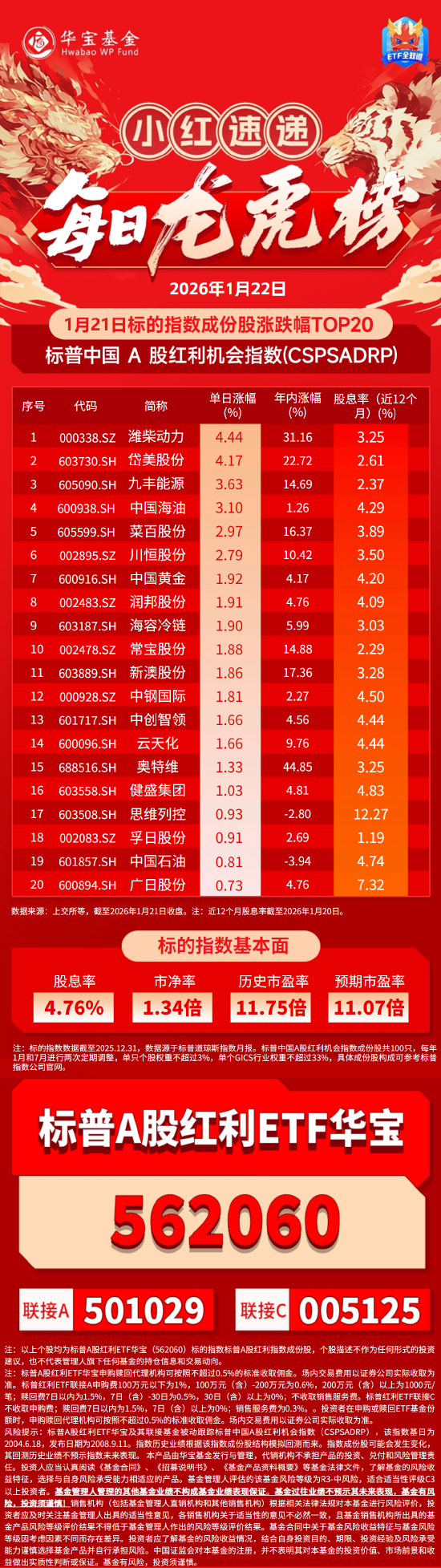
Group 1 - The article highlights the top 20 stocks in the S&P China A-Share Dividend Opportunity Index (CSPSADRP) based on their daily and year-to-date performance as of January 21, 2026 [1][5] - Weichai Power (000338.SZ) leads with a daily increase of 4.44% and a year-to-date increase of 31.16%, with a dividend yield of 3.25% [1][5] - Other notable performers include Daimei Co. (603730.SH) with a daily increase of 4.17% and a year-to-date increase of 22.72%, and Jiufeng Energy (605090.SH) with a daily increase of 3.63% and a year-to-date increase of 14.69% [1][5] Group 2 - The overall dividend yield for the index is reported at 4.76%, with a price-to-book ratio of 1.34 times and a historical price-to-earnings ratio of 11.75 times, while the expected price-to-earnings ratio is 11.07 times [2] - The data is sourced from the Shanghai Stock Exchange and reflects the closing prices as of January 21, 2026, with the dividend yield calculated up to January 20, 2026 [2]



招商证券:商业航天能源系统将快速增长并迎来升级迭代 晶硅与钙钛矿开始光伏发电试用
智通财经网· 2026-01-21 06:34
Core Viewpoint - The commercial aerospace sector is entering a rapid development phase, with low Earth orbit (LEO) satellites becoming a focal point of competition between the US and China, leading to significant growth in supporting energy systems and potential upgrades in technology [2]. Group 1: Commercial Aerospace Development - The US leads the world in the number of operational spacecraft, with China closely following. LEO satellites, due to their low latency and wide coverage, have become a key focus globally, with nearly 70% of satellites in orbit being LEOs. Both countries plan to deploy tens of thousands of satellites to secure scarce frequency and orbital resources [2]. - Both the US and China are encouraging deep participation of commercial capital in the aerospace sector through policies such as establishing funds, simplifying approvals, and opening infrastructure [2]. - Leading companies like SpaceX, Amazon, and China's Xingwang are accelerating the deployment of satellite constellations and expanding into new business areas such as space data centers and in-orbit computing [2]. Group 2: Satellite Power Systems - Satellite power systems, which ensure stable power supply throughout the satellite's lifecycle, consist of solar power generation, lithium battery storage, and power management modules. These systems face unique challenges in space, including strong radiation, extreme temperature variations (over 300°C), and low Earth orbit atomic oxygen erosion [3]. - The cost of satellite power systems accounts for about 20% of the total satellite cost, with nearly two-thirds of that attributed to solar power generation. Reducing costs in this area is a significant industry demand [4]. Group 3: Technological Advancements in Photovoltaics - The current mainstream choice for LEO satellites is gallium arsenide batteries, known for their radiation resistance and thermal performance. Future applications may include two-junction solutions that reduce germanium usage [4]. - P-type PERC silicon products are already in use overseas, while P-type HJT solutions are in testing or trial phases. Perovskite-silicon tandem batteries are also undergoing testing, with the potential to become important or even mainstream solutions in the future [4]. Group 4: High-Performance Batteries and Power Systems - Satellite batteries require high energy density, reliability, and cycle performance, while power modules must withstand radiation, manage extreme heat, and feature efficient DC-DC architectures, indicating high technical barriers [5]. - Key participants in these high-barrier segments are expected to achieve significant profit returns in the future [5]. Group 5: Investment Recommendations - Companies related to photovoltaic power generation include Junda Co., Dike Co., Dongfang Risheng, Maiwei Co., Aotwei, Shanghai Port Bay, Ruihua Tai, and Jingsheng Mechanical [6]. - Companies involved in batteries and power systems include Xinle Energy, Yiwei Lithium Energy, and Weilan Lithium Core [7].

商业航天行业系列五:太空光伏:逐日天穹,叩问千亿星辰市场
GF SECURITIES· 2026-01-21 06:27
Investment Rating - The industry investment rating is "Buy" [2] Core Insights - The report highlights that the development of reusable rocket technology has significantly reduced launch costs, creating a golden opportunity for space photovoltaics [5] - The competition in commercial space between China and the US is accelerating, with low Earth orbit (LEO) communication satellites driving short-term demand for solar wings [5] - AI giants are increasingly recognizing the potential of deploying computing power in space, which is expected to benefit space photovoltaics [5] - The report emphasizes the importance of gallium arsenide as the current mainstream technology for space photovoltaics, while also highlighting the potential of silicon-based batteries and perovskite technology in the long term [5] - Investment recommendations include focusing on HJT/perovskite equipment suppliers and companies covering various segments of the photovoltaic supply chain [5] Summary by Sections 1. Space Photovoltaics: The Main Energy Source in Space - Space photovoltaics convert solar energy into electrical energy in space environments, which are harsher than ground conditions [12][13] - Solar panels are the core component of spacecraft power systems, essential for converting solar energy into the electricity needed for satellite operations [12][13] 2. Downstream Scenarios: Commercial Space Boom Leading to a Trillion-Dollar Market - The report notes a significant increase in global satellite launches since 2020, with a projected 4000 launches by 2025, driven by reduced costs from reusable rockets [38] - The US currently dominates the satellite market, with 11,688 satellites in orbit, while China and Russia lag behind [38] - The competition for orbital resources is intensifying, with both the US and China making substantial satellite deployment plans [44][45] 3. Technology Pathways: Gallium Arsenide as the Current Mainstream, with Potential for Silicon-Based Batteries and Perovskite Breakthroughs - Gallium arsenide solar cells are currently the most efficient option for space applications, with over 30% efficiency [65] - The report discusses the evolution of solar cell technologies, including silicon and multi-junction cells, and the potential for future advancements in perovskite technology [65] 4. Investment Recommendations: Focus on HJT/Perovskite Core Equipment Suppliers - Companies such as Maiwei, Aotwei, and Jiejia Weichuang are highlighted as key players in the HJT/perovskite equipment supply chain [5] - The report suggests monitoring companies that cover the entire photovoltaic supply chain, including polysilicon, batteries, and modules [5]





光伏系列报告:商业航天能源系统将快速增长并迎来升级迭代
CMS· 2026-01-21 05:02
Investment Rating - The report provides investment recommendations for several companies, including strong buy ratings for 帝科股份 (Dike Co., Ltd.) and 亿纬锂能 (EVE Energy Co., Ltd.) [2][3] Core Insights - The commercial aerospace sector is experiencing rapid growth, particularly in low Earth orbit (LEO) satellites, which are becoming a focal point of competition between the US and China. This growth is expected to drive advancements in energy systems that support these satellites [1][7] - The satellite power systems are critical for ensuring stable power supply throughout the satellite's lifecycle, consisting of solar power generation, energy storage, and power management modules. These systems face unique challenges in space, such as high radiation and extreme temperature variations [1][31] - The report highlights the ongoing evolution of photovoltaic (PV) technology, with P-type PERC and perovskite-silicon tandem cells being tested for potential use in space applications. The cost reduction in solar power generation is a significant industry demand [1][36] - High-performance batteries and power systems are identified as high-barrier, high-return segments within the satellite energy systems, with stringent requirements for energy density, reliability, and cycle performance [1][49] Industry Overview - The global aerospace industry is projected to reach a value of $415 billion by 2024, with the number of operational satellites increasing to 11,605, representing a year-on-year growth of 17.81%. The US leads with 8,813 satellites, accounting for 75.9% of the global share [12][13] - The commercial satellite sector is expected to maintain over 70% of the global aerospace market share, with the satellite market projected to grow to $4,808 billion by 2025 and $5,114.9 billion by 2026, reflecting a compound annual growth rate of 6.38% [13][19] - The report emphasizes the importance of government policies in both the US and China that are accelerating the development of the commercial aerospace sector, including funding initiatives and regulatory simplifications [1][27] Company Analysis - Key companies mentioned in the report include: - 帝科股份 (Dike Co., Ltd.) - Strong buy rating, with a market cap of 13.2 billion and projected EPS of 2.48 for 2024 [3] - 亿纬锂能 (EVE Energy Co., Ltd.) - Strong buy rating, with a market cap of 136.9 billion and projected EPS of 1.96 for 2024 [3] - 新雷能 (Newray Energy) - Hold rating, with a market cap of 16.5 billion and projected EPS of -0.92 for 2024 [3] - The report also lists several other companies in the photovoltaic and battery sectors that are positioned to benefit from the growth in commercial aerospace [2][3]