来伊份

Search documents
休闲食品行业上市公司财务总监观察:81%的公司财务总监薪酬上涨 广州酒家的卢加涨薪24.89万元至101.46万元
Xin Lang Zheng Quan· 2025-08-08 10:39
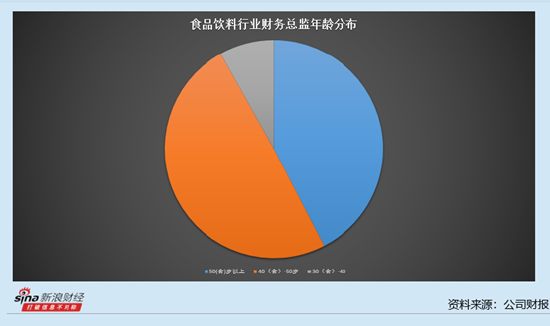
承德露露CFO丁兴贤年纪最大,达到62岁。丁兴贤目前身兼数职,是承德露露总经理、财务负责人, 2019年4月开始任职。元祖股份CFO刘政年纪最小,仅32岁,从2023年10月开始任职。 从学历来看,以本科为主,占比达到58%;其次是硕士,达到28%。专科有16名,占比达到12.4%。此 外博士有1名,为立高食品财务总监王世佳;中职也有一名,为春雪食品财务总监郝孔臣。 专题:专题|2024年度A股CFO数据报告:美的集团钟铮年薪946万,比亚迪周亚琳896万 从薪酬来看,A股食品饮料行业财务总监薪酬总金额为9415.59万元,薪酬均值为95.11万元。 作为上市公司核心管理层关键成员,财务总监CFO的地位与作用至关重要。新浪财经《2024年度A股 CFO数据报告》显示,2024年A股上市公司财务总监CFO群体薪酬规模合计达42.70亿元,平均年薪为 81.48万元。 分行业来看,A股市场99家食品行业公司财务总监薪酬均值为95.11万元(数据来源于choice,截止2024 年末任期不满1年的不参与统计,CFO包括部分公司总会计师等),高于市场均值。 从年龄分布来看,40(含)-50岁是主力人群,人数达到49位 ...


休闲食品板块8月8日跌0.36%,立高食品领跌,主力资金净流入4932.15万元
Zheng Xing Xing Ye Ri Bao· 2025-08-08 08:26
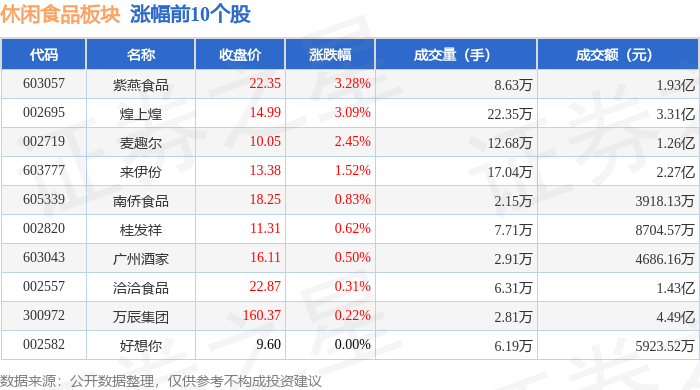
Core Viewpoint - The leisure food sector experienced a decline of 0.36% on August 8, with Lihigh Food leading the drop. The Shanghai Composite Index closed at 3635.13, down 0.12%, while the Shenzhen Component Index closed at 11128.67, down 0.26% [1]. Group 1: Stock Performance - Ziyan Food (603057) saw a closing price of 22.35, with an increase of 3.28% and a trading volume of 86,300 shares, amounting to a transaction value of 193 million yuan [1]. - Huangshanghuang (002695) closed at 14.99, up 3.09%, with a trading volume of 223,500 shares and a transaction value of 331 million yuan [1]. - Maichuer (002719) closed at 10.05, increasing by 2.45%, with a trading volume of 126,800 shares and a transaction value of 126 million yuan [1]. - Lihigh Food (300973) closed at 43.30, down 4.05%, with a trading volume of 32,800 shares and a transaction value of 143 million yuan [2]. - Yanjinpuzi (002847) closed at 70.82, down 2.77%, with a trading volume of 30,300 shares and a transaction value of 215 million yuan [2]. Group 2: Capital Flow - The leisure food sector saw a net inflow of 49.32 million yuan from main funds, while speculative funds had a net inflow of 8.76 million yuan. However, retail investors experienced a net outflow of 58.08 million yuan [2].




休闲食品板块8月7日涨2.84%,万辰集团领涨,主力资金净流入3.29亿元
Zheng Xing Xing Ye Ri Bao· 2025-08-07 08:27
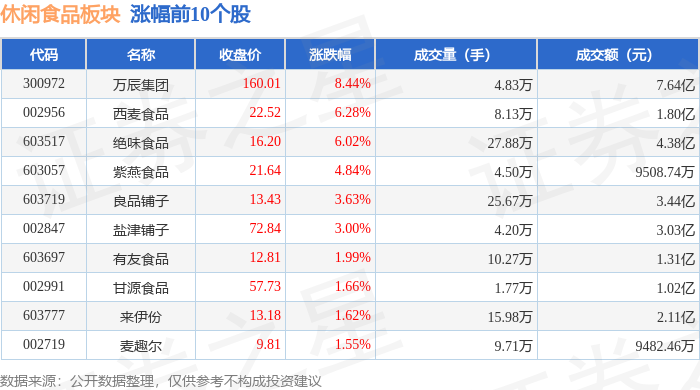
Market Overview - The leisure food sector increased by 2.84% on August 7, with Wancheng Group leading the gains [1] - The Shanghai Composite Index closed at 3639.67, up 0.16%, while the Shenzhen Component Index closed at 11157.94, down 0.18% [1] Key Performers - Wancheng Group (300972) closed at 160.01, up 8.44% with a trading volume of 48,300 lots and a transaction value of 764 million [1] - Ximai Food (002956) closed at 22.52, up 6.28% with a trading volume of 81,300 lots and a transaction value of 180 million [1] - Juewei Food (603517) closed at 16.20, up 6.02% with a trading volume of 278,800 lots and a transaction value of 438 million [1] - Ziyan Food (603057) closed at 21.64, up 4.84% with a trading volume of 45,000 lots and a transaction value of 9.51 million [1] - Liangpin Shop (603719) closed at 13.43, up 3.63% with a trading volume of 256,700 lots and a transaction value of 344 million [1] Capital Flow - The leisure food sector saw a net inflow of 329 million from main funds, while retail funds experienced a net outflow of 298 million [2][3] - Main funds showed significant net inflows in Wancheng Group (1.18 million) and Juewei Food (73.08 million) [3] - Retail funds had notable outflows in Wancheng Group (-1.33 million) and Juewei Food (-4.99 million) [3] Summary of Individual Stocks - Wancheng Group: Main fund inflow of 1.18 million, retail outflow of -1.33 million [3] - Juewei Food: Main fund inflow of 73.08 million, retail outflow of -4.99 million [3] - Liangpin Shop: Main fund inflow of 52.97 million, retail outflow of -4.61 million [3] - Ximai Food: Main fund inflow of 12.45 million, retail inflow of 721,530 [3]


你以为你吃的是麻六记,其实不过是代工“盲盒”
虎嗅APP· 2025-08-06 14:35
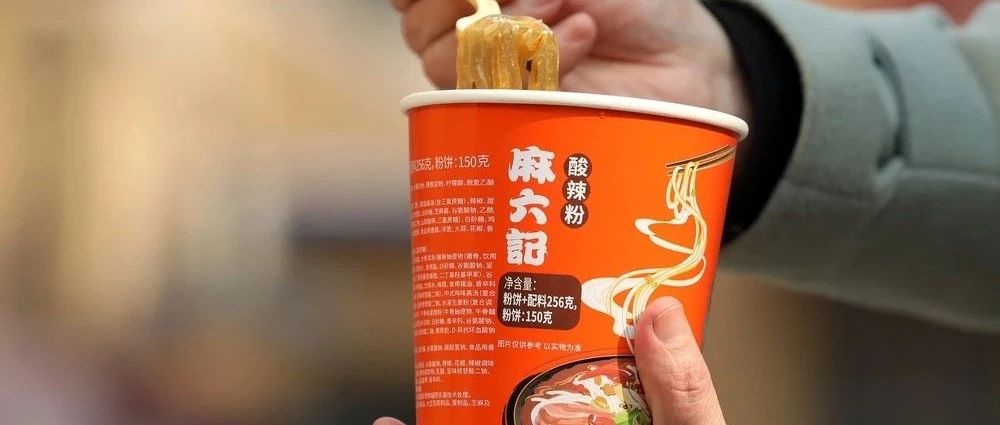
Core Viewpoint - The article highlights a significant food safety incident involving the brand "Ma Liu Ji," which exposes governance shortcomings in China's new consumption sector, particularly in the area of OEM (Original Equipment Manufacturer) production [2][11]. Group 1: Incident Overview - The incident began with reports of moldy and discolored "Ma Liu Ji" spicy noodles, leading to their removal from Costco stores due to quality concerns [2]. - The OEM factory, Sichuan Bai Jia A Kuan Food Industry Co., Ltd., acknowledged production deficiencies in sanitation, resulting in potential bacterial contamination [4]. - The brand's delayed response to the crisis, relying on consumer complaints and external pressures, indicates a failure in proactive governance [4][5]. Group 2: Governance Issues - The shared OEM model among multiple brands creates vulnerabilities, as issues in one brand can lead to widespread distrust across all brands using the same production line [5][10]. - Brand oversight is often limited to contractual agreements and random inspections, lacking real-time data and accountability mechanisms [5][9]. - The lack of transparency in production processes complicates the ability to trace responsibility when issues arise, leading to a "blind box" scenario for consumers [5][10]. Group 3: Broader Implications - The article draws parallels with other brands like "Lai Yi Fen," which have faced similar food safety controversies due to governance failures in their OEM practices [7]. - The reliance on a "light asset" model prioritizes marketing over production oversight, resulting in a lack of governance capabilities within many consumer brands [10][11]. - The article emphasizes that food safety should not solely rely on the integrity of companies but must be integrated into a robust governance framework [11][12]. Group 4: Recommendations for Improvement - Brands should clarify their responsibilities within the ESG (Environmental, Social, and Governance) framework, including supply chain management and compliance protocols [12]. - Establishing "ESG co-governance agreements" with OEM partners can enhance accountability and oversight [12]. - Implementing technology for real-time production data visibility can improve monitoring and governance of OEM practices [12].
你以为你吃的是麻六记,其实不过是代工“盲盒”
Hu Xiu· 2025-08-06 13:16
Core Viewpoint - The recent food safety incident involving the brand "Ma Liu Ji" highlights significant governance shortcomings in China's new consumption sector, particularly in the area of OEM (Original Equipment Manufacturer) production [1][2]. Group 1: Incident Overview - The incident began when "Ma Liu Ji" spicy noodles were reported to have issues such as discoloration, mold, and an unpleasant odor, leading to their removal from Costco stores [1]. - The OEM factory, Sichuan Bai Jia A Kuan Food Industry Co., Ltd., acknowledged the recall due to insufficient disinfection during production, which may have led to bacterial contamination [1][2]. - The brand's delayed response to the crisis, relying on consumer complaints and external pressure, exposed a governance vacuum where oversight was overly dependent on the OEM [2]. Group 2: Governance Issues - The shared OEM model among multiple brands can lead to industry-wide disasters when problems arise, as seen with the "Ma Liu Ji" incident affecting other brands like Li Zi Qi and San Zhi Song Shu [3][4]. - The governance structure is weak, with brands often lacking real-time oversight and accountability, relying instead on contractual agreements that do not translate into effective factory-level monitoring [4][6]. - The lack of transparency in production processes means that consumers may unknowingly purchase products from unregulated OEMs, leading to a "blind box" scenario where quality cannot be guaranteed [4][10]. Group 3: Broader Implications - The incident serves as a warning for the entire industry, indicating that without integrating OEM practices into ESG (Environmental, Social, and Governance) frameworks, food safety issues could become a significant risk [12]. - The reliance on a "light asset" model, where brands focus on marketing rather than production oversight, complicates the assignment of governance responsibilities and can lead to a cycle of blame when issues arise [10][11]. - The interconnected nature of the OEM model means that a single point of failure can lead to widespread trust issues across multiple brands, highlighting the need for a more robust governance structure [8][9].
来伊份入局威士忌,零食巨头布局威士忌该咋看?
3 6 Ke· 2025-08-04 05:58
Core Viewpoint - The entry of Laiyifen into the whiskey market signifies a shift in the traditional beverage landscape in China, challenging the dominance of traditional liquor such as Baijiu and Huangjiu [6][9]. Group 1: Laiyifen's Entry into Whiskey - Laiyifen has partnered with Shanghai Huwei Wine Industry Co., Ltd. to develop a whiskey brand called "Wang Kong," which is currently undergoing maturation in Shanghai's unique climate [3][4]. - The "Dong Cheng Xi Jiu" series, set to launch in May 2025, will feature two products matured for two years using Scottish lowland original liquor, showcasing the potential of Chinese whiskey [3]. - The maturation process in Shanghai is believed to enhance whiskey quality due to significant temperature fluctuations and humidity, which accelerates the interaction between the whiskey and the oak barrels [3][4]. Group 2: Industry Context and Opportunities - The traditional liquor market in China has been dominated by Baijiu and Huangjiu, with limited large-scale production of whiskey, making Laiyifen's move a significant disruption [6][9]. - China possesses favorable conditions for whiskey production, including diverse climates and abundant grain resources, particularly barley, which is essential for whiskey brewing [8]. - For companies like Laiyifen, entering the whiskey market is a strategic diversification to mitigate risks associated with intense competition in the snack industry and to leverage existing sales channels [9][11]. Group 3: Consumer Trends - There is a growing trend among Chinese consumers towards international and diverse consumption experiences, leading to increased interest in various alcoholic beverages, including whiskey [11]. - To succeed in the whiskey market, Laiyifen must innovate and create products that reflect unique Chinese flavors and characteristics, aligning with consumer preferences [11].

微信也没想到,小蓝包会被玩成这样吧
3 6 Ke· 2025-07-30 02:16
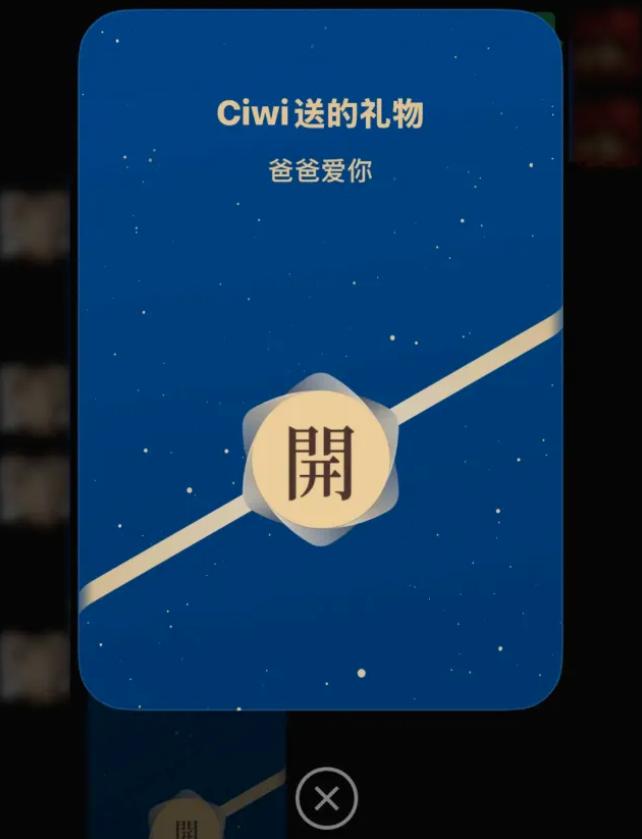
Core Insights - The article discusses the evolution and current state of WeChat's "Little Blue Bag" gift-giving feature, highlighting its unexpected popularity and the variety of gifts available [16][24][29] WeChat's Little Blue Bag Functionality - The Little Blue Bag feature was initially met with skepticism but has gained traction, with 93.7% of respondents aware of it and over 80% using it during the Spring Festival [16][24] - The feature allows users to send gifts individually or in groups, enhancing its usability for social interactions [21][24] Popularity and Sales Performance - During the Spring Festival, notable sales figures were reported, such as over 10 million yuan in sales for Three Squirrels and a 20-fold increase in GMV for certain brands [18][19] - The top three categories for gifts included food items, practical products, and emotional gifts, indicating a diverse range of offerings [19] User Engagement and Feedback - Users have shown a preference for quirky and unconventional gifts, with many expressing satisfaction in comments, suggesting a shift in how gifts are perceived [14][19] - The article notes that while the Little Blue Bag has gained popularity, it still faces challenges in competing with established e-commerce platforms in terms of product variety and pricing [26][28] Future Prospects - The company aims to embed the concept of e-commerce within WeChat through the Little Blue Bag, potentially changing consumer behavior over time [29][30] - There is an acknowledgment that for the Little Blue Bag to thrive, it must address pricing competitiveness and expand its product offerings beyond small gifts [28][29]

休闲食品板块7月29日跌1.22%,盐津铺子领跌,主力资金净流出1.73亿元
Zheng Xing Xing Ye Ri Bao· 2025-07-29 08:34
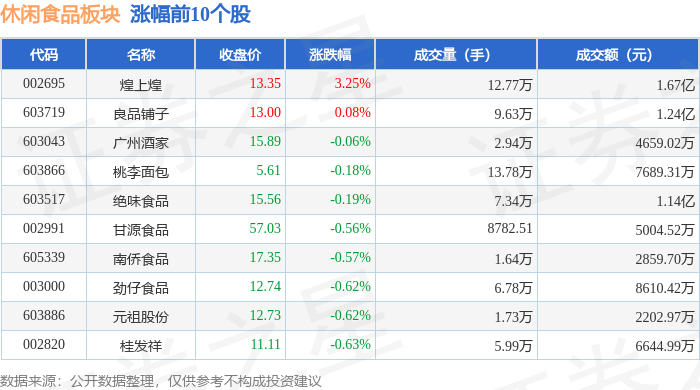
Market Overview - The leisure food sector experienced a decline of 1.22% on July 29, with Yanjinpuzi leading the drop [1] - The Shanghai Composite Index closed at 3609.71, up 0.33%, while the Shenzhen Component Index closed at 11289.41, up 0.64% [1] Individual Stock Performance - Huangshanghuang (002695) saw a price increase of 3.25%, closing at 13.35, with a trading volume of 127,700 shares and a turnover of 167 million yuan [1] - Yanjinpuzi (002847) reported a significant decline of 6.22%, closing at 69.69, with a trading volume of 50,100 shares and a turnover of 355 million yuan [2] - Other notable declines included Maquuer (002719) down 2.61% and Lihigh Food (300973) down 2.18% [2] Capital Flow Analysis - The leisure food sector saw a net outflow of 173 million yuan from institutional investors, while retail investors experienced a net inflow of 212 million yuan [2] - The capital flow for individual stocks showed varied trends, with Lihigh Food receiving a net inflow of 9.36 million yuan from institutional investors [3] - Conversely, Yanjinpuzi experienced a net outflow of 3.56 million yuan from institutional investors [3]

2024年商业特许经营TOP300发布 行业活力与展会机遇引关注
Sou Hu Cai Jing· 2025-07-28 09:05
Core Insights - The "2024 Commercial Franchise TOP 300" list was released by the China Chain Store & Franchise Association (CCFA), showcasing the annual development trends in the franchise sector [1] - The list includes 300 companies across 25 sub-sectors, with a total of 830,000 stores, reflecting a 30.73% increase from the previous year's 630,000 stores [1] - The distribution of sectors shows that the restaurant industry remains stable at 33.67%, retail slightly decreased to 40.00%, and the service industry increased to 26.33% [1] Industry Overview - The 2024 TOP 300 includes 101 restaurant companies, 120 retail companies, and 79 service companies, indicating a slight adjustment in consumer demand structure [1] - The number of franchise brands with over 10,000 stores increased from 9 in 2023 to 18 in 2024, highlighting the growing influence of leading brands in the market [1] - A total of 71 new franchise brands were added to the list, with 34 in the restaurant sector, 26 in services, and 11 in retail, demonstrating the sector's ongoing attractiveness [1] Event Insights - The 65th China Franchise Exhibition will be held from August 8-10 in Shanghai, focusing on the analysis of the TOP 300 list and featuring over 100 quality brands from various sectors [2] - The exhibition will include forums and workshops aimed at exploring growth strategies and promoting sustainable development in the franchise industry [2] - The CCFA Franchise Committee, established in 2015, has grown to include 69 member companies, advocating for the interests of various franchise sectors and promoting industry self-regulation [2]





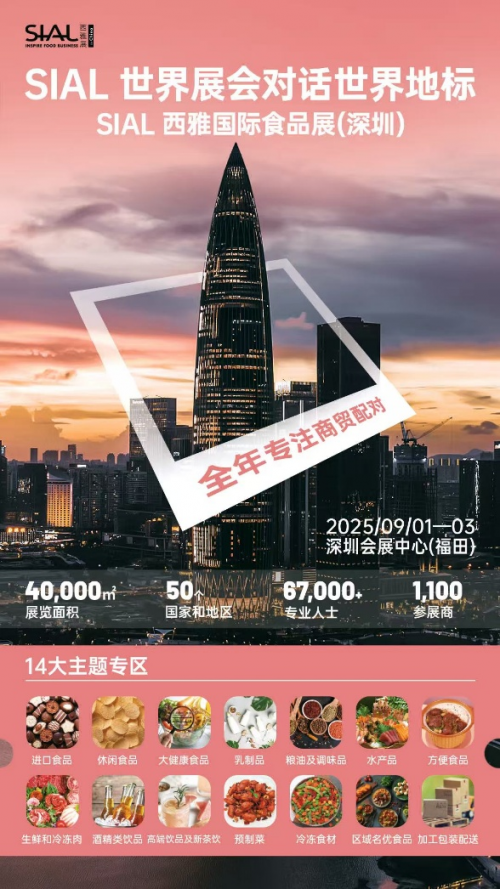
食品展健康升级,SIAL西雅展9月深圳响应健康中国2030,健康化创新成主流
Zhong Guo Shi Pin Wang· 2025-07-23 06:06
Core Insights - The transformation of the snack food industry is shifting from "pursuing tasty" to "pursuing quality," encompassing health, fun, and culture [1] - The SIAL International Food Exhibition in Shenzhen serves as a vital platform for the industry, injecting new vitality into the sector [1] Policy-Driven Health Innovation - National strategies are guiding the health-focused innovation in the snack food industry, with policies aimed at reducing sugar, salt, and oil, as well as promoting clean labels and nutrition [4][5] - The SIAL exhibition will gather over 1,100 exhibitors from 50 countries and regions, discussing pathways and opportunities for health innovation [5] Fun Integration and Young Market - Snack food companies are incorporating fun elements and cultural connotations to attract younger consumers [7] - Companies like Guangdong Jintian Animation Co., Ltd. and Dongguan Jinwang Food Co., Ltd. are leveraging popular IP collaborations to create products appealing to young consumers [7] Channel Innovation - The SIAL exhibition highlights channel innovations, such as Sam's Club's localization strategy, which accelerates the rise of Chinese snacks [9] - The introduction of WeChat's "gift" feature expands new consumption scenarios for snacks, presenting new growth points for the e-commerce sector [9] Supply and Demand Matching - The SIAL exhibition facilitates efficient cooperation and win-win scenarios through its supply-demand matching services, optimizing resource allocation [10] - A significant number of buyers from various channels, including retail, trade, and e-commerce, have pre-registered for the event, enhancing its international appeal [10] Industry Development - The SIAL International Food Exhibition is a key driver for the upgrade and development of the snack food industry, providing a platform for showcasing and exchanging ideas [11] - The exhibition supports companies with comprehensive solutions from product development to scene implementation, underpinned by policy and consumer upgrade dynamics [11]