欣旺达

Search documents
市场洞察:从工业控湿到家居防潮,除湿机如何适配全场景高湿难题?
Tou Bao Yan Jiu Yuan· 2026-01-20 12:36
Investment Rating - The report does not explicitly state an investment rating for the industry Core Insights - The dehumidifier market has evolved from a single-function device to a diverse product that addresses various air quality needs, with significant growth in applications across multiple sectors [2][7] - The household dehumidifier segment dominates the market, accounting for over 80% of total market share, driven by consumer demand for improved living conditions, especially in high-humidity regions of southern China [7] - The industrial dehumidifier market, while smaller, shows stable demand in specific sectors such as new energy, pharmaceuticals, and data centers, with a smaller decline in sales compared to household units [7] Summary by Sections Dehumidifier Types and Applications - Compression condensation dehumidifiers are the mainstream technology for household and commercial use, suitable for typical indoor environments [2] - Rotary dehumidifiers are used in low-temperature environments, ideal for laboratories and archives, but have higher energy consumption [3] - Household dehumidifiers focus on comfort and convenience, often featuring additional functions like air purification [4] - Commercial dehumidifiers are designed for durability and can service multiple areas, suitable for larger spaces like offices and hotels [5] - Industrial dehumidifiers are essential for maintaining optimal humidity in production environments, characterized by high stability and corrosion resistance [6] Regional Market Demand - In 2024, China's domestic and export markets for household dehumidifiers are projected to reach 1.526 million and 10.953 million units, respectively, with growth rates of 27.7% and 39.7% [11] - The export market is significantly larger than the domestic market, driven by differences in consumer habits and climate conditions [11] - The domestic market shows a clear regional disparity, with southern and eastern China accounting for over 50% of total shipments due to their high humidity climate [12] Impact of Lithium Battery Production - The expansion of lithium battery production is expected to drive demand for high-performance industrial dehumidifiers, as strict humidity control is critical in battery manufacturing processes [19] - The production of lithium batteries, particularly lithium iron phosphate batteries, has seen a significant increase, with a 71% year-on-year growth in installed capacity in the first half of 2025 [20] - The shift towards larger, centralized production lines necessitates more efficient and customized dehumidification solutions [20] Pharmaceutical Industry Trends - The pharmaceutical industry in China is experiencing steady growth, with revenue from large-scale enterprises projected to stabilize in 2024 [26] - Strict temperature and humidity control standards in pharmaceutical production and storage create significant opportunities for dehumidifier applications [27] - Future trends indicate a move towards high-precision, energy-efficient, and multifunctional dehumidifiers in the pharmaceutical sector, driven by technological advancements and increased quality demands [27]
中国除湿机行业调研简报:市场洞察:从工业控湿到家居防潮,除湿机如何适配全场景高湿难题?
Tou Bao Yan Jiu Yuan· 2026-01-20 12:24
Investment Rating - The report does not explicitly state an investment rating for the industry Core Insights - The dehumidifier market has evolved from a single-function device to a diverse product that addresses various air quality needs, with significant growth in applications across multiple sectors [2][7] - The household dehumidifier segment dominates the market, accounting for over 80% of total sales, driven by consumer demand for improved living conditions, especially in high-humidity regions of southern China [7] - The industrial dehumidifier market is also growing, particularly in sectors like new energy, pharmaceuticals, and data centers, despite a smaller overall market size [7] Summary by Relevant Sections Dehumidifier Types and Applications - Compression condensation dehumidifiers are the mainstream technology for home and commercial use, suitable for typical indoor environments [2] - Desiccant wheel dehumidifiers are used in specialized environments like laboratories and archives, where humidity control is critical [3] - Household dehumidifiers focus on comfort and convenience, often featuring additional functions like air purification [4] - Commercial dehumidifiers are designed for durability and can service multiple areas, suitable for larger spaces like offices and hotels [5] - Industrial dehumidifiers are essential for maintaining optimal humidity in production environments, characterized by high stability and corrosion resistance [6] Market Demand and Regional Differences - In 2024, China's domestic and export markets for household dehumidifiers are projected to reach 1.526 million and 10.953 million units, respectively, with growth rates of 27.7% and 39.7% [11][14] - The export market is significantly larger than the domestic market, driven by differences in consumer habits and climate conditions [11] - The domestic market shows a clear regional disparity, with southern and eastern China accounting for over 50% of total sales due to their humid climate [12][16] Impact of Lithium Battery Production - The expansion of lithium battery production is expected to increase demand for high-performance industrial dehumidifiers, as strict humidity control is critical in battery manufacturing processes [19][20] - The shift towards larger, centralized production lines necessitates more efficient and customized dehumidification solutions [20] Pharmaceutical Industry Trends - The pharmaceutical sector's growth will drive demand for high-precision, energy-efficient, and multifunctional dehumidifiers, as strict humidity control is essential for drug quality and safety [26][27] - The report highlights the increasing importance of humidity control standards in pharmaceutical production, with specific requirements for various processes [30]
动力电池年度榜单出炉:一线电池厂份额遭蚕食,新玩家登场 | 动力电池排名①
Xin Lang Cai Jing· 2026-01-20 11:45
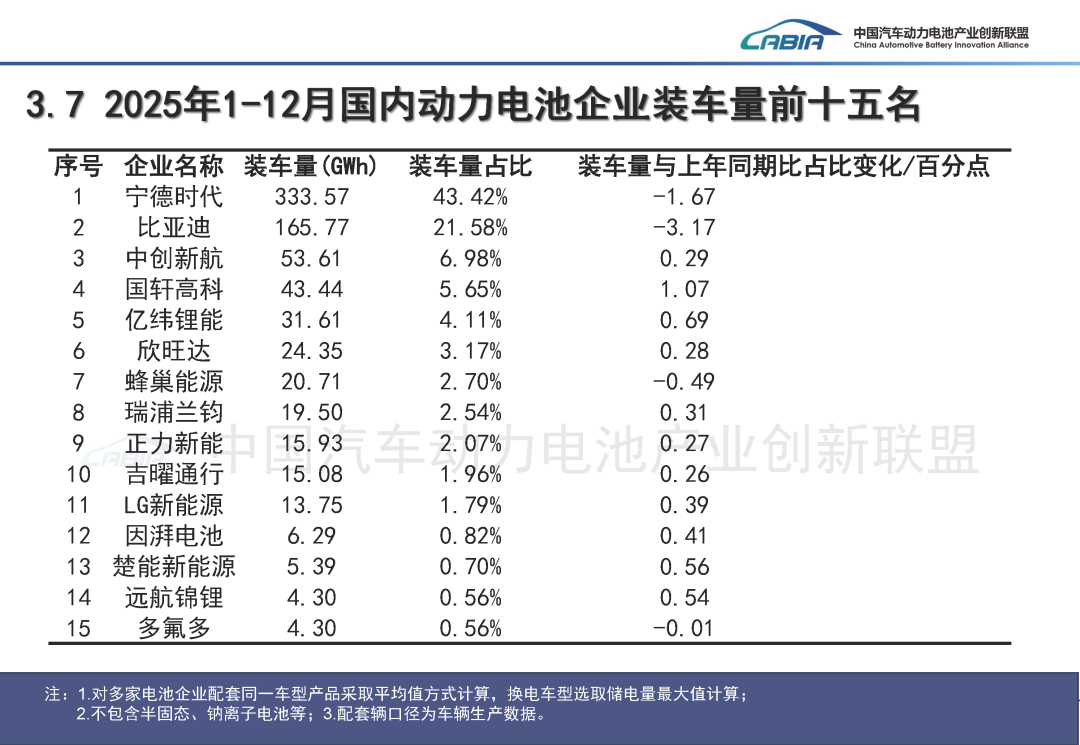
Core Viewpoint - The market share of leading battery manufacturers CATL and BYD has declined in 2025, with a combined drop of nearly 5 percentage points compared to the previous year [1][3]. Group 1: Market Performance - In 2025, the cumulative installed capacity of domestic power batteries is projected to reach 769.7 GWh, representing a year-on-year growth of 40.4% [2]. - Among the total installed capacity, ternary batteries account for 144.1 GWh (18.7%) with a year-on-year growth of 3.7%, while lithium iron phosphate batteries dominate with 625.3 GWh (81.2%) and a year-on-year growth of 52.9% [2]. - CATL leads the market with an installed capacity of 333.57 GWh, holding a market share of 43.42%, while BYD follows with 165.77 GWh and a market share of 21.58% [2][4]. Group 2: Market Share Changes - Both CATL and BYD experienced a decline in market share in 2025, with CATL down by 1.67 percentage points and BYD down by 3.17 percentage points, marking the largest declines among the top fifteen battery manufacturers [3][4]. - In contrast, the majority of second and third-tier battery manufacturers saw an increase in market share, indicating a competitive shift in the industry [5][6]. Group 3: Emerging Competitors - Guoxuan High-Tech recorded the highest market share growth among the top fifteen, achieving an installed capacity of 43.44 GWh and a market share increase of 1.07 percentage points [6][7]. - The rankings for the top five battery manufacturers remained unchanged, while the positions from sixth to fifteenth experienced significant reshuffling, with several new entrants making their debut [8][10]. - New companies like Jiyao Tongxing and Choneng New Energy have entered the top fifteen list, reflecting the growing trend of automakers developing their own battery solutions [11][14]. Group 4: Overall Industry Trends - The total production of power and other batteries in China reached 778.1 GWh in the previous year, with a year-on-year growth of 42.5% [15]. - The cumulative sales of power and energy storage batteries amounted to 1,700.5 GWh, with power batteries accounting for 1,200.9 GWh (70.6%) and energy storage batteries for 499.6 GWh (29.4%) [16]. - The export of power batteries reached 189.7 GWh, representing 62.2% of total exports, with a year-on-year growth of 41.9% [17].



电池板块承压,阳光电源跌超5%,电池50ETF(159796)跌超2%,四连涨后首度回调,固态电池催化密集落地,产业化进程提速!
Xin Lang Cai Jing· 2026-01-20 11:44
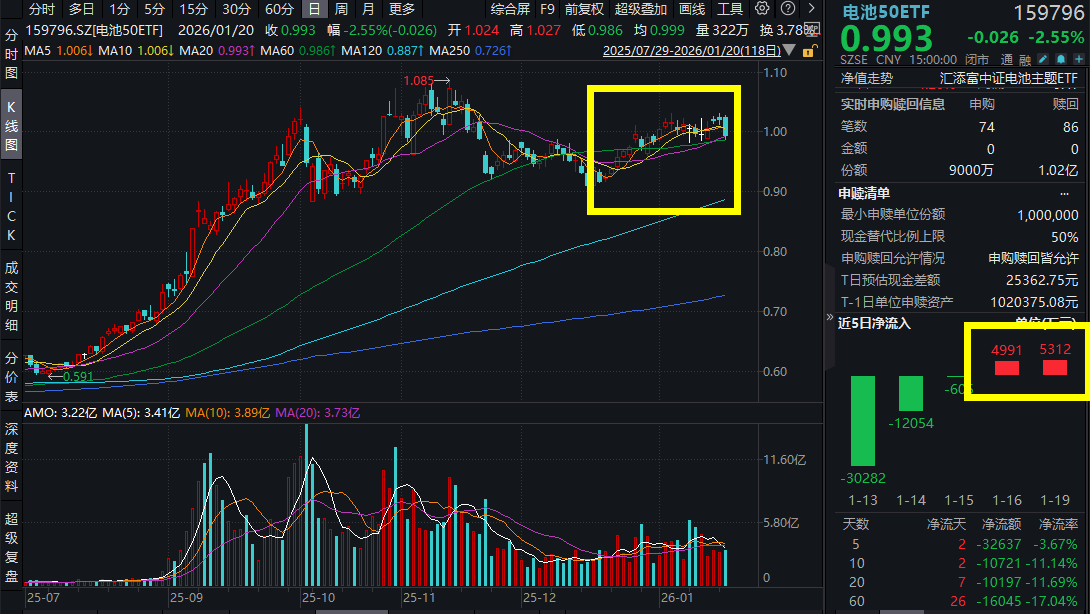
Core Viewpoint - The A-share market experienced fluctuations with the battery sector under pressure, as evidenced by the decline of the Battery 50 ETF (159796) by 2.55% after four consecutive days of gains, with a trading volume of 322 million yuan [1]. Group 1: Market Performance - The Battery 50 ETF (159796) saw most of its constituent stocks decline, with significant drops including Sunshine Power down over 5%, and others like Xian Dao Intelligent and Multi-Fluorine down over 4% [3]. - The top ten constituent stocks of the Battery 50 ETF include major players such as Sunshine Power and Ningde Times, with varying declines in their stock prices [4]. Group 2: Project Announcements - On January 19, China Energy Construction announced the procurement results for a 153 MW battery storage project in South Africa, with Sunshine Power winning the bid for a total project capacity of 742.22 MWh and a contract value of 528 million yuan (approximately 0.86 yuan/Wh) [5]. Group 3: Industry Trends - The battery sector is expected to recover due to multiple catalysts, including a surge in demand for energy storage, rising material prices, and accelerated solid-state battery technology [6]. - Global demand for large-scale energy storage is projected to exceed expectations, with a forecasted growth of over 60% by 2026, driven by various market factors including the U.S. Inflation Reduction Act [7]. - Prices of upstream raw materials have generally increased, with battery-grade lithium carbonate rising by 64.4% to 157,000 yuan/ton, and lithium hydroxide up by 77.51% to 150,000 yuan/ton as of January 16, 2026 [8]. Group 4: Technological Developments - The solid-state battery sector is witnessing rapid advancements, with significant policy support and market catalysts enhancing industry prospects [9]. - Major automotive manufacturers are accelerating the integration of solid-state batteries, with companies like FAW Hongqi and GAC Group making substantial progress towards mass production by 2027 [9]. Group 5: Investment Opportunities - The Battery 50 ETF (159796) is positioned to benefit significantly from the energy storage sector, with a storage component of 18.7%, and a solid-state battery component of 45%, indicating strong growth potential [10]. - The ETF's focus on energy storage and power batteries, along with its low management fee of 0.15% per year, makes it an attractive investment option for capturing opportunities in the battery sector [16].



行业洞察 | 新能源装备制造产业城市竞争力TOP50揭晓:苏州问鼎,长三角集群领跑
Zhong Guo Jin Rong Xin Xi Wang· 2026-01-20 11:40
Core Insights - The Chinese new energy equipment manufacturing industry is transitioning from resource development to high-end manufacturing under the "dual carbon" strategy [2] - The "2025 China New Energy Equipment Manufacturing Industry City Competitiveness TOP 50" list was released, ranking cities based on six core dimensions and over 60 indicators [2] - Suzhou, Jiangsu Province, topped the list with a score of 87.71, followed closely by Shenzhen (87.63) and Changzhou (87.47) [2] Industry Overview - The list highlights a new industrial pattern characterized by "Yangtze River Delta cluster leadership and multi-polar collaborative breakthroughs" [2] - The East China region is a key player in the new energy equipment manufacturing industry, with cities from the Yangtze River Delta accounting for about half of the top 50 [12] City Rankings - The top ten cities in the new energy equipment manufacturing sector include: 1. Suzhou, Jiangsu 2. Shenzhen, Guangdong 3. Changzhou, Jiangsu 4. Wuxi, Jiangsu 5. Shanghai 6. Ningde, Fujian 7. Ningbo, Zhejiang 8. Beijing 9. Hefei, Anhui 10. Nantong, Jiangsu [8][12] Suzhou's Competitive Edge - Suzhou's success is attributed to its "full-chain layout" and "supporting advantages," with a comprehensive new energy industry system covering solar, energy storage, power batteries, wind power, smart grids, hydrogen energy, and green low-carbon + new energy vehicles [12] - The city aims to exceed 1 trillion yuan in new energy industry output by 2026, establishing itself as a fourth trillion-level industrial cluster [12] - Suzhou ranks first in "enterprise aggregation" (91.51) and "development effectiveness" (88.98) [12] Other Notable Cities - Changzhou is recognized as the "capital of new energy," with a significant share of national power battery production [13] - Wuxi focuses on a modern industrial cluster strategy, while Shanghai leads in high-end equipment with strong research and financial capabilities [13] - Shenzhen, as the only non-Yangtze River Delta city in the top three, excels in innovation with a score of 89.24 in the "innovation momentum" category [14] Future Trends - The industry is expected to shift towards green manufacturing, lifecycle carbon management, and deep integration of intelligence and digitalization [15] - The competition will evolve from production capacity to standards, green practices, and intelligence [16] - Cities that enhance core technology, optimize industrial ecosystems, and expand global markets will gain a competitive advantage in the future [16]

璞泰来2025年净利大幅预增 湿法隔膜与涂覆加工业务量同步增长
Zheng Quan Shi Bao Wang· 2026-01-20 09:57
Core Viewpoint - Puxin Technology (璞泰来) expects a net profit of 2.3 to 2.4 billion yuan for the year 2025, representing a year-on-year increase of 93.18% to 101.58% due to favorable market conditions and operational improvements [1] Group 1: Business Overview - Puxin Technology's main business includes key materials for new energy batteries and automation equipment and services, with products such as anode materials, coated separators, PVDF, binders, nano-alumina, and aluminum-plastic packaging films [1] - The company is experiencing a recovery in performance driven by the end of the inventory cycle in the new energy battery and materials sector, alongside strong demand in the automotive and energy storage markets [1] Group 2: Operational Improvements - The wet separator and coating processing business has seen significant growth, with an increase in self-sufficiency of base films, enhancing the synergy of "materials + equipment + processes" [2] - The company has focused on cost reduction in graphite anode materials and is responding to mainstream customer demands for fast charging, long cycle life, and high-capacity products, leading to a recovery in business operations [2] Group 3: Global Strategy and Market Position - Puxin Technology is planning to issue H-shares and list on the Hong Kong Stock Exchange to enhance its global strategic layout and leverage international capital market advantages for overseas business development [2] - The company has strengthened its global presence, supplying major battery manufacturers and automotive companies, including CATL, LG Energy, Samsung SDI, BYD, and others [3] Group 4: Future Goals - For 2026, Puxin Technology aims to achieve a shipment target of 250,000 tons for anode materials, 13 billion square meters for coated separators, 2 to 2.5 billion square meters for base films, and over 40,000 tons for PVDF [3]

邀请函:2026(第二届)起点锂电圆柱电池技术论坛暨圆柱电池20强排行榜发布会4月10日深圳举办!
起点锂电· 2026-01-20 07:31
Group 1 - The core viewpoint of the article highlights the explosive growth of the large cylindrical battery and all-tab technology market, with a projected increase of over 15% in China's cylindrical battery shipments by 2025, and a growth rate exceeding 40% for large cylindrical batteries [3] - Major companies in the large cylindrical battery sector, such as EVE Energy, Molicel, and others, are expected to face supply shortages due to high demand, indicating a robust market outlook for 2026 [3] - The article emphasizes the rapid adoption of large cylindrical battery products in various applications, including lightweight power, electric two- and three-wheelers, portable and home energy storage, and automotive power [3] Group 2 - The event, organized by Qidian Lithium Battery and Qidian Research Institute (SPIR), aims to discuss cutting-edge technologies, processes, and materials related to cylindrical batteries, showcasing the industry's advancements [6][7] - The agenda includes sessions on high-power cylindrical battery technology, innovations in household and portable energy storage, and the development of next-generation large cylindrical batteries [7][8] - A comprehensive ranking of the top 20 companies in the cylindrical battery sector will be released, providing valuable procurement references for the industry [3][8] Group 3 - The forum will feature discussions on the integration of new technologies such as all-tab, high nickel, silicon-carbon, and sodium batteries with cylindrical batteries, creating new growth points and market opportunities [3] - The event is expected to attract over 600 participants, including leading companies in the cylindrical battery sector, downstream application enterprises, and equipment manufacturers [6][10] - The forum will also address challenges and innovations in the manufacturing of large cylindrical batteries, including cost-performance balance and the industrialization of new materials [8][9]

30+固态电池企业新进展
DT新材料· 2026-01-19 22:33
Core Viewpoint - The article discusses the advancements and production timelines of solid-state batteries from various companies, highlighting the competitive landscape and technological progress leading up to 2026 and beyond [4]. Group 1: Company Developments - CATL launched the world's first sulfide solid-state battery pilot line in Hefei in May 2025, achieving an energy density of 450Wh/kg, with plans to expand production capacity to 50GWh by 2026 [6]. - Guoxuan High-Tech introduced its "Guan" quasi-solid-state square aluminum shell cell with an energy density greater than 300Wh/kg and initiated a pilot line with a 90% yield rate in May 2025 [8]. - EVE Energy's solid-state battery, "Longquan No. 2," achieved an energy density of 300Wh/kg and is aimed at high-end applications like humanoid robots and low-altitude aircraft [8]. - Aoxin Technology plans to launch its polymer solid-state battery with an energy density of 400Wh/kg by the end of 2025, targeting high-end new energy vehicles [8]. - Ganfeng Lithium announced the mass production of lithium sulfide, completing the last link in the solid-state battery ecosystem, with plans to launch solid-state batteries by the end of 2025 [9]. Group 2: Industry Trends - The solid-state battery industry is expected to enter a critical year in 2026, with many companies racing to achieve mass production [4]. - The article outlines the competitive landscape, with over 30 companies making significant strides in solid-state battery technology, indicating a robust growth trajectory in the sector [4]. - The anticipated commercialization of solid-state batteries is projected for around 2030, as supply chains mature and production processes are refined [6].



刚因“电芯”遭23亿天价索赔,欣旺达又卷入沃尔沃全球召回风波
Guo Ji Jin Rong Bao· 2026-01-19 13:00
Core Viewpoint - The recent recall of Volvo's electric vehicle EX30 due to battery safety issues has raised concerns about the responsibility of the battery supplier, A123, and has compounded existing sales pressures on Volvo [2][3][5]. Group 1: Volvo's Recall and Sales Performance - Volvo has initiated a global recall of its EX30 electric model due to high-voltage battery overheating risks, affecting markets including the US, Canada, South Africa, and Australia [2]. - In the UK, 10,440 units of the EX30 are confirmed to be affected, covering models from 2024 to 2026 [2]. - Volvo's global sales in 2024 are projected at 763,400 units, an 8% increase year-on-year, but sales in China, its largest market, have dropped to 156,400 units, the lowest in five years [4]. Group 2: Financial Impact and Battery Supplier Issues - In Q3 2023, Volvo's global sales fell to 160,500 units, a 7% year-on-year decline, with revenues of 86.4 billion Swedish Krona, down 6% [5]. - The recall has sparked controversy over battery supply responsibilities, with reports indicating that the problematic battery cells were produced by a joint venture involving A123 [5][6]. - A123's chairman stated that the battery packs were supplied through a different factory, distancing the company from direct responsibility for the issues [5]. Group 3: A123's Challenges and Market Position - A123 is facing significant challenges, including a recent lawsuit from Zeekr over battery quality issues, which has intensified scrutiny on the company's reliability [6][9]. - The company has seen a reduction in orders from key clients like Li Auto and Xiaomi, with the number of models supported by A123 for Li Auto dropping from 10 to 3 [9]. - A123's aggressive pricing strategy has led to declining profit margins, with a gross margin of only 9.77% in H1 2025, significantly lower than competitors [10]. Group 4: Financial Health and Future Outlook - A123 reported a loss of 1.87 billion Yuan in 2024, with cumulative losses exceeding 4.5 billion Yuan from 2023 to H1 2025 [10]. - The company's debt levels have risen sharply, with a debt-to-asset ratio of 67.62% and total liabilities reaching 67.9 billion Yuan [10]. - Concerns about ongoing litigation and financial losses may hinder A123's plans for an IPO in Hong Kong, which was anticipated for 2026 [10].
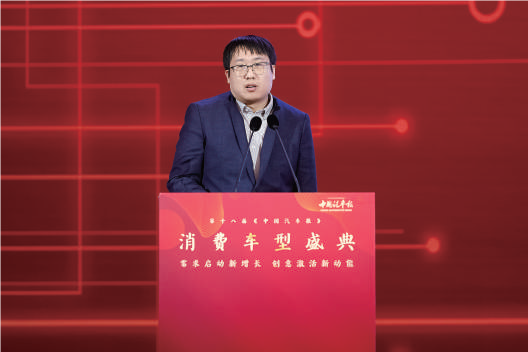
欣旺达动力总裁助理/产品线总经理何轩:超充型电池引领行业变革
Zhong Guo Qi Che Bao Wang· 2026-01-19 03:31
Core Insights - The company, XWANDA, is focusing on a dual-driven strategy of "hybrid on the left, pure electric on the right" to empower automotive companies in their transition to electric vehicles, showcasing its precise understanding of market demands and technological innovation [1][3]. Market Analysis - The global electric vehicle market exhibits differentiated characteristics, with the domestic market seeing a rise in pure electric vehicles due to improved charging infrastructure, while the overseas market, particularly Europe, is experiencing over 40% growth in hybrid models due to Chinese companies expanding internationally [3]. - In China, the market has entered a late-stage mass adoption phase, shifting user demands from policy-driven and cost-effective solutions to longer range, convenient charging, and lifecycle safety, necessitating a multi-dimensional balance in battery products [3]. Product Strategy - XWANDA has developed three platform systems: Xingchi, Xingyao, and Xinghuan, catering to various vehicle types including economical, high-end, and PHEV/BEV cylindrical cells, thus achieving comprehensive coverage across all application scenarios [3]. - The company’s ultra-fast charging technology leads the pure electric vehicle sector, with the latest version of its battery achieving a peak charging rate of 15C and a peak charging power exceeding 1.4 MW, allowing for a 20% SOC recharge in just one minute [4]. Hybrid Solutions - In the hybrid sector, XWANDA is targeting a projected market of 10 million HEVs by 2030, offering high-power battery solutions with significant performance advantages, including a 40% market share in Europe [5]. - The company’s hybrid batteries utilize fast charging technology, achieving a peak charging rate of 4-8C and covering ranges of 200-500 kilometers, with specific solutions designed for A00 to A-class vehicles [5]. Technological Innovation - XWANDA emphasizes technological innovation and safety as core competitive advantages, utilizing AI for battery development and management, and implementing rigorous testing standards to ensure safety and reliability [6]. - The company has successfully equipped nearly 2 million HEV products, with significant partnerships with major automotive brands, demonstrating the strength of its product offerings [6]. Future Outlook - XWANDA aims to continue leveraging its ultra-fast charging technology across its product lines, providing solutions for both hybrid and pure electric vehicles, thereby contributing to the high-quality development of the electric vehicle industry globally [6].