歌尔股份

Search documents
消费电子ETF(561600)盘中涨超1.1%,苹果折叠机型入局,驱动折叠屏市场加速成熟
Xin Lang Cai Jing· 2025-12-19 03:09
截至2025年12月19日 10:37,中证消费电子主题指数(931494)上涨0.77%,成分股电连技术(300679)上涨 4.48%,信维通信(300136)上涨4.05%,长盈精密(300115)上涨3.58%,歌尔股份(002241)上涨2.39%,通 富微电(002156)上涨2.24%。消费电子ETF(561600)盘中一度涨超1.1%,现上涨0.87%,最新价报1.16 元。 消费电子ETF(561600),场外联接(平安中证消费电子主题ETF发起式联接A:015894;平安中证消费电 子主题ETF发起式联接C:015895;平安中证消费电子主题ETF发起式联接E:024557)。 数据来源:wind 风险提示:基金有风险,投资需谨慎。基金管理人承诺以诚实信用、勤勉尽责的原则管理和运用基金资 产,但不保证本基金一定盈利,也不保证最低收益。基金管理人提醒投资人基金投资的"买者自负"原 则,在做出投资决策后,基金运营状况与基金净值变化引致的投资风险,由投资人自行负担。基金的过 往业绩及其净值高低并不预示其未来业绩表现,基金管理人管理的其他基金的业绩不构成对本基金业绩 表现的保证。投资人购买基金,既 ...
歌尔光学增资舜宇奥来微纳光电,舜宇光学成为第二大股东
Jin Rong Jie· 2025-12-18 10:14
Group 1 - The core point of the article is the recent change in ownership and management of Sunyu Aolai Micro-Nano Optoelectronic Information Technology (Shanghai) Co., Ltd, with GoerTek becoming the new sole shareholder [1] - The original shareholder, Ningbo Sunyu Aolai Technology Co., Ltd, has exited the company [1] - The legal representative of the company has changed from Ye Lianing to Rao Yi [1] Group 2 - Sunyu Aolai Micro-Nano Optoelectronic Information Technology (Shanghai) Co., Ltd was established in January 2021 with a registered capital of 143 million RMB [1] - The company's business scope includes manufacturing optical instruments, optoelectronic devices, and electronic components and electromechanical component equipment [1]


烹饪机器人企业智谷天厨完成数千万元A轮融资,启赋资本投资
机器人圈· 2025-12-18 09:46
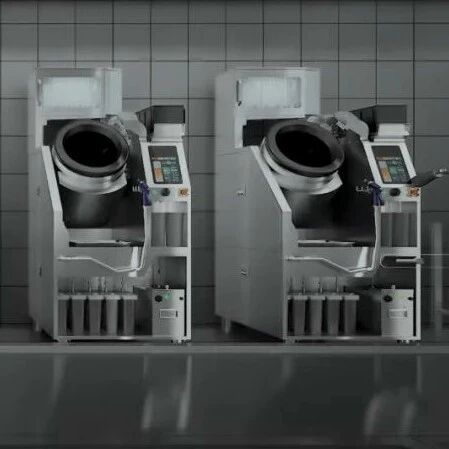
Core Insights - Zhigu Tianchu, a cooking robot company, has completed several rounds of financing, raising over 100 million yuan, with the latest A round led by Qifu Capital [2] - The company will undergo a brand upgrade and officially change its name to "Qianyi Intelligent" in early 2026 [2] - Founded in November 2018, Zhigu Tianchu employs a dual-driven model of "technology research and development + scene implementation," with over 60% of its team dedicated to R&D [2] Business Segmentation - Zhigu Tianchu has divided its business into three main segments: domestic social catering, domestic group catering, and overseas markets, establishing a customer-centric and efficient operational system [2] - The product architecture is designed around various scenarios, including group meals, chain restaurants, and overseas markets, creating clear functional gradients and market positioning [2] Technological Advancements - The company has developed an AI dynamic cooking algorithm and full premixed combustion technology, integrating hardware, software, and data into a comprehensive solution [2] - A team led by post-90s PhDs is focused on developing a "catering embodied brain," utilizing data from diverse cooking processes to enhance decision-making and optimization in cooking robots [4] Market Performance - Zhigu Tianchu has established deep partnerships with major companies like Muyuan, GoerTek, and Foxconn, achieving a record single order of 150 million yuan [4] - The company anticipates that its order volume will exceed 300 million yuan by 2026, with ongoing repurchases from leading industry clients [4] - Since October, the daily visit rate to overseas market clients has increased three to four times, with an overall transaction rate of 50% [4] Service Model - The company has created a comprehensive service system consisting of modular products, local hardware support, and remote software services, successfully implemented in multiple countries and regions including North America, Europe, Australia, Japan, Vietnam, Thailand, Indonesia, and Malaysia [4]

价值百强撑起万亿市值 综合实力持续提升
Zheng Quan Shi Bao· 2025-12-17 19:26
证券时报记者 杨霞 近日,"第十九届上市公司价值论坛暨2025新质生产力巡礼宜宾行"在四川宜宾举行,"第十九届上市公司价值评 选"获奖公司也同步揭晓。 由证券时报主办的上市公司价值评选活动是资本市场一年一度的盛事,迄今已成功举办至第十九届。在资本市场 深化改革与高质量发展的时代浪潮中,上市公司作为经济"基本盘"的价值愈发凸显。本文以主板百强公司为样 本,分析这些公司的行业特征和基本面质量,挖掘19年来A股价值龙头的变动趋势和个股穿越牛熊的核心逻辑。 百强企业构筑价值高地 本次入选主板百强的企业堪称中国资本市场的中流砥柱,这些行业领军者以卓越的综合实力构筑起A股市场的价值 高地。 数据显示,百强企业总市值达19.13万亿元,占全部A股总市值的18.15%,聚集了各个行业的龙头企业。其中,石 化行业的中国石油、保险业的中国平安、通信领域的中国移动与中国电信,以及新能源汽车领军者比亚迪等企业 市值排名居前。 从市值结构看,百强企业呈现显著的头部聚集效应:超半数企业市值超千亿元,贵州茅台与中国石油以万亿市值 稳居市场前列,中国人寿、比亚迪、长江电力等9家企业市值逾5000亿元,构成稳定的中坚力量。 投资者回报是检验上 ...

舜宇光学20251217
2025-12-17 15:50
Summary of the Conference Call for Sunny Optical Technology Group Co., Ltd. Industry Overview - The automotive lens market has significant growth potential, with an expected average of 4.3 cameras per vehicle by 2025, and over 10 cameras in new energy vehicles [2][3] - The XR (Extended Reality) sector shows mixed performance, with weak demand in the VR market but strong performance in smart glasses, particularly driven by a major North American client launching four smart glasses in September 2025 [2][5] - The smartphone market is saturated, with expected shipment volumes in 2025 remaining flat or showing low single-digit growth [2][6] Key Points and Arguments Automotive Sector - Sunny Optical's shipments in the automotive market grew nearly 28% from January to November 2025, driven by the increasing demand for Advanced Driver Assistance Systems (ADAS) [3] - The company has developed ADAS products with 17 to 18 million pixels, positioning itself as a technology leader [2][3] - Future trends include miniaturization and self-cleaning features for automotive lenses, with expectations of over 20% revenue growth in automotive lenses and modules by 2025 [2][4] XR Sector - The smart glasses market is expected to see an increase in the number of cameras per device, potentially exceeding 10, as applications and functionalities expand [2][5] - Despite the VR market's underperformance, the XR-related business revenue is expected to remain stable compared to the previous year [2][5] Smartphone Sector - The company is focusing on high-end product lines, anticipating a 5% to 10% revenue growth in smartphone lenses and modules, with average selling prices (ASP) and gross margins improving [2][6] - The ASP is projected to achieve double-digit growth for the year, with module gross margins expected to be between 8% and 10% [6] Collaboration and Strategic Initiatives - Sunny Optical collaborates with GoerTek in the waveguide segment, focusing on AR technology, although the AR market's slow development has not yet translated into significant performance improvements [2][7] - The partnership involves resource concentration through asset swaps and capital increases, with specific roles still under discussion [7] Future Business Guidance - The company is optimistic about future developments across its business segments, although specific guidance is not yet available due to budget considerations [7][8] - The company is exploring emerging automotive business areas such as LiDAR and HUD smart headlights, with a significant project in LiDAR exceeding 1.5 billion RMB in the first half of 2025 [3][8] Production and Supply Chain - The production capacity is primarily domestic, with a focus on improving utilization rates, especially in smartphone modules, which are expected to reach 80-90% in the second half of 2025 [11] - Geopolitical factors have limited impact on production and supply chains, with existing production bases in Vietnam and India allowing flexibility to meet international client demands [12][10] Financial Considerations - The company is considering increasing dividend payouts and share buyback plans, balancing these with R&D investments and operational funding [14] Additional Important Insights - The company has seen a doubling in revenue from wave-speed hybrid lenses in the first half of 2025, indicating strong market demand for high-end products [13] - The company is prepared to respond quickly to expansion needs, with existing facilities ready for equipment procurement [11]
近五年年化9%,这只偏债基金如何炼成的?|1分钟了解一只吾股好基(七十)
市值风云· 2025-12-17 10:07
Core Viewpoint - The article introduces the "Xingye Juhua Mixed A" fund, managed by seasoned fixed-income investor Ding Jin, which employs a "fixed income plus" strategy to pursue stable returns while controlling volatility [3][27]. Fund Overview - Xingye Juhua Mixed A was established in March 2020 and has been managed by Ding Jin since inception, achieving an annualized return of 9.6% [4]. - The fund's current combined scale exceeds 1.9 billion [3]. - Year-to-date performance shows a return of +15.77%, with a +69.43% return since inception, outperforming the CSI 300 index which returned +23.11% [5]. Performance Analysis - Under Ding Jin's management, the fund has consistently outperformed its benchmark and peers in most complete years, with a maximum drawdown of less than 10% [8][9]. - The fund's performance in recent years includes a return of 16.32% in 2025 and 13.42% in 2024, while it faced a slight decline of -4.07% in 2022 [9]. Investment Strategy - As a mixed-asset fund, Xingye Juhua maintains a stock investment ratio between 0%-40%, with fixed income assets serving as the foundation [16]. - The fund has maintained an equity position around 36%, enhancing its flexibility [17]. - The investment strategy balances value and growth, focusing on sectors like pharmaceuticals, telecommunications, and electronics [19]. Holdings and Concentration - The top ten holdings account for over 75% of the fund's equity market value, indicating a concentrated portfolio [21]. - Major holdings include Midea Group, Luxshare Precision, and Mindray Medical, with significant weightings in each [21]. Bond Allocation - The bond allocation primarily consists of convertible bonds and financial bonds, focusing on high-rated bank bonds for safety and limited downside risk [22]. - The fund has been reducing its convertible bond position in response to a strengthening market, maintaining a defensive allocation [25]. Institutional Interest - The fund has garnered significant institutional interest, with over 80% of the A-class shares held by institutional investors as of June 30, 2025 [27]. Target Audience - The fund is positioned as an attractive option for individual investors seeking higher returns than pure bond funds while maintaining lower volatility than equity funds [29].

领益智造赴港IPO:大客户依赖下增收不增利 多元化布局成效寥寥 此次递表恰逢“果链”估值回调期
Xin Lang Cai Jing· 2025-12-17 09:51
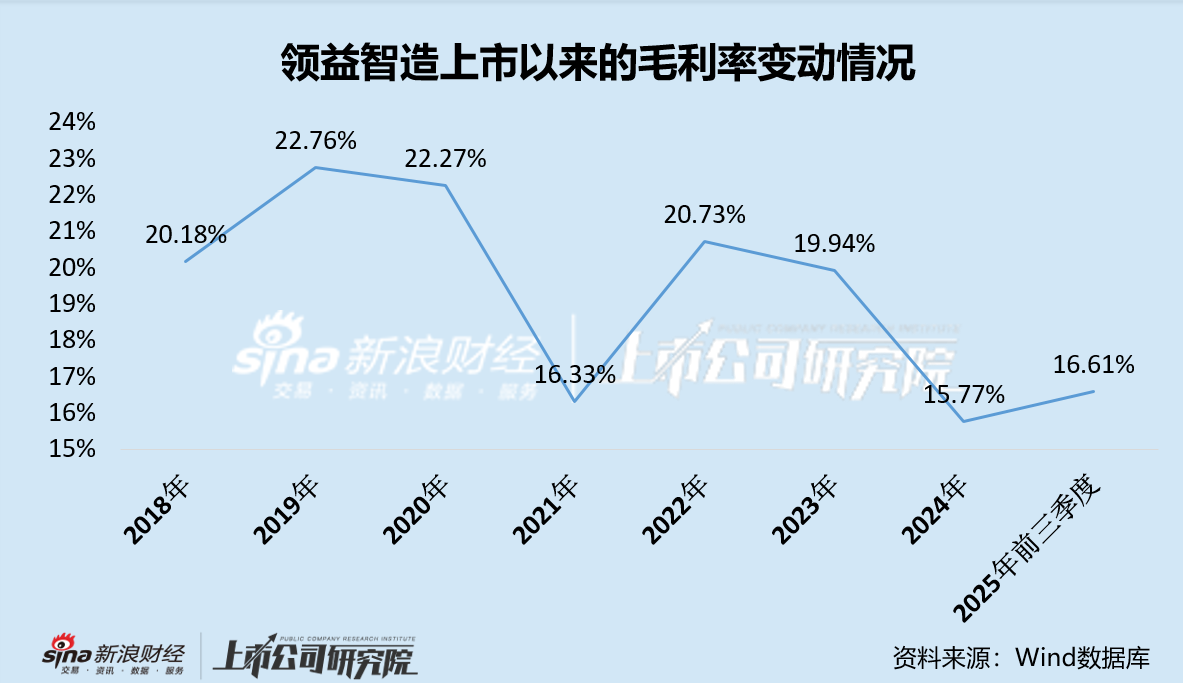
Core Viewpoint - Lingyi Technology is seeking a dual listing on the Hong Kong Stock Exchange, positioning itself as a global core AI hardware precision manufacturing platform, despite its business structure remaining largely unchanged [1]. Group 1: Company Overview - Lingyi Technology was established in 2006 and initially entered the consumer electronics market through die-cutting technology, later becoming part of Apple's supply chain in 2008 [2]. - The company achieved a significant revenue increase from 22.5 billion yuan in 2018 to 44.2 billion yuan in 2024, effectively doubling its revenue [2]. - The reliance on major clients has increased, with revenue from the top five clients rising from 44.26% in 2020 to 56.04% in the first three quarters of 2025 [2]. Group 2: Financial Performance - Despite doubling revenue, the net profit attributable to shareholders has fluctuated, decreasing from 1.894 billion yuan in 2019 to 1.753 billion yuan in 2024, with a peak of no more than 2.3 billion yuan [3]. - The gross margin has declined from over 22% in 2019-2020 to around 15% in recent years, with 2024's gross margin at 15.77% and the first three quarters of 2025 at 16.61% [3]. Group 3: Market Challenges - The company has faced significant impacts from shifts in downstream customer procurement needs, particularly in 2021 and 2024, leading to a drop in overall gross margin [5]. - The performance and stock price of Lingyi Technology are heavily influenced by its major clients, a common issue among "fruit chain" companies [6]. Group 4: Diversification Efforts - To mitigate reliance on Apple, Lingyi Technology is pursuing diversification through acquisitions and investments, targeting automotive and intelligent robotics sectors [12]. - Recent acquisitions include a 95% stake in Zhejiang Jintai for 38 million yuan and stakes in Jiangsu Keda and Zhejiang Xianglong for 3.32 billion yuan and 2.404 billion yuan, respectively [13]. - The automotive business, while growing rapidly, accounted for only 5% of total revenue in the first half of 2025, indicating a slow diversification process [15]. Group 5: Business Structure and Revenue Breakdown - In 2024, the revenue from AI terminal products reached 40.731 billion yuan, while automotive and low-altitude economy segments generated 2.117 billion yuan [14]. - The automotive sector's gross margin is significantly lower than traditional business lines, with 2024's gross margin at only 1.71% [15].

63.40亿元资金今日流入电子股
Zheng Quan Shi Bao Wang· 2025-12-17 09:47
Market Overview - The Shanghai Composite Index rose by 1.19% on December 17, with 28 out of the 31 sectors experiencing gains. The top-performing sectors were telecommunications and non-ferrous metals, with increases of 5.07% and 3.03%, respectively. The electronics sector ranked third in terms of growth [1] - The total net inflow of capital in the two markets was 9.51 billion yuan, with 16 sectors seeing net inflows. The telecommunications sector led with a net inflow of 6.449 billion yuan, followed by the electronics sector with a net inflow of 6.340 billion yuan [1] Electronics Sector Performance - The electronics sector increased by 2.48%, with a total net inflow of 6.340 billion yuan. Out of 474 stocks in this sector, 372 stocks rose, 4 hit the daily limit up, while 98 stocks fell, and 1 hit the daily limit down [2] - Among the stocks with significant net inflows, C Muxi-U topped the list with a net inflow of 1.786 billion yuan, followed by Shenghong Technology and Industrial Fulian with net inflows of 1.162 billion yuan and 720 million yuan, respectively [2] - The sector also had stocks with notable net outflows, with Saiwei Electronics leading at a net outflow of 712.53 million yuan, followed by Xinwei Communication and GoerTek with net outflows of 307.03 million yuan and 303.23 million yuan, respectively [3] Capital Flow in Electronics Sector - The top stocks in terms of capital inflow included: - C Muxi-U: +692.95%, turnover rate of 84.72%, net inflow of 1.785 billion yuan - Shenghong Technology: +5.95%, turnover rate of 5.34%, net inflow of 1.161 billion yuan - Industrial Fulian: +4.33%, turnover rate of 0.82%, net inflow of 719.83 million yuan [2] - The stocks with the highest capital outflows included: - Saiwei Electronics: -5.53%, turnover rate of 20.25%, net outflow of 712.53 million yuan - Xinwei Communication: -1.51%, turnover rate of 7.01%, net outflow of 307.03 million yuan - GoerTek: +0.46%, turnover rate of 2.66%, net outflow of 303.23 million yuan [3]




山东上榜10家!CCM发布2025中国上市企业国际化百强榜单
Da Zhong Ri Bao· 2025-12-17 07:02
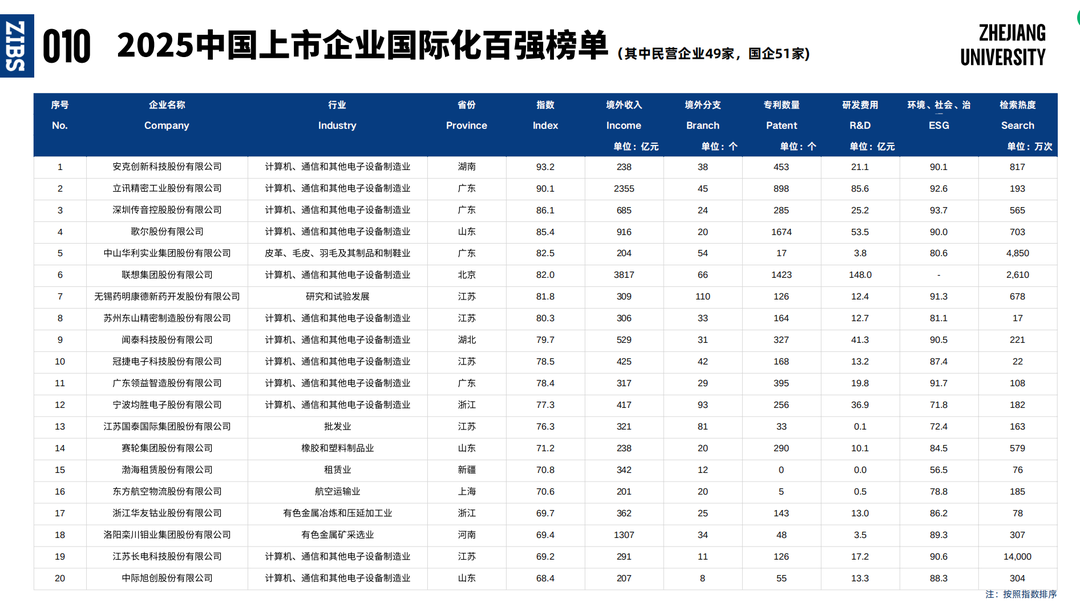
Group 1 - The "2025 China Private Enterprises Internationalization Top 100 List" was released at a forum in Hangzhou, highlighting the globalization progress of Chinese private enterprises [1] - The list is based on a quantitative indicator system assessing "internationalization scale, organization, innovation, and influence," showing that the manufacturing sector remains the main force in internationalization with 61 companies in the top 100 [1] - The Yangtze River Delta region leads in representation, with active participation from companies in Guangdong, Zhejiang, Beijing, Shandong, Jiangsu, and Shanghai [1] Group 2 - The top 100 internationalized enterprises generated a total of 6.02 trillion yuan in overseas revenue, accounting for 16.2% of total revenue, with an average overseas revenue of 602.1 million yuan per company [4] - The entry threshold for the list was set at 1.859 billion yuan, indicating a significant increase in both the scale and quality of internationalization among Chinese enterprises [4] - Shandong province had 10 companies on the list, showcasing its international competitiveness in sectors like non-ferrous metal processing and high-end chemical new materials [4][6] Group 3 - Notable companies from Shandong include GoerTek (4th), Sailun Group (14th), and Zhongji Xuchuang (20th), reflecting the region's diverse industrial strengths [4] - Haier Smart Home ranked among the top companies with overseas revenue of 142.9 billion yuan and 6,406 patents, indicating its strong innovation capabilities [4] - The province's economic structure is characterized by both state-owned enterprises and private enterprises, with the latter driving innovation in precision manufacturing and smart hardware [6][7]


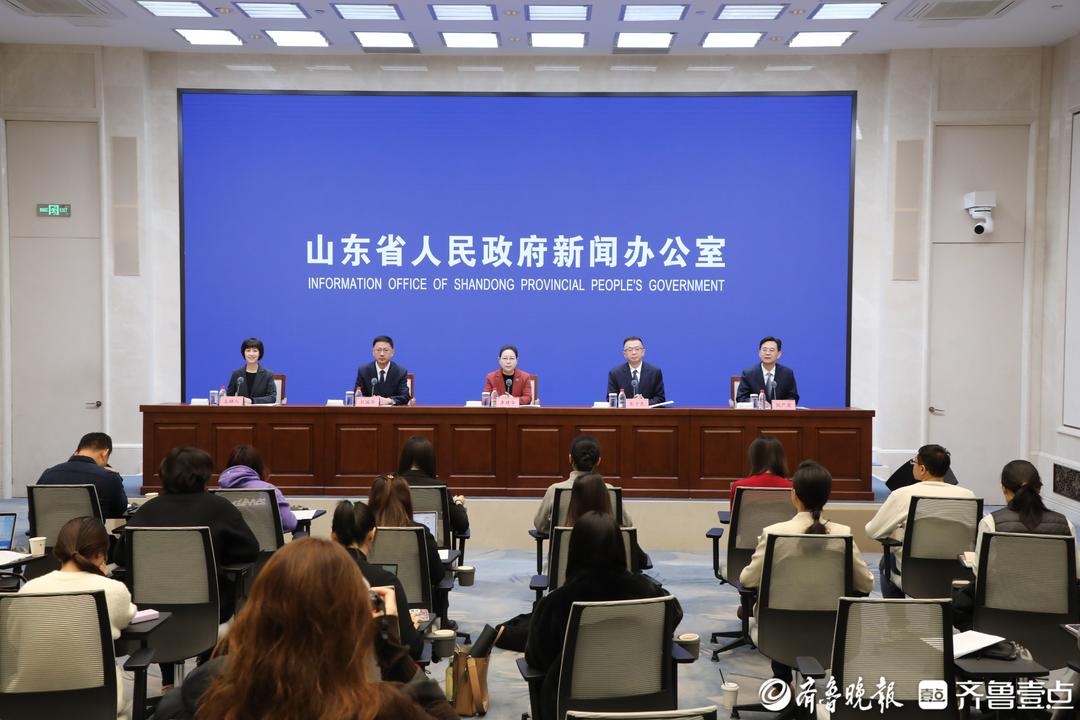
4K超高清、VR/AR引领风潮!山东开创广电视听与科技深度融合发展新局面
Qi Lu Wan Bao· 2025-12-17 03:51
Core Viewpoint - The Shandong provincial government is promoting high-quality development in broadcasting, television, and online audio-visual sectors during the 14th Five-Year Plan period, focusing on the integration of new technologies like 5G and AI to enhance content production and distribution [1][3]. Group 1: Technological Integration and Content Production - Shandong is advancing the integration of broadcasting and online audio-visual services with new technologies, leading to innovative content production methods [3]. - The province has implemented projects such as the broadcasting and online audio-visual boutique project and micro-short drama enhancement project, utilizing advanced technologies like 4K, AI, AR, VR, and 3D to create new forms of interactive and immersive dramas [3]. - Recent successful productions include the TV series "South Comes North," the documentary "Great River of the Continent," and the variety show "National Studies Little Masters," all meeting 4K ultra-high-definition standards [3]. Group 2: Distribution and Transmission Optimization - Shandong has made significant progress in establishing 4K ultra-high-definition channels, with the Shandong Satellite TV 4K channel successfully connecting to cable and IPTV networks across 31 provinces [4]. - The province has enhanced its 4K program production capabilities, with all new long dramas and key documentaries produced in 4K, and has restored 3,000 hours of old programs to enrich its ultra-high-definition content library [4]. - Initiatives to upgrade cable and IPTV networks for 4K/8K ultra-high-definition products are underway, promoting the adoption of ultra-high-definition television and devices [4]. Group 3: Expanding the Audio-Visual Industry Chain - Shandong is fostering a collaborative innovation ecosystem in the audio-visual industry by integrating culture and technology, supported by government policies and multi-departmental cooperation [5]. - The province has organized high-tech video innovation competitions and industry development weeks, showcasing over 200 new products and applications in ultra-high-definition, AI, and virtual reality technologies [5]. - Currently, Shandong has 153 broadcasting institutions and over 3,100 film production companies, with 234 large-scale audio-visual enterprises, forming a comprehensive end-to-end industry chain [5]. Group 4: Future Directions - The province plans to continue emphasizing technology empowerment and project leadership, increasing the supply of high-quality ultra-high-definition content across various genres [6]. - Efforts will focus on upgrading the entire industry chain, including content production, broadcasting systems, and terminal devices, to foster deeper integration of broadcasting and technology [6].