
翰森制药

Search documents
港股公告掘金 | 果下科技拟全球发售3385.29万股H股 引入惠开香港等基石投资者
Zhi Tong Cai Jing· 2025-12-08 15:25
Major Events - GuoXia Technology (02655) plans to conduct an IPO from December 8 to December 11, offering 33.85 million H-shares and introducing cornerstone investors such as Huikai Hong Kong [1] - Basilea Pharmaceutica AG (02616) has its drug Pujihua® (Pralsetinib Capsules) included in the National Medical Insurance Directory for 2025 [1] - Four Seasons Pharmaceutical (00460) sees its innovative drug XuanYueNing® included in the National Basic Medical Insurance Drug List for the first time [1] - Shanghai Pharmaceuticals (02607) successfully negotiates and includes Amisulpride Orally Disintegrating Tablets in the National Medical Insurance Directory [1] - Hansoh Pharmaceutical (03692) has its innovative drug Amelotex® approved for two new indications in the updated 2025 National Medical Insurance Directory [1] - Xiansheng Pharmaceutical (02096) sees EnzeShu® and EnDu® included in the updated National Medical Insurance Drug List [1] - Hutchison China MediTech (00013) has its drug Tazverik® included in the first edition of the National Commercial Health Insurance Innovative Drug List [1] - XuanZhu Biotechnology (02575) has its innovative drug XuanYueNing® included in the National Basic Medical Insurance Drug List for the first time [1] - Yino Pharmaceutical (02591) has its H-shares included in the list of eligible securities for the Shanghai-Hong Kong and Shenzhen-Hong Kong Stock Connect [1] - China Metallurgical Group (01618) and its subsidiaries plan to sell non-core business assets for approximately 60.68 billion yuan, focusing on core businesses in metallurgical engineering, non-ferrous metals, and mining engineering [1] - Cambridge Technology (06166) intends to invest a total of 405 million yuan to acquire and subscribe for shares in the Yangzhong Happiness Home Venture Capital Partnership Fund [1] Operating Performance - Dongfeng Motor Group (00489) reports cumulative automobile sales of 1.697 million units in the first 11 months, a year-on-year decrease of approximately 0.3% [2] - New天绿色能源 (00956) achieves a cumulative power generation of 1,336.89 million MWh in the first 11 months, an increase of 8.04% year-on-year [2] - Longyuan Power (00916) reports a cumulative power generation of approximately 6,909.64 million MWh in the first 11 months, a year-on-year growth of 0.41% [2] - Baolong Real Estate (01238) records a total contract sales of approximately 6.666 billion yuan in the first 11 months, a year-on-year decline of 43.2% [2]

跨国巨头抄底中国创新药
2 1 Shi Ji Jing Ji Bao Dao· 2025-12-08 08:28
Core Insights - The global biopharmaceutical innovation landscape is undergoing a significant structural change, with China's innovative drug industry emerging as a key player on the global stage, transitioning from a "fast follower" to a "first mover" [2] - China's share in global clinical trials and licensing transactions has notably increased, with Chinese biotech companies' stock prices outperforming their U.S. counterparts over the past year, indicating a historic investment opportunity [2][3] - The trend of multinational corporations (MNCs) increasingly sourcing early-stage innovation pipelines from China is becoming more pronounced, driven by cost-effectiveness and superior outcomes [3] Group 1 - China's innovative drug companies can advance drug discovery from target identification to IND application 2-3 times faster than international peers, and patient recruitment in clinical development is 2-5 times quicker, with costs per patient being half of those in Europe and the U.S. [5] - The total amount of external licensing transactions for Chinese innovative drugs surpassed $100 billion in the first three quarters of 2025, highlighting the immense potential for value realization in the domestic market [5] - Significant collaborations, such as the $12.5 billion agreement between 3SBio and Pfizer, have sparked renewed interest in the capital market, leading to a 60.27% increase in the Hang Seng Innovation Drug Index in June [3][5] Group 2 - The current surge in business development (BD) activities is driven by MNCs recognizing the continuous improvement in China's innovation, research, and clinical capabilities, prompting large-scale acquisitions [6] - Investment institutions are focusing on the biopharmaceutical sector, where approximately 80% of market value is concentrated, leading to a clear investment path for capital [6][7] - The market is witnessing a shift towards more innovative collaboration models, such as the "Co-Co model" between Innovent Biologics and Takeda, with potential transaction values reaching $11.4 billion [5] Group 3 - The Chinese innovative drug sector is expected to thrive, with projections indicating a prosperous pharmaceutical industry by 2025, supported by favorable policies and recovering valuations [9] - The overall revenue of listed Chinese innovative drug companies reached 48.83 billion yuan in the first three quarters of 2025, marking a 22% year-on-year increase, with the sector achieving its first quarterly profit since its inception [9] - The Hong Kong market is experiencing a threefold increase in trading volume compared to last year, with both domestic and foreign funds actively investing in the Chinese market [9][10] Group 4 - The capital market is transitioning from a focus on narrative-driven investments to a preference for companies with solid fundamentals, emphasizing the importance of clinical data and asset quality [11][12] - The interaction between A-share and Hong Kong markets is tightening, with a trend of high-quality blue-chip assets seeking listings in Hong Kong, reflecting a more rigorous examination of companies' fundamentals [14][15] - Companies with strong fundamentals are more likely to succeed in the capital market, while those lacking solid foundations may struggle to capitalize on market opportunities [16][17]


跨国巨头抄底中国创新药
21世纪经济报道· 2025-12-08 08:17
Core Viewpoint - The global biopharmaceutical innovation landscape, traditionally dominated by multinational corporations (MNCs), is undergoing a significant structural change, with China's innovative drug industry emerging as a key player on the global stage [1][4]. Group 1: Market Dynamics - China's share in global clinical trials and licensing transactions has significantly increased, with Chinese biotech companies' stock prices outperforming their U.S. counterparts over the past year [1]. - The total market capitalization of Chinese listed biotech companies is still less than 15% of their U.S. peers, indicating a historical investment opportunity as international capital views this as a chance for growth [1]. - The collaboration between domestic companies and MNCs is intensifying, with a notable trend of MNCs increasingly sourcing early-stage innovation pipelines from China [2][4]. Group 2: Cost and Efficiency Advantages - Chinese innovative drug companies exhibit a unique dual advantage of speed and cost-effectiveness, advancing drug discovery phases 2-3 times faster than international counterparts and recruiting clinical trial patients at half the cost [6]. - The total amount of licensing transactions for Chinese innovative drugs is expected to exceed $100 billion in the first three quarters of 2025, reflecting the immense potential for value realization in the domestic market [6]. Group 3: Business Development (BD) Trends - The BD activity in the innovative drug market is thriving, with significant transactions such as the $12.5 billion upfront payment from Pfizer to 3SBio marking a record for domestic innovative drugs [4][10]. - The market is witnessing a shift towards more innovative collaboration models, such as the "Co-Co model" between Innovent Biologics and Takeda, which involves joint development and commercialization [6]. Group 4: Investment Sentiment and Market Outlook - The pharmaceutical industry is projected to experience robust growth by 2025, with the Hang Seng Index expected to double, driven by favorable policies and a rebound in industry valuations [10]. - The innovative drug sector has shown a 22% year-on-year revenue growth, with the sector achieving its first quarterly profit of 1.1 billion yuan in Q3 2025 [10]. - The market is characterized by a cautious optimism, with a significant increase in trading volume and participation from both domestic and foreign funds, indicating a healthy and sustainable market environment [10][11]. Group 5: Regulatory and Market Considerations - The interaction between A-share and Hong Kong markets is expected to tighten, with many quality blue-chip assets seeking to transition from A-shares to Hong Kong listings [15]. - The market has returned to a rational state, with investors focusing more on the fundamentals of companies rather than speculative narratives, emphasizing the importance of a clear commercialization path and sustainable profitability for successful listings [15][18].

香港医疗周报(12/1-12/5):医药流通和CXO板块表现相对较好,医保+商保“双目录”落地-20251208
Haitong Securities International· 2025-12-08 06:34
Investment Rating - The report rates multiple companies in the healthcare sector as "Outperform," including BeiGene, China Resources Pharmaceutical, JD Health, Innovent Biologics, WuXi Biologics, and many others [1]. Core Insights - The Hong Kong healthcare sector has shown resilience, with the Hang Seng Healthcare Index gaining 72.2% year-to-date, outperforming the Hang Seng Index by 41.1 percentage points [4][28]. - The implementation of the "dual catalogs" for basic medical insurance and commercial insurance is expected to support innovation in the pharmaceutical sector, with 114 new drugs added to the basic medical insurance catalog and a success rate of 88% [5][30]. - The report highlights the strong performance of the pharmaceutical distribution and CXO sectors, with respective gains of 2.0% and 1.7% in the past week [15][29]. Summary by Sections Market Performance - The Hang Seng Healthcare Index fell by 0.7% in the week of December 1-5, 2025, underperforming the Hang Seng Index by 1.6 percentage points [4][28]. - The pharmaceutical distribution sector and CXO services performed well, with increases of 2.0% and 1.7%, respectively [15][29]. Drug Catalog Implementation - The "National Basic Medical Insurance Catalog" and the first edition of the "Commercial Insurance Innovative Drug Catalog" were released, with 114 new drugs added to the basic insurance catalog [5][30]. - The commercial insurance catalog includes 19 innovative drugs, emphasizing support for innovation and addressing the needs of the elderly and children [13][30]. Company Highlights - Notable companies that performed well include Jinxin Fertility (+7.5%), Harbour BioMed-B (+5.3%), and WuXi Biologics (+4.7%) [15][29]. - The report suggests increasing focus on companies with strong performance certainty in the CXO sector and those with stable long-term demand in medical services [15][29].
2026年财政政策展望:积极的财政政策持续给力
Bank of China Securities· 2025-12-08 06:10
Index Performance - The Hang Seng Index (HSI) closed at 26,085, up 0.6% for the day and 30.0% year-to-date (YTD) [2] - The Hang Seng China Enterprises Index (HSCEI) increased by 1.0% to 9,198, with a YTD gain of 26.2% [2] - The MSCI China index rose by 0.8% to 85, achieving a YTD increase of 31.6% [2] Commodity Price Performance - Brent Crude oil is priced at $64 per barrel, reflecting a 0.8% daily increase but a 10.6% decline YTD [3] - Gold prices are at $4,198 per ounce, showing a slight decrease of 0.2% but a significant YTD increase of 59.9% [3] - Copper prices rose by 1.5% to $11,621 per ton, with a YTD increase of 32.5% [3] Macro and Earnings Releases - China's exports decreased by 1.1% YoY, while imports increased by 1.0% YoY [4] - The US Producer Price Index (PPI) for final demand rose by 2.7% [4] - New home sales in the US were reported at 800,000, exceeding the consensus of 718,000 [4] Fiscal Policy Outlook - The general public budget deficit ratio for 2025 is raised to 4%, with a broad fiscal deficit ratio expected to reach 8.7% [6] - Government bond financing for 2026 is projected at RMB12.28 trillion to support a fiscal deficit ratio of 8.6% [6] - General public budget revenue is expected to grow by 6.1% in 2026, reversing a 0.6% decline in 2025 [7] Market Strategy - The Hang Seng Index is projected to reach 30,100 by December 2026, based on a forecasted P/E ratio of 13.0, which is a 15% premium over the historical average [10] - Key investment opportunities include sectors focused on economic growth, technological innovation, and domestic consumption [10]
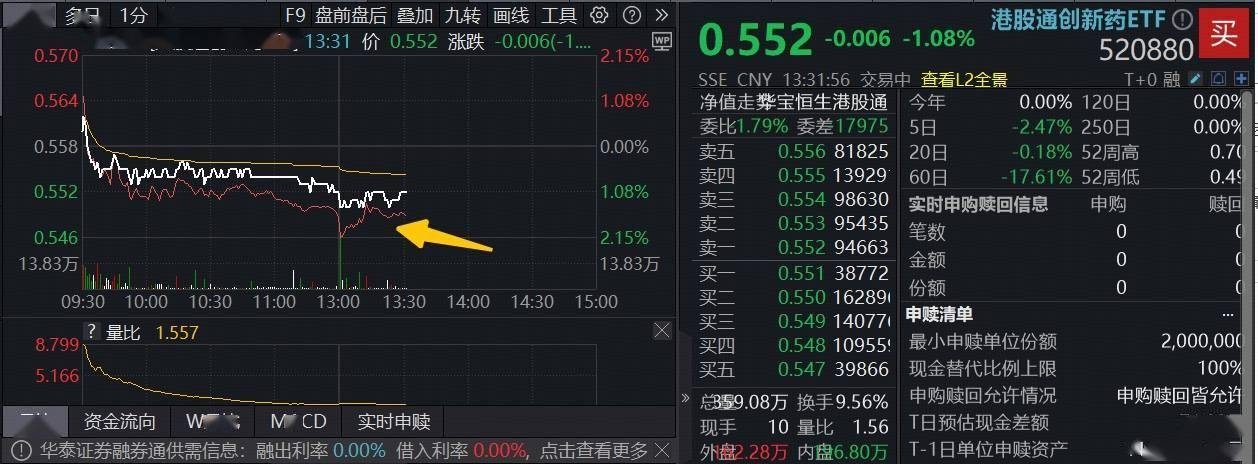
ETF盘中资讯 | 医保、商保“双目录”发布!资金迅速行动,高纯度港股通创新药ETF(520880)宽幅溢价,机构:创新药跨年行情可期
Sou Hu Cai Jing· 2025-12-08 06:00
Group 1 - The core viewpoint of the news highlights the ongoing volatility in the innovative drug sector, with a mixed performance among individual stocks, while some companies like Kangzhe Pharmaceutical and Green Leaf Pharmaceutical show resilience with over 1% gains [1] - The recent release of the "dual directory" for medical insurance and commercial insurance includes 114 new drugs for the national medical insurance drug list by 2025, with 50 being class 1 innovative drugs, indicating a sustained bullish trend for innovative drugs [3] - CITIC Construction Investment Securities notes that China's pharmaceutical industry has entered a critical phase of "innovation realization + global layout," supported by population and domestic demand, with innovative drugs expected to be a major upward trend into 2026 [3] Group 2 - The Hong Kong Stock Connect Innovative Drug ETF (520880) has over 70% of its portfolio invested in leading innovative drug stocks, reflecting strong buying sentiment despite a slight decline in its market price [1][3] - The top ten holdings of the ETF account for 72.57% of its total weight, showcasing the dominance of leading companies in the innovative drug sector [3] - The ETF has a total market value of HKD 12.873 billion, with a daily average trading volume of HKD 4.58 billion since its inception, making it the largest and most liquid ETF tracking the same index [3]
摩根大通解密BD潮:巨头“抄底”中国创新药,下一个爆款在哪?
2 1 Shi Ji Jing Ji Bao Dao· 2025-12-08 04:50
Core Insights - The global biopharmaceutical innovation landscape, traditionally dominated by multinational corporations (MNCs), is undergoing significant structural changes, with China's innovative drug industry emerging as a key player on the global stage [1] - China's transition from a "fast follower" to a "first mover" in innovative drugs is becoming an irreversible trend, as highlighted by The Economist, indicating that Chinese innovation drugs are at a "critical point" of globalization [1] - Data shows that China's share in global clinical trials and licensing transactions is rising significantly, with Chinese biotech companies' stock prices outperforming their U.S. counterparts over the past year [1][2] - The total market capitalization of Chinese listed biotech companies is still less than 15% of their U.S. peers, presenting a "historic investment opportunity" as perceived by international capital [1] Group 1 - The cost-effectiveness and speed advantages of Chinese innovative drug companies are notable, with drug discovery phases being 2-3 times faster and patient recruitment in clinical trials being 2-5 times quicker than international counterparts [4] - The total amount of licensing transactions for Chinese innovative drugs is expected to exceed $100 billion by 2025, with significant deals already occurring, such as the $12.5 billion upfront payment from Pfizer to 3SBio [4][2] - The surge in business development (BD) activities reflects a growing interest from MNCs in China's innovative drug capabilities, particularly in advanced fields like T-cell engagers and CAR-T therapies [2][5] Group 2 - The market is witnessing a "BD frenzy," with MNCs actively engaging in acquisitions, driven by the recognition of China's improving innovation, research, and clinical capabilities [5][6] - The anticipated growth in the pharmaceutical industry is expected to lead to a significant increase in the Hang Seng Index, with projections indicating a potential doubling by 2025 [8] - The overall revenue of Chinese innovative drug companies reached 48.83 billion yuan in the first three quarters of 2025, marking a 22% year-on-year increase, with the sector achieving its first quarterly profit since inception [8] Group 3 - The shift in capital market dynamics is evident, with investors now focusing more on the "hard power" of companies rather than just their narrative or story [10][9] - The trend of companies transitioning from A-share to Hong Kong markets is gaining momentum, with a growing number of firms seeking to list in Hong Kong, reflecting a tightening scrutiny of fundamentals by investors [11][14] - The current market environment is characterized by a rational return, where investors prioritize solid fundamentals over speculative narratives, indicating a more cautious approach to investment [12][13]
摩根大通解密BD潮:巨头"抄底"中国创新药,下一个爆款在哪?
2 1 Shi Ji Jing Ji Bao Dao· 2025-12-08 04:49
Core Insights - The global biopharmaceutical innovation landscape, traditionally dominated by multinational corporations, is undergoing significant structural changes, with China's innovative drug industry emerging as a key player on the global stage [1] - China's transition from a "fast follower" to an "originator" in innovative drugs is becoming an irreversible trend, as highlighted by international media [1] - Data shows a notable increase in China's share of global clinical trials and licensing transactions, with Chinese biotech companies outperforming their U.S. counterparts in stock price growth over the past year [1][3] Group 1: Market Dynamics - Multinational corporations are increasingly inclined to source early-stage innovative pipelines from China due to cost-effectiveness, with costs in China being 30%-40% lower than in the U.S. [2] - The collaboration between domestic companies and multinationals is exemplified by the $12.5 billion upfront payment from Pfizer to 3SBio for overseas rights to a bispecific antibody, marking a record for domestic innovative drugs [2][3] - The Chinese innovative drug sector is expected to see a surge in licensing transactions, with projections indicating that total licensing amounts could exceed $100 billion in the first three quarters of 2025 [3] Group 2: Investment Trends - The biopharmaceutical sector is experiencing a business development (BD) boom, with significant transactions such as the $12 billion collaboration between Hengrui Medicine and GSK, indicating strong interest from multinational companies [3][4] - Investment institutions are focusing on the biopharmaceutical sector, with approximately 80% of the market value concentrated in biotechnology and pharmaceuticals, driving capital flow into these areas [5] - The market is witnessing a shift from "story-driven" investment decisions to a focus on the hard capabilities of companies, emphasizing the importance of clinical data and product quality [9][10] Group 3: Future Outlook - The innovative drug market is expected to thrive, with projections indicating that the Hang Seng Index could double by 2025, driven by favorable policies and a rebound in industry valuations [7] - The Chinese innovative drug sector is anticipated to recover strongly in 2025, with the overall revenue of listed companies in this sector reaching 48.83 billion yuan, a 22% year-on-year increase [7] - The market is seeing a resurgence in IPO activity, with over 20 companies currently queued for listing in Hong Kong, reflecting renewed investor interest in the biopharmaceutical sector [12][13]






红杉中国杨云霞:下一代疗法风口下,坚守长期投资逻辑
2 1 Shi Ji Jing Ji Bao Dao· 2025-12-08 04:49
Core Insights - The Chinese biopharmaceutical sector is experiencing a resurgence after a period of adjustment, with the industry overall rising by 16.72% from early 2025 to the end of November, outperforming the CSI 300 index by 1.68 percentage points [1] - The active business development (BD) transactions and breakthroughs in innovative drug development are key drivers behind this growth [1][2] - The focus on "second-generation technology paradigms" in biotech, such as advancements in antibody technology and CAR-T therapies, is expected to be a significant investment direction in the near future [1][2] Industry Trends - The Chinese biopharmaceutical industry is entering a new phase centered on original innovation and global competitiveness, with China projected to account for 10%-15% of new drug listings globally [4] - As of August this year, the number of external licensing agreements for 2025 has already matched the total for 2024, with a total value of $50 billion, surpassing the entire amount for 2024 [2] - The proportion of external licensing transactions from Chinese companies has exceeded 40%, with half of these involving next-generation therapies [3] Investment Opportunities - There is a significant amount of unmet clinical needs and untapped innovation space in the market, providing rich investment themes and potential for more BD cases [2] - The quality of companies and their growth potential are critical in determining their market value, regardless of temporary low valuations [2] - The collaboration between biotech firms and multinational corporations (MNCs) is increasing, with MNCs expanding their BD teams and establishing regular communication with Chinese biotech companies [3][6] Challenges and Considerations - The industry faces challenges such as the need for improved commercialization capabilities and the risk of resource wastage due to blind competition [4][5] - The pricing of Chinese biotech assets in overseas transactions is often perceived as low, which may hinder their global competitiveness [6] - The importance of establishing long-term trust and understanding international market rules is emphasized for achieving fair valuations in cross-border transactions [6][7] Strategic Insights - The essence of BD transactions lies in the synergy of capital, brand, and capability, which can significantly enhance a company's growth beyond short-term gains [6] - Companies must focus on quality improvement and differentiated innovation rather than merely competing on speed to avoid industry setbacks [4][5] - The investment strategy should consider long-term market dynamics and the potential future landscape of the industry [8]
摩根大通解密BD潮:巨头“抄底”中国创新药 下一个爆款在哪?
2 1 Shi Ji Jing Ji Bao Dao· 2025-12-08 04:48
Core Insights - The global biopharmaceutical innovation landscape, traditionally dominated by multinational corporations (MNCs), is undergoing significant structural changes, with China's innovative drug industry emerging as a key player on the global stage [1][3] - China's transition from a "fast follower" to a "first mover" in innovative drugs is becoming an irreversible trend, as highlighted by international media [1] - Data shows that China's share in global clinical trials and licensing transactions is increasing, with Chinese biotech companies outperforming their U.S. counterparts in stock price growth over the past year [1][2] Group 1: Market Dynamics - The cost-effectiveness and speed of Chinese innovative drug companies are becoming critical factors for MNCs to source R&D pipelines from China, with costs being 30%-40% lower than in the U.S. [2] - The year 2025 is projected to be a breakout year for China's innovative drug licensing transactions, with total amounts surpassing $100 billion in the first three quarters [4][8] - Notable collaborations include a $12.5 billion upfront payment from Pfizer to 3SBio for overseas rights to a bispecific antibody, which significantly boosted market enthusiasm [2][4] Group 2: Investment Trends - MNCs are actively engaging in acquisitions during industry downturns, recognizing the continuous improvement in China's innovation, R&D, and clinical capabilities [5] - The capital market is witnessing a shift from "story-driven" investments to a focus on the "hard strengths" of companies, emphasizing clinical data and product quality [10][11] - The interaction between A-share and Hong Kong markets is tightening, with many quality companies seeking to list in Hong Kong, reflecting a more rigorous examination of fundamentals by investors [11][12] Group 3: Future Outlook - The biopharmaceutical sector is expected to thrive, with projections indicating that the Hang Seng Index could double by 2025 due to favorable policies and recovering valuations [8] - The market is experiencing a healthy adjustment, with the innovative drug sector reporting a 22% year-on-year revenue increase, marking its first quarterly profit since inception [8][9] - The trend of companies transitioning from "fast followers" to "first movers" is gaining momentum, with 5%-10% of innovations now being true first-in-class [11]