蓝色光标

Search documents
全线回调!开年最热赛道突然刹车
Ge Long Hui· 2026-01-16 09:37
Group 1 - The AI application sector experienced a significant decline on January 16, with major stocks like Vision China hitting the limit down, following a period of rapid growth at the beginning of the year [1] - The recent surge in AI applications was driven by the successful listings of large model companies MiniMax and Zhipu on the Hong Kong stock market, which increased market enthusiasm [3] - The acquisition of the AI application company "Butterfly Effect" by Meta for billions of dollars at the end of last year has enhanced the recognition of AI applications in China [4] Group 2 - The large-scale deployment of domestically developed inference chips has led to a drastic reduction in AI invocation costs, prompting large model companies to lower their prices [5] - AI application companies with established user bases and traffic pools have become new market hotspots as hardware valuations have soared [6] - The recent collective drop in AI applications raises questions about the sustainability of the initial enthusiasm, particularly in the marketing and media sector [7] Group 3 - Elon Musk's recent announcement to open-source the latest content recommendation algorithm for the X platform has sparked interest in Generative Engine Optimization (GEO), which aims to enhance brand content visibility in AI-generated responses [8][9] - Gartner predicts that by 2028, AI search will capture 50% of search engine traffic, indicating a significant shift in marketing dynamics [9] - The global GEO market is projected to reach $11.2 billion and $1 billion in China by 2025, with compound annual growth rates (CAGR) of 55% and 53% respectively [10] Group 4 - BlueFocus has shown impressive performance, with a revenue of 51.098 billion yuan in the first three quarters of 2025, reflecting a year-on-year growth of 12.5%, and a significant increase in AI-driven business revenue by 310% [13] - Despite the growth, AI-driven revenue still accounted for less than 5% of BlueFocus's total revenue of 32.36 billion yuan in the first half of the year [15] - The company's AI-driven revenue is currently small relative to its overall operations, indicating that while growth is notable, it does not yet significantly impact the company's financial health [16] Group 5 - The GEO model is expected to reshape the marketing industry, but it may take time for marketing companies to see significant performance improvements [13] - BlueFocus's proprietary marketing model, BlueAI, focuses on enhancing marketing efficiency, and if it can establish a closed-loop system, it may significantly elevate the company's profitability [17] - The competition with major tech firms for AI marketing capabilities poses a challenge for BlueFocus, as it relies on foundational models from companies like ByteDance and Alibaba [18] Group 6 - The year 2026 is anticipated to be pivotal for AI applications, driven by advancements in model capabilities and supportive policies [20] - The demand for AI applications is growing across various sectors, including marketing, where AI can generate personalized advertising materials and optimize strategies in real-time [23] - Companies like AppLovin have demonstrated the potential of AI in marketing, with a 71% year-on-year increase in advertising revenue in Q1 2025 [23] Group 7 - AI is transforming the entire content production chain, lowering creative barriers and increasing productivity, with new forms of content emerging [27] - AI-generated animated series are becoming a new trend, with significant production and consumption potential in the market [28] - The global AI visual generation application market is projected to reach $16.6 billion by 2027, indicating substantial growth opportunities [32] Group 8 - The integration of AI with traditional industries such as manufacturing and finance is expected to lead to a surge in AI applications, with companies showing a strong willingness to invest in AI for efficiency gains [34] - The focus on vertical applications that address specific industry pain points is becoming increasingly valuable, countering initial fears that large model giants would dominate the market [34] - The upcoming years will likely see significant investment opportunities in AI applications, particularly in niche markets that leverage unique technologies and data [35]




全线回调!开年最热赛道突然刹车
格隆汇APP· 2026-01-16 09:29
Core Viewpoint - The article discusses the recent downturn in the AI application sector, highlighting the volatility and potential future trends in the industry, particularly focusing on Generative Engine Optimization (GEO) and its implications for marketing and AI applications [2][12][22]. Group 1: Market Trends and Performance - The AI application sector experienced a significant drop, with companies like Visual China hitting a trading halt and others like Liou Co. and Yidian Tianxia facing scrutiny after rapid stock price increases [3][5]. - The recent listing of large model companies such as MiniMax and Zhipu has increased market enthusiasm, indicating a growing commercial viability for AI applications [7][8]. - The cost of AI operations has drastically decreased due to the large-scale deployment of domestically developed inference chips, prompting many large model companies to lower their prices [10][11]. Group 2: Generative Engine Optimization (GEO) - GEO, defined as Generative Engine Optimization, aims to enhance the visibility of brand content in AI-generated responses, potentially increasing citation rates by 40% [15][16]. - The global GEO market is projected to grow significantly, with estimates of $11.2 billion in 2025 and $100.7 billion by 2030, reflecting a compound annual growth rate (CAGR) of 55% [22]. - The marketing landscape is shifting as AI search engines begin to replace traditional search methods, with predictions that AI search will capture 50% of search engine traffic by 2028 [18][19]. Group 3: Company Performance and Future Outlook - BlueFocus, a marketing company, reported a revenue of 51.098 billion yuan in the first three quarters of 2025, with a notable 310% increase in AI-driven business revenue [26][27]. - Despite impressive growth, AI-driven revenue still represents less than 5% of BlueFocus's total revenue, indicating room for expansion [28]. - The article suggests that while GEO may transform marketing strategies, the fundamental competitive dynamics of the marketing industry remain focused on scale [34]. Group 4: Future of AI Applications - The article anticipates that 2026 will be a pivotal year for AI applications, driven by advancements in model capabilities and supportive policies from government bodies [36][38]. - AI applications are expected to proliferate across various sectors, including marketing, industrial, and financial services, enhancing efficiency and driving revenue growth [52]. - The emergence of AI-generated content, such as AI cartoons, is highlighted as a new trend, with significant market potential indicated by the rapid increase in AI-generated media [44][46].

中国银河证券:计算机行业开门红迎底部反转 AI应用与国产算力成全年投资双主线
Xin Lang Cai Jing· 2026-01-16 09:24
Core Viewpoint - The computer industry is expected to experience a strong start in early 2026, with a potential bottom reversal in industry prosperity driven by AI applications and opportunities in the domestic computing power supply chain [1][5]. Industry Performance - As of early 2026, the computer industry index has increased by 18.04%, ranking third among SW primary industries, significantly outperforming major indices such as the Shanghai Composite Index (3.96%), CSI 300 (2.42%), ChiNext Index (4.56%), and STAR Market 50 Index (11.66%) [6]. - The Wind AI application index has risen by 19.25%, indicating strong market recognition of the AI application sector, which is becoming a core driver for the rebound in the computer sector's prosperity [6]. AI Application Trends - The AI application sector is witnessing a series of favorable catalysts, reshaping flow logic. Major AI model companies like Zhipu and MiniMax have recently gone public and performed strongly, while international movements, such as NVIDIA's $1 billion collaboration with Eli Lilly and OpenAI's acquisition of Torch, further enhance the positive outlook for AI applications [2][6]. - The transition from traditional SEO (Search Engine Optimization) to GEO (Generative Engine Optimization) is accelerating, pushing AI applications from a technology validation phase to a commercial value realization phase [2][6]. Commercialization Pathways - B-end AI applications are expected to see the first wave of explosive growth, with a focus on sectors such as AI + marketing, AI + industrial software, AI + healthcare, and AI + finance [7]. - Traditional C-end companies with strong user bases and brand influence can further solidify their competitive advantages through AI empowerment, making them worthy of long-term investment tracking [7]. Computing Power Infrastructure - The domestic computing power sector is entering a new development cycle, with a recovery trend in AIDC bidding observed in Q4 2025. Major internet companies in China are expected to accelerate data center layouts in 2026 [3][7]. - If H200 supply is restored, it will significantly enhance large model training efficiency, further accelerating the implementation of AI applications and driving demand for domestic computing power chips in inference [3][7]. Investment Recommendations - The report suggests focusing on two main investment lines for 2026, with eight specific sub-sector recommendations: 1. Large model and MaaS vendors, including Alibaba-W, Zhipu, MiniMax, and iFlytek 2. Domestic computing power and data center supply chain, including Cambrian, Haiguang Information, Runze Technology, and Inspur 3. AI + marketing sector, including BlueFocus and Visual China 4. AI + industrial software sector, including Dingjie Zhizhi and BGI 5. AI + healthcare sector, including Jingtai Holdings and Weining Health 6. AI + office sector, including Kingsoft Office and Wanjing Technology 7. AI + ERP sector, including Kingdee International and Yonyou Network 8. AI + finance sector, including Hengsheng Electronics and Tonghuashun [8].

广告营销板块1月16日跌5.79%,蓝色光标领跌,主力资金净流出40.98亿元
Zheng Xing Xing Ye Ri Bao· 2026-01-16 09:00
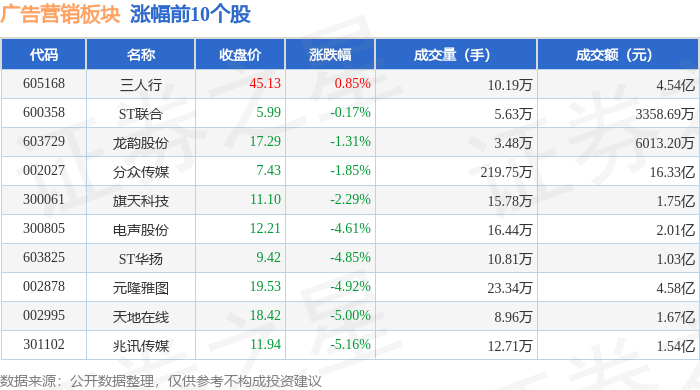
从资金流向上来看,当日广告营销板块主力资金净流出40.98亿元,游资资金净流入4.97亿元,散户资金 净流入36.01亿元。广告营销板块个股资金流向见下表: | 代码 | 名称 | 收盘价 | 涨跌幅 | 成交量(手) | 成交额(元) | | | --- | --- | --- | --- | --- | --- | --- | | 605168 | 三人行 | 45.13 | 0.85% | 10.19万 | | 4.54亿 | | 600358 | ST联合 | 66'5. | -0.17% | 5.63万 | | 3358.69万 | | 603729 | 龙韵股份 | 17.29 | -1.31% | 3.48万 | | 6013.20万 | | 002027 | 分众传媒 | 7.43 | -1.85% | 219.75万 | | 16.33亿 | | 300061 | 旗天科技 | 11.10 | -2.29% | 15.78万 | | 1.75亿 | | 300805 | 电声股份 | 12.21 | -4.61% | 16.44万 | | 2.01亿 | | 603825 | ST华扬 | ...
AI+营销巨头蓝色光标赴港IPO,阿里巴巴是客户,毛利率不足5%
Ge Long Hui· 2026-01-16 08:46
Core Viewpoint - The company BlueFocus is experiencing significant fluctuations in its stock performance amid changes in financing leverage and is currently pursuing a dual listing in Hong Kong while facing challenges in profitability and revenue growth [1][2][38]. Company Overview - BlueFocus was founded in November 2002 and became a joint-stock company in January 2008, headquartered in Chaoyang District, Beijing [5]. - The founder, Zhao Wenquan, holds 3.90% of the company's issued share capital and voting rights [5]. - The company specializes in providing one-stop marketing services driven by technology, serving over 100 Fortune China 500 companies across nearly 200 countries and regions [6][8]. Financial Performance - BlueFocus's revenue for the years 2022, 2023, 2024, and the first nine months of 2025 were RMB 36.68 billion, RMB 52.62 billion, RMB 60.80 billion, and RMB 51.80 billion, respectively [13][17]. - The net profits for the same periods were -RMB 2.18 billion, RMB 111.72 million, -RMB 296.94 million, and RMB 118.66 million [13][17]. - The company has recorded a gross margin of 4.7%, 3.4%, 2.5%, and 2.6% over the reporting periods, indicating a downward trend [18][19]. Revenue Breakdown - The majority of BlueFocus's revenue comes from overseas cross-border marketing services, which accounted for 82.9% of total revenue in the first nine months of 2025, up from 71.9% in 2022 [16][17]. - Domestic integrated marketing services contributed 11.9% of revenue in the same period, down from 17.8% in 2022 [16]. Market Position - BlueFocus holds a 0.68% market share in the global marketing industry, ranking tenth among service providers [28][36]. - The company is the only Chinese firm in the top ten of the marketing industry and ranks first in overseas cross-border marketing services with a market share of 10.97% [36]. Industry Outlook - The global marketing industry is projected to grow steadily, with the market size expected to reach RMB 8.94 trillion in 2024, and the Chinese marketing industry anticipated to grow from RMB 1.89 trillion in 2024 to RMB 3 trillion by 2029, at a CAGR of 9.8% [29][33]. - The overseas cross-border marketing segment is identified as a core and rapidly growing niche within the industry, with market size expected to increase from RMB 440.4 billion in 2024 to RMB 786.6 billion by 2029 [29].
小红书概念下跌4.21%,主力资金净流出43股
Zheng Quan Shi Bao Wang· 2026-01-16 08:44
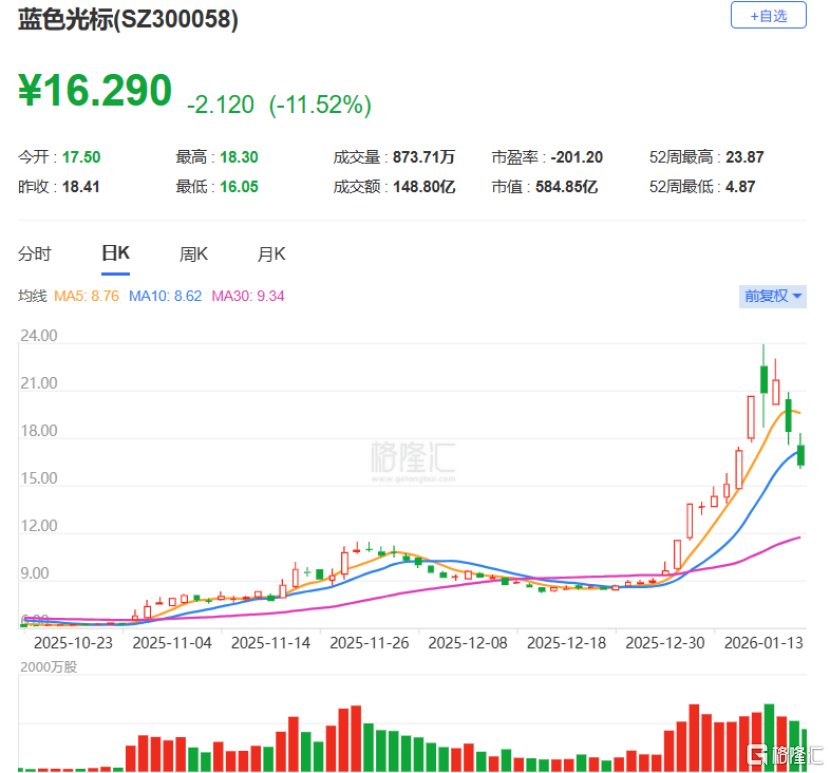
Group 1 - The Xiaohongshu concept sector experienced a decline of 4.21%, ranking among the top losers in the concept sector, with stocks like Xinhua Du, Tianxia Xiu, and Shengguang Group hitting the daily limit down [1] - Major stocks within the Xiaohongshu concept that saw significant declines include BlueFocus (-11.52%), Shengguang Group (-10.00%), and Tianyu Shuke (-7.85%) [3][4] - The sector faced a net outflow of 4.935 billion yuan, with 43 stocks experiencing net outflows, and 10 stocks seeing outflows exceeding 100 million yuan, led by BlueFocus with a net outflow of 1.978 billion yuan [2][3] Group 2 - The top gainers in the Xiaohongshu concept included *ST Tianze, Wanrun Technology, and Yiwan Yichuang, with increases of 4.98%, 3.82%, and 3.53% respectively [1][5] - The overall market saw various concept sectors with notable performances, such as storage chips (+4.08%) and national fund holdings (+4.07%), contrasting with the Xiaohongshu concept's decline [2] - The main inflows in the market were observed in stocks like Wanrun Technology, with a net inflow of 191.39 million yuan, and online and offline with 40.41 million yuan [2][5]




快手概念下跌4.58%,13股主力资金净流出超亿元
Zheng Quan Shi Bao Wang· 2026-01-16 08:41
Core Viewpoint - The Kuaishou concept stock has experienced a significant decline, with a drop of 4.58%, placing it among the top losers in its sector, while several other stocks within the sector also faced substantial losses [1]. Group 1: Market Performance - As of January 16, the Kuaishou concept stock fell by 4.58%, ranking it among the top decliners in its sector [1]. - Other notable decliners in the Kuaishou concept include Xinhua Du, Vision China, and Shengguang Group, which hit the daily limit down, while stocks like *ST Tianze, Wanrun Technology, and Yiwan Yichuang saw gains of 4.98%, 3.82%, and 3.53% respectively [1]. - The Kuaishou concept sector saw a net outflow of 6.034 billion yuan, with 40 stocks experiencing net outflows, and 13 stocks seeing outflows exceeding 100 million yuan [2]. Group 2: Fund Flow Analysis - The stock with the highest net outflow in the Kuaishou concept was BlueFocus, with a net outflow of 1.978 billion yuan, followed by Zhongwen Online, Shengguang Group, and Tianyu Digital, which had net outflows of 511.7 million yuan, 487.3 million yuan, and 444.0 million yuan respectively [2][3]. - The stocks with the highest net inflows included Wanrun Technology, with a net inflow of 191.39 million yuan, followed by Online and Offline and Ruijie Network, with net inflows of 40.41 million yuan and 34.87 million yuan respectively [5].


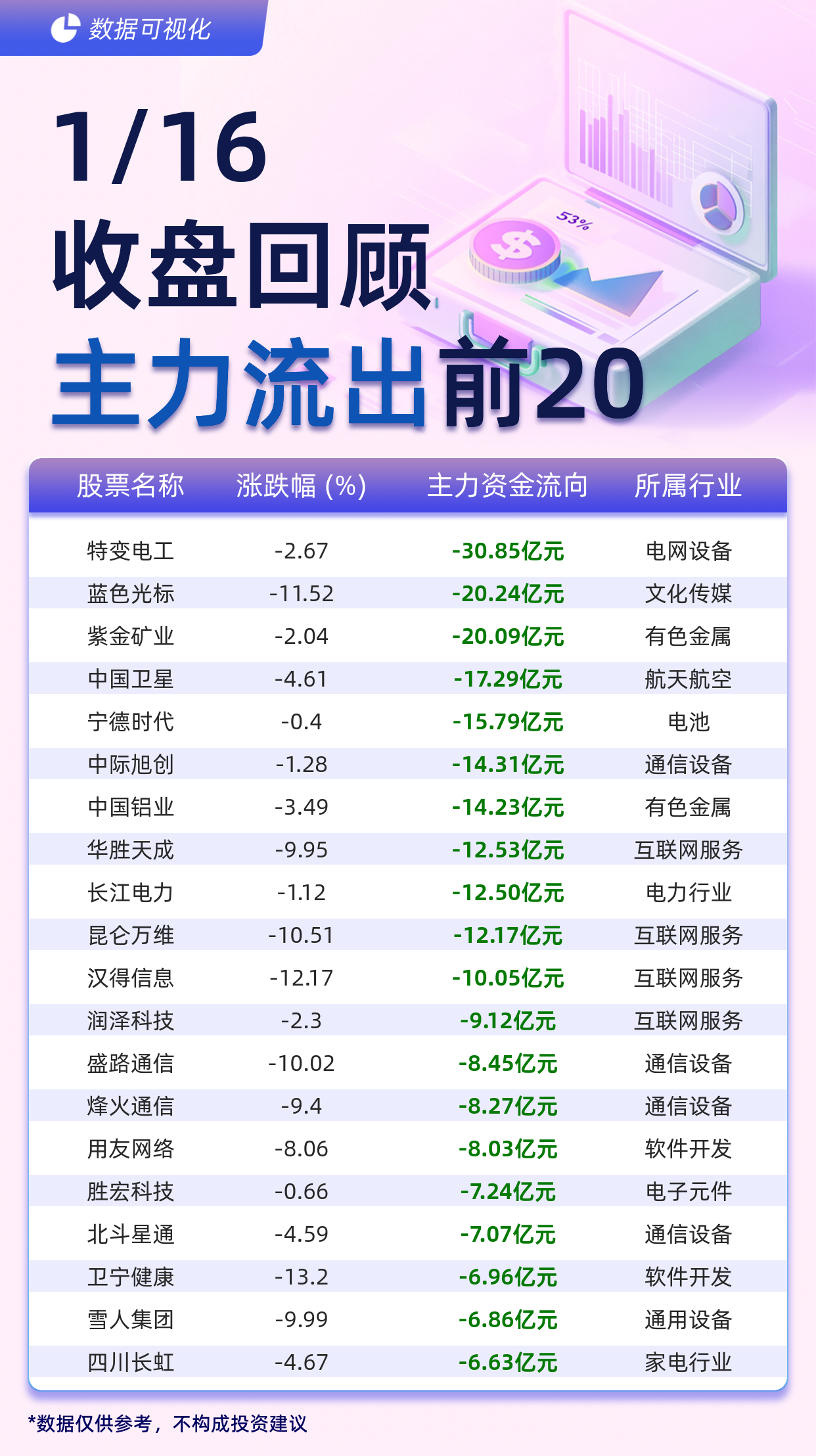
主力个股资金流出前20:特变电工流出30.85亿元、蓝色光标流出20.24亿元
Jin Rong Jie· 2026-01-16 07:40
Core Viewpoint - The data indicates significant outflows of capital from various stocks, with notable declines in share prices across multiple sectors, suggesting a bearish sentiment in the market. Group 1: Stock Performance and Capital Outflow - The top stock with the highest capital outflow is TBEA Co., Ltd. (特变电工), with an outflow of 3.085 billion yuan and a price drop of 2.67% [1][2] - BlueFocus Communication Group (蓝色光标) experienced a capital outflow of 2.024 billion yuan, with a significant price decline of 11.52% [1][2] - Zijin Mining Group (紫金矿业) saw an outflow of 2.009 billion yuan and a price decrease of 2.04% [1][2] - China Satellite Communications (中国卫星) had a capital outflow of 1.729 billion yuan, with a price drop of 4.61% [1][2] - Contemporary Amperex Technology Co., Ltd. (宁德时代) experienced an outflow of 1.579 billion yuan and a minor price decline of 0.4% [1][2] Group 2: Sector Analysis - The electric equipment sector, represented by TBEA Co., Ltd., shows a significant capital outflow, indicating potential challenges in this industry [2] - The cultural communication sector, represented by BlueFocus, is facing substantial capital withdrawal, reflecting investor concerns [2] - The non-ferrous metals sector, including companies like Zijin Mining and China Aluminum (中国铝业), is also experiencing notable outflows, suggesting a broader trend affecting commodity-related stocks [2][3] - The software development sector, represented by companies like Yonyou Network (用友网络) and Weining Health (卫宁健康), is witnessing significant capital outflows, indicating potential vulnerabilities in this area [3]




收评:沪指跌0.26%险守4100点 半导体产业链爆发
Xin Lang Cai Jing· 2026-01-16 07:04
Market Overview - The market experienced a pullback in the afternoon, with all three major stock indices closing lower [1] - The Shanghai Composite Index closed at 4101.91 points, down 0.26%; the Shenzhen Component Index closed at 14281.08 points, down 0.18%; and the ChiNext Index closed at 3361.02 points, down 0.20% [1] Sector Performance - The semiconductor industry chain continued to strengthen, with stocks such as Huicheng Co., Bawei Storage, and Jiangbolong rising over 10% [1] - The CPO sector was actively trading, with stocks like Sanan Optoelectronics, Changdian Technology, and Tongfu Microelectronics hitting the daily limit [1] - The humanoid robot sector was also active, with stocks like Wuzhou New Spring and Ningbo Huaxiang reaching the daily limit [1] - Conversely, the AI application sector saw a significant decline, with Kunlun Wanwei and BlueFocus dropping over 10%, and stocks like Xinhua Du and Oriental Pearl hitting the daily limit [1] - The tourism and hotel sector faced a pullback, led by a decline in Zhongxin Tourism [1] Overall Market Sentiment - Overall, there were more declining stocks than advancing ones, with over 2900 stocks falling [1]
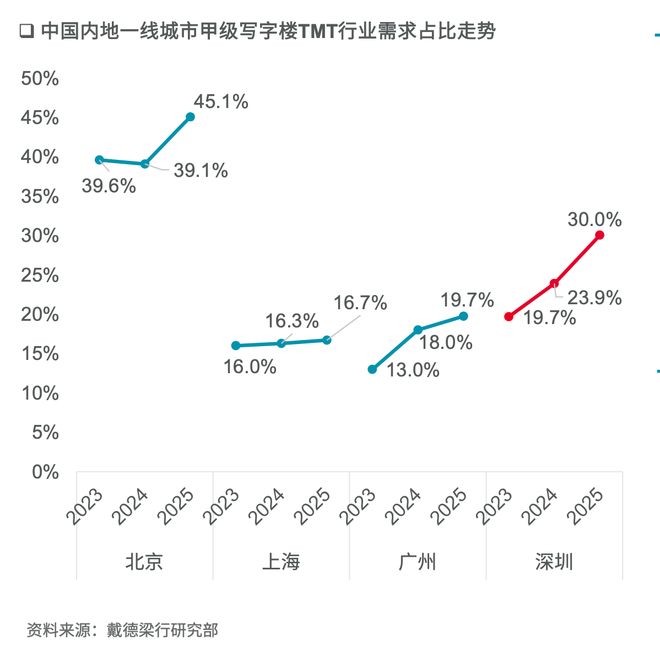
深圳AI产业爆发,TMT的办公租赁占市场总量超三成
Di Yi Cai Jing Zi Xun· 2026-01-16 07:01
2025年,A股市场上最火热的概念莫过于人工智能。在政策加持、资源集聚的持续作用下,人工智能产 业正在以前所未有的速度成长,拉动各相关行业快速发展。目前,深圳人工智能产业规模已突破3600亿 元,在广东省占比近四成,汇聚的企业超2800家,位居全国前列。 伴随着人工智能及其相关产业的快速发展,其办公租赁需求也持续扩张,逐渐成为写字楼市场的一项重 要增长动能。 戴德梁行提供的数据显示,按面积计,2025年,AI相关企业租赁需求在所有办公物业和甲级写字楼中 的占比分别为5.7%以及4.6%;若按宗数计,占比在所有办公物业和甲级写字楼中均有上升,均为 6.5%。 戴德梁行研究院副院长、华南及华中区研究部主管及董事向张晓端第一财经记者分析,"深圳的产业空 间及商办空间当中人工智能相关企业的需求增长,涵盖了龙头企业的持续扩张、中小型企业的快速增 长,以及创业型企业对灵活办公需求等,从具体细分产业来看,包括AI软硬件,以及结合应用场景渗 透到各个行业领域而不断衍生拓展出新的创新应用。" 整体来看,AI行业的租赁需求来源当中包含了大量初创企业及中小企业。"这也印证了当下深圳AI产业 蓬勃的创新创业趋势。"张晓端表示。 深圳 ...