
华硕

Search documents
电竞市场增长,三季度面板价格有望企稳
21世纪经济报道· 2025-08-05 11:27
Core Viewpoint - The global esports market is experiencing a recovery in the first half of 2025, leading to increased demand for monitors and gaming laptops, which in turn injects growth momentum into the panel industry [1][3]. Group 1: Esports Market Growth - The global esports monitor retail market is expected to grow by 34% year-on-year this year, while the gaming laptop retail market is projected to increase by 15% in the first half of the year [1]. - In Q1 of this year, China's esports monitor shipments reached 2.58 million units, a year-on-year increase of 56%, with high-end 4K esports monitors seeing a shipment growth of 71.5% [3]. Group 2: Panel Industry Dynamics - Despite the recovery in esports demand, the overall panel industry is still undergoing structural adjustments, with a temporary decline in panel prices due to seasonal factors [6]. - Starting from Q3, the panel industry is expected to see improved demand, with TV panel shipments projected to increase by 3% to 4% compared to Q2, driven by traditional sales peaks and domestic policies [6]. Group 3: Technological Advancements and Market Opportunities - TCL Huaxing is optimizing its mid-size production lines and accelerating the development of mid-size OLED technology, viewing it as a significant industrial opportunity for the coming years [4]. - The global esports monitor market is projected to reach approximately $11.35 billion by 2025, with a compound annual growth rate of about 6.6% until 2035 [4]. Group 4: Supply Chain and Production Strategies - The company emphasizes the importance of maintaining flexibility in technology, supply chain, and product structure to remain competitive in the industry [1]. - TCL Huaxing has achieved over 50% localization in its supply chain materials and aims to strengthen both domestic and global supply chain capabilities [7].



电竞市场增长,三季度面板价格有望企稳
2 1 Shi Ji Jing Ji Bao Dao· 2025-08-05 09:00
Core Insights - The global esports market is experiencing a recovery in the first half of 2025, leading to increased demand for monitors and gaming laptops, which in turn boosts the panel industry [2][4] - Major panel manufacturers are focusing on esports and high-end displays, with TCL's CEO highlighting a significant growth in the retail market for esports monitors and gaming laptops [2][4] - The esports monitor retail market is expected to grow by 34% year-on-year, while the gaming laptop market is projected to grow by 15% in the first half of the year [2][4] Market Trends - In Q1 2024, China's esports monitor shipments reached 2.58 million units, a 56% year-on-year increase, with high-end 4K monitors seeing a 71.5% increase [4] - The global esports monitor market is projected to reach approximately $11.35 billion by 2025, with a compound annual growth rate (CAGR) of about 6.6% until 2035 [5] Panel Industry Dynamics - Despite the recovery in esports demand, the overall panel industry is undergoing structural adjustments, with a temporary decline in panel prices due to seasonal factors [7] - The third quarter is expected to see a rebound in demand, driven by traditional sales peaks and government policies, with a projected 3-4% increase in TV panel shipments compared to Q2 [7] - The industry is witnessing a healthy inventory level, which, along with recovering demand, is anticipated to stabilize panel prices [7] Technological Innovations - The trend towards larger sizes and technological innovations, such as Mini LED TVs, is expected to drive growth, with a projected 4.2% increase in global large-size panel shipment area by 2025 [8] - The introduction of high-refresh-rate OLED monitors by brands like ASUS and MSI indicates a strong consumer demand for high-end products [4] Supply Chain Strategy - The company emphasizes a dual approach to supply chain management, balancing domestic and global partnerships to enhance resilience [9] - The current domestic material localization rate exceeds 50%, with a strategy to strengthen both domestic and global supply chain capabilities [9]

同比增长25%!上半年联想平板表现强势 Legion Tab季度出货量翻倍
Ge Long Hui· 2025-08-05 08:02
Group 1: Chromebook Market Performance - Lenovo maintains a leading position in the global Chromebook market with a market share of 31.3% and a shipment volume of 3,453 thousand units in the first half of 2025, up from 2,720 thousand units in the same period of 2024, reflecting a year-on-year growth rate of 26.9% [2][3] - The global Chromebook market experienced a significant recovery, with total shipments reaching 11 million units in the first half of 2025, representing a year-on-year increase of 10.6%, driven primarily by the demand for device updates from Japan's GIGA school project, which saw Chromebook shipments in Japan surge over 20 times [2][3] - Lenovo's deep engagement in the education market, including participation in events like the "EDIX Tokyo" education exhibition, has strengthened its connections with educational decision-makers, further solidifying its competitive advantage during this device refresh cycle [3] Group 2: Tablet Market Performance - In the tablet market, Lenovo achieved a shipment volume of 310 thousand units in Q2 2025, with a market share of 7.9%, reflecting a year-on-year growth rate of 24.7%, significantly above the industry average [4][5] - The global tablet market saw a year-on-year growth of 9% and a quarter-on-quarter growth of 5% in Q2 2025, supported by consumer subsidy policies in China and a wave of new product launches, particularly in the gaming tablet segment [5] - Lenovo's Legion Tab gaming tablet has shown remarkable performance, with quarterly shipments doubling, becoming a key driver of growth in the tablet segment [4][5] Group 3: Future Outlook and Financial Performance - The continuous growth of Lenovo from Chromebooks to tablets is attributed to its keen market trend awareness and product innovation capabilities, with a focus on public sector procurement projects and customized solutions in the education sector [6] - International investment bank Citic Lyon has raised Lenovo's earnings expectations for the April to June period, forecasting a 14% quarter-on-quarter growth in IDG revenue, driven by demand in the Chinese market [6] - Citic Lyon has also increased Lenovo's target price from HKD 11 to HKD 12 while maintaining an outperform rating [6]

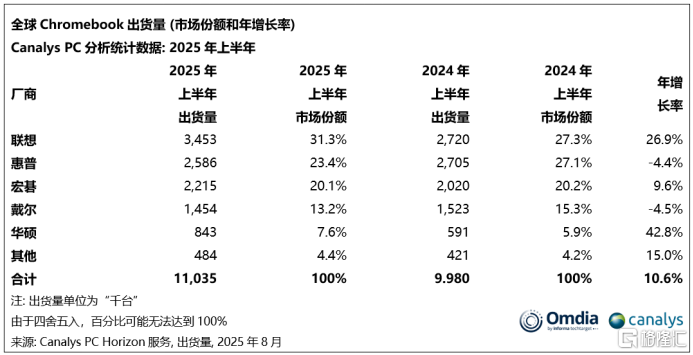
联想(00992)稳居上半年Chromebook市场首位 Legion Tab季度出货量翻倍
智通财经网· 2025-08-05 07:47
Core Insights - Lenovo continues to demonstrate strong competitiveness in the Chromebook and tablet markets, leading the global Chromebook market with a 31.3% market share and achieving a 24.7% year-on-year growth in the tablet market [1][3]. Chromebook Market - In the first half of 2025, Lenovo shipped 3.453 million Chromebooks, representing a 31.3% market share, up from 27.3% in the first half of 2024, with a year-on-year growth rate of 26.9% [2][3]. - The global Chromebook market saw a significant recovery, with shipments reaching 11 million units, a 10.6% increase year-on-year, driven by the demand for device updates from Japan's GIGA school project, which saw Chromebook shipments in Japan surge over 20 times [2][3]. - Lenovo's deep engagement in the education market, including participation in events like the "EDIX Tokyo" education exhibition, has strengthened its connections with educational decision-makers, solidifying its leading position during this device update cycle [3]. Tablet Market - In the second quarter of 2025, Lenovo shipped 3.1 million tablets, achieving a 7.9% market share and a year-on-year growth of 24.7%, significantly above the industry average [4][5]. - The global tablet market experienced a 9% year-on-year growth in the second quarter, supported by consumer subsidy policies in China and global commercial bidding projects, alongside a wave of new product launches, particularly in the gaming tablet segment [5]. - Lenovo's Legion Tab gaming tablet saw a remarkable increase in shipments, doubling its quarterly sales and becoming a key driver of growth in the tablet market [4][5]. Future Outlook - Lenovo's sustained growth is attributed to its keen market trend awareness and product innovation capabilities, particularly in the education sector and consumer electronics [6]. - The company is expected to further expand its market influence by leveraging its leading position in both Chromebook and tablet segments, enhancing the user experience with high-quality smart devices as global educational digitalization and smart device ecosystem integration accelerate [6].
Canalys:2025年第二季度全球平板电脑出货量达到3900万台 同比增长9%
智通财经网· 2025-08-05 06:56
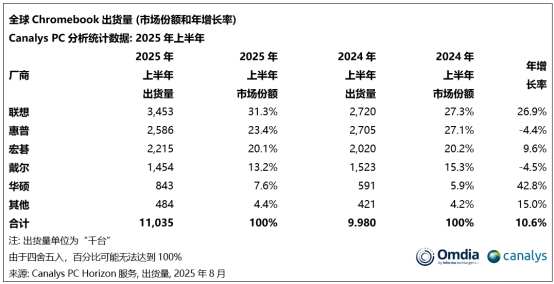
Group 1: Tablet Market Overview - Global tablet shipments are projected to reach 39 million units in Q2 2025, marking a 9% year-on-year increase and a 5% quarter-on-quarter increase, driven by stable demand in China and EMEA regions [1] - Apple remains the market leader with 14.1 million iPads shipped in Q2 2025, a 2% increase year-on-year, while Samsung follows with 6.7 million units [3] - The strong performance of the tablet market is attributed to consumer subsidy policies in China and commercial tender projects globally, alongside a wave of new product launches, particularly in the gaming tablet segment [3] Group 2: Chromebook Market Dynamics - The Chromebook market is experiencing a resurgence, particularly in Japan, where shipments have increased over 20 times due to the GIGA school project, with expectations for this demand peak to continue until mid-2026 [5] - Lenovo leads the global Chromebook market with shipments of 3.45 million units in the first half of 2025, a 27% year-on-year increase, while HP follows with 2.59 million units, experiencing a slight decline [6] - Acer and ASUS also show positive growth, with Acer achieving a 10% increase in shipments to 2.22 million units and ASUS seeing a 43% increase to 0.84 million units, driven by the GIGA project [5][6]
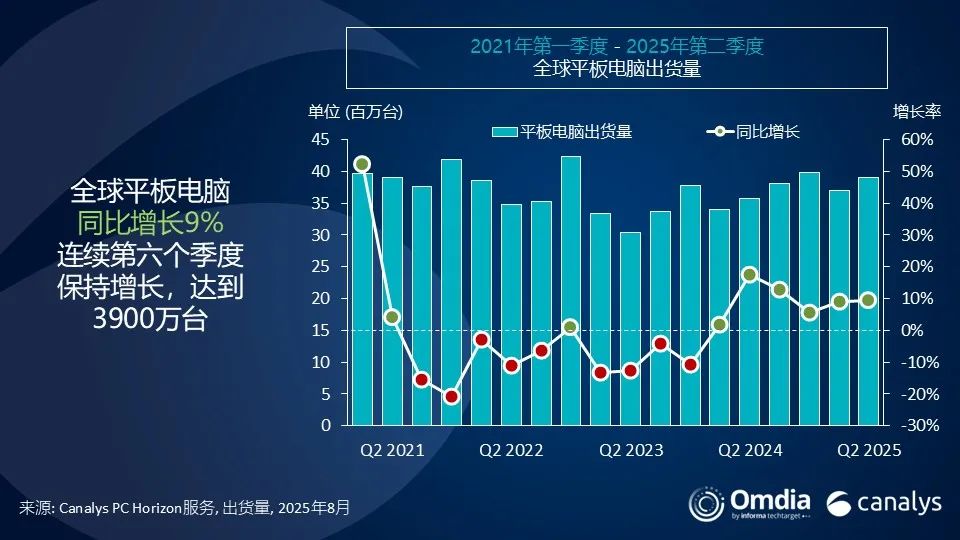
2025年第二季度,全球平板出货实现连续六季度增长,华为表现抢眼,跃升至第三;联想稳居上半年Chromebook市场首位
Canalys· 2025-08-05 06:32
Core Insights - The global tablet market showed strong growth in Q2 2025, with shipments reaching 39 million units, a 9% year-on-year increase and a 5% quarter-on-quarter increase, driven by stable demand in China and EMEA regions [1] - The Chromebook market is experiencing a resurgence, particularly in Japan due to the GIGA school project, with shipments in the first half of 2025 reaching 11 million units [1][6] Tablet Market Overview - Apple remains the leader in the tablet market with 14.1 million iPads shipped in Q2 2025, a 2% increase year-on-year [4] - Samsung follows in second place with 6.7 million units shipped, while Huawei, Lenovo, and Xiaomi have all seen significant growth, particularly in the Chinese market [4] - Notable new product releases in the gaming tablet segment have contributed to market growth, with brands like Xiaomi and Lenovo seeing substantial increases in shipments [3] Chromebook Market Dynamics - Lenovo led the global Chromebook market in the first half of 2025 with shipments of 3.45 million units, a 27% year-on-year increase [7] - The demand for Chromebooks is expected to remain high due to government-funded procurement activities in Japan, with shipments to Japan increasing over 20 times year-on-year [6] - Other brands like HP, Acer, Dell, and ASUS are also participating in this growth, with ASUS showing a 43% increase in shipments [6][7] Market Share and Growth Rates - In Q2 2025, the market shares for key tablet manufacturers were as follows: Apple (36.1%), Samsung (17.1%), Huawei (8.3%), Lenovo (7.9%), and Xiaomi (7.8%) [4] - The Chromebook market share for the first half of 2025 showed Lenovo at 31.3%, HP at 23.4%, and Acer at 20.1%, indicating a competitive landscape [7]





黄仁勋罕见翻车,英伟达桌面CPU出师不利,生态是最大掣肘
3 6 Ke· 2025-08-05 06:01
Core Viewpoint - NVIDIA's entry into the CPU market with its DGX Spark has faced significant delays, raising concerns about its ability to compete against established players like Intel and AMD [1][10][16]. Group 1: Product Launch and Specifications - NVIDIA's DGX Spark, featuring the GB10 Grace Blackwell chip, was initially set to launch in July 2025 but has been delayed, with new expected shipping dates pushed to September 15 [3][4]. - The GB10 chip boasts a performance of approximately 1000 TOPS (FP4) and includes 128 GB of LPDDR5X unified memory, designed to meet the demands of AI model inference [4][9]. - The device is capable of running AI models with parameter scales of up to 200 billion at FP4 precision and 100 billion at FP8 precision, making it suitable for deploying specialized AI models [4][9]. Group 2: Production Challenges - High integration levels in the GB10 chip, which combines multiple cores and a GPU, have led to lower yield rates during mass production, complicating the manufacturing process [7][10]. - The production process involves complex steps, such as the CoWoS-L packaging by TSMC, which requires precise temperature control and can lead to delays if any step encounters issues [7][10]. Group 3: Market Competition and Pricing - The pricing for the base model of the GB10 is reported to be around £3600 (approximately 33,000 RMB), which, while lower than traditional NVIDIA DGX systems, may still be prohibitive for many developers [9][10]. - AMD has launched its Threadripper 9000 series processors, capturing a significant market share, with AMD's server CPU share reaching 39.4% in Q1 2025, indicating strong competition for NVIDIA [11][16]. Group 4: Software Ecosystem and Compatibility - NVIDIA faces significant challenges in building a software ecosystem for its Arm architecture CPUs, as many applications are not optimized for this architecture, leading to performance issues [14][20]. - The success of the GB10 will depend on NVIDIA's ability to ensure that essential software runs smoothly on its platform, as poor user experience could undermine its performance advantages [18][20]. Group 5: Strategic Partnerships and Future Outlook - NVIDIA's strategy includes collaborating with major PC manufacturers like ASUS and Dell to mitigate risks and share benefits, but delays have strained these partnerships [20][21]. - The company must consider forming closer alliances with software developers and operating system providers, such as Microsoft, to enhance the availability of native Arm applications and improve overall ecosystem compatibility [20][21].


电竞市场增长 面板厂商加码布局
2 1 Shi Ji Jing Ji Bao Dao· 2025-08-04 11:32
Core Insights - The global esports market is experiencing a recovery in the first half of 2025, leading to increased demand for monitors and gaming laptops, which in turn boosts the panel industry [1][2] - Major panel manufacturers are actively investing in technology and capacity focused on esports and high-end displays [1][2] Group 1: Market Growth and Demand - The global esports display market is expected to grow by 34% year-on-year in retail sales this year, with gaming laptop sales projected to increase by 15% [1] - In Q1 2024, China's esports monitor shipments reached 2.58 million units, a 56% year-on-year increase, with high-end 4K monitors seeing a 71.5% increase [2] - By 2025, the global esports display market size is projected to be approximately $11.35 billion, with a compound annual growth rate (CAGR) of about 6.6% expected to reach $21.51 billion by 2035 [3] Group 2: Technological Advancements and Product Strategy - TCL Huaxing has maintained the largest global market share in esports MNT displays for three consecutive years, with one in three esports monitors using TCL Huaxing screens [2] - The company is optimizing its mid-size production lines and has completed the acquisition of LGD's Guangzhou factory, enhancing its capacity across various mainstream technologies [2] - TCL Huaxing is accelerating its development of mid-size OLED technology, focusing on printed OLED as a strategic initiative for future product commercialization [2] Group 3: Panel Pricing and Supply Chain Dynamics - Despite the recovery in esports demand, the overall panel industry is undergoing structural adjustments, with a temporary decline in panel prices due to seasonal factors [4][5] - The third quarter is expected to see a rebound in panel prices and demand, driven by traditional sales peaks and government policies [4][5] - The company anticipates a 4.2% year-on-year increase in global large-size panel shipment area by 2025, with Mini LED TV shipments expected to exceed 10 million units for the first time [5] Group 4: Strategic Outlook and Supply Chain Management - The company emphasizes the importance of flexibility in technology, supply chain, and product structure to maintain competitiveness in the market [1][5] - TCL Huaxing is pursuing a dual strategy of domestic and global supply chain collaboration, with over 50% of its material sourcing being localized [5]
长三角议事厅·周报|草根赛事破圈,开拓文旅商体融合新路
Xin Lang Cai Jing· 2025-08-04 09:07
Core Insights - The summer sports events in the Yangtze River Delta, particularly the "Su Super" football league and "Zhe BA" basketball league, have significantly engaged local communities and transformed the cultural and commercial landscape [1][4][5] Policy Coordination and Framework - The integration of culture, tourism, commerce, and sports in the Yangtze River Delta is rooted in national strategies and systematic policy frameworks established since 2018, focusing on industrial collaboration and innovative mechanisms [2][3] - The 2019 "Yangtze River Delta Regional Integration Development Plan" emphasized enhancing policy coordination efficiency, laying the groundwork for the integration of complex industries like culture, tourism, commerce, and sports [2] - In 2021, the "Opinions on High-Quality Development of Sports Integration in the Yangtze River Delta" highlighted the cultivation of original event brands as a key task for regional coordinated development during the 14th Five-Year Plan [2] Economic Impact and Industry Resonance - The "events+" model has demonstrated a multiplier effect, driving cross-industry collaboration and creating a vibrant ecosystem beyond just sports [4][5] - The "Su Super" league is projected to generate over 300 million yuan in comprehensive revenue, with an average increase of 2 million yuan per city, showcasing the economic benefits of local events [5] - During the events, travel-related bookings, including flights and hotels, saw an increase of 9% to 29%, indicating a boost in local tourism and consumption [5] Cultural and Community Engagement - Events have evolved from mere competitions to cultural phenomena, integrating local industries and enhancing community engagement through innovative formats like "second venues" and themed night markets [7][8] - The "Zhe BA" league has created a model of "watching games + tourism," promoting bundled ticket sales and enhancing the cultural experience for attendees [5][7] Systematic Upgrades and Future Outlook - The Yangtze River Delta is developing a comprehensive model for cultural, commercial, and sports integration, characterized by seamless ticketing and travel experiences [8] - The synergy of policy, industry, and market forces is forming a sustainable and replicable "golden triangle" for regional development, positioning sports events as key drivers of economic and cultural revitalization [8]
美国关税政策引爆涨价潮 PC跟进调涨迟早的事
Jing Ji Ri Bao· 2025-08-03 23:20
Group 1 - The article highlights that the U.S. tariff policy has triggered a price increase for technology products, with Nintendo raising the price of the Switch in the U.S. market, followed by potential price hikes for Apple's iPhone 17 series [1] - Counterpoint Research warns that due to uncertainties surrounding U.S. tariff policies, the growth rate of PC shipments may slow down starting in the second half of 2025 compared to the same period last year, which could negatively impact brands like Acer and ASUS in the latter half of the year [1] - Despite the current exemption from tariffs on laptops, the ongoing uncertainty regarding policies poses significant challenges for the global PC manufacturing industry, which is highly concentrated in mainland China [1] Group 2 - ASUS has seen a notable increase in PC shipments in the second quarter due to the launch of new products based on NVIDIA's RTX50 platform and early shipments to the North American market [1] - ASUS's co-CEO has expressed uncertainty about the market conditions for the second half of the year, primarily due to fluctuating exchange rates and tariff issues [1]