
奥特维

Search documents
光伏系列报告:商业航天能源系统将快速增长并迎来升级迭代
CMS· 2026-01-21 05:02
Investment Rating - The report provides investment recommendations for several companies, including strong buy ratings for 帝科股份 (Dike Co., Ltd.) and 亿纬锂能 (EVE Energy Co., Ltd.) [2][3] Core Insights - The commercial aerospace sector is experiencing rapid growth, particularly in low Earth orbit (LEO) satellites, which are becoming a focal point of competition between the US and China. This growth is expected to drive advancements in energy systems that support these satellites [1][7] - The satellite power systems are critical for ensuring stable power supply throughout the satellite's lifecycle, consisting of solar power generation, energy storage, and power management modules. These systems face unique challenges in space, such as high radiation and extreme temperature variations [1][31] - The report highlights the ongoing evolution of photovoltaic (PV) technology, with P-type PERC and perovskite-silicon tandem cells being tested for potential use in space applications. The cost reduction in solar power generation is a significant industry demand [1][36] - High-performance batteries and power systems are identified as high-barrier, high-return segments within the satellite energy systems, with stringent requirements for energy density, reliability, and cycle performance [1][49] Industry Overview - The global aerospace industry is projected to reach a value of $415 billion by 2024, with the number of operational satellites increasing to 11,605, representing a year-on-year growth of 17.81%. The US leads with 8,813 satellites, accounting for 75.9% of the global share [12][13] - The commercial satellite sector is expected to maintain over 70% of the global aerospace market share, with the satellite market projected to grow to $4,808 billion by 2025 and $5,114.9 billion by 2026, reflecting a compound annual growth rate of 6.38% [13][19] - The report emphasizes the importance of government policies in both the US and China that are accelerating the development of the commercial aerospace sector, including funding initiatives and regulatory simplifications [1][27] Company Analysis - Key companies mentioned in the report include: - 帝科股份 (Dike Co., Ltd.) - Strong buy rating, with a market cap of 13.2 billion and projected EPS of 2.48 for 2024 [3] - 亿纬锂能 (EVE Energy Co., Ltd.) - Strong buy rating, with a market cap of 136.9 billion and projected EPS of 1.96 for 2024 [3] - 新雷能 (Newray Energy) - Hold rating, with a market cap of 16.5 billion and projected EPS of -0.92 for 2024 [3] - The report also lists several other companies in the photovoltaic and battery sectors that are positioned to benefit from the growth in commercial aerospace [2][3]

行业洞察 | 新能源装备制造产业城市竞争力TOP50揭晓:苏州问鼎,长三角集群领跑
Zhong Guo Jin Rong Xin Xi Wang· 2026-01-20 11:40
Core Insights - The Chinese new energy equipment manufacturing industry is transitioning from resource development to high-end manufacturing under the "dual carbon" strategy [2] - The "2025 China New Energy Equipment Manufacturing Industry City Competitiveness TOP 50" list was released, ranking cities based on six core dimensions and over 60 indicators [2] - Suzhou, Jiangsu Province, topped the list with a score of 87.71, followed closely by Shenzhen (87.63) and Changzhou (87.47) [2] Industry Overview - The list highlights a new industrial pattern characterized by "Yangtze River Delta cluster leadership and multi-polar collaborative breakthroughs" [2] - The East China region is a key player in the new energy equipment manufacturing industry, with cities from the Yangtze River Delta accounting for about half of the top 50 [12] City Rankings - The top ten cities in the new energy equipment manufacturing sector include: 1. Suzhou, Jiangsu 2. Shenzhen, Guangdong 3. Changzhou, Jiangsu 4. Wuxi, Jiangsu 5. Shanghai 6. Ningde, Fujian 7. Ningbo, Zhejiang 8. Beijing 9. Hefei, Anhui 10. Nantong, Jiangsu [8][12] Suzhou's Competitive Edge - Suzhou's success is attributed to its "full-chain layout" and "supporting advantages," with a comprehensive new energy industry system covering solar, energy storage, power batteries, wind power, smart grids, hydrogen energy, and green low-carbon + new energy vehicles [12] - The city aims to exceed 1 trillion yuan in new energy industry output by 2026, establishing itself as a fourth trillion-level industrial cluster [12] - Suzhou ranks first in "enterprise aggregation" (91.51) and "development effectiveness" (88.98) [12] Other Notable Cities - Changzhou is recognized as the "capital of new energy," with a significant share of national power battery production [13] - Wuxi focuses on a modern industrial cluster strategy, while Shanghai leads in high-end equipment with strong research and financial capabilities [13] - Shenzhen, as the only non-Yangtze River Delta city in the top three, excels in innovation with a score of 89.24 in the "innovation momentum" category [14] Future Trends - The industry is expected to shift towards green manufacturing, lifecycle carbon management, and deep integration of intelligence and digitalization [15] - The competition will evolve from production capacity to standards, green practices, and intelligence [16] - Cities that enhance core technology, optimize industrial ecosystems, and expand global markets will gain a competitive advantage in the future [16]


申万宏源:商业航天进入规模部署与能力升级新阶段 为太空光伏带来新增需求
智通财经网· 2026-01-20 03:13
Group 1 - China's submission of over 200,000 satellite constellation applications marks a significant expansion in the commercial space market, indicating a new phase of large-scale deployment [2][3] - The largest two constellations, CTC-1 and CTC-2, each consist of 96,714 satellites, suggesting a substantial increase in demand across satellite manufacturing and rocket launching sectors [2] - The commercial space sector is transitioning to a new stage characterized by large-scale deployment and capability upgrades, leading to a surge in demand for space photovoltaics [3] Group 2 - The demand for space photovoltaics is expected to grow significantly as the construction of low-orbit constellations moves from the "thousands" scale to "hundreds of thousands" and potentially "millions" in the coming decade [3] - Current mature technology includes gallium arsenide (GaAs) multi-junction batteries, which are high-performance but extremely costly, while silicon-based HJT batteries are seen as a key transitional solution for large-scale deployment [4] - Future potential technologies include perovskite and tandem batteries, which could achieve breakthroughs in efficiency and cost, although they currently face challenges in long-term stability [4] Group 3 - Key equipment suppliers in the space photovoltaic sector include Maiwei Co. (HJT production line equipment), High Measurement Co. (slicing machines), and Aotwei (module string welding equipment) [5] - Battery component manufacturers such as Yunda Co. and Trina Solar are actively developing next-generation space energy products, including collaborations on perovskite technology [5]

未知机构:天风电新太空能源SpaceX主线看好设备先行0120-20260120
未知机构· 2026-01-20 02:10
Summary of Conference Call Notes Industry Overview - The focus is on the solar energy sector, particularly the developments related to companies T and S, which are planning to expand their photovoltaic production capacity [1][1]. Key Points and Arguments 1. **Separate Teams for Production Planning**: Companies T and S are operating as independent teams to plan their photovoltaic production capacity, with T taking the lead and S expected to follow before the Spring Festival [1]. 2. **Technology Pathways**: Company S is pursuing a space technology route using P-type HJT (Heterojunction Technology), while Company T is focusing on ground applications, likely utilizing TOPCon technology due to patent considerations [1]. 3. **Super Factory Plans**: Company T is considering the establishment of a 10GW integrated super factory, with an initial phase potentially reaching 1GW and a long-term capacity target of 50GW [1]. 4. **Capacity Planning**: The combined capacity planning for T and S is approaching 100GW, with T targeting 50GW for ground applications and S aiming for 40GW for space applications, which exceeds initial expectations [1]. 5. **Ongoing Factory Audits**: The factory audit for Company T is just the first round, with potential for additional rounds, indicating that the equipment sector will undergo repeated trading activities [1]. 6. **Systematic Revaluation**: The planning by T and S is seen as exceeding expectations, suggesting that the equipment sector will experience a systematic revaluation beyond just marginal changes from factory audits [1]. Additional Insights - **Investment Recommendations**: The focus is on companies with high value and good market positioning within the solar equipment sector, specifically recommending: - High-value segments: Silicon wafers and battery equipment, with strong endorsements for Liancheng CNC and Laplace, as well as Aotewi, which has a presence in silicon, battery, and module equipment [3]. - Well-positioned segments: Slicing machines and reduction furnaces, with key recommendations for Gaoce Co. and Shuangliang Energy [3]. - **Potential of Space Technology**: The most promising outlook remains with companies like Maiwei Co., which are focused on defining space technology routes that hold the highest value and imaginative potential [2].

未知机构:商业航天持续推荐重视3D打印太空光伏核心环节3D打印是商业航天-20260120
未知机构· 2026-01-20 02:10
Summary of Key Points from Conference Call Industry Focus - The conference call emphasizes the **commercial aerospace industry**, particularly highlighting the significance of **3D printing** and **space photovoltaics** as core components of this sector [1][2][3]. Core Insights and Arguments - **3D Printing in Aerospace**: - 3D printing is identified as one of the highest value segments in commercial aerospace, with the potential to account for over **40%** of the value of a single rocket [1][2]. - The market for 3D printing is vast due to its advantages in **lightweight design** and **cost reduction**, with further penetration expected in the industry [1][2]. - SpaceX has been a pioneer in this area, having utilized 3D printing technology in its Dragon spacecraft since **2013**, and the majority of components in the Raptor 3 engine are now 3D printed, significantly enhancing performance [1][2]. - **Space Photovoltaics**: - Space photovoltaics are highlighted as a crucial direction for applications in commercial aerospace [3]. - The introduction of computing satellites is expected to create at least **100 GW** of new installations in space photovoltaics, with competitive technology routes including **p-HJT**, **p-XBC**, and **perovskite** [4]. - The value of equipment in this sector is projected to significantly exceed that of current terrestrial photovoltaics [4]. Recommendations for Investment - The call recommends focusing on several companies within the 3D printing and space photovoltaics sectors: - **3D Printing**: Companies such as Jiangshun Technology (DED multi-metal printing), Platinum Technology, Huazhu High-Tech, Yinbang Shares, Feiwo Technology, Jinchengzi, and Ruike Laser are highlighted as key players [4]. - **Space Photovoltaics**: Companies like Maiwei Shares (direct beneficiaries), Jiejia Weichuang (leader in perovskite equipment), and Dier Laser (multiple laser technologies compatible with p-type BC, HJT, and ultra-thin space battery demands) are recommended [4]. - Additionally, companies with low valuations and stable main businesses such as China International Marine Containers, CIMC Enric, Hangyang Co., Anhui Heli, and Hengli Hydraulic are suggested for investment [4]. Other Important Insights - The call indicates that the **industrialization** of these technologies is accelerating, with a focus on factory audits and feedback from audited companies [4].
中原证券晨会聚焦-20260120
Zhongyuan Securities· 2026-01-20 00:40
Key Insights - The report highlights that China's GDP for 2025 is projected to reach 1401879 billion yuan, reflecting a growth of 5.0% compared to the previous year, indicating a successful completion of the "14th Five-Year Plan" [5][8] - The semiconductor industry showed strong performance in December 2025, with a 5.11% increase in the domestic semiconductor sector, outperforming the broader market [19] - The electric power and utilities sector maintained a "stronger than market" investment rating, with a focus on stable, high-dividend companies in the sector [36][38] Domestic Market Performance - The Shanghai Composite Index closed at 4114.00, with a slight increase of 0.29%, while the Shenzhen Component Index rose by 0.09% to 14294.05 [3] - The average P/E ratios for the Shanghai Composite and ChiNext indices are 16.80 and 53.52, respectively, indicating a favorable environment for medium to long-term investments [9][10] Industry Analysis - The aerospace and electric grid sectors led the A-share market with slight gains, while the internet services and software development sectors faced challenges [6][9] - The battery and semiconductor sectors are highlighted as key areas for investment, with significant growth potential driven by technological advancements and market demand [11][12] Economic Indicators - The report notes a trend of increased capital inflow into the equity market, with a notable rise in margin trading balances, suggesting a positive outlook for market continuation [10][11] - The CPI showed a slight increase in December 2025, indicating marginal improvements in domestic demand [10][11] Sector-Specific Insights - The new energy vehicle sector saw sales of 171.0 million units in December 2025, a year-on-year increase of 7.14%, supported by favorable policies [15] - The chemical industry experienced a slowdown in price declines, with specific focus on agricultural chemicals and polyester filament [17] - The gaming industry is projected to continue its steady growth, with animation films leading box office revenues [27][30]

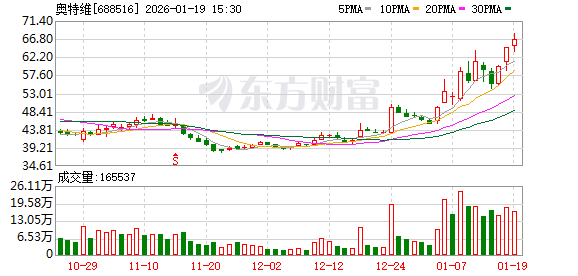
奥特维:截至2025年6月,公司海外收入占公司收入的比例超过20%
Zheng Quan Ri Bao· 2026-01-19 14:15
Group 1 - The core viewpoint of the article indicates that the company, Aotewei, expects its overseas revenue to exceed 20% of total revenue by June 2025, with Europe being a significant market for overseas sales [2][3] - The company employs both direct sales and distribution models for its overseas sales, with direct sales being the primary mode [2]

光伏设备行业点评:商业航天星辰大海,太空光伏设备迎增长机遇
Shenwan Hongyuan Securities· 2026-01-19 13:42
Investment Rating - The report rates the commercial aerospace and photovoltaic equipment industry as "Overweight" [4]. Core Insights - The commercial aerospace sector is entering a new phase characterized by large-scale deployment and capability upgrades, leading to increased demand for space photovoltaic systems. The application for over 200,000 satellites in China marks a transition from "thousands" to "tens of thousands" and even "millions" of satellites, indicating a super cycle in satellite manufacturing and launching over the next decade, which will drive long-term, large-scale demand for satellite energy systems, specifically space photovoltaics [4]. - The extreme conditions in space (high radiation, large temperature differences, vacuum) necessitate stringent requirements, leading to continuous iterations in space photovoltaic technology. The current mature solution is gallium arsenide (GaAs) multi-junction cells, which have high conversion efficiency (generally exceeding 30%) and good radiation resistance, but are extremely expensive and have limited production capacity. The short to medium-term scalable path is the HJT (Heterojunction) battery, which is more cost-effective for mass production despite lower absolute efficiency and radiation resistance compared to GaAs. Long-term potential directions include perovskite and tandem batteries, which have high theoretical efficiency limits and lightweight properties, but face challenges in long-term stability [4]. - Key equipment suppliers to focus on include Maiwei Co., Ltd. (HJT production line equipment), High Measurement Co., Ltd. (integrated slicing and processing services), Aotwei (module string welding equipment), and others. Battery module manufacturers include Yunda Co., Ltd. (collaborating on perovskite technology applications) and Trina Solar [4]. Summary by Sections Industry Overview - The commercial aerospace market in China is expected to expand significantly due to the submission of over 200,000 satellite constellation applications, which will stimulate demand across multiple segments including satellite manufacturing and rocket launching [2]. Technology Development - The report highlights the transition from traditional satellite power supply units to essential energy infrastructure for future space economies, driven by advancements in space computing and AI data centers powered by space photovoltaics [4]. Key Companies and Valuations - The report provides a valuation table for key companies in the industry, including Maiwei Co., Ltd. with a market cap of 66.5 billion and projected net profits for 2026 of 970 million, and others like Aotwei and High Measurement with varying financial forecasts [5].




再Call太空钙钛矿-重视Space-X产业链
2026-01-19 02:29
Summary of Conference Call on Perovskite Solar Cells and Space Industry Industry Overview - The focus is on the perovskite solar cell industry, particularly its application in space technology and its potential to replace traditional gallium arsenide solar cells in low Earth orbit satellites [1][3][5]. Key Insights and Arguments - **Expansion of Perovskite Applications**: It is anticipated that from 2026 to 2027, perovskite technology will transition from ground applications to space applications, becoming a major investment theme [1][3]. - **Cost Reduction**: The cost of perovskite solar cells for space applications is significantly lower, with prices expected to drop from at least 200,000 yuan per square meter for gallium arsenide to between 10,000 to 20,000 yuan per square meter for perovskite [1][5]. - **Market Demand**: The demand for low-cost solar cells in the low Earth orbit satellite market is increasing, driven by the need for cost control in commercial space ventures [1][5]. - **Domestic Competitiveness**: Shanghai Port Bay has successfully launched pure single-junction space components into low Earth orbit, demonstrating the competitiveness of domestic components in the space application field [2][5]. Future Projections - **Ground Perovskite Development**: The bidding volume for ground perovskite solar cells is expected to exceed 3 to 4 GW in 2026, indicating a significant improvement from 2025 [1][3]. - **Technological Advancements**: The industry is moving from the initial development phase (0 to 1) to a more advanced stage (0.8), with improvements in large-area, high-efficiency, and stability issues being gradually resolved [3][4]. Equipment and Supplier Recommendations - **Key Equipment Suppliers**: The report recommends focusing on companies such as Maiwei Co., Ltd., and also highlights Otovi, Jiejia Weichuang, and High Measurement Co., Ltd. as companies to watch [1][4]. - **Potential Market Opportunities**: If SpaceX adopts P-type heterojunction technology, there will be increased demand for heterojunction equipment, crystalline silicon thin-film equipment, and related components, benefiting domestic suppliers [4][5]. Additional Important Points - **Catalytic Effects**: T Company's ground photovoltaic projects may also provide potential catalytic effects in the market [4]. - **Long-term Recommendations**: The report suggests a long-term investment in Shanghai Port Bay and Maiwei Co., Ltd., while also advising attention to other mentioned companies [4].
