宝钢股份

Search documents
2025年1-11月中国焊接钢管产量为5521.3万吨 累计增长0.6%
Chan Ye Xin Xi Wang· 2026-01-10 02:19
Core Viewpoint - The report highlights a decline in China's welded steel pipe production in November 2025, indicating a potential downturn in the industry [1] Group 1: Industry Overview - In November 2025, China's welded steel pipe production was 5.02 million tons, representing a year-on-year decrease of 7.1% [1] - From January to November 2025, the cumulative production of welded steel pipes in China reached 55.213 million tons, showing a slight increase of 0.6% compared to the previous year [1] Group 2: Companies Involved - Listed companies in the welded steel pipe sector include Baosteel Co., Ltd. (600019), Xinxing Cathay International Group (000778), Changbao Steel Pipe (002478), Jiuli Special Materials (002318), Honglu Steel Structure (002541), Youfa Group (601686), CITIC Special Steel (000708), Jinzhu Pipeline (002443), and Yulong Steel (601028) [1] Group 3: Research and Analysis - The report titled "Analysis of Development Models and Future Prospects of China's Welded Steel Pipe Industry from 2026 to 2032" was published by Zhiyan Consulting, a leading industry consulting firm in China [1] - Zhiyan Consulting has over a decade of experience in industry research, providing comprehensive industry solutions to support investment decisions [1]


以确定性转型破局 中国重塑全球气候治理新生态
Zhong Guo Jing Ying Bao· 2026-01-09 15:46
Core Viewpoint - The implementation of the EU Carbon Border Adjustment Mechanism (CBAM) on January 1, 2026, complicates the global climate governance landscape, necessitating China's transition from an "important participant" to an "active leader" in global climate governance [1][2]. Group 1: China's Role in Global Climate Governance - China aims to respond to international climate rules' uncertainties through a systematic transformation towards a green and low-carbon economy, turning external pressures into high-quality development drivers [1]. - The country is positioned as a significant supplier of green production capacity, leveraging its full industrial chain technology advantages in solar, wind, and energy storage sectors [1]. - Projects like the Al Dhafra Solar Power Plant in the UAE, with a capacity of 2.1 GW, exemplify China's commitment to reducing carbon emissions by 2.4 million tons annually and supporting local employment [1]. Group 2: Renewable Energy Cooperation - Through South-South cooperation, China has initiated renewable energy technology transfer projects with countries like Ghana and Zambia, providing clean energy solutions and creating numerous job opportunities [2]. - The De Aar Wind Power Project in South Africa, developed by China National Energy Group, delivers 770 million kWh of clean electricity annually, benefiting 300,000 households and training over 110 local technicians [2]. Group 3: Strategic Responses to CBAM - To address the challenges posed by CBAM, China needs to implement a systematic strategy that includes accelerating the national carbon market's development and establishing a transparent carbon accounting system [3]. - The focus should be on integrating affected industries like steel, aluminum, and cement into carbon market rules and exploring carbon pricing mechanisms to avoid double payments [3]. Group 4: Industry Decarbonization and Competitiveness - The "carbon barrier" represents a competition in green competitiveness, and industries must deeply decarbonize to gain a competitive edge [4]. - Companies like Baosteel and Taiyuan Iron and Steel are leading the way in reducing carbon footprints through innovative processes and clean energy adoption, setting benchmarks for high-energy-consuming industries [4]. - The overall goal is to create a new advantage in green supply chains, making low-carbon practices central to high-quality industrial development [4].
推动我国航空业实现绿色低碳转型
Qi Lu Wan Bao· 2026-01-09 09:54
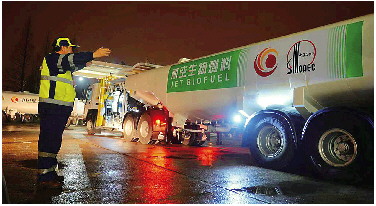
Group 1 - The restructuring of China Petroleum & Chemical Corporation (Sinopec) and China Aviation Oil Group has been approved by the State Council, marking a significant move in the central enterprise restructuring efforts [2] - Sinopec is the world's largest refining company and the leading aviation fuel producer in China, while China Aviation Oil is the largest aviation fuel procurement and service company in Asia, providing fuel support to numerous airports [2] - The integration aims to streamline the entire supply chain from crude oil refining to aircraft refueling, potentially reducing costs and enhancing energy security for China's aviation industry [2][3] Group 2 - The collaboration between Sinopec and China Aviation Oil is expected to facilitate the commercialization of Sustainable Aviation Fuel (SAF), addressing the industry's need for carbon reduction and climate change mitigation [3] - The restructuring is part of a broader trend of accelerated mergers and acquisitions among central enterprises, with several significant consolidations occurring during the 14th Five-Year Plan period [3][4] - The 15th Five-Year Plan emphasizes optimizing the layout and structure of state-owned enterprises to enhance their core functions and competitiveness [3][4] Group 3 - Experts highlight that while the merger is a crucial first step, the real challenge lies in achieving effective integration and synergy between the two companies [4] - The restructuring faces challenges in ensuring national energy security and advancing the dual carbon goals, with stakeholders keenly observing the outcomes [4]

2025年中国汽车车桥行业发展历程、产业链、市场规模、重点企业及趋势研判:车桥行业正加速向轻量化与高效化迭代[图]
Chan Ye Xin Xi Wang· 2026-01-09 01:43
Core Insights - The automotive axle industry in China is experiencing significant growth driven by increasing demand for vehicles, particularly SUVs, and advancements in automotive technology [1][11] - The market size of China's automotive axle industry is projected to reach 67.158 billion yuan in 2025, reflecting a year-on-year growth of 5.93% in 2024 [1][12] - The global automotive axle market is expected to grow to 49.526 billion USD by 2030, indicating a robust demand for high-performance axles [11] Industry Overview - Automotive axles, also known as vehicle axles, connect the wheels to the vehicle frame and are crucial for transmitting forces and maintaining vehicle stability [2][9] - The industry is categorized into light, heavy, and suspension axles, with light axles primarily serving passenger vehicles and heavy axles for commercial vehicles [2][4] Industry Development History - The axle industry began in the early 20th century, evolving from simple steel and chain constructions to advanced materials and manufacturing processes [4][5] - Significant advancements occurred in the 1980s in China, transitioning from reliance on foreign technology to independent research and development [5][6] Industry Value Chain - The upstream of the axle industry includes raw materials like high-strength steel and production equipment, while the midstream focuses on manufacturing, and the downstream encompasses various vehicle applications [7][8] Current Industry Status - The global automotive market is recovering post-pandemic, with production expected to reach 93.95 million units by 2024, which positively impacts the axle industry [10][11] - China's automotive production is projected to be 31.28 million units in 2024, with a notable increase in new energy vehicles [10][11] Competitive Landscape and Key Players - The global axle market is dominated by international giants like ZF, Bosch, and Cummins, while Chinese manufacturers focus on commercial vehicle axles [12] - Key players in China include Liaoning Shuguang Automotive Group, Dongfeng Dana Axle Company, and others, with a strong emphasis on technology and product development [12][13] Industry Trends - The future of the axle industry is leaning towards specialization, with customized solutions for different vehicle types and driving conditions [14] - Lightweight designs using advanced materials and integrated systems are becoming a priority to enhance vehicle efficiency and performance [15][16]




宝钢股份出资38610.047万元成立宝钢神钢汽车铝板(上海)有限公司,持股38.62%
Jin Rong Jie· 2026-01-08 16:09
资料显示,宝钢神钢汽车铝板(上海)有限公司成立于2025年1月9日,法定代表人为吴军,注册资本 99962.148万人民币,公司位于上海市,金属表面处理及热处理加工、高性能有色金属及合金材料销 售、货物进出口。(除依法须经批准的项目外,凭营业执照依法自主开展经营活动)。 财经频道更多独家策划、专家专栏,免费查阅>> 天眼查工商信息显示,近日,宝山钢铁股份有限公司出资38610.047万元成立宝钢神钢汽车铝板(上 海)有限公司,持股38.62%,所属行业为金属制品业。 ...
十五五开局之年!锁定这一海洋装备与关键材料盛会,抢占先机
DT新材料· 2026-01-08 16:05
Group 1 - The conference marks the 11th International Marine Anti-Corrosion and Anti-Fouling Forum and Marine Key Materials Conference, focusing on the development of marine engineering equipment and technology in China since 2016 [2] - The event will feature a comprehensive analysis of global marine equipment anti-corrosion and anti-fouling technology, sharing innovative methods and transformative technologies in marine key materials [2] - The conference will include a main forum, 12 specialized forums, 3 frontier technology and youth forums, and various networking activities, inviting global government departments, industry organizations, experts, and corporate representatives to collaborate [2] Group 2 - The organizing institutions include the National Key Laboratory of Marine Key Materials, the Institute of Oceanology, Chinese Academy of Sciences, Ocean University of China, and the 725th Research Institute of China Shipbuilding Group [4] - The conference will address macro policies, latest research achievements, and industry advancements, with a focus on innovative materials and technologies in marine applications [13] Group 3 - Specialized forums will cover topics such as marine functional materials, marine structural materials, and marine environmental materials, focusing on new types of anti-corrosion coatings and materials for various marine applications [13][14] - The conference will also explore corrosion and protection technologies, digital technologies, and artificial intelligence applications in marine material development [14][15] Group 4 - The event will feature a youth forum aimed at encouraging young scientists to present key scientific issues and innovative solutions, with awards for outstanding presentations [17] - Various specialized forums will focus on marine key materials, corrosion and protection technologies, and wear and protection technologies, addressing the latest research and practical applications [18][19][20] Group 5 - The conference will include special activities such as large-scale terminal matching sessions, showcasing the latest solutions for anti-fouling, corrosion life prediction models, and innovative products and technologies [21] - The previous conference in 2025 highlighted applications in green shipping, deep-sea aquaculture, offshore wind power, coastal nuclear power, and marine oil and gas, with over 500 participants and numerous presentations [23][24]

财经聚焦丨中国石化“牵手”中国航油,影响几何?
Xin Hua Wang· 2026-01-08 13:47
Group 1 - The restructuring of China Petroleum & Chemical Corporation (Sinopec) and China Aviation Oil Group has been approved by the State-owned Assets Supervision and Administration Commission (SASAC), marking a significant move in the central enterprise restructuring landscape [1][5] - Sinopec is the world's largest refining company and the largest aviation fuel producer in China, while China Aviation Oil is the largest integrated aviation fuel supply chain service provider in Asia, serving hundreds of airports [1][3] - The merger aims to create a seamless supply chain from crude oil refining to aircraft refueling, enhancing energy security for China's aviation industry and improving international competitiveness [3][5] Group 2 - The restructuring aligns with China's "dual carbon" goals, promoting the use of Sustainable Aviation Fuel (SAF) as a key measure for carbon reduction in the aviation sector [3][6] - Sinopec has been a pioneer in SAF production, and the collaboration is expected to break commercial barriers for SAF, facilitating its large-scale application at domestic airports [3][6] - The restructuring reflects a broader trend of central enterprises optimizing their structure and enhancing core competitiveness, with multiple strategic mergers occurring across various sectors [5][6]

战新产业与未来产业领航,央企开辟增长“第二曲线”
Hua Xia Shi Bao· 2026-01-08 12:16
Core Insights - The article emphasizes the importance of the "14th Five-Year Plan" implementation period starting in 2026, focusing on enhancing core functions and competitiveness of state-owned enterprises (SOEs) to achieve world-class status [2] - The central government aims to accelerate industrial upgrades and foster new growth drivers through strategic investments in emerging industries such as artificial intelligence, biomedicine, and digital economy [2][3] Group 1: Industrial Upgrades and Strategic Focus - The State-owned Assets Supervision and Administration Commission (SASAC) is promoting a dual-track development model for SOEs, focusing on both traditional industry enhancement and the cultivation of new growth drivers [3] - Central enterprises are expected to invest in strategic emerging industries, with an annual investment growth rate exceeding 20% over the past five years, reaching 3.3 trillion yuan in fixed asset investments (excluding real estate) from January to November 2025 [3] Group 2: Technological Advancements and R&D Investment - Central enterprises have significantly increased R&D investment, amounting to 890.16 billion yuan from January to November 2025, with an R&D intensity of 2.62% [5] - Breakthroughs in key technologies have been achieved, such as the development of a world-first megawatt-level CO₂ thermal energy storage system and a 700-megawatt ultra-supercritical circulating fluidized bed boiler [5][6] Group 3: Collaborative Ecosystem and Mechanism Reforms - SOEs are moving away from isolated operations by forming innovation alliances and promoting collaborative development across the industrial chain, with 24 innovation alliances involving over 800 enterprises and institutions [7] - The SASAC plans to advance strategic and specialized mergers and acquisitions in 2026, focusing on sectors like new energy, integrated circuits, and biotechnology to enhance competitive advantages [8]

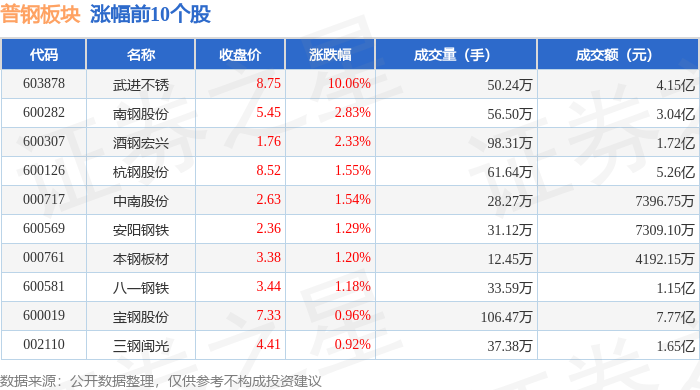
普钢板块1月8日涨0.52%,武进不锈领涨,主力资金净流入1693.28万元
Zheng Xing Xing Ye Ri Bao· 2026-01-08 08:51
Group 1 - The core viewpoint of the news is that the steel sector showed mixed performance on January 8, with the overall sector index rising by 0.52%, while the Shanghai Composite Index fell by 0.07% and the Shenzhen Component Index decreased by 0.51% [1] - Wujin Stainless Steel led the gains in the steel sector with a closing price of 8.75, reflecting a significant increase of 10.06% [1] - The trading volume for Wujin Stainless Steel was 502,400 shares, resulting in a transaction value of 415 million yuan [1] Group 2 - The steel sector experienced a net inflow of 16.93 million yuan from main funds, while retail funds saw a net inflow of 56.80 million yuan, and speculative funds had a net outflow of 73.73 million yuan [2] - The top three stocks by main fund inflow were Wujin Stainless Steel with 79.40 million yuan, Nanjing Steel with 38.11 million yuan, and Shougang Group with 35.47 million yuan [3] - The stock with the highest net outflow from speculative funds was Wujin Stainless Steel, with a net outflow of 25.48 million yuan [3]