小红书

Search documents
涉网络销售消费品!美团、京东、抖音等9家企业签署承诺书
Bei Jing Ri Bao Ke Hu Duan· 2025-12-16 12:37
Group 1 - The core viewpoint of the article is the release of the "Monitoring and Evaluation Guidelines for the Joint Commitment on the Safety and Recall of Consumer Goods Sold Online" by the State Administration for Market Regulation, aimed at enhancing the supervision of defective consumer goods recalls in online sales [1][2] Group 2 - The guidelines set monitoring indicators for online trading platforms to ensure they leverage data and resources to establish a mechanism for monitoring and sharing information on defective consumer goods, and to conduct ongoing risk assessments [1] - Online trading platforms are required to take action within 24 hours of receiving recall information from market regulation authorities to stop the sale of defective consumer goods [1] - Platforms must provide conditions for sellers to prominently display recall information on their store pages and inform consumers of their rights [1] - Platforms are expected to strengthen tracking of the handling of defective product recalls to prevent these products from being re-listed [2] - Online trading platforms must take necessary management measures against sellers who knowingly continue to sell defective products or re-list products that have not had their defects resolved [2] - Nine online trading platforms, including Taobao, Meituan, JD.com, Xiaohongshu, Tencent, Kuaishou, Douyin, Dewu, and Vipshop, have signed the "Joint Commitment on the Safety and Recall of Consumer Goods Sold Online" [2] - The market regulation authorities will gradually expand the number of participating platforms and will monitor the implementation of commitments, releasing results as appropriate [2]



加强网售缺陷消费品召回监管 市场监管总局发布监测评估指南
Yang Shi Xin Wen· 2025-12-16 12:12
Core Viewpoint - The Market Supervision Administration has released guidelines for monitoring and evaluating the commitment to safety and recall governance for online consumer goods sales, focusing on the implementation of commitments by online trading platforms [1][2]. Group 1: Monitoring Indicators - Online trading platforms are required to leverage data and resource advantages to establish a monitoring and sharing mechanism for defective consumer goods information, continuously conducting information monitoring and risk assessment [1]. - Platforms must take action within 24 hours to stop the sale of defective consumer goods upon receiving recall information from market supervision authorities [1]. - Platforms should provide conditions for operators to prominently display recall information on their storefronts and inform consumers of their rights [1]. Group 2: Follow-up and Compliance - Platforms are expected to strengthen tracking of the handling of defective product recalls to prevent the re-listing of such products [2]. - Online trading platforms must take necessary management measures against operators who knowingly sell defective products or re-list products that have not had their defects resolved [2]. - Nine online trading platforms, including Taobao, Meituan, JD.com, Xiaohongshu, Tencent, Kuaishou, Douyin, Dewu, and Vipshop, have signed the commitment to safety and recall governance [2].


QuestMobile2025年新媒体生态盘点:五大平台月活用户达11.49亿,多元内容与算法技术差异化竞争,年轻用户更爱跨平台
3 6 Ke· 2025-12-16 05:43
Core Insights - The active user base of typical new media platforms is projected to reach 1.149 billion by October 2025, with an average monthly usage time of 3,367.5 minutes, reflecting year-on-year growth of 7.3% and 5.4% respectively, indicating increasing user engagement driven by diverse content and algorithmic recommendations [1] User Demographics and Behavior - The competitive landscape among platforms has stabilized, with distinct user demographics: platforms like Weibo, Xiaohongshu, and Bilibili have a significant proportion of users under 30 years old, at 58.6%, 54.2%, and 66.5% respectively, while Douyin and Kuaishou have 22.2% and 22.6% of users aged 51 and above [1] - Users are increasingly adopting a multi-platform usage habit, with 39.8% of users engaging with three or more new media platforms, and 54.2% of these users are under 30 years old [1] Content and Platform Dynamics - New media platforms are capturing user attention through enhanced content quality and technology, leading to deeper user engagement [7] - The growth in user engagement time is increasingly reliant on content quality and recommendation technology rather than just user base expansion [12] - Platforms are shifting from merely attracting users to seeking them across various scenarios, enhancing flow through capability output and ecosystem integration [14] User Segmentation and Growth Drivers - The competition is becoming more segmented, with growth driven by diverse user groups, including younger and older demographics, as well as lower-tier markets [17] - Multi-faceted users, primarily young and high-spending, are using different platforms to meet various needs such as socializing, entertainment, and learning, fostering a complementary ecosystem among platforms [20] Content Ecosystem Characteristics - Platforms are transitioning from broad traffic competition to enhancing their unique ecological characteristics, with strategies tailored to their specific user bases [23] - AI-related content has seen a 9.9 percentage point increase in user penetration year-on-year, with younger male users showing a higher interest [26] - The rise of knowledge-based influencers reflects a shift in user demand from entertainment to practical value [32][38] Commercialization Strategies - New media platforms are entering a phase of strategic deepening in commercialization, with hard advertising revenues leading the way [40] - The unique characteristics of platform ecosystems are shaping differentiated advertising models, with soft advertising becoming a significant monetization method [42] - Platforms are enhancing local business strategies, extending their reach from online to offline commerce, with various initiatives to support local merchants [54]

QuestMobile2025年新媒体生态盘点:五大平台月活用户达11.49亿,多元内容与算法技术差异化竞争,年轻用户更爱跨平台
QuestMobile· 2025-12-16 02:01
Core Insights - The article discusses the evolving landscape of new media platforms and their user engagement trends, highlighting the growth in active users and usage duration by 2025 [4][5][6]. User Engagement and Demographics - By October 2025, the active user base of typical new media platforms is projected to reach 1.149 billion, with an average monthly usage time of 3367.5 minutes, reflecting year-on-year growth of 7.3% and 5.4% respectively [5]. - Platforms like Weibo, Xiaohongshu, and Bilibili show a significant concentration of users under 30 years old, with respective proportions of 58.6%, 54.2%, and 66.5%, while Douyin and Kuaishou have 22.2% and 22.6% of users aged 51 and above [5][6]. Multi-Platform Usage - A notable trend is the combination usage of multiple platforms, with 39.8% of users engaging with three or more new media platforms, particularly among users under 30 (54.2%) and those from first and new first-tier cities (31.6%) [6]. Content Quality and User Attention - The article emphasizes that the growth in user engagement is increasingly driven by content quality and algorithmic recommendations rather than just user base expansion [18]. - New media platforms are focusing on enhancing user attention through improved content quality and technology, leading to deeper user participation [13][18]. Competitive Landscape - The competitive landscape among platforms is stabilizing, with distinct user demographics and content strategies emerging. Platforms are shifting from broad traffic competition to focusing on unique ecological characteristics and user engagement [30][32]. - The rise of AI content and tools is reshaping user engagement, with a 9.9 percentage point increase in AI-related content penetration among users by October 2025 [34][36]. Monetization Strategies - New media platforms are entering a phase of strategic deepening in monetization, with hard advertising revenues leading the way. The unique characteristics of each platform are shaping differentiated advertising models [48][50]. - Soft advertising is becoming a significant revenue stream, with brands selecting platforms based on their marketing goals, reflecting the alignment of KOL income with platform content and user expectations [54]. Local Business Integration - Platforms are increasingly integrating local businesses into their ecosystems, transitioning from rapid growth to a more stable phase in local merchant numbers [63].



李国庆,再战电商
3 6 Ke· 2025-12-16 01:47
Group 1 - Li Guoqing, a veteran in the e-commerce industry, has launched a new company "Li Xiang Life" focusing on high-end online membership stores at the age of 60, marking his return to the core e-commerce battlefield [1] - The company aims to maintain a strict markup rate of 1.25 times, significantly lower than the industry average, and plans to serve only 5,000 premium members in its first year [1] - "Li Xiang Life" has been registered with a capital of 1 million yuan, with Li Guoqing holding 99% of the shares, and the company will sell a wide range of products including pre-packaged food, daily necessities, electronics, and jewelry [2] Group 2 - The platform is set to officially launch live streaming sales on December 18, entering a highly competitive membership e-commerce market [3] - Major players in the membership e-commerce sector are rapidly expanding, with Sam's Club opening over 60 stores in more than 30 cities and maintaining a growth rate of over 30% in its e-commerce business [3] - Industry challenges are evident, as seen with the closure of Hema X membership stores and the suspension of Xiaohongshu's "Xiaohong Card" just three months after its launch, highlighting common issues such as insufficient store coverage and difficulties in user retention [3][4] Group 3 - Experts emphasize that the success of membership e-commerce requires strong product, operational, and organizational capabilities, indicating that it is not merely a "curated + membership" model [4] - The future of the industry is expected to see intensified competition, with a trend towards the integration of online and offline channels, suggesting that pure online membership platforms may likely expand into physical stores or collaborate with existing ones [4]
“小红卡”上线不足百日折戟 小红书本地生活“交学费”
Xin Lang Cai Jing· 2025-12-16 00:21
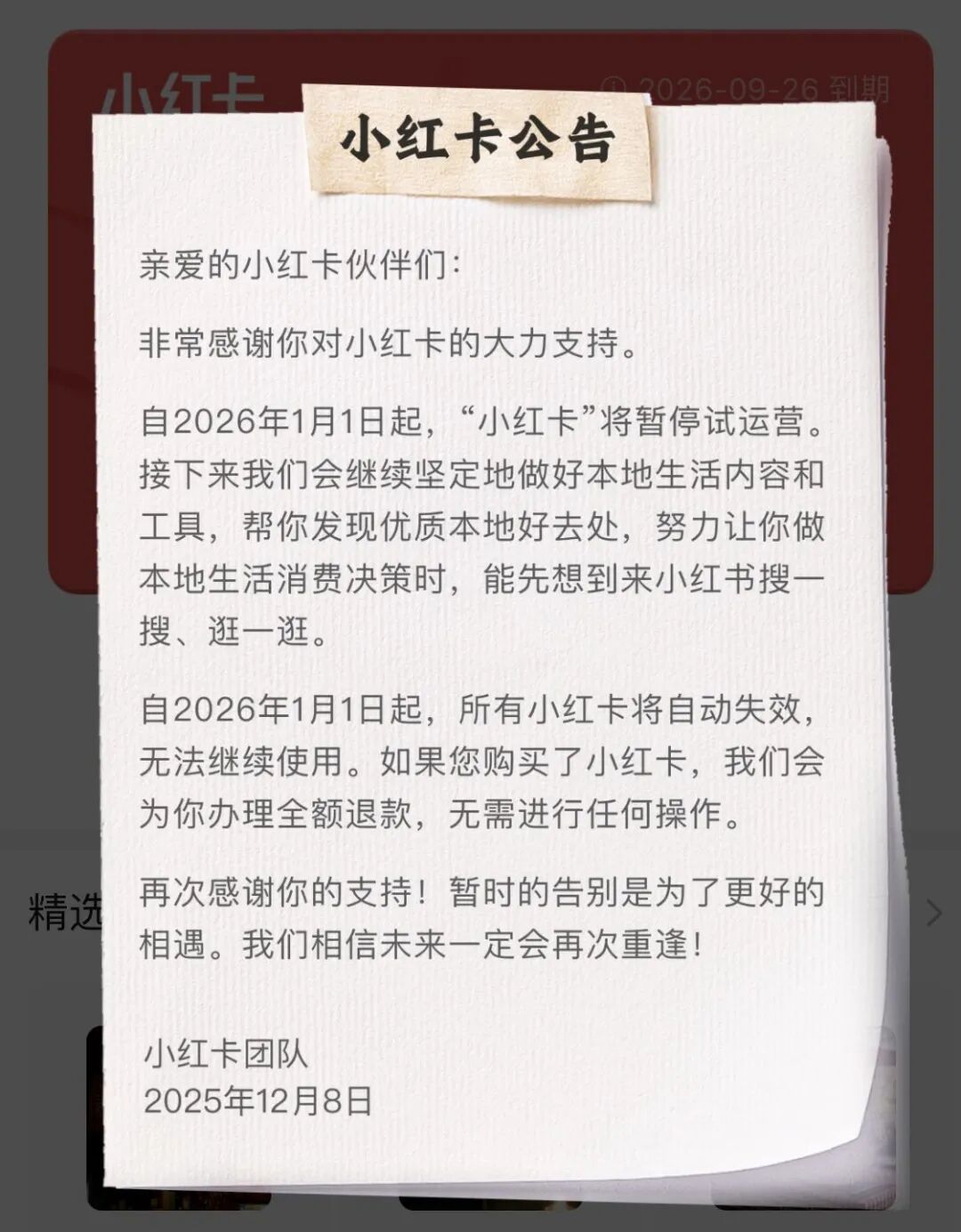
每经记者 陈婷 每经编辑 余婷婷 小红书的"本地生活之路"走得并不顺利。 近日,小红书官方发布公告,宣布其本地生活产品"小红卡"将于2026年1月1日起暂停试运营,并为所有 购卡用户办理全额退款。这一公告距离"小红卡"在9月上线尚不足百日。 12月12日,上海一家连锁烘焙品牌门店的工作人员对《每日经济新闻》记者表示,"小红卡"活动已经结 束了,"市场因素,说结束就结束了"。当日,记者在"小红卡"精选门店中还能找到这家门店。 不过,这并不代表着小红书会在本地生活赛道上就此止步。"小红卡"团队在小红书上表示,其接下来会 继续坚定地做好本地生活内容和工具,努力让大家在做本地生活消费决策时,都能先想到来小红书搜一 搜、逛一逛。 可见,小红书对本地生活赛道还维持着不小的兴趣和斗志。今年9月,小红书本地产品负责人莱昂曾对 包括《每日经济新闻》记者在内的媒体记者表示:"我一直觉得,小红书做本地生活是一个不得不做、 肯定会做的事。" "小红卡"项目百日折戟足以说明,当前小红书还在"交学费"阶段。长远来看,小红书还能否走通"本地 生活之路"还有待继续观察。 小红卡"先天不足"? 9月15日,小红书第三届马路生活节官宣启动。彼时 ...

小红书从严治理直播打赏乱象,一个月处置违规直播间超5600个
Bei Jing Shang Bao· 2025-12-15 14:00
Core Viewpoint - The article highlights the efforts of Xiaohongshu to combat inappropriate live streaming practices, including the manipulation of user behavior through misleading narratives and low-quality content, by launching a two-month special cleanup initiative [1] Group 1: Regulatory Actions - Xiaohongshu has disposed of over 5,600 illegal live streaming rooms and 975 violating users since the start of the cleanup [1] - The focus of the initiative includes four main issues: vulgar group broadcasts inducing tips, false personas deceiving users, inducing minors to tip, and stimulating irrational tipping behavior [1] - The platform is enhancing real-time monitoring, standardizing tipping processes, and improving rules for handling violations to reduce the space for illegal activities [1] Group 2: Community Engagement - Xiaohongshu is promoting a positive interaction culture through the "Live Streaming Potato Light Plan," which encourages quality streamers to advocate for rational consumption and resist bad tipping behaviors [1] - The initiative aims to foster a healthy and positive interactive culture from the ground up by engaging the community [1] Group 3: Industry Context - The article mentions that since the launch of the Central Cyberspace Administration's special action to rectify online live streaming tipping chaos, various platforms have been held accountable for addressing issues like vulgar inducement and irrational tipping [1] - The overall industry ecosystem is being positively influenced by these governance efforts [1]

上线不足百日,“说结束就结束了” ,小红书宣布“小红卡”暂停试运营,年费168元全额退款
Mei Ri Jing Ji Xin Wen· 2025-12-15 07:10
Core Viewpoint - Xiaohongshu's local lifestyle initiative, "Xiaohong Card," is facing significant challenges, leading to its suspension after less than 100 days of operation, with full refunds being issued to users [1][3]. Group 1: Xiaohong Card Overview - "Xiaohong Card" was launched in September 2023 as a "selected lifestyle card" with an annual fee of 168 yuan, offering discounts at selected stores nationwide [4]. - The initiative aimed to connect users with high-quality local businesses, leveraging user discussions and merchant reputations to curate a list of "selected stores" [4][5]. - Despite claims of partnering with "thousands" of merchants, many well-known brands are absent from the program, indicating limited market penetration [5]. Group 2: Market Challenges - The local lifestyle service sector is highly competitive, with established players like Douyin offering substantial support to merchants, making it difficult for Xiaohongshu to attract sufficient partners [5][10]. - Analysts suggest that the subscription model of "Xiaohong Card" may not be suitable for the local lifestyle market, which is increasingly driven by online traffic and immediate retail needs [5][6]. - Xiaohongshu's lack of a clear entry point for local lifestyle services on its platform indicates hesitation and a need for a more defined strategy [9]. Group 3: Future Directions - Xiaohongshu remains committed to exploring the local lifestyle sector, with plans to enhance content and tools for users to make informed consumption decisions [1][3]. - The company is in the early stages of understanding user willingness to pay for local services, focusing on user experience and feedback [7][11]. - Future strategies may involve shifting from a membership model to more product and service-oriented offerings, which could require significant investment and face strong competition [9][10].
5家消费公司拿到新钱;小红书暂停试运营“小红卡”;霸王茶姬联名Hello Kitty|创投大视野
36氪未来消费· 2025-12-14 12:29
Financing Activities - Ningkang Ruizhu completed over 100 million RMB Series A financing, led by Longpan Investment, with funds aimed at accelerating technology platform expansion and clinical research [3] - Anlan Power secured millions in angel financing, focusing on the iterative development and testing of electric and intelligent leisure boat products [4] - Jiang Liutong Pet Fresh Food raised 20 million RMB in angel financing, primarily for product R&D upgrades and capacity expansion [6] - Jiyouyou completed 10 million RMB in angel financing, with plans to deepen its "front store, middle clinic, back platform" strategy and digital upgrades [8] - Hualiao finished several million RMB in angel financing, aimed at enhancing its core product "Hualiao" social app and preparing for a potential listing on the Beijing Stock Exchange [9] Company Developments - Xiaohongshu announced the suspension of its "Xiaohong Card" trial operation starting January 1, 2026, due to unmet user expectations [10] - Mingming Hen Mang's listing application has been approved by the China Securities Regulatory Commission [11] Market Trends - Mixue Ice City launched a breakfast set priced at 7.9 RMB, including breakfast milk and bread, indicating a new product line [12] - Heytea closed over 600 stores within a year, with a net decrease of 711 stores, reflecting a 15.41% year-on-year decline [14] - Super Box NB, a community supermarket under Hema, opened its first production warehouse in Shandong, enhancing its supply chain [15] Consumer Insights - A recent oil price adjustment will reduce consumer costs by approximately 2 RMB for a full tank of gasoline [18] - The price of a trivalent flu vaccine has dropped to 5.5 RMB, highlighting intense competition and oversupply in the vaccine market [19]


招聘市场回暖!脉脉高聘:字节招聘量断层领先 AI科学家平均月薪12.7万元
Mei Ri Jing Ji Xin Wen· 2025-12-14 06:22
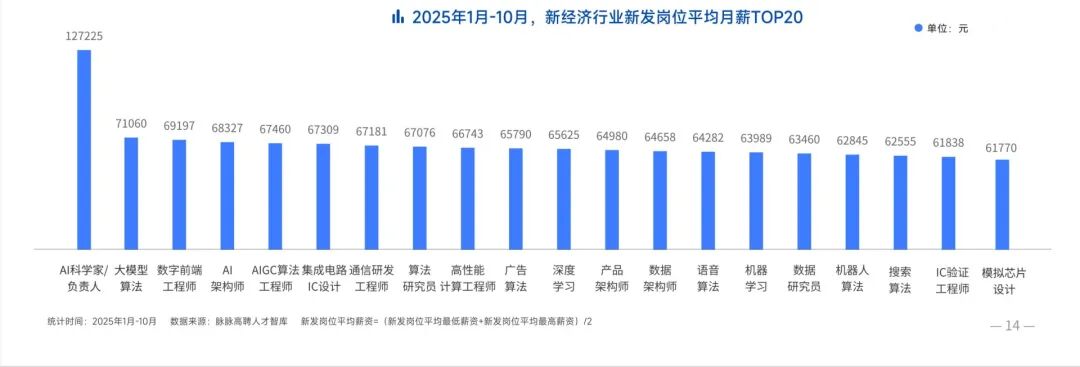
Group 1 - The report indicates that the average monthly salary for the top 20 high-paying positions in 2025 exceeds 60,000 yuan, with AI research and development roles dominating the list [1][2][3] - ByteDance leads in new job postings, followed by Meituan and Alibaba, with Tencent in fourth place and Xiaohongshu surpassing JD.com, NetEase, and Ant Group to enter the top five [1][6] - Chasing has the highest growth rate in new job postings, exceeding 300%, indicating a significant demand for talent in the AI sector [1][8] Group 2 - The job market is showing signs of recovery, with the talent supply-demand ratio in the new economy sector rising to 2.23, meaning 2.23 individuals are competing for one position [2] - From January to October 2025, the number of new AI job postings surged by 543% year-on-year, with a monthly increase of over 11 times in September alone [2] - The most in-demand technical positions in the new economy sector include algorithm engineers and large model algorithms, with high-performance computing engineers being the most scarce [2][3] Group 3 - AI positions dominate the high-paying job market, with AI algorithm engineers earning nearly 18% more than regular algorithm engineers, and AI product managers earning 20% more than their counterparts [2][3] - The average monthly salary for AI scientists/managers is 127,225 yuan, with large model algorithm positions and digital front-end engineers following closely [3][5] - Hardware technology roles such as integrated circuit design and IC verification engineers also maintain competitive salaries, reflecting the broad application of algorithm technology [5] Group 4 - The demand for AI talent is particularly strong in the smart hardware and internet sectors, with companies like Huawei, OPPO, and Xiaomi entering the top 20 for AI job demand [10] - The automotive and transportation industries, including companies like Xiaopeng Motors and Didi, are also showing significant demand for AI positions [10] - The transformation of organizational structures in the AI era is emphasized, with a call for HR to embrace advanced AI tools and redefine operational efficiency [10]