
生活服务

Search documents
字节回应“武汉研发中心全部被裁”
第一财经· 2026-03-15 07:15
Core Viewpoint - ByteDance's Wuhan R&D center is reportedly closing, but the company clarifies that only 50 employees are being relocated, not a complete layoff of the entire workforce [3][4]. Group 1 - Recent rumors suggested that ByteDance would completely lay off its employees in Wuhan, which has raised concerns [3]. - ByteDance confirmed that it currently employs over 2,000 staff in Wuhan, working across various sectors including lifestyle services, automotive, Feishu, and advertising engines [4]. - The company plans to continue increasing its investment in Hubei province despite the adjustments [4].


字节:基于业务调整将有50位员工调整办公地
财联社· 2026-03-14 11:58
Group 1 - The core message indicates that ByteDance's Wuhan R&D center will not be completely shut down, contrary to rumors circulating online [1] - ByteDance confirmed that there will be an adjustment involving 50 employees relocating, but the claim of "all employees in Wuhan being laid off" is inaccurate [1] - Currently, ByteDance employs over 2,000 staff in Wuhan, working across various sectors including lifestyle services, Dongche Di, Feishu, Douyin Engine, and Volcano Engine, and plans to increase investment in Hubei [1]

字节辟谣!否认“武汉研发中心全员裁员”
程序员的那些事· 2026-03-14 08:33
Core Viewpoint - The rumors regarding the mass layoffs and closure of ByteDance's Wuhan R&D center were officially denied, clarifying that the situation involves a normal business adjustment affecting only 50 employees who will change their office location, not a large-scale layoff or center closure [2]. Group 1 - On March 13, rumors circulated about ByteDance's Wuhan R&D center facing full staff layoffs and closure by mid-June, which sparked significant public concern [1]. - ByteDance confirmed that it currently employs over 2,000 staff in Wuhan, covering multiple core business lines such as lifestyle services, Dongche Di, Feishu, and others, indicating the center's importance in the central China region [2]. - The company emphasized its commitment to increasing investment in Hubei and maintaining stable operations for the team [2].

字节回应“武汉研发中心全部被裁”:内容不实,50人因业务调整换办公地
新华网财经· 2026-03-14 08:06
Group 1 - The core viewpoint of the article is that ByteDance's Wuhan R&D center is not shutting down entirely, despite rumors, and the company is making adjustments to its workforce [1] - ByteDance confirmed that it will be relocating 50 employees as part of a business adjustment, and the claim that all employees in Wuhan are being laid off is false [1] - The company currently employs over 2,000 staff in Wuhan, working across various sectors including lifestyle services, Dongche Di, Feishu, and others, and plans to continue increasing its investment in Hubei [1]

字节回应武汉研发中心裁员
21世纪经济报道· 2026-03-14 07:35
Group 1 - ByteDance's Wuhan R&D center is reportedly closing in mid-June, but the company clarified that only 50 employees will be relocated, and the claim of a complete shutdown is false. The company currently employs over 2,000 staff in Wuhan across various businesses, including lifestyle services and other platforms, and plans to increase investment in Hubei [1] - A viral health product, freeze-dried strawberries, has seen its price surge from 9 yuan to 300 yuan, raising concerns among consumers who label it as a "智商税" (intelligence tax) [2] - A recent report revealed that freeze-dried strawberries contain excessive levels of a carcinogenic substance and over 20 types of pesticides, prompting Yunnan to establish an investigation team [2] - Three major financial data terminal companies have announced the launch of a new stock trading product dubbed "小龙虾" (little lobster) [2]

市场监管总局:严打“抢票神器”、酒店涨价、年货乱象
Xin Jing Bao· 2026-02-18 05:05
Group 1 - The core viewpoint of the articles highlights the intensified regulatory measures by market supervision departments across various regions in China to ensure fair pricing and consumer protection during the Spring Festival holiday [1][2][3] Group 2 - Market supervision departments are focusing on key areas such as accommodation, dining, scenic spots, transportation, and New Year goods to combat consumer service irregularities and maintain market order [1] - Regulatory actions include price monitoring, guiding businesses to set reasonable prices, and conducting administrative talks to enforce pricing commitments [1] - Specific regions like Guangdong, Guangxi, Sichuan, and Yunnan have implemented strict oversight on hotel accommodation prices, with Guangdong's Shantou department establishing a regulatory list of 392 accommodation providers and investigating 10 cases of price violations [1] Group 3 - In Shandong, market supervision is addressing transportation pricing issues, particularly in the rental car market, to protect consumer interests and prevent price fraud [2] - Hubei's market supervision is focusing on life service pricing, with investigations into price hikes at pet stores and monitoring services like hairdressing and cleaning [2] - Beijing's market supervision is targeting misleading practices related to train ticket sales, requiring platforms to ensure transparency in pricing and eliminate deceptive promotions [2] Group 4 - Zhejiang and Guangdong are addressing misleading advertising practices related to New Year goods, with strict investigations and product removals from 65 stores in Guangdong [3] - The overall aim of these regulatory efforts is to maintain fair competition and protect consumer rights, creating a safe and satisfactory shopping environment during the festive season [3]
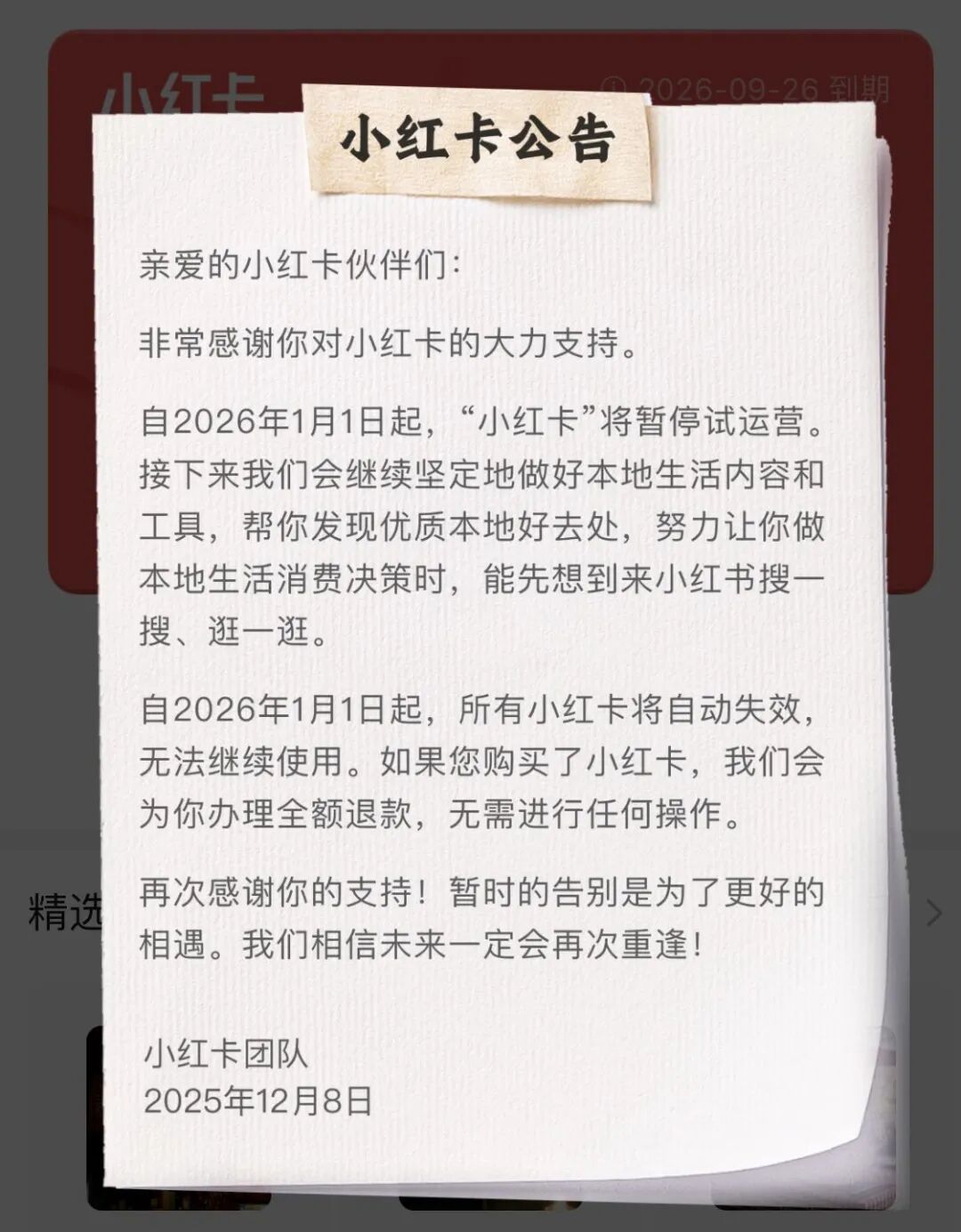
上线不足百日,“说结束就结束了” ,小红书宣布“小红卡”暂停试运营,年费168元全额退款
Mei Ri Jing Ji Xin Wen· 2025-12-15 07:10
Core Viewpoint - Xiaohongshu's local lifestyle initiative, "Xiaohong Card," is facing significant challenges, leading to its suspension after less than 100 days of operation, with full refunds being issued to users [1][3]. Group 1: Xiaohong Card Overview - "Xiaohong Card" was launched in September 2023 as a "selected lifestyle card" with an annual fee of 168 yuan, offering discounts at selected stores nationwide [4]. - The initiative aimed to connect users with high-quality local businesses, leveraging user discussions and merchant reputations to curate a list of "selected stores" [4][5]. - Despite claims of partnering with "thousands" of merchants, many well-known brands are absent from the program, indicating limited market penetration [5]. Group 2: Market Challenges - The local lifestyle service sector is highly competitive, with established players like Douyin offering substantial support to merchants, making it difficult for Xiaohongshu to attract sufficient partners [5][10]. - Analysts suggest that the subscription model of "Xiaohong Card" may not be suitable for the local lifestyle market, which is increasingly driven by online traffic and immediate retail needs [5][6]. - Xiaohongshu's lack of a clear entry point for local lifestyle services on its platform indicates hesitation and a need for a more defined strategy [9]. Group 3: Future Directions - Xiaohongshu remains committed to exploring the local lifestyle sector, with plans to enhance content and tools for users to make informed consumption decisions [1][3]. - The company is in the early stages of understanding user willingness to pay for local services, focusing on user experience and feedback [7][11]. - Future strategies may involve shifting from a membership model to more product and service-oriented offerings, which could require significant investment and face strong competition [9][10].
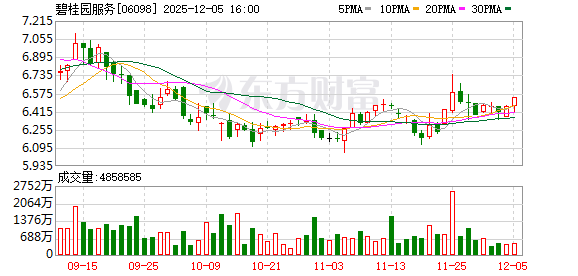
碧桂园服务调整组织架构
Zheng Quan Ri Bao· 2025-12-07 15:43
Group 1 - The core point of the news is that Country Garden Services has undergone significant organizational changes, including the resignation of CFO Huang Peng and the appointment of Tian Tian as the new CFO, aimed at enhancing governance and driving business innovation and transformation [2][3] - Huang Peng will continue to serve as the Executive President and manage the incubation business, which includes environmental services, commercial management, real estate brokerage, and asset management [2] - The organizational restructuring consolidates various service segments into a "Big Property Segment" and renames the strategic incubation segment to "Incubation Business Segment," with no layoffs involved [3] Group 2 - The "Big Property Segment" will focus on value creation, efficiency improvement, and customer satisfaction through systematic construction and digital operations [4] - The new business growth segment will leverage the reputation of basic property services to explore high-value diversified businesses and accelerate business incubation [4] - Recent collaborations include a strategic partnership with Mengniu Group to enhance community retail services and a joint venture with Anhui Keda Nengtong Technology to develop community renewable energy services [5] Group 3 - For the first half of 2025, Country Garden Services reported a revenue of 23.19 billion, reflecting a stable growth of 10.2% year-on-year, with core business revenues reaching 20.781 billion, a 14.9% increase [5] - The core businesses now account for 89.7% of total revenue, with a managed area of 1.063 billion square meters outside of the "Three Supplies and One Industry" business [5] - The adjustments signify a shift from scale expansion to core capability building, enhancing long-term competitiveness [5][6]

碧桂园服务启动组织升级,聚焦服务质量与未来增长
Xin Lang Cai Jing· 2025-12-07 11:01
Core Viewpoint - Country Garden Services announced a significant organizational restructuring aimed at optimizing governance, promoting business innovation, and enhancing transformation capabilities, which includes the appointment of a new CFO and the rebranding of business segments [1][3][4]. Group 1: Management Changes - Huang Peng has resigned as CFO to focus on managing the group's incubation business, effective immediately [1][3]. - Ms. Tian Tian has been appointed as the new CFO, responsible for financial management and capital market operations [1][3]. - Huang Peng will continue as the Executive President, overseeing daily management of the incubation business segment [1][3]. Group 2: Organizational Restructuring - The company has unified its property management, new business growth, and functional service segments into a "Large Property Segment" [1][3][4]. - The strategic incubation business segment has been renamed to "Incubation Business Segment" [1][3][4]. - The restructuring aims to enhance core capabilities, stimulate organizational vitality, and clarify responsibilities, without involving personnel layoffs [2][4]. Group 3: Business Strategy - The "Large Property Segment" will focus on value creation, deepening service quality, cost reduction, and streamlining authority [2][4]. - New business growth segments will leverage the reputation of core property services to explore high-value diversified businesses [2][4]. - The Incubation Business Segment is positioned for multi-dimensional growth, including empowering existing independent businesses and researching innovative business models [2][4]. Group 4: Industry Response - Analysts view the organizational changes as a proactive response to the national "Property Service Quality Improvement Action," emphasizing the need to solidify service foundations while allowing space for high-value innovation [3][5]. - The adjustments are seen as practical and forward-looking, addressing current challenges in the property industry and providing a clear path for sustainable development [5].
中国加快推动解决养老服务标准缺失滞后问题
Zhong Guo Xin Wen Wang· 2025-11-26 11:01
Core Points - China is accelerating efforts to address the lack of standards in elderly care services due to the increasing aging population, which has become a significant public concern [1] - The National Market Supervision Administration and the Ministry of Civil Affairs jointly released the "Guidelines for the Construction of Elderly Care Service Standards System (2025 Edition)" to tackle issues related to outdated and insufficient standards [1] Summary by Sections Standard System Revision - The revised guidelines have shifted from three sub-systems in the 2017 version to four, adding a new service management standard system to regulate various aspects of elderly care institutions [2] - The new service management standards will cover admission and discharge processes, standard system construction, dispute resolution, service quality monitoring, institution evaluation, credit management, risk prevention, and protection of elderly rights [2] Future Directions - The National Market Supervision Administration plans to continue strengthening the coordination of standards for elderly products and services, focusing on key areas such as rehabilitation aids, textiles, home appliances, public facilities, smart products, and life services [2] - The aim is to accelerate the development of age-appropriate standards to enhance the quality of life for the elderly population [2]