蓝色光标

Search documents
ETF盘前资讯|光模块业绩催化,算力赛道突然逆袭!12亿元资金火速布局,创业板人工智能ETF(159363)规模再创新高!
Sou Hu Cai Jing· 2026-01-16 01:22
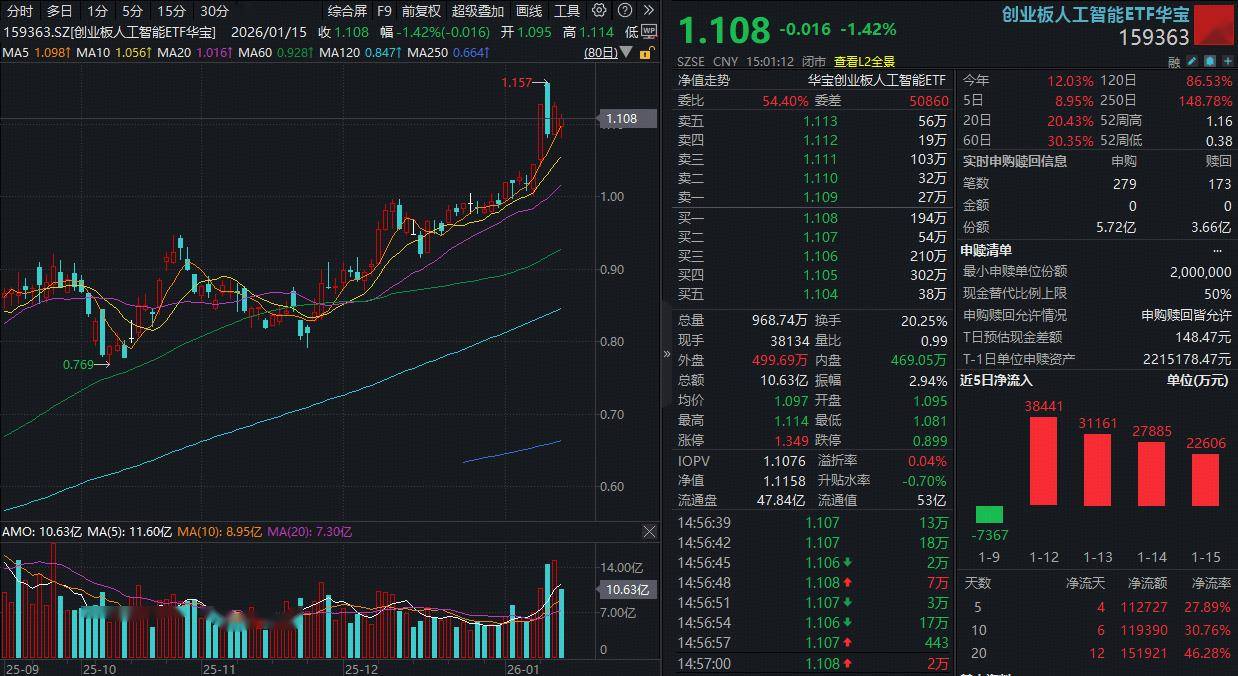
Core Viewpoint - The AI sector, particularly in the context of the ChiNext board, is experiencing a rebound, with significant movements in AI-related stocks and ETFs, indicating strong investor interest and potential growth opportunities in the market [1][3]. Group 1: Market Performance - The ChiNext AI ETF (159363) showed a strong recovery, closing positively with a daily trading volume exceeding 1 billion CNY, reflecting continued capital inflow and a total increase of 1.2 billion CNY over the past four days [1][2]. - The ETF's latest scale reached a record high of 5.527 billion CNY, with an average daily trading volume of nearly 800 million CNY over the past six months, leading among eight ETFs tracking the ChiNext AI index [2][3]. Group 2: Sector Opportunities - The optical module sector is experiencing a high growth cycle, driven by increasing demand for AI computing power, with major manufacturers ramping up production in mainland China and Thailand [3][4]. - The AI application landscape is evolving, with Alibaba's Qianwen App integrating various services, indicating a significant advancement in AI shopping functionalities [3][4]. Group 3: Investment Insights - The ChiNext AI ETF is strategically positioned to benefit from the commercialization of AI technologies, with approximately 60% of its portfolio focused on computing power (mainly optical modules) and 40% on AI applications [4]. - Analysts suggest that the optical module sector could become a focal point for investors during market corrections, highlighting its potential as a strong performer in the near term [3][4].


光模块业绩催化,算力赛道突然逆袭!12亿元资金火速布局,创业板人工智能ETF(159363)规模再创新高!
Xin Lang Cai Jing· 2026-01-16 01:19
Core Viewpoint - The AI sector, particularly the entrepreneurial board's AI ETF (159363), is experiencing significant inflows and growth, with a focus on both computing power and AI applications, indicating a strong market sentiment and potential investment opportunities [3][9][10]. Group 1: ETF Performance - The entrepreneurial board AI ETF (159363) reached a new high of 55.27 billion yuan as of January 15, with an average daily trading volume of nearly 800 million yuan over the past six months, leading among eight ETFs tracking the entrepreneurial board AI index [3][9]. - The ETF has seen a cumulative increase of 1.2 billion yuan in the last four days, reflecting strong investor interest and confidence in the sector [7][9]. Group 2: Sector Opportunities - The optical module CPO sector is experiencing a surge, driven by high demand for AI computing power, with leading manufacturers in mainland China and Thailand accelerating production [10]. - The optical module industry is in a high prosperity cycle, with expectations for significant capacity release in the first quarter of 2026, which could drive a new performance growth phase for companies in this sector [10]. Group 3: AI Application Developments - Alibaba's Qianwen App has integrated with various Alibaba ecosystem services, enabling AI-driven functionalities such as food delivery and flight booking, marking a significant advancement in AI applications [10]. - The AI industry is witnessing rapid developments, with new financing rounds for overseas AI companies and domestic policies promoting "AI + manufacturing," suggesting a potential new wave of AI application growth [10].
A股部分概念炒作熄火
第一财经· 2026-01-15 14:20
Core Viewpoint - The article discusses the recent decline in the stock prices of popular concept stocks, particularly in the GEO (Generative Engine Optimization) and AI application sectors, highlighting the disconnect between stock prices and fundamental performance [3][4]. Group 1: Market Reactions and Stock Performance - On January 15, 2026, major sectors such as internet and cultural media saw significant declines, with the internet index dropping by 5.31% and the cultural media index by 3.33% after reaching new highs on January 14 [6]. - Notable stocks like ZhiDeMai and ZhuoYi Information in the internet sector hit the 20% daily limit down, while TianLong Group in the cultural media sector also faced a 20% drop [6]. - ZhiDeMai's stock price increased by 91.44% from the beginning of 2026 to January 14, but the company clarified that it does not engage in GEO business, and its AI-related revenue is minimal [6][8]. Group 2: Company Announcements and Risk Warnings - Several companies, including TianLong Group and YiDianTianXia, issued risk warnings stating they do not engage in GEO business, and their related AI business has not yet generated significant revenue [7][8]. - 引力传媒 reported a stock price increase of 104.03% during the same period but acknowledged performance volatility, with a net profit of 20.36 million yuan for the first three quarters of 2025, reflecting a decline in gross margin [13][14]. Group 3: Regulatory Actions and Market Oversight - Regulatory bodies have taken action against companies for misleading disclosures and abnormal trading behaviors, with companies like Hangxiao Steel Structure and Electric Science Digital facing warnings [10][12]. - Hangxiao Steel Structure's stock experienced a significant rise before being penalized for inadequate information disclosure regarding its contracts, which were minor relative to its overall revenue [11][12]. - The article emphasizes the importance of accurate information disclosure and the need for companies to avoid speculative behaviors that could mislead investors [16]. Group 4: Long-term Market Trends and Investor Guidance - The article suggests that the current market environment reflects a clash between short-term speculative behavior and long-term industry trends, particularly in fields like commercial aerospace and AI [15]. - It advocates for a return to fundamental analysis, urging investors to scrutinize the actual business contributions of companies to their stock performance [16]. - The article concludes that regulatory measures are intended to foster a healthier market environment, promoting compliance and value investing as the future norm [16].

怕赌场被玩炸 又怕没人气
Datayes· 2026-01-15 12:22
Core Viewpoint - The article discusses recent monetary policy adjustments by the People's Bank of China (PBOC) aimed at stimulating economic growth, particularly focusing on support for small and medium-sized enterprises (SMEs) and technological innovation [4][5][8][10]. Monetary Policy Adjustments - Starting January 19, 2026, the PBOC will lower the re-lending and re-discount rates by 0.25 percentage points, with new rates set at 0.95%, 1.15%, and 1.25% for 3-month, 6-month, and 1-year re-lending respectively [4][8]. - An additional 400 billion yuan will be allocated to support technological innovation and transformation loans, increasing the total to 1.2 trillion yuan [5][10]. - The PBOC will also increase the re-lending quota for agricultural and small business support by 500 billion yuan, with a total quota of 1 trillion yuan for private enterprises [5][10]. Support for Green Projects - Projects related to energy efficiency, green upgrades, and low-carbon transitions will be included in the carbon reduction support tool, with an annual operation limit of 800 billion yuan [5][10]. Market Reactions - The article notes a mixed performance in the stock market, with significant fluctuations in various sectors, particularly in technology and materials [15][28]. - The semiconductor sector is highlighted, with companies like TSMC planning substantial capital expenditures and projecting significant sales growth [18][22]. Economic Indicators - In December, new RMB loans totaled 910 billion yuan, marking the lowest seasonal increase since 2018, with corporate loans being the primary contributor [12]. - The M2 money supply grew by 8.5% year-on-year, indicating ample liquidity in the market, while M1 growth was only 3.8%, suggesting businesses are not converting funds into active deposits for expansion [12].


上市公司密集降温、蹭热点被罚,A股部分概念炒作熄火
Di Yi Cai Jing· 2026-01-15 12:20
Core Viewpoint - The market is experiencing a significant correction as speculative trading in popular concept stocks, particularly in the fields of GEO (Generative Engine Optimization) and AI applications, has led to substantial declines in stock prices, prompting regulatory actions to ensure transparency and protect investors [1][2][11] Group 1: Market Reaction and Stock Performance - On January 15, 2026, major thematic sectors such as internet and cultural media saw significant declines, with the internet index dropping by 5.31% and the cultural media index by 3.33% after reaching peak levels on January 14 [3] - Notable stocks within these sectors, including ZhiDeMai and ZhuoYi Information, faced "20cm" trading limits, while TianLong Group also hit the limit, indicating severe market corrections [3] - ZhiDeMai's stock price increased by 91.44% from 2026 to January 14, 2026, but the company clarified that it does not engage in GEO business, and its AI-related revenue is minimal [3][5] Group 2: Company Announcements and Risk Warnings - Multiple companies, including Upwind New Materials and Gravity Media, issued risk warnings stating that their stock prices had significantly deviated from their fundamental performance, with some clarifying that they do not engage in GEO business [1][5] - TianLong Group reported a cumulative stock price increase of 115.99% during the same period but emphasized that it does not directly engage in AI business and has not generated additional revenue from AI tools [4] - Companies like BlueFocus and others indicated that their AI-driven revenue constitutes a small portion of overall income, thus not materially affecting their financial performance [5] Group 3: Regulatory Actions and Market Oversight - Regulatory bodies have taken action against companies for misleading statements and speculative trading practices, with firms like Hangxiao Steel Structure and Electric Science Digital receiving warnings for inadequate information disclosure [6][8] - Hangxiao Steel Structure's stock experienced a rapid rise due to market speculation but faced a significant drop after regulatory scrutiny, highlighting the risks associated with speculative trading [7][8] - The Shanghai Stock Exchange has implemented measures to address abnormal trading behaviors, particularly in stocks like Guosheng Technology, where investor trading activities were deemed disruptive [8] Group 4: Underlying Financial Performance - Many companies involved in the speculative trading have reported declining financial performance, with Gravity Media's net profit for the first three quarters of 2025 at 20.36 million yuan, reflecting a decrease in gross margin [9][10] - Similar trends were observed in other companies, such as Zhejiang Wenlian and Tianxia Show, which reported significant declines in net profit during the same period [10] - Analysts suggest that the current market enthusiasm for concepts like commercial aerospace and AI may overlook the substantial gap between concept and actual performance, leading to increased speculative risks [10][11]




【15日资金路线图】两市主力资金净流出超500亿元 电子等行业实现净流入
Zheng Quan Shi Bao· 2026-01-15 11:54
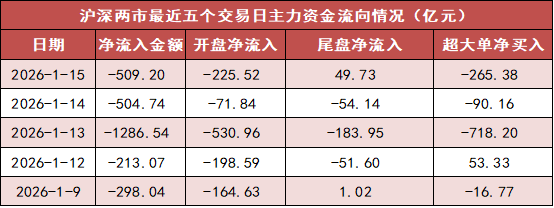
1月15日,A股市场主要指数涨跌不一,全市场超3100股下跌。 截至收盘,上证指数收报4112.6点,下跌0.33%;深证成指收报14306.73点,上涨0.41%;创业板指收报3367.92 点,上涨0.56%。两市合计成交29054.96亿元,较上一交易日减少10358.93亿元。 1.两市主力资金净流出超500亿元 今日沪深两市主力资金开盘净流出225.52亿元,尾盘净流入49.73亿元,全天净流出509.2亿元。 | | | 沪深两市最近五个交易日主力资金流向情况(亿元) | | | | --- | --- | --- | --- | --- | | 日期 | | 净流入金额 开盘净流入 | 尾盘净流入 | 超大单净买入 | | 2026-1-15 | -509.20 | -225. 52 | 49.73 | -265. 38 | | 2026-1-14 | -504. 74 | -71.84 | -54. 14 | -90. 16 | | 2026-1-13 | -1286.54 | -530. 96 | -183. 95 | -718. 20 | | 2026-1-12 | -213.07 | - ...
【15日资金路线图】两市主力资金净流出超500亿元 电子等行业实现净流入
证券时报· 2026-01-15 11:50
今日沪深两市主力资金开盘净流出225.52亿元,尾盘净流入49.73亿元,全天净流出509.2亿元。 1月15日,A股市场主要指数涨跌不一,全市场超3100股下跌。 截至收盘,上证指数收报4112.6点,下跌0.33%;深证成指收报14306.73点,上涨0.41%;创业板指收报 3367.92点,上涨0.56%。两市合计成交29054.96亿元,较上一交易日减少10358.93亿元。 1. 两市主力资金净流出超500亿元 | | | 沪深两市最近五个交易日主力资金流向情况(亿元) | | | | --- | --- | --- | --- | --- | | 日期 | | 净流入金额 开盘净流入 | 尾盘净流入 | 超大单净买入 | | 2026-1-15 | -509.20 | -225.52 | 49.73 | -265. 38 | | 2026-1-14 | -504.74 | -71. 84 | -54. 14 | -90. 16 | | 2026-1-13 | -1286.54 | -530. 96 | -183. 95 | -718. 20 | | 2026-1-12 | -213.07 | - ...

A股缩量震荡!顺周期起舞,有色ETF华宝、化工ETF逆市创新高!热门赛道遇冷,通用航空ETF华宝跌超3%
Xin Lang Cai Jing· 2026-01-15 11:31
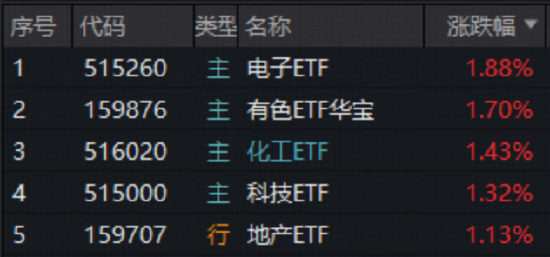
Market Overview - The A-share market experienced fluctuations on January 15, with the Shanghai Composite Index briefly falling below 4100 points before recovering at the close. The Shanghai Composite Index fell by 0.33%, while the Shenzhen Component Index rose by 0.41%, and the ChiNext Index increased by 0.56%. The total trading volume in the Shanghai and Shenzhen markets was 29.388 trillion yuan, a significant decrease of over 1 trillion yuan compared to the previous day [1][20]. Electronic Sector - The electronic sector saw a strong rally in the afternoon, with the electronic ETF (515260) rising by 1.88%. This ETF is heavily weighted in semiconductor and consumer electronics industries, and it recovered its 5-day moving average [3][23]. - The electronic sector attracted a net inflow of 16.862 billion yuan, leading all 31 primary industries in terms of capital inflow [3][23]. - Key stocks in the semiconductor sector, such as Unisoc and Huazhong Microelectronics, saw significant gains, with Unisoc hitting the daily limit of 10% [25][26]. Chemical Sector - The chemical sector also performed well, with the chemical ETF (516020) reaching a peak increase of 2.42% during the day, closing up 1.43%, marking a new three-year high [8][29]. - The basic chemical sector attracted a net inflow of 14.694 billion yuan, the highest among 30 primary industries, and has seen a cumulative net inflow of 254.049 billion yuan over the past 60 days [10][31]. - The chemical ETF has outperformed major indices since the beginning of 2025, with a cumulative increase of 48.29%, significantly higher than the Shanghai Composite Index's 22.7% and the CSI 300 Index's 20.75% [29][30]. AI and Semiconductor Trends - The U.S. government announced a 25% tariff on specific semiconductors, which may enhance domestic substitution sentiment in the market [25][27]. - The demand for AI computing power is expected to drive significant price increases in storage chips, with projections indicating a rise of up to 1800% for certain DDR chips by 2025 [27]. - The trend of "self-controllable" and AI synergy is anticipated to strengthen in the electronics industry, with a focus on domestic computing power and semiconductor equipment [27]. Investment Tools - The electronic ETF (515260) and its linked funds are effective tools for investors looking to gain exposure to core assets in the electronic sector, particularly in AI chips, automotive electronics, and 5G technologies [27]. - The chemical ETF (516020) is also highlighted as a strategic investment vehicle, covering various segments within the chemical industry, including AI computing and robotics [13][29].
“易中天”尾盘短线拉升,创业板人工智能ETF顽强收阳!基金经理:业绩驱动下,光模块或成资金抱团方向
Xin Lang Cai Jing· 2026-01-15 11:20
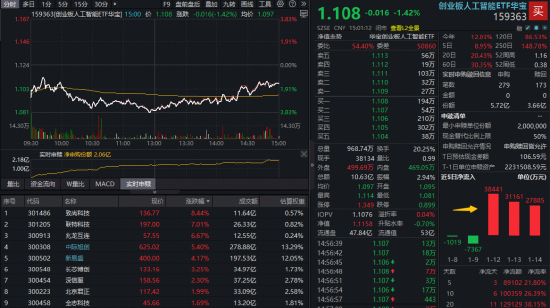
Core Viewpoint - The AI sector is experiencing a rebound, with significant movements in the stock market, particularly in the AI application and computing power segments, indicating a strong market sentiment despite some short-term corrections [1][8]. Group 1: Market Performance - The ChiNext AI index showed a strong recovery, closing positively despite a notable drop in AI application stocks like BlueFocus and Toray, which fell over 10% [1][8]. - The computing power segment, particularly light modules, saw a late surge, with stocks like Zhongji Xuchuang and Xinyi Sheng rising over 5% and 4% respectively [1][8]. - The popular ETF tracking the ChiNext AI index (159363) experienced a net subscription of 206 million units in a single day, with total trading volume exceeding 1 billion yuan [1][8]. Group 2: Industry Insights - The light module industry is in a high prosperity cycle, driven by the explosive demand for AI computing power, with supply becoming a core issue [3][10]. - Major manufacturers in the light module sector are accelerating production in mainland China and Thailand, with expectations of significant capacity release by Q1 2026 [3][10]. - The ETF manager highlighted that the recent market corrections do not alter the strong performance expectations for the A-share market in the first half of the year, suggesting that light module stocks could be a good focus during this period [11]. Group 3: AI Application Developments - Alibaba's Qianwen App has integrated with various services within its ecosystem, marking a significant advancement in AI shopping capabilities [11]. - The AI industry is witnessing rapid developments, with new financing rounds for overseas AI companies and the introduction of domestic policies promoting "AI + manufacturing" [11]. - The commercialization of AI applications is accelerating, with a notable decrease in costs associated with inference and long-window models, leading to increased validation in commercial scenarios [11]. Group 4: ETF Performance and Strategy - The ChiNext AI ETF (159363) has been included in the Hong Kong Stock Exchange's mutual market access list, which is expected to enhance liquidity and trading activity [12]. - As of January 14, the ETF's total assets reached a record high of over 5.3 billion yuan, with an average daily trading volume of over 700 million yuan in the past six months, ranking first among eight ETFs tracking the ChiNext AI index [12].
主力资金 | 消费电子龙头被盯上,尾盘净流入超8亿元
Zheng Quan Shi Bao· 2026-01-15 11:09
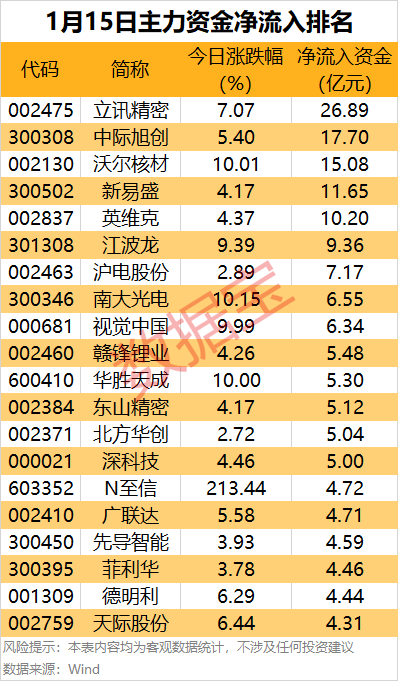
Market Overview - On January 15, the main funds in the Shanghai and Shenzhen markets experienced a net outflow of 509.2 billion yuan, with the ChiNext board seeing a net outflow of 302.36 billion yuan, while the CSI 300 index stocks had a net inflow of 53.17 billion yuan [1]. Industry Performance - Among the 11 primary industries, 9 saw net inflows of main funds, with the electronics industry leading at 99.72 billion yuan. The banking sector followed with a net inflow of 16.34 billion yuan, while basic chemicals, real estate, transportation, and coal industries also had inflows exceeding 2 billion yuan [1]. - Conversely, 20 industries experienced net outflows, with the comprehensive industry leading the decline at 3.35%. The defense, media, and computer sectors also faced significant outflows, each exceeding 2% [1]. Individual Stock Highlights - Leading the net inflow of main funds was Luxshare Precision, with an inflow of 26.89 billion yuan and a stock price increase of 7.07%. Other notable stocks included Zhongji Xuchuang with 17.7 billion yuan and Woer Cable with 15.08 billion yuan [2][3]. - A total of 117 stocks saw net inflows exceeding 1 billion yuan, with 5 stocks exceeding 10 billion yuan in inflows [1]. Notable Outflows - The stock BlueFocus saw the highest net outflow at 31.39 billion yuan, followed by Shanzi Gaoke with 27.17 billion yuan. Other significant outflows included Dongfang Caifu and Yanshan Technology, each with outflows exceeding 17 billion yuan [4][5]. - Over 250 stocks experienced net outflows exceeding 1 billion yuan, with 9 stocks exceeding 10 billion yuan in outflows [3]. Tail-End Market Activity - At the market close, there was a net inflow of 49.73 billion yuan, with the ChiNext board contributing 5.5 billion yuan and the CSI 300 index stocks contributing 37.04 billion yuan [6]. - Among individual stocks, Luxshare Precision led with a tail-end net inflow of 8.66 billion yuan, followed by NewEase with 3.23 billion yuan and Huadian Electric with 2.49 billion yuan [7].