复星医药

Search documents
复星医药(02196) - 海外监管公告 - 关於控股子公司药品註册申请获受理的公告
2026-01-08 10:23
上 海 復 星 醫 藥( 集 團 )股 份 有 限 公 司 香港交易及結算所有限公司及香港聯合交易所有限公司對本公告的內容概不負責,對其準確性或完整性亦不 發表任何聲明,並明確表示,概不對因本公告全部或任何部份內容而產生或因倚賴該等內容而引致的任何損 失承擔任何責任。 (於中華人民共和國註冊成立的股份有限公司) (股份代號:02196) Shanghai Fosun Pharmaceutical (Group) Co., Ltd.* 海外監管公告 本公告乃根據香港聯合交易所有限公司證券上市規則第13.10B條而作出。 茲載列上海復星醫藥(集團)股份有限公司(「本公司」)在上海證券交易所網站刊登的《關於 控股子公司藥品註冊申請獲受理的公告》,僅供參閱。 承董事會命 上海復星醫藥(集團)股份有限公司 董事長 陳玉卿 中國,上海 2026 年1 月8 日 上海复星医药(集团)股份有限公司 关于控股子公司药品注册申请获受理的公告 本公司董事会及全体董事保证本公告内容不存在任何虚假记载、误导性陈述 或者重大遗漏,并对其内容的真实性、准确性和完整性承担法律责任。 一、概况 近日,上海复星医药(集团)股份有限公司(以下简称 ...
复星医药(600196) - 复星医药关于控股子公司药品注册申请获受理的公告
2026-01-08 09:45
证券代码:600196 股票简称:复星医药 编号:临 2026-002 上海复星医药(集团)股份有限公司 关于控股子公司药品注册申请获受理的公告 本公司董事会及全体董事保证本公告内容不存在任何虚假记载、误导性陈述 或者重大遗漏,并对其内容的真实性、准确性和完整性承担法律责任。 近日,上海复星医药(集团)股份有限公司(以下简称"本公司")控股子公 司复星万邦(江苏)医药集团有限公司就丁二酸复瑞替尼胶囊(项目代号:SAF-189, 申请注册分类:化药 1 类;以下简称"该新药")再次递交的药品注册申请获国家 药品监督管理局受理,本次申报适应症为用于间变性淋巴瘤激酶(ALK)阳性的局部 晚期或转移性非小细胞肺癌(NSCLC)患者的治疗。 二、该新药的基本信息及主要研究情况 该新药为创新型小分子化学药物。除本次申报适应症外,截至本公告日期(即 2026 年 1 月 8 日),该新药的另一适应症非小细胞肺癌(ROS1+)于中国境内(不 包括港澳台地区,下同)也已完成 II 期临床研究。 截至 2025 年 11 月,本集团(即本公司及控股子公司/单位,下同)现阶段针对 该新药的累计研发投入约为人民币 4.80 亿元(未 ...
复星医药:丁二酸复瑞替尼胶囊药品注册申请获受理
Zheng Quan Shi Bao Wang· 2026-01-08 09:35
Core Viewpoint - Fosun Pharma has submitted a drug registration application for SAF-189, a drug for treating ALK-positive locally advanced or metastatic non-small cell lung cancer, which has been accepted by the National Medical Products Administration [1] Group 1 - Fosun Pharma's subsidiary, Fosun Wanguo (Jiangsu) Pharmaceutical Group Co., Ltd., is responsible for the drug registration application [1] - The application is classified as a Class 1 chemical drug [1] - The indication for the drug is specifically for patients with ALK-positive locally advanced or metastatic non-small cell lung cancer [1]
复星医药(600196.SH):丁二酸复瑞替尼胶囊药品注册申请获受理
Ge Long Hui A P P· 2026-01-08 09:35
Core Viewpoint - Fosun Pharma's subsidiary, Fosun Wanbang, has submitted a drug registration application for a new drug, SAF-189, which targets ALK-positive locally advanced or metastatic non-small cell lung cancer (NSCLC) patients, and the application has been accepted by the National Medical Products Administration [1] Group 1 - The new drug, SAF-189, is classified as a Class 1 chemical drug and is an innovative small molecule chemical drug [1] - In addition to the current application, another indication for SAF-189, targeting ROS1-positive non-small cell lung cancer, has completed Phase II clinical trials in mainland China as of January 8, 2026 [1]
新版医保目录实施一周:创新药“首单”频现,患者用药门槛降低
Bei Jing Shang Bao· 2026-01-08 08:10
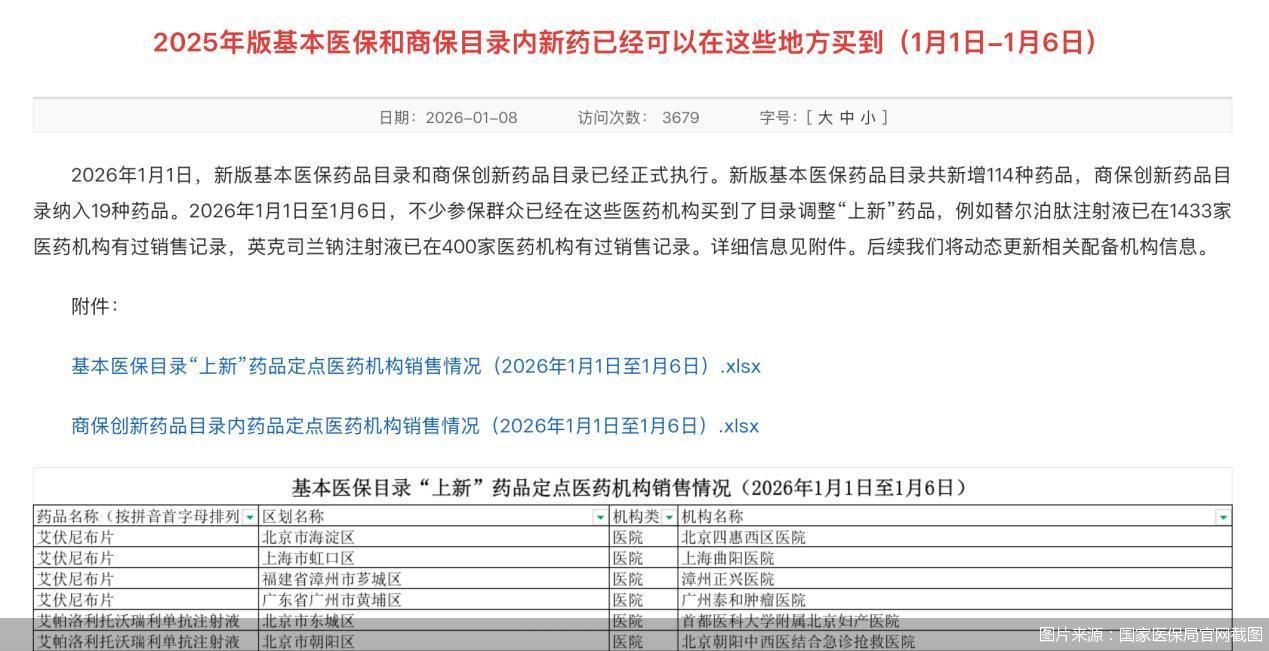
Core Insights - The new medical insurance directory has entered a substantial implementation phase, with several innovative drugs, including Tislelizumab and Fuzhengzhu, being prescribed under insurance in various hospitals, indicating a reduction in access barriers for patients [1] - The adjustment includes 114 new drugs and introduces a commercial health insurance directory for innovative drugs, marking a significant shift towards a multi-tiered insurance system [1][5] - The rapid inclusion of innovative drugs in the insurance directory reflects increased support for "true innovation" with high clinical value [5] Group 1: New Drug Inclusion - The new medical insurance directory has added 124 unique products, including Tislelizumab, the first targeted drug for thyroid eye disease, and Fuzhengzhu, a biological agent for psoriasis [5] - Heng Rui Medicine is a major beneficiary, with 20 products and indications adjusted, including 10 new drugs entering the directory for the first time [5][6] - Other biotech companies like BeiGene and Innovent Biologics have also benefited, with multiple products included in the new directory, enhancing their commercialization prospects [7] Group 2: Commercial Health Insurance Directory - The introduction of the commercial health insurance directory provides a secondary market for high-value innovative drugs, with price reductions ranging from 15% to 50%, which is less severe than the basic insurance cuts [9] - The directory aims to improve accessibility for high-priced drugs while ensuring adequate returns for pharmaceutical companies [9] - Notable CAR-T therapies have been included in the commercial directory, overcoming previous barriers to entry, with prices for these therapies exceeding 1 million yuan [8][10] Group 3: Market Dynamics and Drug Exits - The adjustment process has also seen the removal of 29 drugs from the insurance directory, including Benarutide, which faced competition from more effective alternatives [12][14] - The dynamic adjustment mechanism emphasizes the need for drugs to demonstrate clinical value, reinforcing a "can enter, can exit" policy [14] - Companies are encouraged to shift from "me-too" products to genuine innovations, focusing on high-value areas such as oncology and rare diseases [10][14]




A股头条:央行今日开展1.1万亿元买断式逆回购操作;八部门联合发文,事关“人工智能+制造”
Sou Hu Cai Jing· 2026-01-07 23:57
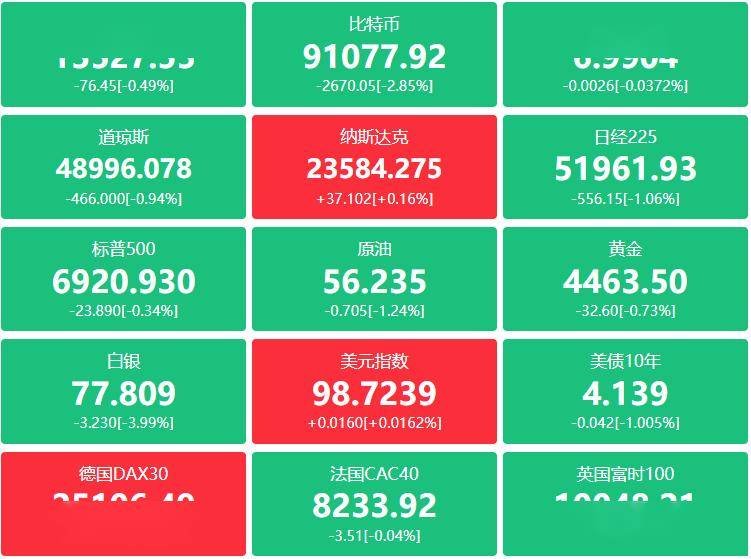
Group 1 - The Ministry of Commerce has initiated an anti-dumping investigation into imported dichlorodihydrosilane from Japan, following a domestic industry's application, citing a 31% price drop and increased import volume from 2022 to 2024 [1] Group 2 - Eight departments, including the Ministry of Industry and Information Technology, have issued an implementation opinion aiming for secure and reliable supply of key AI technologies by 2027, with plans to develop 3-5 general models for deep application in manufacturing [2] - The initiative includes creating 100 high-quality industrial data sets and promoting 500 typical application scenarios, while fostering 2-3 globally influential enterprises and a number of specialized small and medium-sized enterprises [2] Group 3 - The People's Bank of China announced a 1.1 trillion yuan reverse repurchase operation to maintain liquidity in the banking system, with a term of 90 days, indicating expectations for potential interest rate cuts in early 2026 [3] Group 4 - China's central bank has increased its gold reserves for the 14th consecutive month, reaching 7.415 million ounces (approximately 2306.323 tons) by the end of December, with a month-on-month increase of 30,000 ounces [4] Group 5 - The Ministry of Industry and Information Technology aims to promote the upgrade of new industrial networks for at least 50,000 enterprises by 2028, enhancing the integration of industrial internet and AI [5] Group 6 - The National Medical Products Administration is optimizing the review and approval process for urgently needed foreign drugs already on the market, encouraging simultaneous global research and application in China [6] Group 7 - The U.S. stock market showed mixed results, with the Dow Jones falling by 466 points (0.94%) while the Nasdaq rose by 37 points (0.16%), indicating a rotation in market funds affecting financial and energy stocks [8] Group 8 - The dollar index rose by 0.10% to 98.677 points, while various commodities such as gold and oil experienced declines, with gold futures down 0.73% to $4463.50 [10] Group 9 - The Ministry of Industry and Information Technology has issued a plan to enhance industrial intelligent computing power supply, encouraging the deployment of edge computing devices and promoting the integration of industrial internet with computing centers [13] Group 10 - The National Medical Products Administration emphasized the need for increased inspections and checks on key drug varieties to support pharmaceutical research and innovation, aiming for a high level of drug safety [14]
AI驱动 英矽智能与施维雅达成多年期研发合作
Zheng Quan Ri Bao Wang· 2026-01-07 12:56
Company Overview - InSilico Medicine, a biotechnology company, focuses on integrating artificial intelligence and automation technologies to accelerate drug discovery and drive innovation in the life sciences sector [1][3]. Recent Developments - On January 5, InSilico Medicine announced a multi-year research collaboration with Servier, a global independent pharmaceutical company, to utilize its AI platform Pharma.AI in the oncology field, aiming to identify and develop new therapeutic drugs [1]. - The agreement allows InSilico Medicine to receive up to $32 million in upfront and milestone payments while leading the discovery and development of potential drug candidates [1]. Strategic Partnerships - InSilico Medicine has established multiple collaborations with pharmaceutical companies, including Fosun Pharma, Sanofi, Eli Lilly, and Menarini, to integrate AI capabilities into drug development [3]. - The company plans to adopt a diversified business model, including drug development collaborations, pipeline licensing, and software licensing, which provides stable revenue and alleviates cash flow pressure from high R&D investments [3]. Industry Insights - The industry consensus acknowledges that AI algorithms can shorten the drug development cycle, although the specific integration paths remain unclear. The collaboration between InSilico Medicine and Servier may offer a viable approach [1][2]. - Several domestic biotech companies leveraging AI technology have begun to produce distinctive products, with potential for continued influence in overseas markets [4]. Future Outlook - InSilico Medicine's CEO emphasizes that AI is evolving from a tool to a foundational infrastructure for pharmaceutical companies, requiring long-term technical accumulation and solid clinical validation [5].
医药制造行业2026年度信用风险展望(2025年12月)
Lian He Zi Xin· 2026-01-07 11:29
Investment Rating - The report indicates that the overall credit risk of the pharmaceutical manufacturing industry is controllable, with stable operating performance expected in 2026 [5][6][11]. Core Insights - The pharmaceutical manufacturing industry has shown a slight increase in the number of enterprises, with a deepening degree of differentiation within the industry. Revenue and total profit have remained stable year-on-year due to a stabilizing policy environment [6][11]. - The "14th Five-Year Plan" supports the development of innovative drugs, with the scale of license-out exceeding the total for 2024 in the first three quarters of 2025, indicating a positive outlook for innovative drug development [6][11]. - The industry has maintained net inflows in bond market financing, with overall debt pressure being manageable despite a significant amount of bonds maturing within one year [6][11]. Industry Fundamentals Industry Policy - The pharmaceutical industry is highly sensitive to policy changes, with a "three medical linkage" policy framework encouraging innovation, improving medical services, and optimizing medical insurance payments. The "14th Five-Year Plan" emphasizes the strategic importance of the biomanufacturing industry [7][8]. - Recent policies have focused on cost control in medical insurance, reforming payment methods, and promoting the development of generic drugs and innovative medicines [7][8]. Industry Operating Conditions - As of the end of 2024, the number of pharmaceutical manufacturing enterprises in China reached 9,793, with a slight increase in the number of loss-making enterprises, indicating a growing differentiation within the industry [12][11]. - The basic medical insurance fund's income and expenditure structure has improved, with significant cost control effects observed [11][12]. Financial Performance Growth Metrics - In 2024, the pharmaceutical manufacturing industry reported total revenue of 25,298.5 billion yuan and total profit of 3,420.7 billion yuan, with minor fluctuations expected in 2025 [22][23]. - For the first three quarters of 2025, total revenue was 18,211.4 billion yuan, a decrease of 2.00% year-on-year, while total profit was 2,534.8 billion yuan, down 0.70% [22][23]. Profitability - The gross profit margin for the pharmaceutical manufacturing industry has shown a declining trend, with the sales expense ratio remaining stable and the management expense ratio slightly decreasing [24][25]. - The net cash flow from operating activities has been declining, indicating potential liquidity risks [24][25]. Leverage and Solvency - The leverage level in the pharmaceutical manufacturing industry remains low, with a slight fluctuation observed in recent years. The debt-to-asset ratio has been stable, and the overall solvency indicators are at a high level [30][31]. - As of September 2025, the liquidity ratios have slightly improved, indicating a manageable debt repayment risk [31][32]. Bond Market Performance Issuance Overview - In 2025, the pharmaceutical manufacturing industry experienced a net inflow in bond market financing, with a total of 104 bonds issued amounting to 713.80 billion yuan [39][41]. - The industry has seen a concentration of bond issuers at the AA+ level, with a significant number of private enterprises involved [39][41].
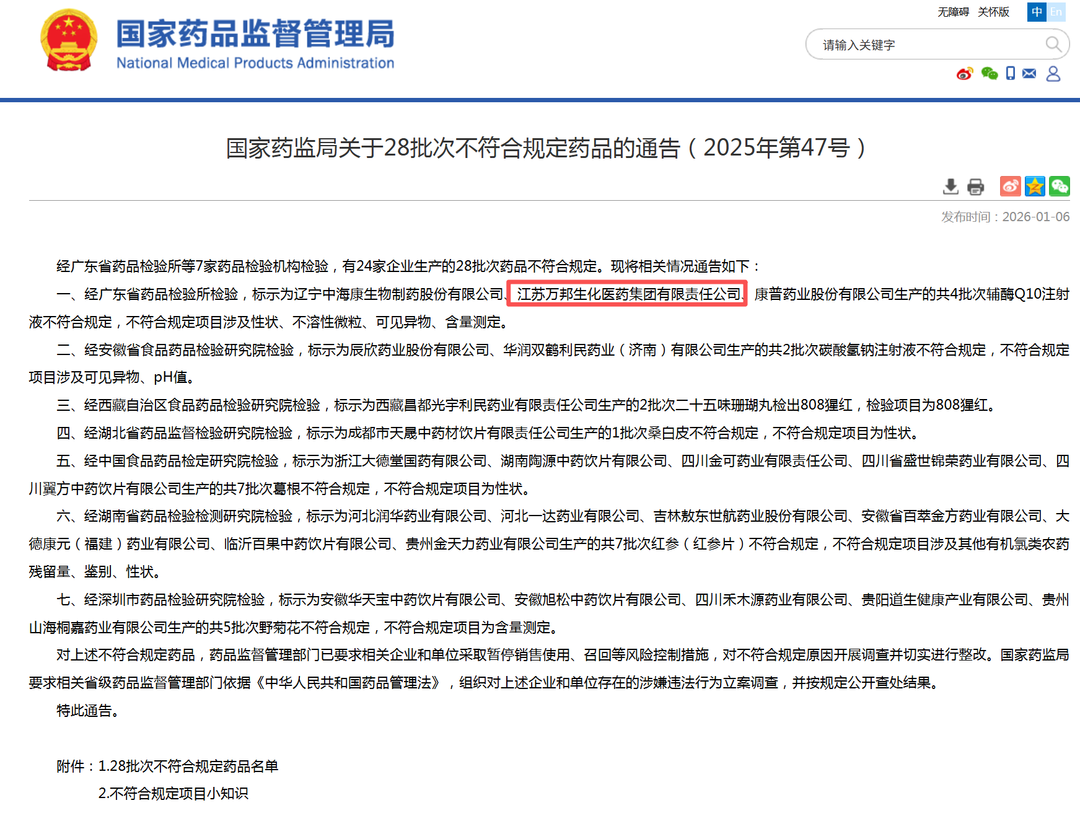
辅酶Q10抽检不合格,复星万邦(江苏)医药集团有限公司被通报
Qi Lu Wan Bao· 2026-01-06 13:35
Group 1 - The National Medical Products Administration (NMPA) announced that the Coenzyme Q10 injection produced by Jiangsu Wanbang Biopharmaceutical Group Co., Ltd. does not meet regulatory standards [1][3] - The non-compliance issues include characteristics, insoluble particles, visible foreign matter, and content measurement [3] - The regulatory authorities have ordered the company to suspend sales and usage of the affected product, recall it, and conduct an in-depth investigation into the reasons for non-compliance [3] Group 2 - Jiangsu Wanbang Biopharmaceutical Group Co., Ltd. is a wholly-owned subsidiary of Shanghai Fosun Pharmaceutical (600196), which is part of the larger Fosun Pharmaceutical Group established in 1994 [3] - The company was renamed to Fosun Wanbang (Jiangsu) Pharmaceutical Group Co., Ltd. in 2024 and focuses on research and development, manufacturing, and market promotion in various therapeutic areas [4] - The company operates over 20 member enterprises and has established 8 production bases across China, with business operations in more than 40 countries and regions worldwide [4]
又出血液肿瘤新药,百济神州股价微跌,“创新药一哥”能再造爆款?
3 6 Ke· 2026-01-06 12:12
Core Viewpoint - The approval of the BCL-2 inhibitor Sotorakra by BeiGene marks a significant advancement in the treatment of hematologic malignancies, with potential implications for the competitive landscape of BCL-2 inhibitors in the market [1][3]. Company Developments - BeiGene's Sotorakra has received approval for two indications: treatment of adult patients with previously treated chronic lymphocytic leukemia/small lymphocytic lymphoma (CLL/SLL) and mantle cell lymphoma (MCL) [1]. - The approval came just eight months after the new drug application was accepted by the NMPA, indicating a rapid development timeline [1]. - Sotorakra is positioned as a next-generation BCL-2 inhibitor, designed to block the BCL-2 protein that aids tumor cell survival, and has shown strong efficacy and specificity in clinical trials [1][2]. Clinical Trial Results - Early clinical trials of Sotorakra combined with Zebutini have demonstrated unprecedented rates of undetectable minimal residual disease in treatment-naive CLL patients [2]. - Recent data from five clinical studies indicate significant clinical benefits for Sotorakra, suggesting its potential as a cornerstone therapy for various B-cell malignancies [2]. Market Landscape - The global BCL-2 inhibitor market is projected to reach $5.2 billion by 2028, with the Chinese market expected to reach 1.4 billion yuan [5]. - The approval of Sotorakra follows the approval of another BCL-2 inhibitor, Lisatoclax, from Ascentage Pharma, indicating a growing presence of Chinese companies in the BCL-2 space [3][5]. - The competitive landscape is intensifying as multiple Chinese pharmaceutical companies, including Innovent Biologics and Zai Lab, are developing BCL-2 inhibitors [3][4]. Financial Performance - BeiGene's Zebutini has become a significant revenue driver, with global sales reaching $1.3 billion in 2023, marking a 129% year-over-year increase [6]. - In the first half of 2025, BeiGene reported a revenue of 17.52 billion yuan, a 46% increase year-over-year, largely driven by Zebutini sales [6][7]. - The company is under pressure to identify the next blockbuster product as Zebutini's growth may slow down in the future [7].