
宝钢股份

Search documents
普钢板块1月5日跌0.7%,武进不锈领跌,主力资金净流入2575.74万元
Zheng Xing Xing Ye Ri Bao· 2026-01-05 09:02
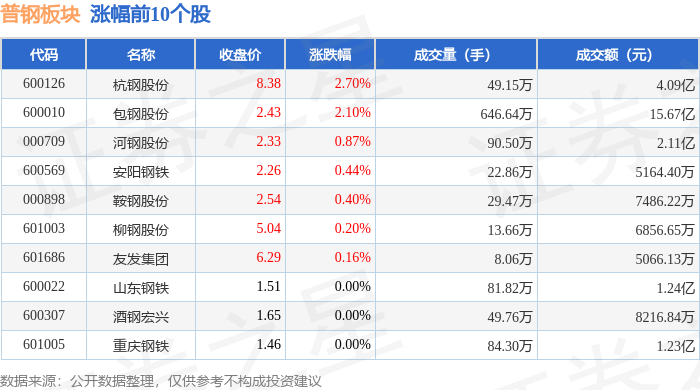
Group 1 - The steel sector experienced a decline of 0.7% on January 5, with Wujin Stainless Steel leading the drop [1] - The Shanghai Composite Index closed at 4023.42, up 1.38%, while the Shenzhen Component Index closed at 13828.63, up 2.24% [1] - Key stocks in the steel sector showed varied performance, with Hangang Co. rising by 2.70% and Baogang Co. increasing by 2.10% [1] Group 2 - Wujin Stainless Steel saw a significant drop of 10.04%, with a trading volume of 426,500 shares and a transaction value of 363 million yuan [2] - Other notable declines included Sangang Min Guang at -2.73% and Baosteel at -2.28% [2] - The overall net inflow of funds in the steel sector was 25.76 million yuan, with retail investors showing a net outflow of 41.90 million yuan [2] Group 3 - Major stocks like Baogang Co. and Baosteel had significant net inflows from institutional investors, with Baogang Co. receiving 88.19 million yuan [3] - Retail investors showed negative sentiment towards several stocks, with significant outflows from Huazhong Steel and Hangang Co. [3] - The data indicates a mixed sentiment in the steel sector, with institutional investors favoring certain stocks while retail investors are withdrawing [3]


国家发改委推进绿色氢氨醇布局
GUOTAI HAITONG SECURITIES· 2026-01-05 06:10
Report Summary 1. Report Industry Investment Rating No information provided. 2. Core Viewpoints The report focuses on the latest policies, industry developments, and upcoming events in the hydrogen energy industry. The National Development and Reform Commission is promoting the national green hydrogen, ammonia, and alcohol planning layout, and multiple regions have introduced relevant industrial policies. There are also many significant industrial developments, such as the launch of new projects and the delivery of new products. Additionally, a major industry conference is upcoming [3][6][12]. 3. Summary by Directory 3.1 Industry Policies - The National Development and Reform Commission promotes the national green hydrogen, ammonia, and alcohol planning layout, including building zero - carbon transportation corridors and stations, increasing new energy supply, etc. [3][6] - Beijing encourages the construction of renewable energy projects in factories and explores the use of hydrogen energy [6]. - Urumqi plans to add no less than 20,000 tons/year of green hydrogen production capacity by 2027 [6]. - Guangzhou Baiyun promotes the application of hydrogen - fuel - cell vehicles and supports the construction of hydrogen refueling stations [6]. - Shandong Zhaoyuan focuses on developing nuclear power, wind and solar equipment, energy storage batteries, and hydrogen production industries [6]. 3.2 Industry Dynamics - A 100 - million - yuan project for 100 sets of 1000 - standard - cubic - meter alkaline electrolyzer components is about to start [7]. - Kunhua Technology delivers 200 hydrogen - powered heavy trucks in Xinjiang Hami [8]. - Dalian Shipbuilding delivers the world's first methanol - dual - fuel - powered intelligent VLCC, with significant emission reduction [8]. - Rongcheng New Energy starts the trial operation of the first batch of hydrogen - assisted two - wheeled vehicles [8]. - Jieqing Technology delivers a new small - power closed - type air - cooled system for a German hydrogen - powered drone inspection project [8]. - A 3.534 - billion - yuan project for alloy solid - state hydrogen storage materials in Inner Mongolia is approved [8]. - A 4 - billion - yuan green hydrogen project of China Guangdong Nuclear Power is in the environmental impact assessment publicity stage [8]. - China National Coal Group signs a 200,000 - ton green methanol project in Inner Mongolia [8]. - Dongfang Hydrogen Energy unveils the "Hydrogen Intelligence Safety Center" [8]. - Sunlight and Longji are pre - selected for the bid of 29 alkaline electrolyzers of State Power Investment Corporation [9]. - CIMC Enric and Datang Hainan plan to cooperate on a green methanol project in Hainan [9]. - The first "carbon compensation" trade in the hydrogen energy field in China is completed in Zhejiang Jiaxing [3][9]. - China's first million - ton - level near - zero - carbon steel production line is fully connected, with a potential carbon reduction of 50% - 80% [3][9]. - Fujian's first hydrogen - powered zero - carbon bus demonstration line (Xiamen Route 736) is opened [3][9]. 3.3 Investment and Financing Events No investment and financing events are reported [10]. 3.4 Industry Conference Forecast The 2nd China Hydrogen Energy and Fuel Cell Technology Conference will be held from January 22 to 23, 2026, in Hefei, Anhui. The conference focuses on the innovation of the entire hydrogen fuel cell industry chain, and many well - known enterprises and institutions will participate [12].
2025年1-11月中国钢材产量为13.3亿吨 累计增长4%
Chan Ye Xin Xi Wang· 2026-01-05 03:38
2020-2025年1-11月中国钢材产量统计图 数据来源:国家统计局,智研咨询整理 知前沿,问智研。智研咨询是中国一流产业咨询机构,十数年持续深耕产业研究领域,提供深度产业研 究报告、商业计划书、可行性研究报告及定制服务等一站式产业咨询服务。专业的角度、品质化的服 务、敏锐的市场洞察力,专注于提供完善的产业解决方案,为您的投资决策赋能。 上市企业:宝钢股份(600019),鞍钢股份(000898),马钢股份(600808),沙钢股份(002075),首钢股 份(000959),包钢股份(600010),太钢不锈(000825),华菱钢铁(000932),河钢股份(000709),南 钢股份(600282) 相关报告:智研咨询发布的《2026-2032年中国钢材深加工行业竞争格局分析及投资发展研究报告》 根据国家统计局数据显示:2025年11月中国钢材产量为1.2亿吨,同比下降2.6%;2025年1-11月中国钢 材累计产量为13.3亿吨,累计增长4%。 ...

2025年1-11月中国粗钢产量为8.9亿吨 累计下降4%
Chan Ye Xin Xi Wang· 2026-01-05 03:38
根据国家统计局数据显示:2025年11月中国粗钢产量为0.7亿吨,同比下降10.9%;2025年1-11月中国粗 钢累计产量为8.9亿吨,累计下降4%。 2020-2025年1-11月中国粗钢产量统计图 上市企业:宝钢股份(600019),鞍钢股份(000898),马钢股份(600808),沙钢股份(002075),首钢股 份(000959),包钢股份(600010),太钢不锈(000825),华菱钢铁(000932),河钢股份(000709),八 一钢铁(600581) 相关报告:智研咨询发布的《2026-2032年中国粗钢行业市场运行态势及发展趋势分析报告》 数据来源:国家统计局,智研咨询整理 知前沿,问智研。智研咨询是中国一流产业咨询机构,十数年持续深耕产业研究领域,提供深度产业研 究报告、商业计划书、可行性研究报告及定制服务等一站式产业咨询服务。专业的角度、品质化的服 务、敏锐的市场洞察力,专注于提供完善的产业解决方案,为您的投资决策赋能。 ...

2025年1-11月中国生铁产量为7.7亿吨 累计下降2.3%
Chan Ye Xin Xi Wang· 2026-01-05 03:38
数据来源:国家统计局,智研咨询整理 上市企业:宝钢股份(600019),马钢股份(600808),鞍钢股份(000898),首钢股份(000959),河钢股 份(000709),凌钢股份(600231),重庆钢铁(601005),安阳钢铁(600569),八一钢铁(600581),南 钢股份(600282) 知前沿,问智研。智研咨询是中国一流产业咨询机构,十数年持续深耕产业研究领域,提供深度产业研 究报告、商业计划书、可行性研究报告及定制服务等一站式产业咨询服务。专业的角度、品质化的服 务、敏锐的市场洞察力,专注于提供完善的产业解决方案,为您的投资决策赋能。 根据国家统计局数据显示:2025年11月中国生铁产量为0.6亿吨,同比下降8.7%;2025年1-11月中国生 铁累计产量为7.7亿吨,累计下降2.3%。 2020-2025年1-11月中国生铁产量统计图 相关报告:智研咨询发布的《2026-2032年中国高纯生铁行业市场产销状况及投资战略研判报告》 ...

【新华社】科研追光者的破壁之路
Xin Hua She· 2026-01-05 02:24
Group 1: Quantum Technology - China's quantum technology sector is making significant advancements, with researchers focusing on high-level self-reliance and innovation in quantum communication [4][8] - The successful launch of the world's first quantum science satellite, "Mozi," in 2016 marked a pivotal moment, leading to the establishment of a quantum communication network [8] - Ongoing efforts aim to enhance the capabilities of quantum satellites and communication networks, with plans for new satellite launches in 2024 [8] Group 2: Advanced Steel Manufacturing - China Baowu Steel's Shanxi Taiyuan Iron and Steel Co. has achieved mass production of "hand-tear steel," a critical material for high-end manufacturing, producing approximately 3 tons per day [9][10] - The technology for "hand-tear steel," previously monopolized by foreign companies, has been successfully developed domestically, with thickness records being broken [9][10] - The company is expanding its product range, developing over 20 varieties of "hand-tear steel" and achieving breakthroughs in superconducting materials [10] Group 3: Marine Biomedicine - The Qingdao Marine Biomedical Research Institute is focused on developing marine drugs, with significant progress in creating a new class of anti-tumor drugs derived from Antarctic algae [12][13] - The research team is advancing multiple new drug candidates, including those targeting hepatitis B and chronic obstructive pulmonary disease, leveraging supercomputing and AI technologies [13] - The institute aims to establish a national-level marine biomedicine platform to fully utilize marine resources for public health [13] Group 4: Membrane Technology - Jiangsu Province's Industrial Technology Research Institute has pioneered a project management method to enhance the commercialization of scientific research, addressing initial funding challenges [14][15] - The development of a molecular sieve membrane capable of efficiently separating helium from natural gas has positioned the institute as a leader in membrane technology [14][15] - The institute has successfully incubated numerous high-tech enterprises, contributing to the growth of the membrane industry and fostering innovation [16]

固态电池产业化进程加速
Xin Lang Cai Jing· 2026-01-04 19:01
Group 1 - Solid-state batteries surpass existing liquid lithium-ion batteries in energy density, safety, lifespan, and performance potential, marking a significant technological revolution in electric vehicles, energy storage, and consumer electronics [1] - Ulaanbaatar City is focusing on solid-state battery materials and equipment manufacturing as a key direction for transformation, aiming to create a distinctive industrial cluster [1] - The city has established a coal tar deep processing production line with an annual capacity of 300,000 tons and a needle coke production facility with a capacity of 50,000 tons, forming a competitive industrial chain for battery anode materials [1] Group 2 - Qingtao (Ulaanbaatar) Energy Technology Co., Ltd. is set to produce 50,000 tons of solid-state battery materials and 10 GWh of solid-state batteries and energy storage systems, significantly boosting the local solid-state battery industry [2] - Ulaanbaatar's climate is ideal for solid-state battery production due to its dry environment, and the region offers significant advantages in electricity costs and supporting industries [2] - The city has a planned solid-state battery industrial park covering over 1,700 acres, with expectations that the industry chain's output value will exceed 21.5 billion yuan by 2030, with anode and cathode material capacities reaching 200,000 tons and solid-state battery capacity reaching 30 GWh [2] Group 3 - Ulaanbaatar aims to develop two industrial clusters focused on solid-state battery materials and equipment manufacturing, as well as biodegradable new materials, to create a modern industrial system that is small yet strong [3]
2025年工业阀门行业词条报告
Tou Bao Yan Jiu Yuan· 2026-01-04 13:13
Investment Rating - The report rates the industrial valve industry as a growth sector with a positive outlook, projecting a market size increase from $14.586 billion in 2024 to $18.705 billion by 2029, reflecting a compound annual growth rate (CAGR) of 5.10% [3][59]. Core Insights - The industrial valve market is driven by the demand for ball valves and cast steel valves, with new power plants and smart city construction contributing to growth [3]. - The industry is characterized by a wide variety of valve types, significant cost influence from upstream materials, and a clear technological gradient, with high barriers in high-end sectors [8][10][11]. - The market is expected to expand due to factors such as new infrastructure, energy demand, accelerated domestic substitution of ball valves, and downstream industry upgrades [3]. Industry Definition - Industrial valves are essential components in industrial fluid control systems, used across various sectors including oil, chemicals, power, and aerospace [4]. - They can be categorized into different types based on their functions, including shut-off valves, check valves, safety valves, regulating valves, and diverter valves [4][5][6][7]. Industry Characteristics - The industry features a diverse range of products that can adapt to complex working conditions, with costs heavily influenced by upstream material prices [8][10]. - There is a notable technological gradient, with high-end valves requiring advanced materials and manufacturing techniques, creating significant barriers to entry [11]. Development History - The industrial valve industry has evolved through several phases, from its inception in the early 20th century to a period of rapid growth post-1979, leading to increased marketization and technological advancements [12][20]. Industry Scale - The market size of the industrial valve industry grew from $11.945 billion in 2019 to $14.586 billion in 2024, with a CAGR of 4.08% [59]. - The demand for ball valves is particularly strong, accounting for 24.50% of the market share in 2024, driven by their applications in oil and gas, food and beverage industries [61]. Industry Chain Analysis - The industrial valve industry chain includes upstream raw materials, midstream manufacturing, and downstream application sectors, with each segment influencing the overall market dynamics [22][49]. - Upstream material quality and processing techniques significantly impact valve manufacturing efficiency and cost [24][25][36][38]. Downstream Analysis - The oil and gas sector remains a traditional stronghold for valve applications, while emerging markets such as marine engineering are becoming increasingly important [54]. - The nuclear power sector is identified as a key area for technological advancement and competitive positioning among valve manufacturers [58].
新能源及有色金属月报:矿端恢复不及预期,需求或在价格回落之际被激发-20260104
Hua Tai Qi Huo· 2026-01-04 12:00
1. Report Industry Investment Rating - Unilateral: Cautiously bullish [7] - Arbitrage: On hold - Options: Sell put options 2. Core View of the Report - The resumption progress of the mining end does not meet expectations, processing fees remain low, terminal demand shows a trend of traditional weakness while new energy is relatively strong. Combined with the emotional support from AI and computing power, it is expected that tin prices will maintain a strong pattern. Enterprises in need of buying hedging are advised to buy in batches and on dips between RMB 286,000/ton and RMB 310,000/ton [7] 3. Summary of Each Section Market News and Important Data Mining End - In December 2025, the trading mainlines of the mining end revolved around "the resumption rhythm of Wa State in Myanmar" and "the easing of the situation in the Democratic Republic of the Congo". The beneficiation plants in Wa State only maintained an operating rate of 30 - 40%. The import volume of Wa State before mid - December was only 3,800 tons, a 12% decrease compared with the same period in November. In the Democratic Republic of the Congo, although the land transportation of tin concentrates in the Kivu region resumed, the actual arrival volume was limited due to port congestion in South Africa. The processing fees for tin concentrates in China remained at a low level, and the profits of smelters were compressed. In late December, Wa State announced full resumption of production on January 5, 2026, and it is expected that the domestic concentrate arrival volume in January 2026 will increase by 15 - 20% month - on - month, with processing fees expected to rise slightly [1] Domestic Refined Tin Production and Import and Export - In December, the national refined tin production was expected to be 14,200 tons, a 2.3% month - on - month increase but a 5.7% year - on - year decrease. The operating rate of large - scale smelters in Yunnan increased, while the recycled tin production in Jiangxi decreased. The import and export windows remained closed. In January, with the increase in the ore volume from Wa State and a slight repair of processing fees, the national output may increase by 5% month - on - month to 14,900 tons, and the overall supply will maintain a pattern of "low imports + stable domestic production" [2] Processing End - In December, the tin processing sector showed the characteristic of passive inventory accumulation due to high prices suppressing demand. The processing fees for solder bars remained flat, but the order volume declined. The shipment volume of lead - free solder paste decreased, and only the high - silver solder paste for photovoltaic ribbons maintained a 3% increase. The demand for tin - plated sheets decreased, and the social inventory of tinplate reached an 18 - month high. In January, the demand for processing products is expected to decrease by 8 - 10%, but the demand for photovoltaic ribbons is expected to increase by 5%, and the processing fees will probably remain stable [3] Terminal End - In December, the traditional terminal consumption was cold, while the new energy sector showed a positive trend. In the consumer electronics field, the shipment volume of mobile phones decreased, and the inventory days of TWS earphones and laptops increased. The export of home appliances decreased, while the photovoltaic sector was the only bright spot. The AI server maintained high - level prosperity, and the demand for high - order solder paste increased. The overall tin consumption in the automotive sector increased slightly. In January, the traditional electronic and home appliance orders are expected to decline, but the new energy sector may bring some incremental demand [4] Inventory - In December 2025, the SHFE tin ingot inventory first increased and then decreased, with a net increase of 1,071 tons for the whole month. The social inventory increased by 17%. The LME Asian warehouses continued to destock. In January, the domestic smelter shipment rhythm will slow down, and the SHFE inventory is expected to fall to around 7,500 tons. If the incremental supply from Wa State arrives at the port smoothly, the LME Asian warehouses may restock, and the overall global visible inventory is still at a low level, providing bottom support for tin prices [5][6] Strategy Unilateral - Cautiously bullish. Enterprises in need of buying hedging are advised to buy in batches and on dips between RMB 286,000/ton and RMB 310,000/ton [7] Arbitrage - On hold Options - Sell put options Tin Variety Basis Situation - In December, the basis of mainstream brands against the futures main contract rose from par to a premium of RMB 400/ton, with increased volatility. The premium of Yunnan Tin was RMB 500 - 700, and that of small brands was RMB 0 - 200, with the spread range widening by RMB 100 month - on - month. In January, the deliverable supply is expected to increase by 8 - 10% month - on - month, and the premium of mainstream brands is expected to fall to RMB 200 - 400. The strategy for holders of Yunnan Tin spot is to sell the SN2602 contract to lock in a premium of RMB 300 - 500. Arbitrageurs should pay attention to the spread between February and March, and consider positive arbitrage if the Back structure is greater than RMB 400 [9]
年,月钢铁继往开来
GOLDEN SUN SECURITIES· 2026-01-04 10:04
中信钢铁指数报收 1,933.16 点,下跌 0.55%,跑赢沪深 300 指数 0.03pct, 位列 30 个中信一级板块涨跌幅榜第 16 位。 重点领域分析: 投资策略:2026 年新的一年已经到来,过去两年我们用《走向成熟》、《时 代的周期》、《告别放任的年代》、《江河万古流》、《重估中国》以及《人间 正道是沧桑》六份周期深度报告去扭转过去盛行的用所谓的西方经验对中 国的悲观叙事。当 2025 年一连串事件冲击后,事实证明其实以前很多担 忧都是过虑了。社会认知开始反思,过去两三年一度流行的"中国经济的 日本叙事"论调也随之破产。其实我们生命中有很多周期很长以至于我们 不易察觉,只有有些距离感以后才能看清楚一些事情的轮廓。如今经过工 业化成熟后的转型蜕变,崭新的中国故事未来也将绽放光芒。在新的发展 阶段,后发工业国成熟后资本市场繁荣的基础是全社会总量的资本过剩, 结构上分别通过居民存款配置、金融机构大类资产配置、企业分红回购与 海外热钱等渠道注入市场,这些资金管道共同构成了增量资金的主要来 源,当其中一个部门形成较大资金流进入资本市场的时候,股市就会出现 趋势性牛市上涨的行情。当全社会将过剩资本通过以上 ...