格力电器

Search documents
2025Q4家电板块基金持仓点评:行业重仓仍处低位,白电持仓环比提升
Guolian Minsheng Securities· 2026-01-26 06:04
Investment Rating - The report maintains an "Outperform" rating for the home appliance industry [3] Core Insights - The home appliance sector's fund holding ratio remains low at 2.40% for Q4 2025, with a slight increase of 0.08 percentage points from the previous quarter, which is still at a low level compared to historical data since 2010 [6][9] - The white goods segment saw an increase in holdings, while the vacuum cleaner segment experienced a reduction in allocation [17][21] - There is a divergence in northbound holdings, with some companies like Hisense Home Appliances and Bull Group seeing increases, while others like Vatti and Roborock saw declines [42] Summary by Sections Home Appliance Sector Fund Holding Ratio - The fund holding ratio for the home appliance sector in Q4 2025 is 2.40%, ranking 12th among all sectors, with a cumulative increase of 4.09% in the CITIC home appliance index, also ranking 12th in absolute returns [6][9][14] White Goods Increase and Vacuum Cleaner Reduction - The fund holding ratios for sub-segments in Q4 2025 are as follows: white goods at 1.88% (+0.24 percentage points), small appliances at 0.71% (+0.08 percentage points), upstream appliances at 0.27% (-0.16 percentage points), black goods at 0.08% (-0.03 percentage points), kitchen appliances at 0.03% (-0.01 percentage points), and lighting at 0.03% (stable) [17][21] Northbound Holdings Divergence - The northbound holdings for the home appliance sector showed mixed results in Q4 2025, with increases for Hisense Home Appliances (+0.78 percentage points), Bull Group (+0.41 percentage points), and Yitian Smart (+0.41 percentage points), while declines were noted for Vatti (-2.31 percentage points), Roborock (-1.69 percentage points), and XGIMI (-1.47 percentage points) [42][44] Investment Recommendations - The report recommends leading white goods companies such as Midea Group, Haier Smart Home, Gree Electric Appliances, and Hisense Home Appliances, as well as TV leader Hisense Visual and cleaning appliance leaders Roborock and Ecovacs [57]




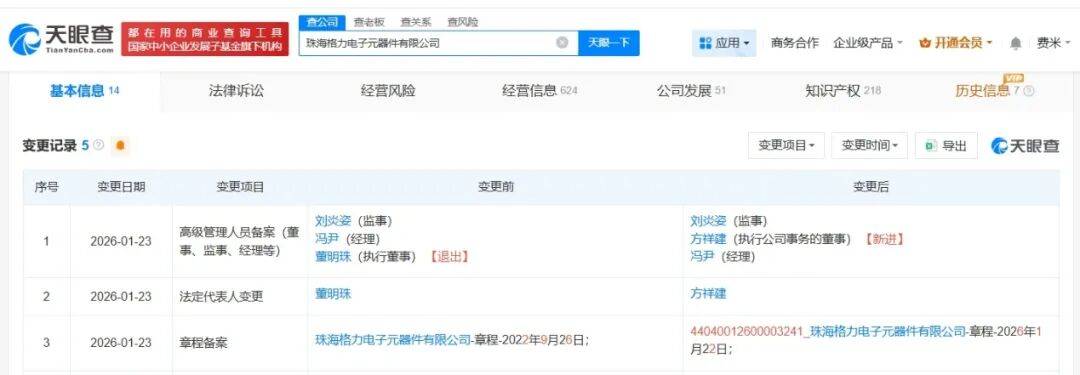
格力芯片板块人事地震:董明珠退出,谁将接掌关键业务?
Sou Hu Cai Jing· 2026-01-26 06:01
天眼查工商信息显示,近日,珠海格力电子元器件有限公司发生工商变更,董明珠卸任法定代表人、执行董事,方祥建接任法定代表人并担任执行公司事 务的董事。 珠海格力电子元器件有限公司成立于2022年7月,注册资本1亿人民币,经营范围包括电子元器件制造、电子元器件批发、电力电子元器件制造等。股东信 息显示,该公司由格力电器(000651)全资持股。 | ● 大眼堂 | | 都在用的商业首届丁具 国家中小企业发展于基金属下机构 | 查公司 盛志板 直关系 直风险 珠海格力电子元器件有限公司 | න | 天殿一下 | ■ 应用 · 商务合作 企业级产品 | | | --- | --- | --- | --- | --- | --- | --- | --- | | 基本信息 14 | | 法律诉讼 | 经营风险 | 经营信息 624 | | 公司发展 51 知识产权 218 | 历史信息70 | | 变更记录 5 0 @ | | | | | | 变更项目 · 变更时间 - 心天眼直 | 日 | | 序号 | 变更日期 | 变更项目 | 变要前 | | | 变更后 | | | 1 | 2026-01-23 | 高级管理人员备案 ...

全指现金流ETF鹏华(512130)涨近2%,有色石油领涨市场
Xin Lang Cai Jing· 2026-01-26 05:29
Group 1 - The core viewpoint of the articles highlights the strong performance of the non-ferrous metals and oil sectors, driven by rising commodity prices and geopolitical tensions [1] - Spot gold has reached a historical high of $5080.60 per ounce, with a 2% increase, while spot silver briefly surpassed $108 per ounce, showing a daily increase of over 4.6% [1] - The cash flow index's focus on "strong cyclical resources" like non-ferrous metals and chemicals reflects its structural advantages and precise value in the market [1] Group 2 - The CSI All-Share Free Cash Flow Index (932365) has risen by 0.81%, with significant gains in constituent stocks such as silver non-ferrous (up 10.03%), Nanshan Aluminum (up 7.08%), and China National Offshore Oil Corporation (up 5.86%) [1] - The CSI All-Share Free Cash Flow ETF (512130) has increased by 1.84%, marking its sixth consecutive rise, with the latest price at 1.33 yuan [1] - As of December 31, 2025, the top ten weighted stocks in the CSI All-Share Free Cash Flow Index include China National Offshore Oil Corporation, SAIC Motor, and Gree Electric Appliances, collectively accounting for 53.78% of the index [2]



短期与中期逻辑均具备坚实支撑!红利低波ETF(512890)近20个交易日吸金18.8亿
Xin Lang Cai Jing· 2026-01-26 04:22
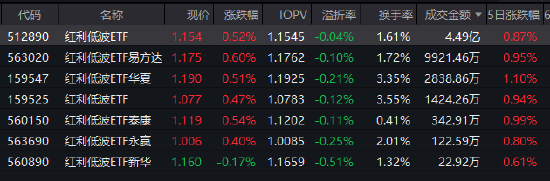
Core Viewpoint - The report focuses on the investment opportunities in AI applications, commercial aerospace, and nuclear fusion for 2026, highlighting the performance of the Dividend Low Volatility ETF (512890) amidst a mixed market environment [1][7]. Market Performance - On January 26, A-shares showed mixed results with the Shanghai Composite Index up by 0.12%, while the Shenzhen Component and ChiNext Index experienced declines [1][7]. - The Dividend Low Volatility ETF (512890) rose by 0.52%, closing at 1.154 yuan, with a turnover rate of 1.61% and a transaction volume of 449 million yuan [1][7]. Fund Holdings - The latest quarterly report indicates a mixed performance among the top ten holdings of the Dividend Low Volatility ETF. Notable movements include Shanghai Bank down by 0.21%, Nanjing Bank up by 1.35%, and Gree Electric down by 0.58% [2][9]. - The specific holdings and their market values are as follows: - Shanghai Bank: 781.92 million yuan - Nanjing Bank: 747.01 million yuan (up 32.82%) - Ping An Bank: 712.31 million yuan - Agricultural Bank of Shanghai: 704.49 million yuan - China National Sugar: 690.55 million yuan (down 7.95%) [9]. Fund Flow - The Dividend Low Volatility ETF has seen significant net inflows, with 1.34 billion yuan over the last 5 trading days, 1.88 billion yuan over the last 20 days, and 4.39 billion yuan over the last 60 days. As of January 23, 2026, the fund's circulation scale was 27.845 billion yuan [9]. Investment Strategy - Analysts suggest that the current liquidity environment is a key driver for the spring market rally, supported by new insurance premiums, maturing deposits, and the appreciation of the RMB attracting foreign capital [4][11]. - The report emphasizes the importance of focusing on sectors with strong earnings performance and relatively low price increases, such as AI hardware, batteries, pharmaceuticals, steel, and non-bank financials [11]. - The Dividend Low Volatility strategy is seen as a robust tool for asset allocation in volatile markets, with a three-year return of 36.01%, outperforming its benchmark [12].
董明珠退出珠海格力电子元器件公司
Xin Lang Cai Jing· 2026-01-26 04:07
Core Viewpoint - Recently, there has been a change in the management of Zhuhai Gree Electronics Components Co., Ltd., with Dong Mingzhu stepping down as the legal representative and executive director, and Fang Xiangjian taking over the role [1] Company Information - Zhuhai Gree Electronics Components Co., Ltd. was established in 2022 with a registered capital of 100 million RMB [1] - The company is wholly owned by Gree Electric Appliances (000651) and operates in the manufacturing and wholesale of electronic components [1]
292亿资金涌入现金流赛道,现金流ETF嘉实(159221)一键布局优质“现金牛”组合
Xin Lang Cai Jing· 2026-01-26 03:09
Group 1 - The core viewpoint of the articles highlights the performance of the National Index of Free Cash Flow, which has seen a rise of 0.65% as of January 26, 2026, with significant gains in constituent stocks such as silver and various industrial companies [1] - The current market has 101 ETFs tracking free cash flow-related indices, with a total scale of 29.291 billion yuan as of January 21 [1] - Western Securities notes that during the Kondratiev wave downturn, geopolitical uncertainties have increased, leading to a natural preference for gold or stable cash flow "safe assets," which has re-evaluated the dividend strategy in the A-share market [1] - The free cash flow strategy has shown advantages over the dividend strategy, particularly in bull markets, as it has not underperformed the market in bear markets [1] - As of December 31, 2025, the top ten weighted stocks in the National Index of Free Cash Flow include major companies like China National Offshore Oil Corporation and SAIC Motor Corporation, accounting for 51.95% of the index [1] Group 2 - The cash flow ETF managed by Harvest (159221) closely tracks the National Index of Free Cash Flow, aiming to create a combination of profitability quality and dividend potential [2] - Investors can also access the cash flow ETF through the Harvest's off-market connection (024574) to seize investment opportunities [3]
西部证券晨会纪要-20260126
Western Securities· 2026-01-26 02:50
Group 1: Shipping Industry - The global shipping market is expected to improve in 2026, with specific attention on container ships, bulk carriers, and tankers [1][5] - The resumption of operations in the Red Sea is crucial for container ships, while the West Simandou iron ore mine is anticipated to reshape global iron ore trade flows, benefiting bulk shipping [1][5] - OPEC+ has begun to increase production, leading to a tight supply-demand balance in the tanker market due to US sanctions on Russia [1][5] Group 2: Weigao Group (1066.HK) - Weigao Group is positioned for a transformation driven by R&D, with expectations of net profits of 2.091 billion, 2.287 billion, and 2.507 billion yuan from 2025 to 2027, reflecting growth rates of 1.18%, 9.37%, and 9.62% respectively [9][10] - The global biopharmaceutical market is projected to grow at a CAGR of 10.4% from 2024 to 2030, with significant demand for filters and consumables [9] - The company has a robust product portfolio with 927 domestic product registrations and 1,084 patents, including 218 invention patents [9] Group 3: AI Animation Industry - The continuous iteration of generative AI models is providing a technological foundation for the cost-effective and high-quality development of AI animation [16][18] - AI animations are gaining market acceptance, with significant growth in production and viewership, exemplified by the rapid increase in the number of AI animations launched on platforms like Douyin [16][17] - The cost advantages of AI animations compared to traditional animation methods are notable, with production costs significantly lower [17][18] Group 4: 3D Printing in Commercial Aerospace - 3D printing technology is effectively reducing costs and increasing efficiency in the commercial aerospace sector, with significant reductions in the number of parts and production time for rocket engines [20][21] - The domestic 3D printing equipment market is experiencing growth, with exports reaching 3.777 million units valued at 8.9 billion yuan in 2024 [21][22] - The technology is also being applied in the production of micro-nano satellite components, showcasing its advantages in mass production [21][22] Group 5: Zijin Mining (601899.SH) - Zijin Mining's Giant Dragon Copper Mine Phase II has commenced production, increasing annual copper output from 190,000 tons to an expected 300,000-350,000 tons in 2026 [28][29] - The mine's production capacity has significantly increased, positioning it as China's largest copper mine and one of the world's highest-altitude, low-grade copper mines [29][30] - The company anticipates further growth with plans for a Phase III project that could increase copper reserves and production capacity [30]
中国消费行业:2026 年 GCC 会议要点 -估值仍具吸引力,消费复苏迹象显现-China Consumer Sector_ 2026 GCC takeaways_ Sector valuation remains attractive with signs of consumption recovery
2026-01-26 02:50
Summary of Key Points from the Conference Call Industry Overview - **Sector**: China Consumer Sector - **Key Insights**: The sector shows signs of consumption recovery despite a near-term property market downturn. Valuation remains attractive, approximately 1 standard deviation below 10-year averages, indicating that a consumption recovery is not yet priced in [2][21]. Consumer Staples - **Baijiu**: Anticipated demand support for mid-end baijiu due to easing alcohol bans and private consumption growth. Companies are expected to accelerate channel transformations for sustainable EPS growth [3][8]. - **Beer**: Premiumization continues through product diversification and in-home channel expansion, despite on-trade softness. CR Beer expects low-single-digit volume growth in 2025, with Heineken volumes projected to grow by 20% YoY [3][8]. - **Dairy**: Liquid milk sales are expected to recover modestly in 2026, driven by marketing and innovation, despite a weak 2025. Fresh milk shows resilience with double-digit growth [3][8]. - **Freshly-Made Beverages (FMB)**: Guming is expected to maintain steady SSSG in 2026 through category expansion and dine-in growth, despite the phase-out of delivery subsidies [3][8][19]. - **Condiments**: Sequentially improving demand is expected, with Haitian focusing on multi-product categories and Jonjee anticipating a cleaner 2026 after a weak 4Q25 [3][8]. Consumer Discretionary - **Home Appliances**: Companies like Midea and Haier expect higher overseas growth compared to domestic markets in 2026. Strategies include price hikes and operational efficiencies [4][10]. - **Jewelry**: Brands with unique designs may consolidate post-VAT reform. Laopu is expected to achieve strong sales growth due to increased focus on value-added services [4][10]. - **Restaurants**: Intense competition leads to divergent strategies, with some companies lowering prices while others upgrade offerings. DPC Dash is on track for expansion despite market uncertainties [4][10]. Stock Implications - **Most Preferred Stocks**: CR Beer, Guming, MIXUE, China Foods, YUM China, among others, are highlighted as preferred investments due to their growth potential [5]. - **Least Preferred Stocks**: Companies like Swellfun, Nongfu, and Gree are noted as less favorable due to various challenges [5]. Key Risks - Risks include demand recovery uncertainties, cost inflation or deflation, and changes in the competitive landscape. These factors could significantly impact the consumer sector's performance [21]. Additional Insights - **Pet Food**: The industry is shifting towards online sales, with over 85% of sales occurring digitally. Competition is intensifying, pushing brands towards innovation and product differentiation [13]. - **Snack Sector**: Rapid category diversification and channel restructuring are creating growth opportunities, particularly through snack discounters [9][12]. This summary encapsulates the essential insights and projections from the conference call, providing a comprehensive overview of the current state and future outlook of the China consumer sector.



铝研究-从家电领域看铝代铜前景分析与展望
2026-01-26 02:49
Summary of Aluminum Replacement for Copper in the Air Conditioning Industry Industry Overview - The focus is on the air conditioning industry and the trend of replacing copper with aluminum in heat exchangers due to cost advantages and resource security [1][6]. Key Points and Arguments 1. **Cost Advantage**: Aluminum prices are approximately one-fourth of copper prices, leading to significant cost savings in air conditioning production [1][6]. 2. **Performance Efficiency**: Full aluminum microchannel heat exchangers can improve thermal conversion efficiency by about 10% compared to full copper, while also reducing weight by half and refrigerant usage by nearly half [1][3]. 3. **Technical Feasibility**: Aluminum heat exchangers can achieve 90% of copper's performance, with potential improvements to 96%-98% through structural optimization and the addition of rare earth alloys [1][10]. 4. **Market Adoption**: Major air conditioning companies like Haier, Midea, Gree, Xiaomi, and Aux have begun mass production of aluminum products, with Haier having a high export ratio [1][11]. 5. **Projected Growth**: The penetration rate of aluminum replacement technology is expected to reach over 80% by 2027, driven by price advantages and the plans of leading companies [2][22]. Additional Important Content 1. **Material Comparison**: Four main technical paths for heat exchanger materials are identified: aluminum replacing copper, non-wing (plate-type) heat exchangers, and aluminum-copper composite heat exchangers, each with distinct advantages and disadvantages [2][5]. 2. **Environmental Impact**: The use of aluminum or composite materials contributes to lightweight design, enhancing energy efficiency and reducing refrigerant usage, thus promoting environmental sustainability [7]. 3. **Standardization Efforts**: Ongoing efforts in the industry include the establishment of technical standards, testing and validation of new materials, and collaboration among leading brands to ensure product reliability and performance consistency [7][8]. 4. **Consumer Acceptance**: Consumer acceptance of aluminum components varies, with lower acceptance in high-end markets compared to mid-range and low-end markets [18]. 5. **Challenges**: Key challenges include higher maintenance costs and potential reductions in product lifespan, with estimates suggesting a decrease of 20% in lifespan when using aluminum instead of copper [16][20]. Conclusion The air conditioning industry is poised for a significant shift towards aluminum as a replacement for copper in heat exchangers, driven by cost efficiency, performance improvements, and environmental considerations. Major players are already adapting their strategies to align with this trend, indicating a robust future for aluminum technology in this sector.
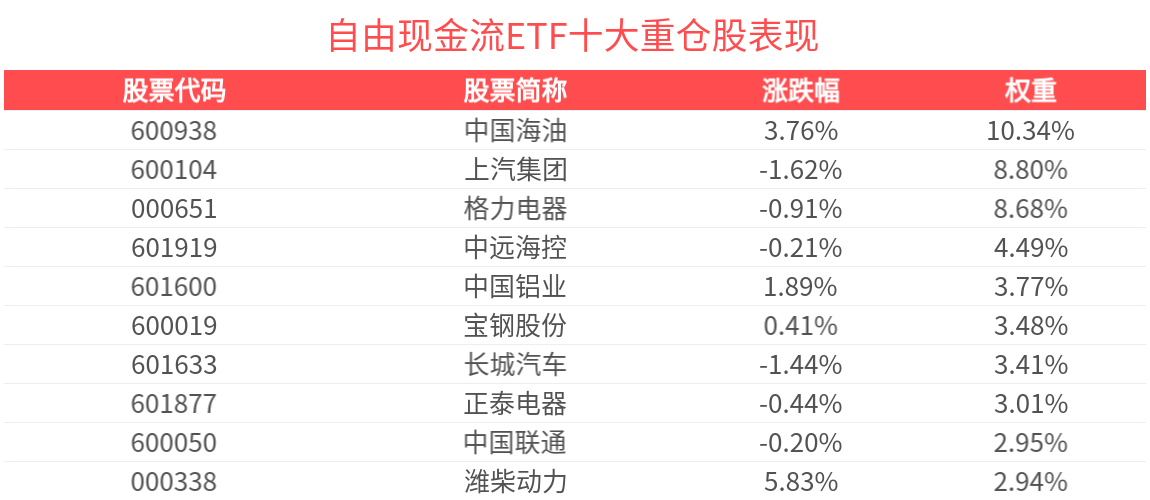
自由现金流ETF(159201)冲击6连涨,最新规模达113.78亿元,创成立以来新高
Xin Lang Cai Jing· 2026-01-26 02:13
Core Viewpoint - The National Index of Free Cash Flow has shown positive performance, with significant increases in both the index and its constituent stocks, indicating strong investor interest and liquidity in the market [1][2]. Group 1: Market Performance - As of January 26, 2026, the National Index of Free Cash Flow rose by 0.59%, with notable increases in constituent stocks such as Silver Nonferrous (+8.68%), Weichai Power (+5.83%), and China National Offshore Oil Corporation (+3.76%) [1]. - The Free Cash Flow ETF (159201) has experienced a 0.30% increase, marking its sixth consecutive rise, with a trading volume of 1.84 billion yuan [1]. - Over the past week, the Free Cash Flow ETF has averaged daily transactions of 6.16 billion yuan, reflecting strong liquidity [1]. Group 2: Fund Inflows and Performance - The Free Cash Flow ETF has seen continuous net inflows over the past six days, with a peak single-day net inflow of 672 million yuan, totaling 1.402 billion yuan in net inflows [1]. - The latest share count for the Free Cash Flow ETF reached 8.709 billion shares, with a total scale of 11.378 billion yuan, setting a new record since its inception [1]. - The ETF has recorded a financing net purchase amount of 3.3297 million yuan this month, with a current financing balance of 137 million yuan [1]. Group 3: Historical Returns - Since its inception, the Free Cash Flow ETF has achieved a maximum monthly return of 7%, with the longest streak of consecutive monthly gains being six months and a total gain of 22.69% [2]. - The ETF has an 80% monthly profit percentage and a 100% probability of profitability over a six-month holding period [2]. - As of January 23, 2026, the ETF outperformed its benchmark with an annualized excess return of 5.21% over the past six months [2]. Group 4: Index Composition - The top ten weighted stocks in the National Index of Free Cash Flow as of December 31, 2025, include China National Offshore Oil Corporation, SAIC Motor, and Gree Electric Appliances, collectively accounting for 51.95% of the index [2]. - The index reflects the price changes of listed companies with high and stable free cash flow levels in the Shanghai and Shenzhen stock exchanges [2].