
商汤科技

Search documents
禾赛科技三位创始人再创业,成立机器人公司;OpenAI或于2026年推出首款硬件设备;疯狂动物城2成全球影史好莱坞动画电影票房冠军丨邦早报
创业邦· 2026-01-20 00:10
Group 1 - Hesai Technology's co-founders have established a new robotics company, Sharpa, aimed at developing general-purpose robots and core components, with over 100 employees [1] - Porsche's global sales for 2025 are projected to be 279,400 units, a 10% decrease year-on-year, with a significant decline of 26.28% in the Chinese market [4] - UTree Technology is expected to ship over 5,500 humanoid robots in 2025, with mass production exceeding 6,000 units [9] - OpenAI's annual revenue for 2025 is projected to exceed $20 billion, a significant increase from $6 billion in 2024, driven by an expansion in computing power [13] - The UK government has announced a substantial subsidy plan for electric trucks, with a total budget of £318 million, aiming to boost the adoption of electric vehicles [19] Group 2 - The HuRun Research Institute's report on China's AI companies ranks Cambricon first with a valuation of 630 billion yuan, reflecting a 165% increase from the previous year [10] - Anker Innovations and Feishu have launched the AI hardware product "Anker AI Recording Bean," which features advanced recording capabilities and is priced at 899 yuan [21] - Alibaba Health has introduced the AI product "Hydrogen Ion," designed for medical professionals, which aims to minimize hallucination rates in AI responses [23] - Xiaopeng Motors has successfully developed the first robot based on automotive standards, marking a significant milestone in their robotics initiative [24] - Apple's iPhone shipments surged by 28% during the holiday season, regaining market leadership in China despite overall market declines [30]


AI 与半导体双爆发!寒武纪领衔 AI 50 强!首发中国独角兽毕业榜
是说芯语· 2026-01-19 06:46
Core Insights - The report highlights the top 50 AI companies in China for 2025, with a focus on their valuations and industry distribution [1][10]. Group 1: Company Rankings - Cambricon leads the list with a valuation of 630 billion RMB, marking a 165% increase from the previous year [1][3]. - Moore Threads ranks second with a valuation of 310 billion RMB, while Muxi holds the third position at 250 billion RMB [1][3]. - The top 10 list is dominated by AI chip-related companies, with seven out of ten positions occupied by firms such as Horizon Robotics and Rockchip [1][3]. Group 2: Geographic Distribution - Over 60% of the listed companies are based in Beijing and Shanghai, with Beijing contributing 19 companies and Shanghai 14 [1][5]. - Shenzhen has six companies on the list, while Guangzhou has four, indicating a concentration of AI firms in major urban centers [1][5]. Group 3: Industry Segmentation - The report categorizes companies into various segments, with 14 companies in the computing hardware sector, an increase of nine from last year [2][6]. - Data analysis and decision-making companies account for 11 firms, up by four, while content generation, visual recognition, and autonomous driving each have eight companies represented [2][6]. Group 4: Youngest Companies - The youngest companies on the list, established in 2023, include "The Dark Side of the Moon" and "Bai Chuan Intelligent," both valued between 150-220 million RMB [7]. - Other young entrants include "Zero One Everything" and "Yuan Shen," showcasing the emergence of new players in the AI sector [7].

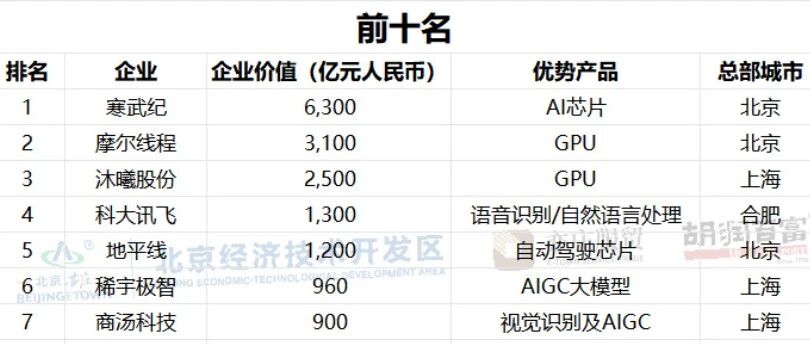
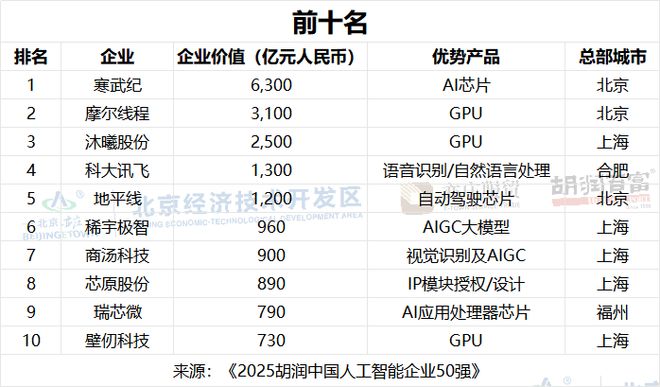
《2025胡润中国人工智能企业50强》重磅发布 寒武纪(688256.SH)以6300亿价值位居榜首
Zhi Tong Cai Jing· 2026-01-19 03:41
Core Insights - The "2025 Hurun China AI Companies Top 50" list highlights the growth and valuation of AI-focused companies in China, with a significant increase in the number of AI chip companies due to tightening U.S. export controls on high-end AI chips [1][3]. Group 1: Rankings and Valuations - Cambricon leads the list with a valuation of 630 billion RMB, marking a 165% increase from the previous year [1][3]. - Moer Technology ranks second with a valuation of 310 billion RMB, experiencing a 182% year-on-year revenue growth [1][3]. - Muxi ranks third with a valuation of 250 billion RMB, being one of the first companies to achieve full domestic production of high-end GPUs [1][3]. - The average valuation of listed companies is 54 billion RMB, which is 2.4 times higher than last year [1]. Group 2: Market Trends - The number of AI chip companies on the list has increased to 14, up from 5 last year, indicating a growing focus on AI chip development in China [1]. - The entry threshold for the list has risen to 9.5 billion RMB, an increase of 3.5 billion RMB from the previous year [1]. - The top ten companies have a combined valuation significantly higher than last year, reflecting the rapid growth in the AI sector [1]. Group 3: Geographic Distribution - Beijing leads with 19 companies on the list, followed by Shanghai with 14, indicating a concentration of AI talent and resources in first-tier cities [1]. - Over 80% of the listed companies are based in first-tier cities, showcasing their importance in the AI industry [1]. Group 4: Company Profiles - Cambricon has achieved a revenue of 2.88 billion RMB in the first half of 2025, a 43-fold increase year-on-year [3]. - Moer Technology's rapid IPO process has garnered significant attention, with a record approval time of 88 days [3]. - iFlytek, ranked fourth, has a valuation of 130 billion RMB and is a leader in intelligent voice and natural language processing technologies [3].

越秀资本:越秀产业基金所管理的基金投资了商汤科技、第四范式,目前均已实现IPO
Mei Ri Jing Ji Xin Wen· 2026-01-16 09:36
Group 1 - The company has invested in representative enterprises in the AI agent industry, including SenseTime and Fourth Paradigm, through its subsidiary, Yuexiu Industrial Fund [1] - Both SenseTime and Fourth Paradigm have completed their IPO processes [1] - The investment is not expected to have a significant impact on the company's operating performance [1]

熠知电子牵头打造首批“芯模数智”生态共建解决方案,开启数智协同新范式
Xin Lang Zheng Quan· 2026-01-16 08:10
Core Insights - The article highlights the launch of the "Chip-Model Digital Intelligence" ecosystem solutions by Shanghai Yizhi Electronic Technology Co., in collaboration with SenseTime, Caiyue Xingchen, and Biran Technology, focusing on sectors such as healthcare, finance, and smart manufacturing [1] Group 1: Company Developments - Shanghai Yizhi Electronic Technology Co. has made significant strides in integrating AI chip technology with industry applications, marking a key step in the fusion of computing power and industry scenarios [1] - The collaboration with He Sheng New Material (002290) showcases the company's strong foundation in capital operations and industry chain collaboration, emphasizing its leadership position in the AI chip ecosystem [1] Group 2: Industry Trends - The initiative aims to break down industry barriers and promote collaborative innovation in areas such as intelligent diagnosis, risk control, and production line upgrades, injecting new momentum into the deep integration of the digital economy and the real economy [1] - The release of these solutions represents a concentrated presentation of the deep integration of models, chips, data, and intelligence within specific industries [1]

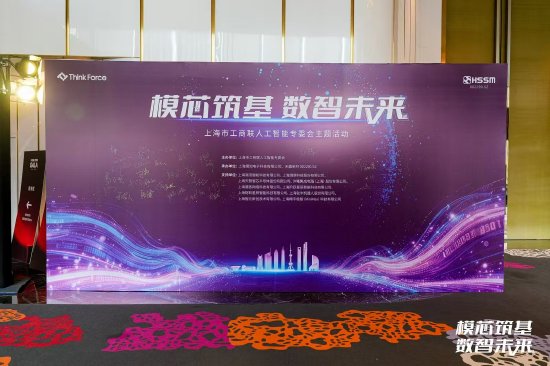
熠知电子联合商汤、壁仞等打造首批“芯模数智”生态共建解决方案
Zheng Quan Shi Bao Wang· 2026-01-16 07:47
Group 1 - The core viewpoint of the article highlights that He Sheng New Materials (002290) has strategically invested in Yizhi Electronics, which, along with companies like SenseTime, Caiyue Xingchen, and Biran Technology, has launched the first batch of "Chip Model Intelligent" ecological co-construction solutions across various fields such as healthcare, securities, and intelligent manufacturing, promoting the integration of digital and physical realms [1] Group 2 - The solutions aim to empower multiple sectors, indicating a broad application potential and collaboration among leading technology firms [1] - The initiative reflects a growing trend in the industry towards digital transformation and smart solutions, which are increasingly important in today's market [1] - The collaboration among these companies signifies a strategic move to enhance innovation and competitiveness in the technology landscape [1]
MiniMax市值破千亿,上市首日涨幅超100%,AI应用Talkie贡献六成收入
Jin Rong Jie· 2026-01-13 08:42
Core Viewpoint - MiniMax, a general artificial intelligence company, successfully listed on the Hong Kong Stock Exchange on January 9, 2026, with a share price of HKD 165, closing at HKD 345 on the first day, marking a 109.09% increase and a market capitalization exceeding HKD 100 billion [1] Group 1: Company Overview - MiniMax was founded in 2021 by CEO Yan Junjie, who holds a PhD from the Chinese Academy of Sciences and previously held an executive position at SenseTime [1] - The company focuses on consumer-oriented (C-end) and global development paths from its inception [1] - MiniMax has developed multimodal model technologies, including text model MiniMax M2, video model Hailuo 02, and voice model Speech 02 [1] Group 2: Product and Revenue - The company has launched several AI-native products, including the AI companionship application Talkie/Xingye and the visual generation platform Hailuo AI [1] - According to the prospectus, Talkie/Xingye contributed 63.7% of the total revenue in 2024 [1] - As of September 2025, MiniMax's AI native products have served over 212 million individual users globally, with over 70% of revenue coming from overseas markets [1] Group 3: Financial Performance - MiniMax's revenue has grown rapidly, with total revenue of USD 30.52 million in 2024, increasing to USD 53.437 million in the first three quarters of 2025 [2] - The company is currently in a loss position due to high R&D investments, with an adjusted net loss of USD 345 million from 2022 to 2024 [2] Group 4: Investment and Legal Issues - Prior to its IPO, MiniMax secured multiple rounds of investment from major firms including Alibaba, Tencent, MiHoYo, Hillhouse, IDG Capital, and Sequoia China [2] - Alibaba, through Alisoft China, holds a 12.52% stake, making it the second-largest shareholder [2] - In September 2025, MiniMax faced a copyright infringement lawsuit from several U.S. film production companies, including Disney and Universal Pictures, regarding its visual generation platform Hailuo AI [2] - The company believes the allegations lack factual basis and sufficient evidence, and plans to contest the lawsuit [2] Group 5: Market Position - According to ZhiShi Consulting, MiniMax ranks as the tenth largest model technology company globally by revenue based on models in 2024, holding a market share of 0.3% [2] - The global large model market is expected to reach USD 22 billion by 2025, with MiniMax projected to maintain approximately 0.3% market share [2]
阿里云通义智能硬件展,千余款 “黑科技”AI硬件“吸睛”
Zhong Guo Zheng Quan Bao· 2026-01-10 09:43
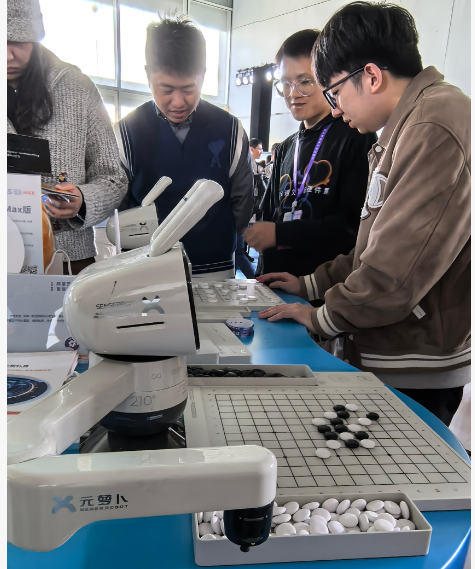
Core Insights - The event showcased over 76 categories, 200 exhibitors, and more than 1,000 AI hardware products, highlighting the integration of AI large models into hardware applications [1] - Alibaba Cloud launched a multimodal interaction development kit, integrating three foundational models to enhance the perception and interaction capabilities of devices like AI glasses and robots [1] Group 1: AI Hardware Innovations - The "Yuanluobo" robot from SenseTime can play four types of chess and serves as an "AI enlightenment teacher," engaging children through interactive learning [2] - The AI simulation panda "Hongbao" from Changhong uses biological simulation technology to provide emotional companionship, mimicking a 1.5-month-old panda cub [4] - The DexForce W1 Pro robot from Kuawei Intelligent acts as a barista, capable of natural voice interaction and executing complex tasks through the integration of the Tongyi Qianwen model [6] Group 2: Sports and Health Applications - The AI tennis robot ACEMATE S10 integrates the Tongyi Qianwen VL model, offering dynamic reasoning and strategy formulation for enhanced training experiences [8] - Rongtai Health, in collaboration with Alibaba Cloud, introduced a smart massage chair that utilizes a health model to create personalized therapy plans through voice interaction [8] Group 3: Development Kit Features - The multimodal interaction development kit provides a low-threshold platform for hardware companies, supporting over 30 mainstream ARM, RISC-V, and MIPS architecture terminal chip platforms [9] - The kit includes proprietary models optimized for various multimodal interaction scenarios, achieving low latency for voice and video interactions [9] - It also features over ten MCP tools and Agents, covering multiple scenarios such as life, work, entertainment, and education [9] Group 4: Comprehensive Solutions - Alibaba Cloud presented solutions for smart wearable devices and companion robots, enabling real-time monitoring and alerting for abnormal situations [10] - The solutions for AI glasses include functionalities like simultaneous translation, photo translation, and multimodal memo capabilities [10]
抢滩万亿具身智能蓝海 泛汽车企业“卡位”人形机器人赛道
Zhong Guo Jing Ying Bao· 2026-01-09 19:58
Core Viewpoint - The automotive industry is increasingly entering the humanoid robot sector, viewing it as a "third growth curve" alongside traditional automotive business lines, with significant investments and product developments underway [3][4][5]. Group 1: Investment and Development - Chery Group announced it is accelerating the incubation of its humanoid robot, Moja, with a recent investment of 35 million yuan from Wuhu Bertli Automotive Safety Systems [3]. - The humanoid robot market is projected to reach a size of $5 trillion by 2050, with an estimated deployment of 1 billion units, indicating a vast market opportunity for automotive companies [7]. - Dongfeng Group is also developing humanoid robots for tasks such as customer reception and material handling in factories, showcasing the diverse applications of these robots [5]. Group 2: Technological Synergy - Automotive companies possess inherent advantages in technology and manufacturing processes, which can be leveraged in the development of humanoid robots [7][10]. - The overlap in supply chains between smart vehicles and humanoid robots is as high as 60%, providing a natural pathway for cost reduction [10]. - Chery's approach to humanoid robots is seen as a natural extension of its existing automotive technology and manufacturing capabilities [8]. Group 3: Market Entry and Competition - New players, including companies like SenseTime and Black Sesame Intelligence, are entering the humanoid robot market, indicating a competitive landscape [4][6]. - SenseTime's recent product launches and partnerships in the humanoid robot space highlight the industry's focus on collaboration and ecosystem development [4]. - The entry of automotive companies into the humanoid robot sector is seen as a strategic move to capture future technological opportunities and enhance their market positions [7][11]. Group 4: Challenges and Future Outlook - The humanoid robot industry is still in its early stages, facing challenges such as the lack of industry standards and safety regulations [9]. - Key technological breakthroughs are needed in areas like AI chips, battery technology, and sensor systems to enable large-scale deployment of humanoid robots [10]. - The development of commercial models, such as robot leasing platforms, is emerging as a potential avenue for revenue generation in the humanoid robot sector [11].

城记|上海AI“五连发”:一月内五企上市 加速构建全栈创新生态
Xin Hua Cai Jing· 2026-01-09 13:53
Core Viewpoint - The recent IPOs of five AI companies in Shanghai highlight the city's rapid development in the AI sector, showcasing a robust innovation ecosystem from foundational computing power to advanced AI applications [1][10]. Group 1: Recent IPOs and Market Performance - MiniMax, a company that has been established for less than four years, successfully listed on the Hong Kong Stock Exchange, demonstrating strong stock performance on its debut [1]. - The recent IPOs include MiniMax, TianShu ZhiXin, and BiRan Technology, marking a significant moment for Shanghai's AI industry with five companies going public within a month [1][2]. Group 2: Industry Landscape and Growth - The companies listed represent a vertical cross-section of Shanghai's AI technology industry, with a focus on foundational computing power, particularly in the GPU sector [2]. - TianShu ZhiXin is noted for being the first domestic company to develop general-purpose GPUs, supporting over 450 AI models across various critical industries [2]. Group 3: Innovation Ecosystem - Shanghai's integrated circuit industry is projected to generate over 460 billion yuan by 2025, doubling its revenue in five years, with over 1,200 integrated circuit companies established [2]. - The city is fostering a high-density innovation community, particularly in the Caohejing Development Zone, which provides resources and subsidies to support AI companies [5][6]. Group 4: AI Applications and Advancements - MiniMax has achieved a record for the shortest time from establishment to IPO in the AI sector, reflecting its rapid development in multimodal models [3]. - AI is penetrating various fields, with companies like YingSi Intelligent transforming traditional pharmaceutical development timelines from an average of 4.5 years to just 12-18 months for clinical candidate nominations [3]. Group 5: Future Development and Talent Cultivation - Shanghai is focusing on nurturing talent through innovative educational institutions like the Chuangzhi Academy, which has already incubated 17 companies with a total valuation exceeding 2 billion yuan [8]. - The city is implementing a "Hundred Teams, Hundred Projects" initiative to foster collaboration between industry and academia, aiming to solve real-world problems with AI technology [9].