
Coherent

Search documents
美股光通信盘前部分走高
Ge Long Hui A P P· 2026-01-30 13:32
格隆汇1月30日丨Lumentum涨超9%,Coherent涨超7%,Applied Optoelectronics涨超5%,康宁涨超2%。 ...
全球三代半上市公司市值分化与价值评估:美日仍是主导,中国力量重塑梯队
Ju Chao Zi Xun· 2026-01-30 05:59
Core Insights - The third-generation semiconductor industry is experiencing rapid growth due to its essential role in strategic emerging fields such as electric vehicles, 5G communication, artificial intelligence, and energy storage, driven by global carbon neutrality and digital transformation [2] Market Dynamics - The total market capitalization of the sample companies in the third-generation semiconductor industry increased from 1,157.213 billion to 1,526.268 billion, reflecting a growth rate of 31.89% [3] - The top five companies accounted for 69.73% of the total market capitalization, indicating a concentration of market power, with Mitsubishi Electric alone representing 28.48% [3] - Mitsubishi Electric led the industry with a market cap of 434.73 billion, achieving a 67.35% increase, while Coherent saw a remarkable growth rate of 130.44%, reaching a market cap of 243.141 billion [3] Company Performance - Traditional semiconductor giants like STMicroelectronics and ON Semiconductor showed stable performance, with slight increases or declines in market cap [4] - Chinese companies are gaining prominence, with Sanan Optoelectronics reaching a market cap of 70.495 billion and a growth rate of 16.11%, while Innoscience achieved a growth rate of 154.7% [4] - Some companies, such as Wolfspeed, faced significant market cap declines, highlighting competitive pressures in the silicon carbide sector [4] Valuation Evolution - The industry is transitioning from profit-oriented valuations to future scenario pricing, with Mitsubishi Electric's P/E ratio at 34.24, reflecting market confidence in its capabilities [6] - Coherent's P/E ratio exceeds 300, indicating high market expectations for profitability, contrasting with Mitsubishi Electric's growth model [6] - Chinese firms like Sanan Optoelectronics exhibit extremely high P/E ratios, driven by national policies and market demand, indicating a strategic premium in valuations [7] Market Trends - The valuation logic in capital markets is shifting towards future technological potential rather than current profitability, necessitating a deeper understanding of companies' technological paths and market positions [8] - The global landscape is characterized by a complex competitive structure, with emerging Chinese firms reshaping the industry hierarchy alongside established international players [7][10] - The third-generation semiconductor industry is expected to maintain strong growth, but internal differentiation may intensify, with innovation and market responsiveness becoming critical competitive factors [10]



这个半导体材料,火了!
半导体芯闻· 2026-01-23 09:38
Core Viewpoint - The article emphasizes the critical role of indium phosphide (InP) in the future of computing power, particularly in the context of AI and data centers, highlighting its unique properties that make it essential for high-speed optical communication [1][2]. Group 1: Indium Phosphide's Unique Properties - InP exhibits over ten times the electron mobility of silicon, making it suitable for high-frequency applications [2]. - It is particularly advantageous for optical communication at key wavelengths of 1310nm and 1550nm, where it can efficiently produce photonic devices [2]. - InP's high thermal resistance and radiation tolerance are crucial for AI servers operating in high-temperature environments [2]. Group 2: Market Demand and Growth - The global AI infrastructure spending is expected to exceed $1 trillion by 2026, driving demand for high-speed optical modules [1][5]. - The demand for InP devices is projected to reach 2 million units by 2025, with a supply gap of 70% as current production capacity is only 600,000 units [10]. - The market for InP is anticipated to grow at an annual rate of over 25% in the next five years, marking a historic growth period [6]. Group 3: Applications and Industry Expansion - InP is becoming increasingly important in various fields, including AI data centers, laser radar, 5G/6G mobile communication, and quantum computing [8]. - The commercialization of Co-Packaged Optics (CPO) technology is expected to further increase the demand for InP, as it reduces power consumption significantly [6][7]. - The global market for CPO is projected to grow approximately 166 times by 2030, indicating a substantial opportunity for InP [7]. Group 4: Global Market Dynamics - The InP industry is currently dominated by a few key players, with Japan's Sumitomo Electric holding a 60% market share [9]. - Major companies are expanding production capacities to meet the surging demand, but the market remains highly oligopolistic, with over 95% of production capacity controlled by a few firms [10]. - Domestic companies in China are making strides to break the foreign monopoly, with several firms achieving significant advancements in InP substrate production [11][13]. Group 5: Challenges and Future Outlook - The InP industry faces challenges related to production costs and technology, particularly in crystal growth processes that are complex and yield variable results [17][18]. - Despite these challenges, the industry is exploring ways to reduce costs through larger wafer sizes and improved production techniques [18]. - The geopolitical landscape and export controls are adding uncertainty to the supply chain, but they also drive nations to strengthen their domestic industries [19].

磷化铟,火了
3 6 Ke· 2026-01-23 03:28
Core Insights - The future of computing power will be determined by optical transmission efficiency, highlighting the critical role of optical interconnect technology and the growing market enthusiasm for indium phosphide (InP) materials [1][2] - The global AI infrastructure spending is expected to exceed $1 trillion by 2026, driving the rapid iteration of data center optical modules to 800G/1.6T and beyond [1] - The demand for InP materials is surging due to their unique properties, with a significant supply-demand gap projected to persist until 2026 [1][9] Group 1: InP Material Advantages - InP exhibits over ten times the electron mobility of silicon, making it suitable for high-frequency and high-speed applications, particularly in optical communication at critical wavelengths [3][4] - InP's high thermal resistance and radiation tolerance are essential for AI servers and data centers operating in high-temperature environments [3] - InP is positioned as the core material for high-end long-distance communication, outperforming silicon and gallium arsenide in efficiency and adaptability [4] Group 2: Market Demand Drivers - The explosive growth of AI data centers is the primary driver for the increasing demand for InP, with 800G optical modules becoming standard [6] - The introduction of Co-Packaged Optics (CPO) technology is expected to significantly increase the demand density for InP substrates, with a projected market growth of 166 times by 2030 [7] - In addition to data centers, InP is penetrating advanced fields such as LiDAR, 5G/6G mobile communications, low Earth orbit satellite communications, and quantum computing [8] Group 3: Global Market Dynamics - The global InP industry is characterized by a high degree of oligopoly, with major players like Sumitomo Electric and AXT dominating over 95% of the market [9] - A significant supply-demand gap is anticipated, with a projected need for 2 million InP devices by 2025 against a production capacity of only 600,000 [9] - Major manufacturers are ramping up production capacity to address this gap, with AXT planning to double its capacity by 2026 [9][10] Group 4: Domestic Industry Developments - Chinese companies are accelerating efforts to break the foreign monopoly in the InP market, with several firms achieving significant milestones in production capacity and technology [10][11] - The domestic market is witnessing a collaborative push towards a full-chain upgrade in the InP industry, enhancing quality and efficiency [12] - Government policies are supporting the development of InP materials, including tax reductions and funding for research in high-purity indium production [12] Group 5: Future Outlook and Challenges - The InP industry is on the brink of a significant scale-up, driven by the urgent need for high-performance materials in AI and optical communication [18] - Despite the promising outlook, challenges such as low crystal growth yield and high costs remain, necessitating technological advancements and cost reductions [14][15] - Geopolitical factors and export controls are creating uncertainties in the global supply chain, impacting the InP industry's growth trajectory [16]



光模块龙头净利齐涨超40%,2026年争夺1.6T市场
2 1 Shi Ji Jing Ji Bao Dao· 2026-01-21 12:20
21世纪经济报道记者雷晨 全球AI算力建设正处于一个前所未有的爆发阶段,光模块作为数据高速传输的"血管",迎来了真正的黄金年代。从2025年开始,800G需求持 续放量,1.6T已进入商用导入期,行业正从速率竞赛全面转向效率竞争。 随着2025年年度业绩预告陆续披露,以天孚通信、剑桥科技为代表的国内光模块龙头企业,交出了增速惊人的答卷,归母净利润同比增幅均超 40%,直观印证了AI算力基础设施需求激增带来的行业高景气度。 行业新周期已然来临,技术迭代与供需博弈成为核心主线。800G出货量同比翻倍至近2000万只,1.6T产品进入商用元年,头部厂商加速产能 卡位与技术攻坚。但光芯片供应缺口仍存,供应链掌控力成为竞争关键。 在AI巨头资本开支持续加码、"光替铜"浪潮将至的背景下,光模块行业正站在量价齐升与格局重塑的交叉点,开启新一轮成长周期。 业绩高增 去年,光模块行业整体呈现"量价齐升"格局,头部企业凭借产品结构优化与产能优势,交出亮眼业绩答卷。 天孚通信作为光器件领域龙头,业绩维持增长。公司1月21日披露的业绩预告显示,2025年归母净利润预计为18.81亿元-21.5亿元,同比增长 40%-60%,延续高增 ...



行业聚焦:全球激光焊接头行业头部生产商市场份额及排名调查
QYResearch· 2026-01-15 10:26
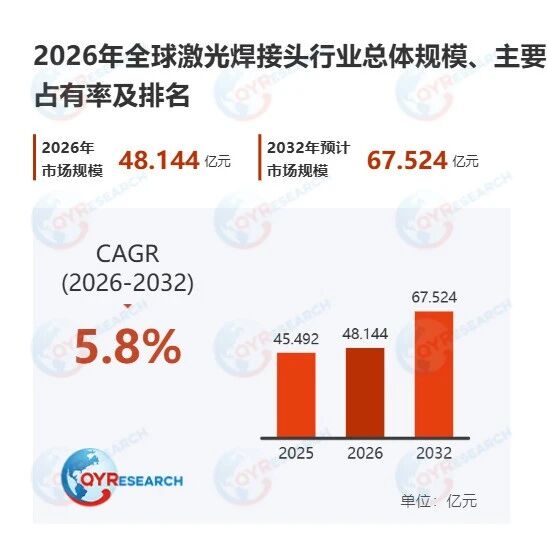
Core Insights - The global laser welding head market is experiencing rapid growth driven by the demand for precision welding in sectors such as electric vehicles, power batteries, and consumer electronics [4][7] - The market is characterized by an oligopolistic structure, with major players like Trumpf, IPG, Coherent, and Precitec holding approximately 70% of the high-end market share [4][9] - The market is projected to reach USD 993 million by 2032, with a compound annual growth rate (CAGR) of 5.8% over the coming years [5] Global Trends and Drivers - The primary drivers of the laser welding head market include the rigid demand for high-precision and high-efficiency welding processes in industries such as electric vehicles and energy storage [7] - The integration of welding heads with automation technologies, including robotics and vision systems, is being accelerated by industrial automation upgrades [4][7] - The trend towards lightweight materials, such as aluminum alloys and composites, is increasing the demand for advanced laser welding heads capable of swing welding and remote scanning [7] Competitive Landscape - The laser welding head market exhibits a concentrated competitive landscape, with leading companies leveraging technological advantages and comprehensive supply chain strategies [4] - Major companies dominate the high-end market, while Chinese manufacturers are gaining ground in the mid-to-low-end market through cost-effectiveness and rapid response [4][9] - Future competition is expected to focus on advanced applications such as composite welding and ultrafast laser technologies, with leading firms enhancing their ecosystem control through mergers and acquisitions [4] Opportunities and Challenges - Structural opportunities arise from global "carbon neutrality" policies promoting the expansion of green industries, particularly in battery and lightweight material processing [5] - Regulatory challenges, including export restrictions on high-end optical components and compliance costs associated with data security laws, pose risks to market expansion [5][8] - The high initial investment and maintenance costs of laser welding heads limit adoption among small and medium enterprises, while reliance on imported core optical components creates supply chain vulnerabilities [8] Industry Development Opportunities - The demand for precision welding in green energy sectors, such as power batteries and hydrogen energy, is creating new market opportunities for high-performance welding heads [10] - The trend towards domestic substitution is allowing local companies to penetrate the mid-market and specific applications, such as 3C electronics and hardware processing [10] - The push for smart and digital solutions is driving the development of integrated welding heads with capabilities for visual monitoring and adaptive control [10]
美股光通讯概念股走高,Lumentum涨超4%
Mei Ri Jing Ji Xin Wen· 2026-01-15 09:52
Group 1 - The core viewpoint of the article highlights the rise in stock prices of optical communication concept stocks in the US market, indicating positive market sentiment in this sector [1] Group 2 - Lumentum's stock increased by over 4%, reflecting strong investor interest and confidence in the company's performance [1] - Coherent's stock rose by more than 3%, suggesting a favorable outlook for the company's future growth [1] - Astera Labs experienced a stock increase of over 2%, indicating a positive trend in the optical communication industry [1]
Credo遭错杀了?
半导体芯闻· 2026-01-09 10:55
Core Viewpoint - Nvidia's CEO Jensen Huang's speech at CES impacted Credo Technology's stock negatively, but market analysts believe the stock may have been unfairly punished [1]. Group 1: Market Reaction - Credo Technology, a leader in Active Electrical Cables (AEC), saw its stock drop by 5.2% on January 6 and further decline by over 6% on January 7 due to concerns that Nvidia's new Vera Rubin system would shift away from copper cables to optical interconnect solutions [1]. - After hitting a low of $125 on January 7, Credo's stock experienced a dramatic turnaround, closing up 6.05% at $141, even surpassing its closing price from January 5 [1]. Group 2: Future Outlook - Analysts clarified that Huang still favors expanding the use of copper cables within cabinets to maximize connection speeds between GPUs [1]. - Despite Nvidia's movement towards more optical interconnect solutions, Credo is actively developing its own optical and photonic solutions, which could mitigate concerns about its future [2]. - Analysts recommend investors consider buying Credo's stock if it falls below $140 [2].
港股异动 | 光通信概念反弹 长飞光纤光缆(06869)涨超10% 剑桥科技(06166)涨超5%
智通财经网· 2026-01-07 02:30
Group 1 - The optical communication sector is experiencing a rebound, with companies like Yangtze Optical Fibre and Cable (06869) rising by 9.6% to HKD 53.75 and Cambridge Technology (06166) increasing by 5.14% to HKD 89.95 [1] - Overnight, US optical communication stocks such as Lumentum surged over 11% and Coherent rose more than 4%, indicating strong market interest [1] - Tianfeng Securities suggests that the market size for Scale-up interconnects, which will eventually lead to Scale-up CPO, has significantly surpassed that of Scale-out networks, highlighting a shift in market dynamics [1] Group 2 - According to a report from Fangzheng Securities, the average price of G.652.D optical fiber has increased for two consecutive quarters, showing a clear price recovery trend [1] - Historical trends indicate that the optical fiber and cable market has certain cyclical characteristics, with a projected production of 125 million core kilometers of optical cables in China by the first half of 2025, despite a year-on-year decline that is narrowing [1] - The prices of common cables and fibers are beginning to rebound, and the procurement prices from operators are expected to stabilize and recover, suggesting an overall improvement in industry sentiment [1]
光通信概念反弹 长飞光纤光缆涨超10% 剑桥科技涨超5%
Zhi Tong Cai Jing· 2026-01-07 02:28
Group 1 - The optical communication sector is experiencing a rebound, with stocks such as Yangtze Optical Fibre (601869) and Cambridge Technology (603083) seeing significant increases of 9.6% and 5.14% respectively [1] - Overnight, US optical communication stocks like Lumentum and Coherent saw gains of over 11% and 4%, indicating strong market interest [1] - Tianfeng Securities suggests that the market size for Scale-up applications is expected to dominate, driven by the expansion of Scale-up domains and increased interconnection speeds [1] Group 2 - According to a report from Fangzheng Securities, the average price of G.652.D optical fiber has risen for two consecutive quarters, showing a clear recovery trend [1] - Historical trends indicate that the optical fiber and cable market exhibits cyclical behavior, with a projected production of 125 million core kilometers of optical cables in the first half of 2025, despite a year-on-year decline [1] - The decline in production has narrowed, and prices for common cables are beginning to rebound, suggesting that operator procurement prices may stabilize and the overall industry outlook could enter an upward phase [1]