
第三代半导体

Search documents
【公告全知道】芯片+ HJT电池+PCB+第三代半导体!公司具备HJT、钙钛矿以及钙钛矿叠层整线设备供应能力
财联社· 2026-03-17 15:39
Group 1 - The article highlights the importance of weekly announcements related to the stock market, including key events such as suspensions, investments, acquisitions, and performance reports, which are marked in red for easy identification [1] - A company is noted for its capabilities in supplying HJT, perovskite, and perovskite tandem line equipment, indicating a strong position in the semiconductor and renewable energy sectors [1] - Another company has reportedly won a total of 121 million yuan in new energy project bids, showcasing its involvement in green electricity, energy storage, smart grids, and robotics [1] - A company has signed a sales contract worth 1.085 billion yuan for deep-sea wind turbine foundation structures, reflecting its engagement in offshore wind technology [1]


2026全国“两会”中关于半导体、AI的提案
仪器信息网· 2026-03-11 03:55
Group 1: Semiconductor Industry - The focus of discussions during the 2026 National Two Sessions was on semiconductor, chip, and artificial intelligence, emphasizing the need for domestic chip production and AI empowerment in industries [2][3] - National Committee member Zhou Hongyi highlighted the exponential growth in inference computing power demand, predicting that by 2027, inference computing power will account for over 70% of total computing power in China, advocating for national policies to guide this layout [3] - Suggestions were made to transition domestic chips from "usable" to "user-friendly," with a call for systematic breakthroughs and integration across the entire supply chain [4] - The importance of rare resources, such as gallium, was emphasized, with recommendations to leverage these for scaling up industries like compound semiconductors and photonic chips [4] - Recommendations included establishing a world-class optoelectronic information industry cluster and focusing on core technology breakthroughs in light chips and compound semiconductors [5] Group 2: Artificial Intelligence - The 2026 Government Work Report marked the first inclusion of "intelligent economy" and "intelligent agents," aiming to promote the commercialization of AI across key industries [6] - Suggestions were made to empower the semiconductor industry with AI, including legislative measures for data rights and establishing a fault-tolerant mechanism to encourage innovation [6][7] - Emphasis was placed on the need for talent cultivation in AI governance, focusing on creativity and critical thinking skills that AI cannot replicate [7] - Proposals included the establishment of a national AI project and collaboration among national laboratories, leading enterprises, and research institutions to tackle AI challenges [6][7] Group 3: Data Governance - Recommendations were made to construct a national industrial data governance framework and establish a national industrial data service platform [8] - Suggestions included creating AI demonstration factories and industry clusters to promote the application of large models and intelligent systems [9] - Proposals aimed at encouraging financial institutions to innovate in data asset financing and establishing special development funds to address financing challenges for innovative data companies [9][10] Group 4: Capital Support - Proposals were made to establish special financing channels for high-tech industries like integrated circuits and semiconductors, with differentiated financing rules [11] - Recommendations included optimizing capital market refinancing rules to improve funding efficiency for enterprises [11] - Suggestions were made to adjust funding ratios for key technology projects to alleviate financial pressures on companies engaged in critical technology development [11]
日本芯片巨头,被收购?
半导体行业观察· 2026-03-07 03:07
Group 1 - The core viewpoint of the article is that Denso's acquisition offer for Rohm represents a significant shift in Japan's semiconductor industry from collaboration to consolidation in response to global competition pressures [2][6][7] - Denso's strategic move to acquire Rohm is part of a long-term plan, having initially partnered with Rohm in 2025 and gradually increasing its stake to nearly 5% before proposing a full acquisition [3][4] - The acquisition is seen as a potential "crisis redemption" for Rohm, which is facing financial difficulties, including a projected net loss of 50 billion yen for the fiscal year 2024 [4][5] Group 2 - The merger is indicative of Japan's power semiconductor industry seeking to "band together for survival" amid rising competition from Chinese firms, which have been gaining market share in the mid to low-end segments [6][7] - The Japanese Ministry of Economy, Trade and Industry is encouraging semiconductor companies to consolidate resources to better compete globally, making Denso's acquisition aligned with this policy direction [6][7] - The potential merger could reshape the global power semiconductor landscape, posing new competitive pressures on international giants like Infineon and ON Semiconductor, as well as Chinese companies [10]
【公告全知道】MicroLED+CPO+芯片+第三代半导体!公司设备可应用于部分光模块的器件组装工序
财联社· 2026-03-05 15:15
Core Viewpoint - The article highlights significant announcements in the stock market, including various corporate actions such as suspensions, investments, acquisitions, and performance updates, aimed at helping investors identify potential opportunities and risks in a timely manner [1] Group 1: Technology and Equipment - The company is involved in the production of MicroLED and CPO technologies, with its self-developed chip mounter being a key equipment for the production of Micro LED micro-displays [1] - The company has received a small number of orders for MiniLED-related equipment, indicating a growing presence in the market for storage chips and robotics, particularly in collaboration with Huawei [1] Group 2: Marine and High-end Equipment - A subsidiary of the company has signed a significant shipbuilding contract valued between 400 million to 600 million USD, showcasing its capabilities in marine equipment and high-end manufacturing [1]

战火一燃,国产半导体又要渡劫了!
是说芯语· 2026-03-05 00:30
Core Viewpoint - The ongoing geopolitical tensions, particularly in the Middle East, are severely impacting the semiconductor industry, especially the third-generation semiconductors, which are already facing significant challenges [2][19]. Supply Chain Disruption - The supply of high-purity neon gas, crucial for semiconductor manufacturing, has been drastically affected, with Iran accounting for 18% and Ukraine for 70% of global supply, leading to a halving of available neon gas [4][5]. - Domestic semiconductor manufacturers have only 1-3 months of neon gas inventory, which poses a critical risk to production during this crucial ramp-up phase [4][5]. - The reliance on imported materials and equipment exacerbates the situation, as logistics disruptions can halt production lines and lead to significant financial losses [10][12]. Cost and Production Challenges - The third-generation semiconductors are particularly vulnerable due to their high energy consumption and reliance on stable logistics, with production costs expected to rise significantly due to increased prices of raw materials and transportation [9][10]. - The industry is already struggling with high investment and low output, and the current crisis could lead to many companies facing bankruptcy or being forced to raise prices, which may not be feasible [9][10]. Market Dynamics - While some companies may see an influx of orders due to instability in other regions, the ability to fulfill these orders is compromised by supply chain weaknesses and reliance on imports [12][14]. - The competition in the semiconductor industry is not just about technology but also about the resilience of the supply chain, which is currently under severe strain [21][22]. Long-term Implications - The ongoing crisis serves as a wake-up call for the semiconductor industry in China, highlighting the urgent need for self-sufficiency and robust supply chains to withstand future disruptions [16][22]. - Companies must focus on improving production yields and stabilizing supply chains to survive and thrive in the evolving global landscape [19][22].

晶科电子股份(02551)拟出资2.68亿元参与成立基金
智通财经网· 2026-02-24 14:09
Group 1 - The company announced the establishment of a fund with a total investment of approximately RMB 668 million, with the company committing RMB 268 million, representing about 40.12% of the total fund commitment [1] - The fund will focus on the semiconductor and integrated circuit industry within the strategic industrial clusters of Guangzhou's "12218" modernization industrial system [1] - The fund is expected to support government strategic industries, including a proposed investment in Guangdong Chip Aggregation Energy [1] Group 2 - The company's strategic layout in the "third-generation semiconductor" industry cluster aims to support key applications such as new energy vehicles, new displays, photovoltaics, energy storage, and AI data centers [2] - Collaborations with Guangzhou's industrial and information development fund and state-owned platforms will create a mechanism for "government guidance, market operation, and industry traction" [2] - This initiative is expected to enhance the company's long-term high-quality development and provide greater value returns to shareholders [2]
玩的就是心跳!昨天崩盘今天疯涨,全球市场熔断接力赛,4800股上涨
Sou Hu Cai Jing· 2026-02-03 17:03
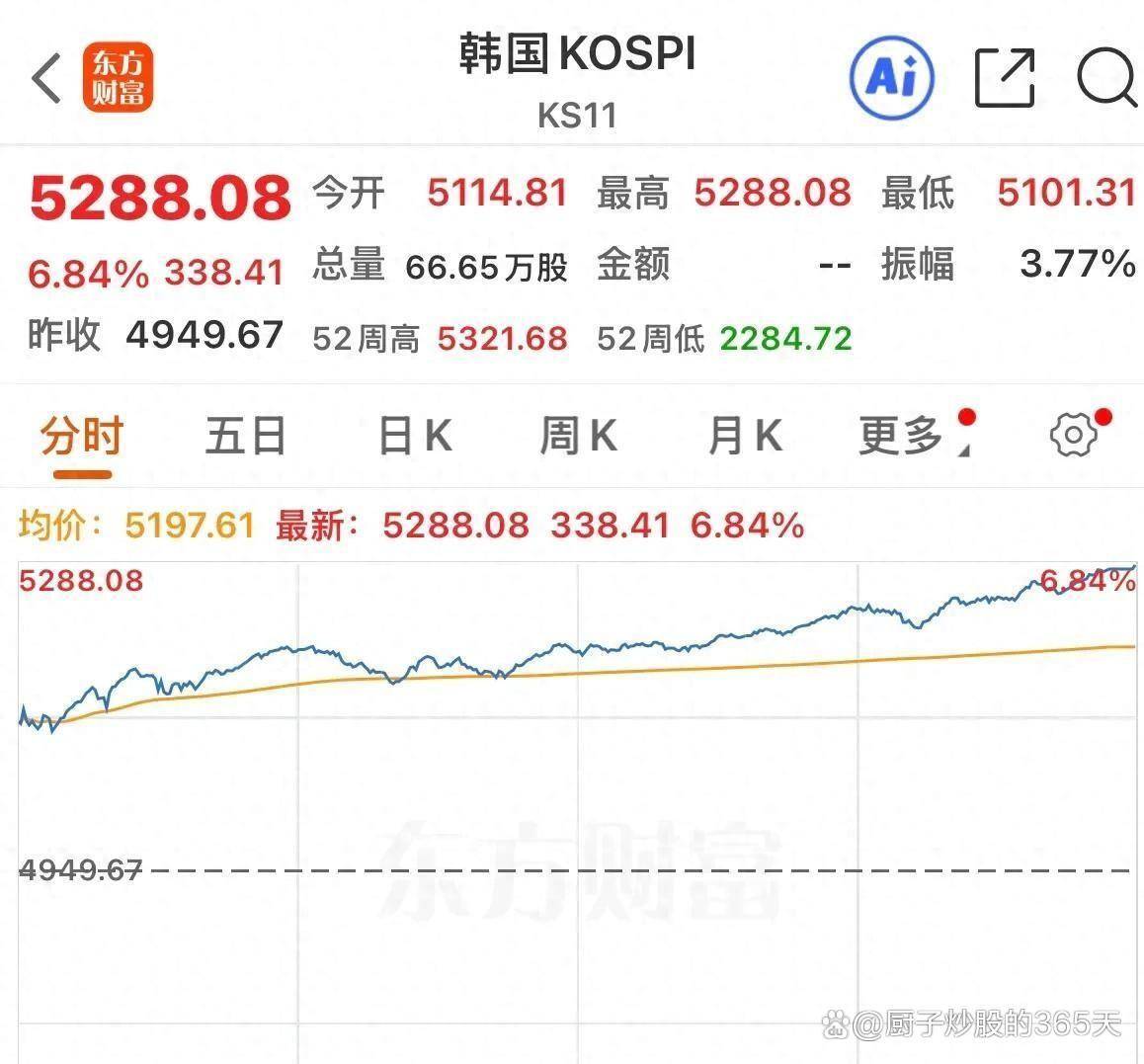
Group 1 - The South Korean stock market experienced a dramatic turnaround, jumping 6.75% after a previous day of significant decline, triggering a "circuit breaker" twice in two days [2][3] - The A-share market also rebounded strongly, with nearly 4800 stocks rising after a day of over 4600 stocks declining, indicating a complete reversal in market sentiment [3][6] - Key sectors driving the A-share rally included new energy, semiconductor, and communication equipment, with average gains between 3% and 7% across various sectors [3][6] Group 2 - The market's volatility was influenced by global factors, particularly concerns over the U.S. Federal Reserve's potential tightening of monetary policy, which initially led to panic selling [7][9] - Following the panic, some investors perceived the previous day's sell-off as an overreaction, leading to a rebound in both the South Korean stock market and gold prices [9][10] - The A-share market's strength was supported by internal factors, including favorable industry policies and rumors of long-term capital inflows, which boosted investor confidence [9][10]
全球三代半上市公司市值分化与价值评估:美日仍是主导,中国力量重塑梯队
Ju Chao Zi Xun· 2026-01-30 05:59
Core Insights - The third-generation semiconductor industry is experiencing rapid growth due to its essential role in strategic emerging fields such as electric vehicles, 5G communication, artificial intelligence, and energy storage, driven by global carbon neutrality and digital transformation [2] Market Dynamics - The total market capitalization of the sample companies in the third-generation semiconductor industry increased from 1,157.213 billion to 1,526.268 billion, reflecting a growth rate of 31.89% [3] - The top five companies accounted for 69.73% of the total market capitalization, indicating a concentration of market power, with Mitsubishi Electric alone representing 28.48% [3] - Mitsubishi Electric led the industry with a market cap of 434.73 billion, achieving a 67.35% increase, while Coherent saw a remarkable growth rate of 130.44%, reaching a market cap of 243.141 billion [3] Company Performance - Traditional semiconductor giants like STMicroelectronics and ON Semiconductor showed stable performance, with slight increases or declines in market cap [4] - Chinese companies are gaining prominence, with Sanan Optoelectronics reaching a market cap of 70.495 billion and a growth rate of 16.11%, while Innoscience achieved a growth rate of 154.7% [4] - Some companies, such as Wolfspeed, faced significant market cap declines, highlighting competitive pressures in the silicon carbide sector [4] Valuation Evolution - The industry is transitioning from profit-oriented valuations to future scenario pricing, with Mitsubishi Electric's P/E ratio at 34.24, reflecting market confidence in its capabilities [6] - Coherent's P/E ratio exceeds 300, indicating high market expectations for profitability, contrasting with Mitsubishi Electric's growth model [6] - Chinese firms like Sanan Optoelectronics exhibit extremely high P/E ratios, driven by national policies and market demand, indicating a strategic premium in valuations [7] Market Trends - The valuation logic in capital markets is shifting towards future technological potential rather than current profitability, necessitating a deeper understanding of companies' technological paths and market positions [8] - The global landscape is characterized by a complex competitive structure, with emerging Chinese firms reshaping the industry hierarchy alongside established international players [7][10] - The third-generation semiconductor industry is expected to maintain strong growth, but internal differentiation may intensify, with innovation and market responsiveness becoming critical competitive factors [10]


中信建投:AIDC电源革命正式开启 电源主机、储能等四大方向有望共振
智通财经网· 2026-01-15 08:24
Core Insights - The fundamental driver of AI power supply solutions is the continuous improvement in single-chip and single-cabinet power levels, with companies like NVIDIA leading the charge in upgrading their AI chips [1] - The power of AI data centers in North America is projected to reach 71GW by 2028, driven by advancements in multi-chip designs such as NVL72 from NVIDIA and Superpod from Google [1] Group 1: Power Supply Evolution - The main directions for AIDC power supply iteration are high power, high voltage, and direct current, with NVIDIA's white paper outlining a clear path from AC to 800V DC solutions [2] - The OCP organization has established ±400V power supply standards, aiming for MW-level cabinet power through direct current supply [2] Group 2: Technological Changes and Growth - The evolution of power supply solutions has led to the development of integrated devices like HVDC Sidecar and SST hosts, which can perform multiple functions such as voltage reduction and power quality improvement [3] - Key challenges in R&D include power conversion modules and high-frequency isolation transformers, with third-generation wide bandgap semiconductors like SiC and GaN being crucial for achieving high voltage and efficiency [3] Group 3: Investment Opportunities - Four key areas for investment consideration include AIDC power hosts (PSU, HVDC, SST), with companies like Sungrow Power (300274.SZ) and Megmeet (002851.SZ) being notable mentions [4] - Energy storage solutions at the station level are highlighted, with companies such as Sungrow Power and Fluence Energy (FLNC.US) being potential investment targets [4] - Core incremental components like solid-state circuit breakers and electronic fuses are also identified, with companies like Liyang Technology (002706.SZ) and Vicor Corporation (VICR.US) being recommended [4] - Third-generation semiconductors like GaN and SiC are emphasized as critical components for future developments [4]



投资48单、交割超120亿:中建材新材料基金加码新材料投资
2 1 Shi Ji Jing Ji Bao Dao· 2025-12-17 13:09
Core Insights - The new materials industry is a crucial support for advancing new industrialization in China, with China National Building Material Group (CNBM) focusing on the integration of technological and industrial innovation to contribute to the construction of a strong materials and manufacturing nation [1][3] Investment and Fund Performance - CNBM's New Materials Fund has a total scale of 20 billion yuan, with an initial scale of 15 billion yuan, focusing on investments in inorganic non-metallic materials, organic polymer materials, composite materials, special metals, and other new materials [1] - As of now, the New Materials Fund has completed investments in 48 projects, with a total delivery scale of 12.14 billion yuan, indicating stable operational performance in the new materials sector [1] Semiconductor Materials Focus - The New Materials Fund is paying close attention to the semiconductor materials sector, including large silicon wafers, photoresists, electronic specialty gases, target materials, wet electronic chemicals, storage devices, and third-generation semiconductors, forming a comprehensive semiconductor materials industry cluster [2] Central-Local Cooperation - CNBM is building a second growth curve centered on the new materials industry, focusing on cultivating industries with scales of 1 billion, 5 billion, and 10 billion yuan, aiming for a revenue of 100 billion yuan and a profit of 10 billion yuan in the new industry group [3] - The cooperation between CNBM and local governments, such as Jiangsu and Anhui provinces, is injecting capital into the new materials industry, promoting high-quality development [4] Technological and Investment Synergy - CNBM emphasizes the integration of technology and investment in driving the development of the new materials industry, highlighting the need for investment to catalyze technological innovation across various stages of development [6][7] - The company aims to leverage its investment strategies to discover new growth points and enhance existing business strengths through its funds [6] AI and New Materials - The integration of artificial intelligence (AI) with new materials is seen as a transformative force, with AI reshaping productivity and driving advancements in various sectors, including integrated circuits, which are foundational to AI capabilities [7]