Manus

Search documents
机构称2026年情绪消费高景气度或将延续,港股通消费ETF(513230)现小幅微涨
Mei Ri Jing Ji Xin Wen· 2026-01-14 06:28
1月14日,恒指午后转跌,恒生科技指数现跌0.19%。港股通消费ETF(513230)午盘震荡,现小幅微 涨。持仓股中,康耐特光学、海底捞、农夫山泉、老铺黄金、古茗、布鲁可等涨幅靠前;下跌方面,高 鑫零售、同程旅行、名创优品等跌幅居前。 华西证券认为,2026年情绪消费高景气度延续。Z世代消费群体,商品消费逐步过渡到商品+情绪消费 并重需求,消费者买单意愿强,情绪消费有望迎来持续高景气发展阶段;服务型消费成为重要的促内需 抓手。政策端持续强调服务消费潜力,包括养老、育儿、旅游、离岛免税等,25年政策端正持续发力, 目前效果正逐步显现(例如离岛免税迎来强势增长),26年迎来结构性增长亮点;AI应用商业化加速 发展Meta近期以数十亿美元收购中国AI智能体公司Manus,标志着AI应用端26年或有望加速,AI+消费 服务业发展有望迎来新一轮发展高潮;品质商超再创佳绩,超市调改或进入收获期。山姆、胖东来25年 再创零售额新高,持续高增长,线下零售商场调改有望进入收获期。 港股消费ETF(513230)跟踪中证港股通消费主题指数,一键打包港股新消费龙头,成分股近乎囊括港 股消费的各个领域,包括泡泡玛特、百胜中国、安踏 ...
今日视点:AI投资逻辑转向释放三重积极信号
Xin Lang Cai Jing· 2026-01-13 23:09
Core Viewpoint - The domestic large model industry is experiencing significant positive developments, with companies like Beijing Zhiyuan Huazhang Technology Co., Ltd. and MiniMax achieving notable market valuations, indicating a shift in AI investment focus towards application value [1][7]. Group 1: Transition of Investment Logic - The investment logic in the AI industry is shifting from large-scale investments in computing power and model construction to a focus on the realization of application scenarios and commercial value [1][7]. - This transition marks a critical phase of "technology monetization," as evidenced by companies like SANY Heavy Energy reducing product defect rates by 20% and delivery times by over 30% through AI technology [2][8]. - The formation of a commercial closed loop is creating sustainable development opportunities, with domestic companies proving the multi-scenario monetization potential of AI applications [2][8]. Group 2: Empowerment of the Real Economy - AI investment is increasingly benefiting the real economy, with a broader emphasis on "Artificial Intelligence +" enabling intelligent transformation across various industries [3][9]. - The "Artificial Intelligence + Manufacturing" initiative aims to launch 1,000 high-level industrial intelligent entities and promote 500 typical application scenarios by 2027 [3][9]. - New marketing paradigms like Generative Engine Optimization (GEO) are emerging, providing more efficient exposure paths compared to traditional search engine optimization (SEO) [3][9]. Group 3: Changes in Market Ecology - The investment logic is evolving from a single technology assessment to a comprehensive evaluation of "technology + scenario + business model," favoring projects that can bridge data silos and reconstruct business processes [4][10]. - The market is moving towards a "multi-dimensional symbiosis" ecosystem, breaking the previous notion of "winner takes all" and recognizing the independent value of vertical AI applications [5][11]. - The emergence of companies like Beijing Zhiyuan Huazhang Technology and MiniMax on the Hong Kong Stock Exchange reflects a market preference for composite players that combine model capabilities, scenario understanding, and commercial viability [5][11]. Group 4: Future Outlook - The shift in AI investment logic signifies a transition from "barbaric growth" to "rational maturity," with the realization of technological value providing a more stable foundation for the AI industry [6][12]. - Continuous policy support and deepening technology applications are expected to position AI applications as the core engine for industrial growth in 2026 and beyond [6][12]. - Companies that excel in vertical fields and deliver practical value are likely to emerge as the true winners in the AI investment wave, facilitating a critical leap from "quantitative accumulation" to "qualitative breakthroughs" in the AI industry [6][12].
AI投资逻辑转向释放三重积极信号
Zheng Quan Ri Bao· 2026-01-13 17:13
Core Insights - The domestic large model industry is experiencing significant positive developments, with Beijing Zhiyu Huazhang Technology Co., Ltd. becoming the first global large model stock listed on the Hong Kong Stock Exchange, and MiniMax achieving a market capitalization exceeding 100 billion yuan on its first trading day. This indicates a shift in AI investment focus towards application value [1] - The investment logic has transitioned from large-scale investments in computing power and model construction to a deeper exploration of application scenarios and commercial value realization, marking a critical phase for the AI industry [1][6] Group 1: Commercialization and Application - The acceleration of the commercialization loop is creating sustainable development opportunities, with domestic companies achieving profitability through AI social products and industry solutions, demonstrating the multi-scenario monetization potential of AI applications [2] - AI technology is moving from "laboratory" to "production line," with practical applications validating its ultimate value. For instance, SANY Heavy Energy's wind blade factory reduced product defect rates by 20% and shortened delivery times by over 30% through digital platforms [1] Group 2: Industry Empowerment and Economic Upgrade - AI investment is benefiting the real economy, with a shift from "single-point breakthroughs" to "panoramic penetration," promoting intelligent transformation across various industries. The Ministry of Industry and Information Technology and other departments have set goals for 2027 to launch 1,000 high-level industrial intelligent bodies and promote 500 typical application scenarios [3] - The emergence of new industries and business models, such as Generative Engine Optimization (GEO), is reshaping traditional industries and creating new market opportunities [3] Group 3: Market Ecology and Innovation - The investment logic has shifted from a "winner-takes-all" approach to a "multi-dimensional coexistence," alleviating concerns about monopolistic tendencies in the AI industry. This shift has led to a re-evaluation of AI application value, with vertical application companies gaining recognition for their independent value [5] - The market is now more inclined to support companies that combine model capabilities, scene understanding, and commercial implementation, fostering a diverse ecosystem where large tech firms and specialized small enterprises can thrive together [5] Group 4: Future Outlook - The transition of AI investment logic towards applications is a necessary evolution from "barbaric growth" to "rational maturity," with the realization of technological value providing a more stable foundation for the AI industry [6] - Continuous policy support and deepening technology applications are expected to make AI applications the core engine for industrial growth in 2026 and beyond, with companies excelling in vertical fields likely to emerge as the true winners in the AI investment wave [6]
Manus和它的「8000万名员工」
36氪· 2026-01-13 10:14
Core Insights - Manus represents a significant paradigm shift in AI applications, transitioning from content generation to autonomous task completion, marking a "DeepSeek moment" in the industry [5][6]. - The Manus model is characterized by three core values: it is the first company with over 80 million "employees," it functions as an "artificial intelligence operating system," and it signifies a potential leap in human civilization by enhancing productivity [7][8]. Manus Model and Its Impact - Manus has created over 80 million virtual computing instances, which are crucial for its operational model, allowing AI to autonomously handle complex tasks [10][11]. - The Manus model is compared to the mobile internet era, where cloud computing served as the backbone for numerous virtual machines operated by humans, whereas Manus utilizes AI to operate these virtual machines independently [11][12]. - The Manus system signifies a shift in core operators from humans to AI, indicating a potential 0.5-level leap in human civilization as AI takes over digital economy-related jobs [13][14]. AI Application's "DeepSeek Moment" - The release of Anthropic's multi-agent system demonstrated a 90.2% performance improvement in handling complex tasks compared to single-agent systems, highlighting the importance of collaboration among AI [15][19]. - The Manus architecture emphasizes a division of labor among AI agents, enhancing efficiency and enabling them to tackle complex problems collaboratively [17][21]. - Manus achieved an annual recurring revenue (ARR) of over $100 million within a year of launch, indicating strong commercial viability and interest in its offerings [21][22]. Technological Foundations of Multi-Agent Systems - Manus's multi-agent system relies on several core technologies, including virtual machines for secure execution environments and resource pooling for efficient utilization [25][26]. - The virtual machine architecture allows for isolated execution of tasks, addressing compatibility issues and ensuring data security [28][29]. - The intelligent orchestration of resources enables Manus to dynamically allocate models based on task complexity, significantly reducing token consumption [31][32]. Competitive Landscape and Industry Dynamics - Major tech companies are rapidly adopting multi-agent systems, recognizing their potential to enhance the capabilities of existing large models and redefine human-computer interaction [36][37]. - In the domestic market, companies like Alibaba, Tencent, and Baidu are exploring multi-agent systems, indicating a competitive environment for AI development [38][39]. - The emergence of new players like Kimi, which has secured significant funding to enhance multi-agent system development, suggests a growing interest and investment in this area [40]. Evolution of Human Roles in the AI Era - The relationship between humans and AI is evolving from "operator-tool" to "manager-team," with humans focusing on task design and oversight while AI handles execution [42][43]. - The automation of routine creative tasks by multi-agent systems may reduce demand for lower-level creative jobs while amplifying the value of higher-level creative work [43][44]. - The structural transformation of organizations is anticipated, with multi-agent systems enabling flatter hierarchies and redefining the ownership of production resources [44][45]. Challenges and Considerations - Data sovereignty and system security are critical concerns as multi-agent systems evolve, necessitating new frameworks for data ownership and quality assurance [46][47]. - The complexity of ensuring safety in multi-agent interactions poses significant challenges, requiring robust monitoring and validation mechanisms [49][50]. - The balance between security and efficiency remains a fundamental issue, as achieving absolute security may compromise system performance [50][51].

德媒:美国抢中国技术与人才,中方展开调查!
Sou Hu Cai Jing· 2026-01-13 08:44
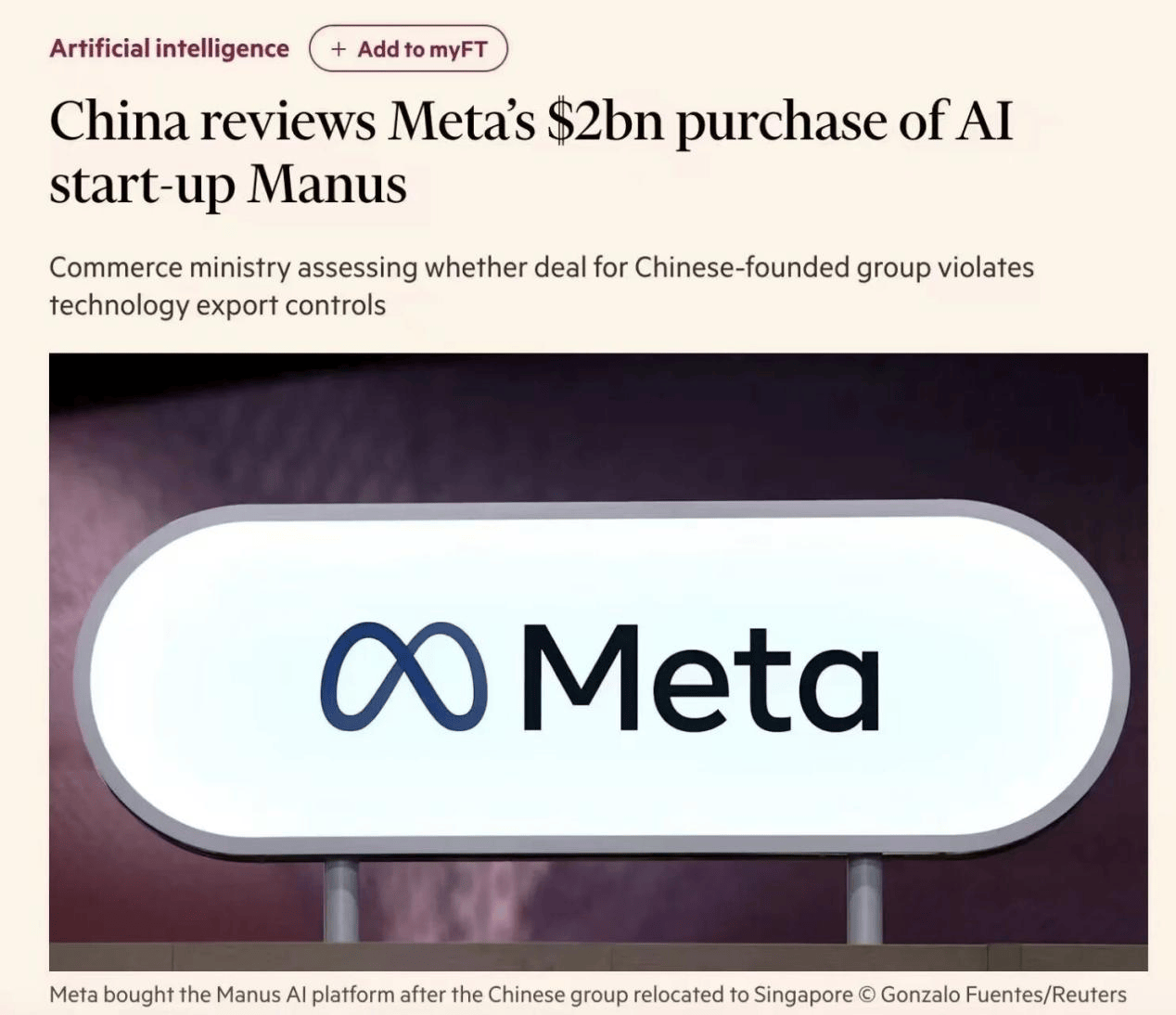
最近,这则消息在西方世界引发了极大的关注。中国商务部新闻发言人何亚东在1月8日回应有关审查美国科技巨头Meta收购中国人工智能初创企业Manus的 提问时明确表示,商务部将会同相关部门,对这项收购进行评估,特别是在出口管制、技术进出口、对外投资等相关法律法规的合规性上开展调查。这一声 明无疑是给西方国家,尤其是美国,传递了一个明确的信号:中国正在对美国科技公司伸手触碰中国的人工智能人才和技术进行警告!商务部的这项调查也 体现了中国在面对美国科技巨头对人工智能技术兴趣时,竭力保护自身技术和人才的决心。 德国《商业内幕》评论指出,此次调查突显出中国在保护人工 智能领域人才和技术方面的战略意图。Manus,作为一家由人工智能工作室Butterfly Effect于2023年3月在中国创立的初创企业,因为其宣布开发一款"通用 型"人工智能代理而迅速引起了全球关注。该代理能够在极少人工干预下完成任务,并且在2025年中,这家公司将其总部迁至新加坡。去年12月,Meta宣布 计划收购Manus,并与中国完全断绝关系。据悉,这项交易的价值超过20亿美元(约合17亿欧元)。 长期以来,美国一直在通过多种方式限制中国的科技发展 ...

AI小登的尽头,是卖身老登?
Sou Hu Cai Jing· 2026-01-13 03:23
Core Insights - Major AI companies are aggressively acquiring startups to fill capability gaps and enhance their competitive edge in the rapidly evolving AI landscape [1][4][5] Group 1: Acquisitions and Strategic Moves - Nvidia acquired AI chip startup Groq for $20 billion, Google spent $4.75 billion on clean energy firm Intersect Power, and Meta invested $4.5 billion in AI agent Manus to secure energy sovereignty and enhance application capabilities [1][4] - The trend of high-valuation acquisitions reflects the urgency of established companies ("old players") to differentiate their technology and the need for startups ("young players") to monetize their first-mover advantages quickly [4][5] - Meta's acquisition of Manus is driven by the belief that AI agents are the future, allowing Meta to quickly expand user scenarios and explore monetization opportunities [6][10] Group 2: Market Dynamics and Challenges - OpenAI, despite its significant resources, faces challenges in monetization, with only 5% of its active users being paid subscribers [4] - The dominance of Nvidia in the GPU market, with a projected 94% market share by Q2 2025, creates significant barriers for smaller AI startups, which struggle with high procurement costs and potential supply shortages [7][12] - The pressure on startups to survive has shifted their focus from independent growth to strategic exits, as seen in the case of companies like Zhiyun, which opted for an IPO to avoid falling behind [8][15] Group 3: Future Outlook and Innovation - The ongoing acquisition spree by major players aims to build a comprehensive ecosystem that integrates models, data, applications, and hardware, thereby enhancing their competitive positioning against rivals like Google [12][18] - The ability to integrate external technologies into existing platforms with vast user bases is a critical advantage that startups cannot easily replicate [17][18] - Despite the challenges, opportunities remain for innovative startups, as experienced talent from major companies is entering the market, potentially leading to new AI developments and business models [19][20]
Manus和它的“8000万名员工”
虎嗅APP· 2026-01-13 00:49
Core Viewpoint - Manus represents a significant paradigm shift in AI applications, transitioning from merely generating content to autonomously completing tasks, marking a "DeepSeek moment" in the industry [6][7]. Group 1: Manus's Unique Model - Manus has created over 80 million virtual computer instances, which are crucial to its operational model, allowing AI to autonomously handle complex tasks [9][10]. - This model signifies a shift in core operators from humans to AI, establishing Manus as an "artificial intelligence operating system" [11]. - The Manus model is expected to lead to a 0.5-level leap in human civilization, as AI takes over digital economy-related jobs [12]. Group 2: AI Application's "DeepSeek Moment" - Manus achieved an annual recurring revenue (ARR) of over $100 million within a year, indicating its strong market performance [20]. - The introduction of multi-agent systems has shown a 90.2% performance improvement in handling complex tasks compared to single-agent systems, emphasizing the importance of collaboration among AI [14][17]. - The transition from AI as a tool to AI as a worker signifies a major evolution in AI applications, moving beyond the "toy" and "assistant" phases [20]. Group 3: Technological Foundations of Multi-Agent Systems - Manus's multi-agent system relies on several core technologies, including virtual machines for secure execution environments and resource pooling for efficient resource utilization [22][24]. - The virtual machine architecture allows for independent task execution, addressing safety and reliability issues in AI applications [25]. - Intelligent orchestration ensures optimal resource allocation and task management, enhancing overall system efficiency [26][27]. Group 4: Competitive Landscape and Industry Dynamics - Major tech companies are rapidly advancing in multi-agent systems, with Meta, Google, Microsoft, and Amazon all integrating these capabilities into their platforms [30][32]. - In the domestic market, companies like Alibaba, Tencent, and Baidu are also making significant strides in developing multi-agent technologies [31]. - The emergence of new players like Kimi, which has raised $500 million for multi-agent system development, indicates a growing competitive landscape [33]. Group 5: Evolution of Human Roles - The relationship between humans and AI is shifting from operator-tool dynamics to manager-team dynamics, where humans define tasks while AI executes them [35]. - This evolution will likely reduce the demand for lower and mid-level creative jobs while amplifying the value of high-level creative work [37]. - The traditional hierarchical structure of organizations may flatten as multi-agent systems can handle the entire workflow from strategy to execution [38]. Group 6: Underestimated Risks - Data ownership and system security are critical concerns in multi-agent systems, as data becomes a currency for AI collaboration and system evolution [40][41]. - The complexity of multi-agent systems introduces new security challenges, including process safety, collaboration safety, and evolution safety [42][43]. - Balancing security and efficiency remains a fundamental challenge, as overly secure systems may hinder performance while efficient systems may expose vulnerabilities [44]. Group 7: Irreversible Development Path - The proliferation of Manus's 80 million virtual machines signals a new era of productivity, redefining the nature of work itself [47]. - In the short term, vertical applications of multi-agent systems are expected to explode across various industries, leading to intense market competition [48]. - Over the long term, human-AI collaboration will evolve into a more integrated system, blurring the lines between human and machine contributions [49].

Meta Picks Former White House Advisor to Drive AI Projects
PYMNTS.com· 2026-01-12 19:46
Meta has appointed new executives to head various aspects of its artificial intelligence (AI) initiatives.By completing this form, you agree to receive marketing communications from PYMNTS and to the sharing of your information with our sponsor, if applicable, in accordance with our Privacy Policy and Terms and Conditions .Complete the form to unlock this article and enjoy unlimited free access to all PYMNTS content — no additional logins required.“Meta is planning to build tens of gigawatts this decade, an ...

Meta 20亿“闪购”Manus难落地,Meta千金买“股”或成空
3 6 Ke· 2026-01-12 08:41
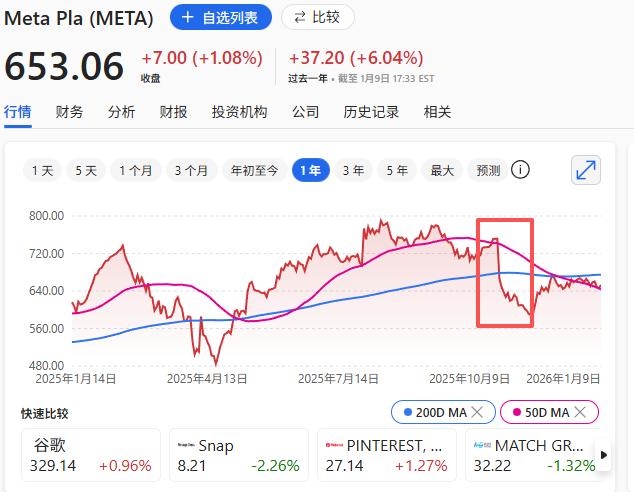
Core Viewpoint - Meta's acquisition of AI company Manus for approximately $2 billion marks a significant and rapid transaction in the tech industry, raising questions about the valuation and the strategic necessity behind the deal [1][3][9]. Group 1: Acquisition Details - The acquisition was finalized in just a few weeks, making it Meta's third-largest acquisition after WhatsApp and Scale AI [1]. - Manus, which transitioned to the AI sector less than three years ago, has generated $125 million in revenue within a year of launching its first product [8][9]. - The deal has sparked considerable interest and debate within the tech community, especially given Manus's recent move from Wuhan to Singapore [1][2]. Group 2: Meta's Perspective - Meta has faced challenges in maintaining market confidence, particularly after the perceived failure of its metaverse initiatives, despite current revenue growth [5][7]. - The company has been criticized for its high capital expenditures in AI, which have led to downgrades from several financial institutions [5][7]. - The acquisition of Manus is seen as a potential solution to restore investor confidence and provide new growth opportunities across various sectors, including social media and enterprise services [9][18]. Group 3: Manus's Perspective - Manus, while effective, has limitations in efficiency and integration into existing workflows, which could hinder its long-term success without the backing of a larger entity like Meta [11][12]. - The AI agent market is crowded with subpar products, making Manus's established revenue and operational capabilities particularly valuable [15][16]. - The partnership with Meta could enhance Manus's market presence and allow it to leverage Meta's resources for further growth [16][17]. Group 4: Regulatory Considerations - The Chinese Ministry of Commerce announced an evaluation of the acquisition concerning export controls and compliance with legal regulations, adding uncertainty to the deal [2][17]. - The potential for delays in the transaction due to regulatory scrutiny could impact both companies' strategic timelines in the rapidly evolving AI landscape [17][18].
AI进入「拼爹」的时代
创业邦· 2026-01-12 03:27
Core Viewpoint - The AI industry is increasingly dominated by major tech giants like Google, Microsoft, and ByteDance, making it difficult for smaller companies to compete effectively [6][9][10]. Group 1: Competitive Landscape - Major players such as Google and Microsoft are leveraging their vast resources to enhance their AI offerings, with Google's Gemini surpassing OpenAI's ChatGPT in various evaluations [10][12]. - Smaller AI companies like Manus and Kimi are struggling to maintain their market positions as they face overwhelming competition from these tech giants [10][11]. - The integration of AI into widely used applications, such as Google's embedding of Gemini into Android and Microsoft's integration of AI into Office, creates a significant barrier for smaller firms [10][12]. Group 2: Resource Dependency - The success of AI applications is heavily reliant on the backing of large corporations, as smaller companies lack the necessary resources and ecosystem integration to thrive [11][12]. - AI startups often find it challenging to monetize their technologies compared to larger firms that can bundle services and leverage existing customer bases [15][18]. - The financial struggles of AI startups are evident, with many facing increasing losses and limited paths to profitability [24][25]. Group 3: Monetization Strategies - Larger companies can implement diverse monetization strategies, such as bundling AI services with existing products, which enhances their revenue potential [15][18]. - Smaller companies often lack the ability to create similar attractive packages, limiting their monetization options to straightforward subscription models [21][20]. - The competitive pricing landscape for AI subscriptions is constrained, making it difficult for startups to charge premium prices [21][23]. Group 4: Acquisition Trends - The trend of larger companies acquiring smaller AI firms is becoming more prevalent, as seen with Meta's acquisitions of Scale and Manus, which can provide these startups with enhanced capabilities and market access [27][28]. - Acquired companies can benefit from the resources and infrastructure of their parent companies, allowing them to operate more effectively within the market [27][28]. - The desire for independence among some AI firms, like OpenAI, complicates the landscape, as they aim to establish themselves as major players rather than being absorbed by larger entities [28].