方大特钢

Search documents
特钢板块9月22日跌0.03%,西宁特钢领跌,主力资金净流出5132.74万元
Zheng Xing Xing Ye Ri Bao· 2025-09-22 08:40
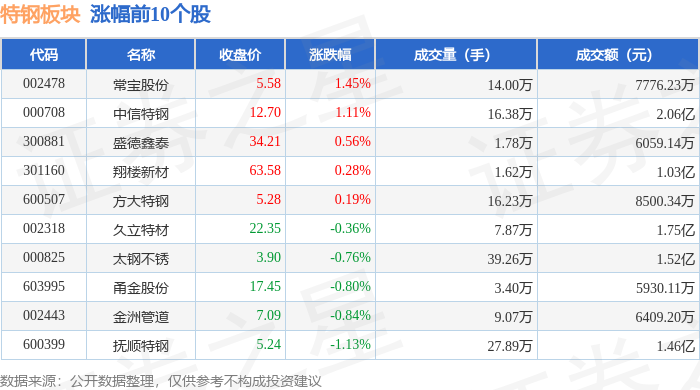
Group 1 - The special steel sector experienced a slight decline of 0.03% on September 22, with Xining Special Steel leading the drop [1] - The Shanghai Composite Index closed at 3828.58, up 0.22%, while the Shenzhen Component Index closed at 13157.97, up 0.67% [1] - Individual stock performance in the special steel sector varied, with Changbao Co. rising by 1.45% and Jiu Li Special Materials falling by 0.36% [1] Group 2 - The net capital outflow from the special steel sector amounted to 51.33 million yuan, while retail investors saw a net inflow of 52.02 million yuan [3] - The table detailing capital flow for individual stocks in the special steel sector was provided, indicating varying levels of investment activity [3]


钢铁篇:底部涅槃,曙光渐近
2025-09-22 01:00
Steel Industry Analysis Summary Industry Overview - The steel industry is experiencing a significant recovery in profit margins, with profitability reaching nearly 80% in July 2025, despite a slight recent decline. This recovery is primarily due to a larger decrease in raw material costs compared to steel prices and expectations from production control policies [1][2]. Key Points Profitability and Market Performance - As of 2025, 27 steel companies reported a profitability ratio of 58.87%, a notable improvement from the previous year when most companies faced losses [2]. - The steel sector's stock prices saw a slight increase in the first half of 2025, with a stronger performance in Q1 compared to Q2, which was weaker due to slow policy implementation and market shifts towards technology sectors [3]. Demand Trends - Demand for steel in the real estate sector is declining but at a slower rate, while manufacturing sectors (automotive, machinery, home appliances, and shipbuilding) are showing growth, effectively offsetting the downturn in real estate [1][6]. - Infrastructure demand is expected to stabilize due to increased government bond issuance and special debt issuance, with a projected year-on-year decline in demand of around 1% [9]. Sector-Specific Insights - Manufacturing investment from January to July 2025 grew by 6.2%, with low inventory levels across various sectors, indicating robust demand [10]. - The automotive sector is projected to see an 8% increase in steel demand in 2025, driven by a 12.6% increase in production from January to July [12]. - The shipbuilding industry maintains a strong demand growth of around 20%, supported by long-term orders [14][15]. Export and Pricing Dynamics - Direct exports of steel increased significantly in 2025, with total import and export volumes exceeding 70 million tons, a year-on-year increase of 1.4 million tons [16]. - Domestic steel prices remain low compared to global markets, which has stimulated export growth despite challenges from anti-dumping investigations in Vietnam and South Korea [17]. Policy and Regulatory Environment - The steel industry is undergoing regulatory changes focusing on environmental standards and energy consumption, with a requirement for ultra-low emissions by 2026 [21][22]. - The carbon emissions trading market is being tightened, which will compel companies to reduce production capacity or energy consumption [23]. Raw Material Supply and Pricing - The raw material market is showing mixed trends, with iron ore prices remaining strong while coking coal prices have seen fluctuations due to production controls [24][26]. - Future supply of iron ore is expected to be relatively loose, while coking coal prices may remain firm due to ongoing supply disruptions [27]. Investment Recommendations - Investment focus should be on high-demand sectors within manufacturing, such as high-end automotive components and nuclear power-related needs, as well as capacity optimization strategies [28]. - Key companies to watch include leading firms like Hualing, Baosteel, and Nanjing Steel, along with flexible companies like Fangda Special Steel and New Steel [30]. Conclusion - The steel industry is poised for a recovery with stable long-term demand driven by manufacturing upgrades and infrastructure investments, despite challenges in the real estate sector and regulatory pressures. The focus on environmental compliance and production efficiency will shape the competitive landscape moving forward.
反内卷下,钢铁表外产能的退出路径
Changjiang Securities· 2025-09-21 23:30
Investment Rating - The industry investment rating is Neutral, maintained [9] Core Insights - The report highlights the exit paths for off-balance steel production capacity under the "anti-involution" policy, focusing on the need for stricter regulation and the removal of illegal production capacities [5][7] - Seasonal recovery in construction demand and liquidity support have contributed to a rebound in steel prices, although the demand during the "Golden September" period is not particularly strong [4][27] - The report emphasizes the importance of regulatory measures to ensure the exit of illegal and excess steel production capacities, which is crucial for improving the supply-demand balance in the steel industry [7][28] Summary by Sections Section: Current Market Conditions - Construction demand has shown seasonal recovery, with apparent consumption of five major steel products increasing by 0.34% year-on-year and 0.55% month-on-month [4] - Daily average pig iron production has risen to 2.4102 million tons, reflecting a slight increase of 0.47 tons per day [4] - Total steel inventory has increased by 0.32% month-on-month and 7.16% year-on-year [4] Section: Regulatory Environment - Recent inspections by the Central Environmental Protection Supervision Team have focused on illegal steel production capacities in several provinces, highlighting issues such as unauthorized construction and the persistence of "rebar steel" production [5][6] - The report identifies three main forms of illegal steel production: capacity replacement schemes, production under the guise of casting and forging, and the construction of illegal rebar steel [6] Section: Future Outlook - The report anticipates a clear direction for steel production regulation, emphasizing the need to eliminate illegal capacities and enforce strict compliance with production standards [7] - It suggests that the ongoing "anti-involution" policies will enhance the supply-side contraction expectations, potentially leading to significant valuation recovery for steel companies with low price-to-book ratios [27][28]
2025年四季度策略:三擎拱牛市
CAITONG SECURITIES· 2025-09-21 08:18
Economic Outlook - The overall economy is expected to stabilize with structural reforms accelerating, supported by continuous fiscal efforts and a recovery in the real estate sector [3][11][19] - The "反内卷" (anti-involution) policy is anticipated to drive a rebound in PPI, benefiting industries such as coal and photovoltaics [5][30] - The technology sector is experiencing a significant surge, with new technologies like AI expected to empower a growth cycle lasting over a decade [3][6][45] Old Economy Insights - The "反内卷" policy is likely to push PPI to a turning point, with historical data indicating that PPI recoveries correlate with economic cycles [5][30] - During PPI upturns, stock market trends generally rise, with the greatest elasticity observed during the initial stages of PPI recovery [35][37] New Economy Insights - The current technology sector trend is still in its early stages, with historical patterns showing that industry trends require a conducive macroeconomic environment and liquidity [6][45] - Emerging technologies such as AI, low-altitude economy, deep-sea technology, and quantum technology are at a critical juncture, with potential for explosive growth in the next two years [6][45] Funding Landscape - In a low-interest-rate environment, there is a significant shift of household savings towards equity assets, with the current allocation in stocks and funds at 15%, compared to 40% in developed markets [7][19] - Public fund issuance is expected to see a turning point as net asset values recover, with a historical correlation indicating that 80% of funds reaching positive net values leads to increased issuance [7][19] Investment Strategy - The investment strategy should focus on three main lines: old economy sectors benefiting from PPI recovery, new economy sectors driven by AI and overseas expansion, and consumer sectors emphasizing emotional consumption [8][45] - Specific sectors to watch include metals, coal, and new energy for the old economy, while AI hardware and applications are key for the new economy [8][45]
特钢板块9月19日跌0.35%,翔楼新材领跌,主力资金净流出403.62万元
Zheng Xing Xing Ye Ri Bao· 2025-09-19 08:42
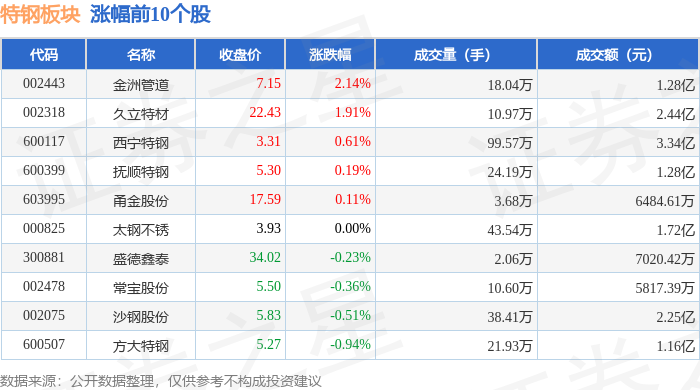
Market Overview - On September 19, the special steel sector declined by 0.35%, with Xianglou New Materials leading the drop [1] - The Shanghai Composite Index closed at 3820.09, down 0.3%, while the Shenzhen Component Index closed at 13070.86, down 0.04% [1] Stock Performance - Key stocks in the special steel sector showed varied performance, with Jinzhou Pipeline up by 2.14% and Xianglou New Materials down by 3.47% [1][2] - The closing prices and changes for notable stocks include: - Jinzhou Pipeline: 7.15, +2.14% - Xianglou New Materials: 63.40, -3.47% - Xining Special Steel: 3.31, +0.61% - Taiyuan Iron & Steel: 3.93, 0.00% [1][2] Trading Volume and Capital Flow - The total trading volume for the special steel sector was significant, with Jinzhou Pipeline achieving a transaction amount of 1.28 billion yuan [1] - The net capital flow showed a net outflow of 403.62 million yuan from main funds, while retail investors had a net inflow of 2328.13 million yuan [2][3] Individual Stock Capital Flow - Notable capital flows for specific stocks include: - Xining Special Steel: Main funds net inflow of 18.89 million yuan, retail net outflow of 39.89 million yuan [3] - Jinzhou Pipeline: Main funds net inflow of 12.61 million yuan, retail net outflow of 6.93 million yuan [3] - Xianglou New Materials: Main funds net outflow of 1.91 million yuan, retail net inflow of 14.58 million yuan [3]


特钢板块9月18日跌2.42%,盛德鑫泰领跌,主力资金净流出1.43亿元
Zheng Xing Xing Ye Ri Bao· 2025-09-18 08:46
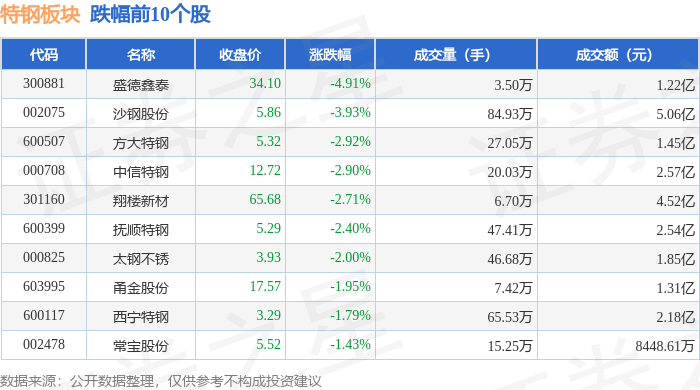
Market Performance - The special steel sector experienced a decline of 2.42% on September 18, with Shengde Xintai leading the drop [1] - The Shanghai Composite Index closed at 3831.66, down 1.15%, while the Shenzhen Component Index closed at 13075.66, down 1.06% [1] Individual Stock Performance - Shengde Xintai (300881) closed at 34.10, down 4.91% with a trading volume of 35,000 shares and a turnover of 122 million yuan [1] - Shagang Group (002075) closed at 5.86, down 3.93% with a trading volume of 849,300 shares and a turnover of 506 million yuan [1] - Fangda Special Steel (600507) closed at 5.32, down 2.92% with a trading volume of 270,500 shares [1] - CITIC Special Steel (000708) closed at 12.72, down 2.90% with a trading volume of 200,300 shares and a turnover of 257 million yuan [1] - Xianglou New Materials (301160) closed at 65.68, down 2.71% with a trading volume of 67,000 shares and a turnover of 452 million yuan [1] Capital Flow Analysis - The special steel sector saw a net outflow of 143 million yuan from main funds, while retail investors contributed a net inflow of 51.37 million yuan [1] - The table of capital flow indicates that Jiuli Special Materials (002318) had a main fund net inflow of 5.58 million yuan, while Shengde Xintai (300881) experienced a significant net outflow of 21.40 million yuan [2]



特钢板块9月17日涨0.77%,沙钢股份领涨,主力资金净流出1312.05万元
Zheng Xing Xing Ye Ri Bao· 2025-09-17 08:42
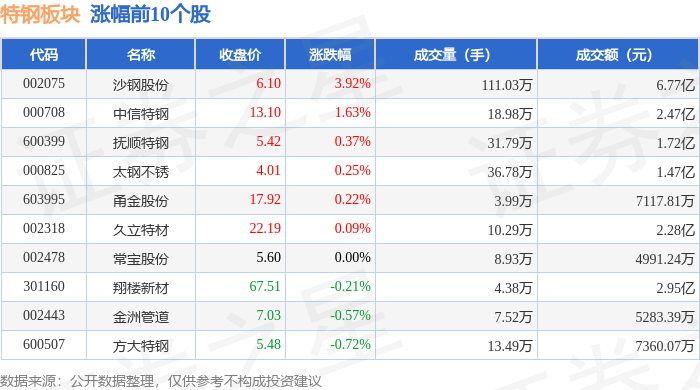
Market Performance - On September 17, the special steel sector rose by 0.77% compared to the previous trading day, with Shagang Co., Ltd. leading the gains [1] - The Shanghai Composite Index closed at 3876.34, up 0.37%, while the Shenzhen Component Index closed at 13215.46, up 1.16% [1] Individual Stock Performance - Shagang Co., Ltd. (002075) closed at 6.10, with a gain of 3.92% and a trading volume of 1.11 million shares, amounting to a transaction value of 677 million yuan [1] - CITIC Special Steel (000708) closed at 13.10, up 1.63%, with a trading volume of 189,800 shares and a transaction value of 247 million yuan [1] - Fushun Special Steel (600399) closed at 5.42, up 0.37%, with a trading volume of 317,900 shares and a transaction value of 172 million yuan [1] - Other notable performances include Taiyuan Iron & Steel (000825) at 4.01 (up 0.25%) and Jiu Li Special Materials (002318) at 22.19 (up 0.09%) [1] Capital Flow Analysis - The special steel sector experienced a net outflow of 13.12 million yuan from main funds, while retail funds saw a net inflow of 28.99 million yuan [2] - The individual stock capital flow indicates that Shagang Co., Ltd. had a main fund net outflow of 42.04 million yuan, while retail funds saw a net inflow of 4.30 million yuan [3] - Taiyuan Iron & Steel had a main fund net inflow of 14.73 million yuan, while retail funds experienced a net outflow of 1.76 million yuan [3]

方大特钢:战略深耕破局行业挑战 以质量与人才筑牢发展根基
Zhong Guo Jin Rong Xin Xi Wang· 2025-09-17 02:35
Core Insights - The company is enhancing its innovation-driven strategy by integrating newly recruited high-educated talents into key operational roles, which aligns with its ongoing "Quality Month" initiative to strengthen its development foundation based on quality and talent [1][4]. Group 1: Strategic Developments - In the first half of 2025, the domestic steel industry faced challenges due to "strong supply and weak demand," but the company achieved impressive results by adhering to a "low-cost, differentiated, and specialized" development path and implementing its "two upgrades" strategy [1]. - The company focuses on a "combination of common and special products" as its core product strategy, exploring new growth areas while consolidating its advantages [1]. - The commercial vehicle market's gradual recovery has increased demand for spring flat steel, allowing the company to respond quickly and deliver over 100 specifications of spring flat steel products [1]. Group 2: Quality Management Initiatives - The "Quality Month" activity emphasizes quality control across the entire production chain, promoting a culture of quality awareness among all employees through various communication channels [2]. - The technical center will conduct specialized training on the QEOEn management system to strengthen employees' understanding of quality management [2]. - Daily inspections and real-time feedback mechanisms are implemented to ensure adherence to quality standards throughout the production process [3]. Group 3: Talent Development and Market Confidence - Newly recruited master's and doctoral talents are provided with mentors and hands-on training to enhance their understanding of production processes and contribute to quality improvement and technological innovation [4]. - The capital market's recognition of the company's strategy is evident, with significant share purchases by major stakeholders, reflecting confidence in the company's quality management capabilities and growth potential [4]. - The company aims to continue deepening its "two upgrades" strategy, reinforcing its commitment to quality and talent-driven innovation in the steel industry [5].
中国企业500强公布:辽宁方大集团跃升至第126位!
Zheng Quan Shi Bao· 2025-09-16 18:09
Group 1 - The core viewpoint of the news is that Liaoning Fangda Group has shown resilience and growth across its various sectors, ranking 126th in the 2025 China Top 500 Enterprises and 40th in the Top 100 Leading Enterprises in Strategic Emerging Industries [1] - The company focuses on five major sectors: carbon products, steel, pharmaceuticals, commerce, and aviation, aiming to develop new productive forces and achieve stable growth [1] - In the first eight months of 2025, the company emphasized its commitment to national strategies and innovation, adapting to market pressures from raw material price fluctuations and steel demand [1] Group 2 - Fangda Steel Group achieved a sales revenue of 46.317 billion yuan and a profit of 1.699 billion yuan in the first half of the year, with its subsidiaries ranking high in profitability within the industry [2] - The pharmaceutical sector, particularly Northeast Pharmaceutical, is advancing in cell therapy for various cancers, with over ten products in development and a strong research pipeline [2] - The commercial sector, represented by Zhongxing Commercial, reported a 25.08% increase in net profit year-on-year, while Tianjin Yishang's revenue exceeded 7.1 billion yuan with a 63% profit increase [3] Group 3 - HNA Group, part of the aviation sector, launched the "HNA PLUS Membership Card" to enhance service offerings and received multiple awards for its airlines, achieving record passenger numbers during the summer travel season [3] - The company is committed to aligning its development with national strategies and regulations, focusing on technological innovation to contribute to high-quality economic growth in China [4]

特钢板块9月16日跌0.57%,久立特材领跌,主力资金净流出6995.81万元
Zheng Xing Xing Ye Ri Bao· 2025-09-16 08:39
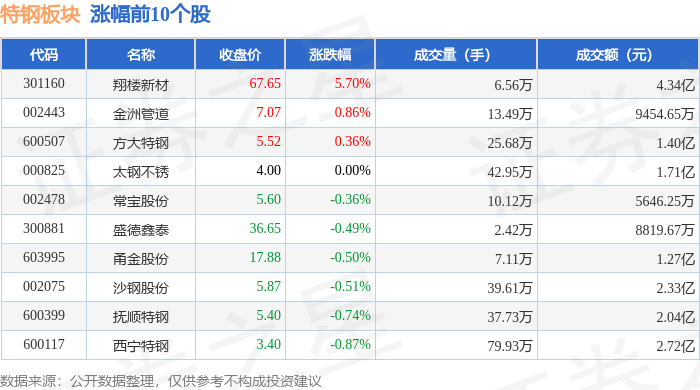
Market Overview - The special steel sector experienced a decline of 0.57% on September 16, with Jiuli Special Materials leading the drop [1] - The Shanghai Composite Index closed at 3861.87, up 0.04%, while the Shenzhen Component Index closed at 13063.97, up 0.45% [1] Stock Performance - Notable stock performances included: - Xianglou New Materials: closed at 67.65, up 5.70% with a trading volume of 65,600 and a turnover of 434 million [1] - Jiu Li Special Materials: closed at 22.17, down 1.95% with a trading volume of 146,600 and a turnover of 326 million [2] - Other stocks like Fushun Special Steel and Xining Special Steel also saw declines of 0.74% and 0.87% respectively [1][2] Capital Flow - The special steel sector saw a net outflow of 69.96 million from institutional investors, while retail investors contributed a net inflow of 59.04 million [2] - The capital flow for specific stocks showed: - Jiuli Special Materials had a net outflow of 25.39 million from retail investors [3] - Xining Special Steel experienced a net inflow of 1.22 million from institutional investors [3] Summary of Key Stocks - Key stocks in the special steel sector and their performance included: - Jiuli Special Materials: net outflow of 36.50 million from institutional investors [3] - Xining Special Steel: net inflow of 1.22 million from institutional investors [3] - Fushun Special Steel: net outflow of 17.23 million from institutional investors [3]