
银华基金

Search documents
恒指重上27000点,1.31万亿南向资金扫货港股
Di Yi Cai Jing· 2025-11-13 11:29
Core Insights - The Hong Kong stock market is experiencing a significant influx of capital, with southbound funds reaching a record net purchase of 1.31 trillion HKD this year, surpassing 5 trillion HKD in total net purchases historically [1][2] - Public fund holdings in Hong Kong stocks have also surged, reaching 1.36 trillion HKD by the end of Q3, marking a more than 40% increase from the previous quarter and doubling from the same period last year [2][3] - The market is witnessing a shift in investment preferences, with dividend-paying assets gaining popularity over technology stocks, indicating a potential change in investment themes [1][7] Fund Flows and Performance - The Hong Kong stock market has shown a "first decline, then rise" pattern in Q4, with the Hang Seng Index up 0.81% as of November 13, despite a maximum drawdown of 8.17% [2] - Southbound funds experienced a net outflow of 35.21 million HKD on November 13, ending a streak of 16 consecutive days of net buying, although the year-to-date net inflow remains at a historic high [2][3] - Public equity funds have increased their exposure to Hong Kong stocks, with over half of the 1980 products analyzed raising their allocations significantly [3][4] ETF Growth and Investment Trends - The total size of Hong Kong stock ETFs has exploded, increasing 3.4 times from 799.57 billion HKD at the end of last year to 3.53 trillion HKD, making them a key channel for capital allocation [4][5] - Dividend-themed ETFs are particularly popular, with significant net subscriptions recorded for various funds, indicating a strong preference for stable income-generating assets [5][6] Market Dynamics and Sector Rotation - The alternating activity between A-shares and Hong Kong stocks is attributed to industry cycle rotations rather than significant capital shifts between the two markets [6][7] - The current market environment allows for both defensive and growth-oriented investments, with blue-chip stocks offering high dividend yields and innovative sectors attracting substantial capital [7][8] - Concerns about potential bubbles in growth assets are countered by the argument that recent price increases are corrections from previously low valuations rather than speculative bubbles [7][8]
和远气体股价涨5.1%,银华基金旗下1只基金重仓,持有4.92万股浮盈赚取9.74万元
Xin Lang Cai Jing· 2025-11-13 02:29
Group 1 - The core point of the news is that Huan Yuan Gas has seen a stock price increase of 5.1%, reaching 40.79 CNY per share, with a total market capitalization of 8.639 billion CNY [1] - Huan Yuan Gas, established on November 20, 2003, specializes in the research, production, sales, and service of various gas products, as well as industrial waste gas recovery and recycling [1] - The company's revenue composition includes bulk gases (49.40%), industrial-grade chemicals (30.51%), clean energy (12.30%), other projects (3.79%), electronic special gases and chemicals (3.32%), and waste gas recovery (0.68%) [1] Group 2 - From the perspective of fund holdings, one fund under Yinhua Fund has a significant position in Huan Yuan Gas, with an increase of 32,100 shares in the third quarter, bringing the total to 49,200 shares, which represents 0.74% of the fund's net value [2] - The Yinhua Specialized and New Quantitative Optimal Stock Initiation A Fund (014668) has achieved a return of 47.84% this year, ranking 570 out of 4216 in its category [2] - The fund manager, Yang Teng, has been in position for nearly 4 years, with the fund's total asset size at 2.753 billion CNY and a best return of 29.56% during his tenure [3]
超频三股价涨6.55%,银华基金旗下1只基金重仓,持有4.5万股浮盈赚取2.07万元
Xin Lang Cai Jing· 2025-11-13 02:28
Core Viewpoint - ChaoPing San experienced a 6.55% increase in stock price, reaching 7.48 CNY per share, with a total market capitalization of 3.421 billion CNY as of November 13 [1] Company Overview - Shenzhen ChaoPing San Technology Co., Ltd. was established on April 27, 2005, and listed on May 3, 2017. The company is located in Longgang District, Shenzhen, Guangdong Province [1] - The main business areas include the research, production, and sales of new electronic product cooling devices, lithium battery cathode materials, and LED lighting fixtures, along with providing high-quality contract energy management and lighting engineering services to downstream customers [1] Revenue Composition - Revenue breakdown: - Lithium-ion battery materials: 46.35% - Cooling products: 28.92% - Other products: 15.77% - LED lighting fixtures: 5.04% - Lighting engineering: 3.92% [1] Fund Holdings - The YinHua Fund has a significant holding in ChaoPing San, with the 2000 Enhanced ETF (159555) holding 45,000 shares, representing 0.71% of the fund's net value, ranking as the eighth largest holding [2] - The 2000 Enhanced ETF has a total scale of 44.1959 million CNY and has achieved a year-to-date return of 47.41% [2] Fund Manager Performance - Fund managers Zhang Kai and Zhang Yichi have notable track records: - Zhang Kai has a tenure of 13 years, managing assets totaling 1.992 billion CNY, with a best return of 130.54% and a worst return of -43.75% [3] - Zhang Yichi has a tenure of 4 years and 174 days, managing assets of 7.745 billion CNY, with a best return of 61.37% and a worst return of -35.59% [3]
FOF再出“小爆款”!
券商中国· 2025-11-12 15:03
Core Viewpoint - The FOF (Fund of Funds) market is experiencing significant growth in both the number of products and total fundraising, with a notable increase in "small blockbuster" FOFs, indicating a trend towards diversified asset allocation and the need for improved cross-market investment capabilities [1][2][6]. Group 1: FOF Market Growth - As of November 12, 2023, a new FOF from the Wanguo Fund raised nearly 1.8 billion yuan, contributing to over 60 FOFs established this year with a total fundraising exceeding 56 billion yuan, significantly higher than the 10.6 billion yuan raised in 2024 [1][2]. - The total scale of FOFs has surpassed 200 billion yuan, with 17 products raising over 1 billion yuan each, highlighting a growing interest in FOFs despite the overall market size being significantly smaller than the underlying funds [1][9]. Group 2: Performance of New FOFs - The newly established Wanguo Zhiyue Stable 90-Day Holding FOF raised 1.793 billion yuan with 5,835 effective subscriptions, while another product, Wanguo Hengyi 3-Month Holding ETF-FOF, raised 414 million yuan [2][5]. - In October alone, several FOFs raised over 2 billion yuan, including Huatai Bairui Yingtai Stable 3-Month Holding FOF, which raised 5.577 billion yuan, indicating a strong demand for these investment vehicles [3][5]. Group 3: Diversification and Asset Allocation - FOFs are increasingly diversifying their underlying assets, now including passive index funds and REITs, with a notable preference for gold and bond ETFs among FOF managers [6][7]. - The top ten most held index funds by FOFs are predominantly bond ETFs, reflecting a strategic shift towards safer asset classes amid market volatility [7][10]. Group 4: Challenges and Opportunities - Despite the growth, over 60% of FOFs have a scale of less than 200 million yuan, indicating a significant disparity in size compared to the underlying public funds, which exceed 30 trillion yuan [9]. - The FOF market faces challenges such as investor perception of complex structures and concerns over double fees, which may hinder further growth [9][10].


上一轮牛市买的主动权益基金,近40%未回本
2 1 Shi Ji Jing Ji Bao Dao· 2025-11-12 13:49
Core Insights - The recent performance of active equity funds has been under scrutiny, with over 38% of these funds still in losses over the past five years despite a significant number achieving positive returns since 2025 [1][2][3] - Key factors contributing to the underperformance include high-level accumulation, frequent trading, and reliance on specific sectors, which have eroded fund values [1][5][7] Performance Overview - As of November 10, 2025, the Shanghai Composite Index has risen by 19.42%, while 97.45% of active equity funds reported positive returns [2][3] - However, 1019 active equity funds remain in losses, with 38% of the total, indicating a stark contrast in performance for investors who entered the market earlier [1][2] Fund Performance Analysis - Among the 2695 active equity funds with over five years of existence, 1676 have achieved positive returns, with six funds reporting over 200% returns [3] - Conversely, nearly 40% of active equity funds have not turned a profit in five years, with some funds experiencing maximum drawdowns starting in 2021 [3][4] Underperforming Funds - Notable underperformers include funds managed by well-known managers, with losses exceeding 30% over five years [4] - Specific funds like Tianzhi New Consumption and Fangzheng Fubang Innovation Power have reported losses of -65.25% and -62.32%, respectively [3][4] Trading Behavior - High average stock positions during market peaks have been linked to poor long-term performance, with funds showing an average stock position of 84.22% during critical periods [5][6] - Frequent trading has also negatively impacted fund performance, with an average turnover rate of 460.71% across all active equity funds, rising to 508.45% for those with over 30% losses [7][8] Sector Reliance - Many funds have shown over-reliance on traditional sectors, leading to underperformance despite being labeled as "new" or "growth" funds [8][9] - Funds like Tianzhi New Consumption and Invesco Great Wall New Growth have shifted their holdings but still struggle to achieve positive returns [8][9] Market Outlook - The active equity fund market is seeing a resurgence, with 1354 new funds launched in 2025, indicating renewed investor interest [11] - Fund managers are advised to focus on sectors with long-term growth potential, such as high-end manufacturing and new consumption, while being cautious of market volatility [12]
上一轮牛市买的主动权益基金,为何还有4成未回本?
2 1 Shi Ji Jing Ji Bao Dao· 2025-11-12 12:13
Core Insights - The article highlights the performance of active equity funds in the context of the Shanghai Composite Index surpassing 4000 points for the first time in a decade, revealing that over 97% of these funds achieved positive returns since 2025, yet 38% remain in losses over the past five years [1][2][3] - Key reasons for the underperformance of many active funds include high-level accumulation, frequent trading, and reliance on specific sectors, which have eroded fund values [1][5][6] Performance Overview - As of November 10, the Shanghai Composite Index closed at 4018 points, marking a significant recovery, with major indices like the Shenzhen Composite and ChiNext Index showing gains of 27.6% and 46.35% respectively since 2025 [2] - Despite a high percentage of active equity funds showing positive returns in 2023, the long-term performance reveals a stark contrast, with many investors experiencing losses since entering the market around the end of 2020 [2][3] Fund Performance Analysis - Among the 2695 active equity funds with over five years of existence, 1676 have achieved positive returns, while nearly 40% remain unprofitable, with some funds experiencing drawdowns exceeding 50% [3][4] - Notable underperformers include funds managed by well-known managers, indicating that even established names are not immune to market challenges [4] Causes of Underperformance - High-level accumulation during market peaks has been identified as a significant factor contributing to the long-term underperformance of active equity funds [5][6] - Frequent trading has also negatively impacted fund performance, with average turnover rates for underperforming funds significantly higher than the market average [7][8] Market Trends and Future Outlook - The article notes a shift in investor sentiment towards active management products, with a notable increase in the number of newly established funds and a doubling of issuance scale compared to the previous year [11] - Fund managers are advised to focus on sectors with long-term growth potential, such as high-end manufacturing and new consumption, while being cautious of over-reliance on specific themes or sectors [12]
南财观察|上一轮牛市买的主动权益基金,为何还有4成未回本?
2 1 Shi Ji Jing Ji Bao Dao· 2025-11-12 11:49
Core Insights - The article discusses the performance of actively managed equity funds in the context of the Shanghai Composite Index surpassing 4000 points for the first time in ten years, revealing a significant number of funds still in loss despite a majority achieving positive returns since 2025 [1][2] Fund Performance Overview - As of November 10, 2023, 97.45% of 4679 actively managed equity funds reported positive returns since 2025, with some funds achieving over 200% gains [2] - However, nearly 38% of actively managed equity funds, totaling 1019 funds, remain in loss over the past five years, including products from leading public fund institutions and well-known fund managers [1][3] Reasons for Underperformance - Key factors contributing to the underperformance of these funds include high-level increases in positions, frequent trading, and reliance on specific sectors [1][6] - The average stock position for funds with negative returns was significantly higher than the overall market average during peak market periods, indicating poor timing decisions [6] Fund Manager Challenges - Frequent trading has negatively impacted fund performance, with an average turnover rate of 460.71% for all actively managed equity funds from 2021 to 2024, and even higher for those with significant losses [7] - Changes in fund management have led to inconsistent investment strategies, further complicating performance recovery [8] Market Trends and Future Outlook - The market has seen a resurgence in the issuance of new funds, with 1354 new funds launched in 2023, reflecting a renewed interest in actively managed products [10] - Fund managers are advised to focus on sectors with long-term growth potential, such as high-end manufacturing and new consumption, while being cautious of market volatility [11]

公司债ETF(511030):债市波动下,净值稳健回撤可控
Sou Hu Cai Jing· 2025-11-12 06:11
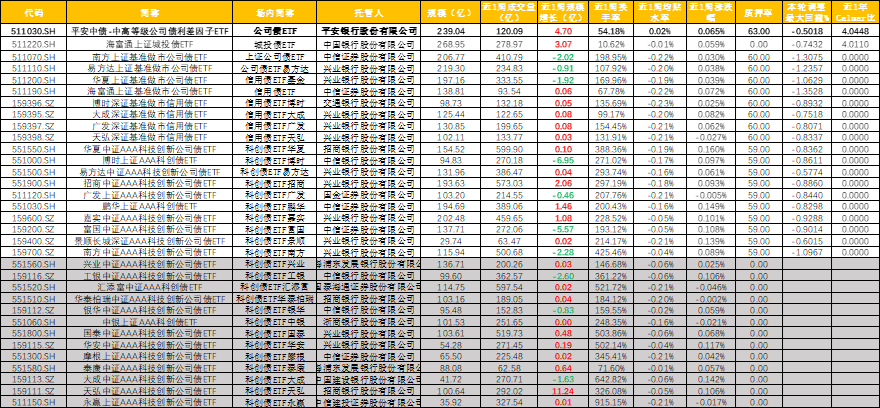
Core Insights - The total scale of credit bond ETFs is 493 billion yuan, with a daily decrease of 1.3 billion yuan, indicating a slight contraction in the market [1] - The weighted median duration is 3.3 years, suggesting a moderate interest rate sensitivity among the ETFs [1] - The average transaction amount is 6.92 million yuan, with a median turnover rate of 33.8%, reflecting active trading in the market [1] Liquidity - The overall transaction amount reached 189.8 billion yuan, with the benchmark market-making ETF averaging 4.87 million yuan per transaction [1] - The median yield is 1.84%, with a median discount rate of -18.3 basis points, indicating a slight underperformance compared to benchmarks [1] Valuation - The Ping An Company Bond ETF (511030) saw an inflow of 470 million yuan, attributed to its short duration of 1.95 years and a static high yield of 1.90% [1] - The ETF has a relatively stable net value with a year-to-date drawdown of -0.50%, showcasing its competitive edge in the current market environment [1] Performance Comparison - The performance of various ETFs shows significant differences, with some experiencing inflows while others face outflows, highlighting the competitive landscape [1] - The table provided illustrates the recent trading volumes and performance metrics of different ETFs, indicating varying levels of investor interest and market dynamics [1]
新能源ETF领涨,机构建议把握行业拐点性机会丨ETF基金日报
2 1 Shi Ji Jing Ji Bao Dao· 2025-11-12 02:53
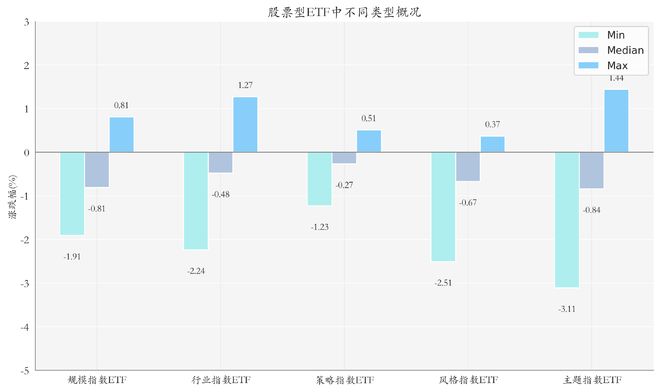
Market Overview - The Shanghai Composite Index fell by 0.39% to 4002.76 points, with a high of 4024.94 points during the day [1] - The Shenzhen Component Index decreased by 1.03% to 13289.0 points, reaching a peak of 13493.17 points [1] - The ChiNext Index dropped by 1.4% to 3134.32 points, with a maximum of 3209.89 points [1] ETF Market Performance - The median return of stock ETFs was -0.75% [2] - The highest performing scale index ETF was the Yinhua CSI 2000 Enhanced Strategy ETF with a return of 0.81% [2] - The top industry index ETF was the Penghua National Grain Industry ETF, yielding 1.27% [2] - The highest return among thematic index ETFs was the Penghua SSE Sci-Tech Innovation Board New Energy ETF at 1.44% [2] ETF Performance Rankings - The top three ETFs by return were: - Penghua SSE Sci-Tech Innovation Board New Energy ETF: 1.44% [4] - Huatai-PB SSE Sci-Tech Innovation Board New Materials ETF: 1.44% [4] - Penghua National Grain Industry ETF: 1.27% [4] - The largest declines were seen in: - Guotai CSI All Share Communication Equipment ETF: -3.11% [5] - Guotai ChiNext Artificial Intelligence ETF: -2.93% [5] - Fortune ChiNext Artificial Intelligence ETF: -2.88% [5] ETF Fund Flows - The top three ETFs by fund inflow were: - Guotai CSI All Share Securities Company ETF: 564 million yuan [6] - E Fund CSI 300 Non-Bank Financial ETF: 439 million yuan [6] - Guotai CSI All Share Communication Equipment ETF: 399 million yuan [6] - The largest outflows were from: - Huaxia SSE 50 ETF: 278 million yuan [7] - Fortune CSI Tourism Theme ETF: 221 million yuan [7] - Penghua CSI National Defense ETF: 214 million yuan [7] ETF Margin Trading Overview - The highest margin buy amounts were: - Huaxia SSE Sci-Tech Innovation Board 50 Component ETF: 508 million yuan [8] - E Fund ChiNext ETF: 427 million yuan [8] - Guotai CSI All Share Securities Company ETF: 424 million yuan [8] - The largest margin sell amounts were: - Huaxia CSI 1000 ETF: 33.26 million yuan [9] - Southbound CSI 500 ETF: 18.57 million yuan [9] - Huatai-PB CSI 300 ETF: 17.97 million yuan [9] Institutional Insights - Wanlian Securities suggests focusing on investment opportunities driven by the growth of new energy storage downstream demand and project profitability [10] - The firm highlights the importance of grid upgrades and the core role of new energy storage in the consumption of renewable energy [10] - Galaxy Securities notes that the gradual completion of new energy policies presents pivotal opportunities, recommending attention to the reliability and flexibility of power systems [11]
中信建投证券2026年资本市场峰会暨中国-沙特投资合作论坛在北京成功举办
Xin Lang Zheng Quan· 2025-11-11 13:56
Group 1: Event Overview - The CITIC Securities 2026 Capital Market Summit and China-Saudi Investment Cooperation Forum opened on November 11, 2025, in Beijing, focusing on global macroeconomic policies and investment strategies for 2026 [1] - The summit attracted over 2,000 participants, including experts, scholars, entrepreneurs, and investors from various countries, discussing global economic changes and new investment opportunities [1][8] - This summit is co-hosted by CITIC Securities and the Saudi Stock Exchange, marking the first collaboration between a Chinese brokerage and the Saudi exchange in China [1] Group 2: Strategic Goals of CITIC Securities - CITIC Securities aims to accelerate the development of a "value investment bank" to enhance international market competitiveness and provide sustainable returns to shareholders [2] - The company is committed to becoming a "new quality investment bank" by embedding itself in the national innovation system and enhancing its service capabilities across the entire industry chain [3] - CITIC Securities is also focused on becoming a "digital investment bank," leveraging data-driven strategies and digital transformation to improve customer service and business collaboration [3] Group 3: Saudi Stock Exchange Insights - The Saudi Stock Exchange is one of the fastest-growing capital markets globally, with a significant increase in foreign direct investment from China, reaching nearly $8.3 billion by the end of last year [4] - The exchange has signed memorandums of understanding with Shanghai and Shenzhen stock exchanges to deepen capital flow between China and Saudi Arabia [4] Group 4: Economic Outlook for 2026 - The chief economist of CITIC Securities predicts that 2026 will be a year of foundational strengthening and comprehensive efforts, with GDP growth expected around 5% [5] - The monetary policy in China is anticipated to be accommodative, with a potential 50 basis points reduction in the reserve requirement ratio and continued interest rate cuts [6] - The "new four bulls" logic driving the A-share and Hong Kong markets includes capital inflow, technological innovation, institutional reform, and consumption upgrades [6] Group 5: Forum Discussions - The forum featured two roundtable discussions focusing on "cross-border business and long-term capital cooperation" and "asset allocation outlook: China, Saudi Arabia, and globally," with participation from industry leaders and experts [7][8]
