
丸美生物

Search documents
化妆品板块9月17日跌0.24%,青松股份领跌,主力资金净流出1.05亿元
Zheng Xing Xing Ye Ri Bao· 2025-09-17 08:52
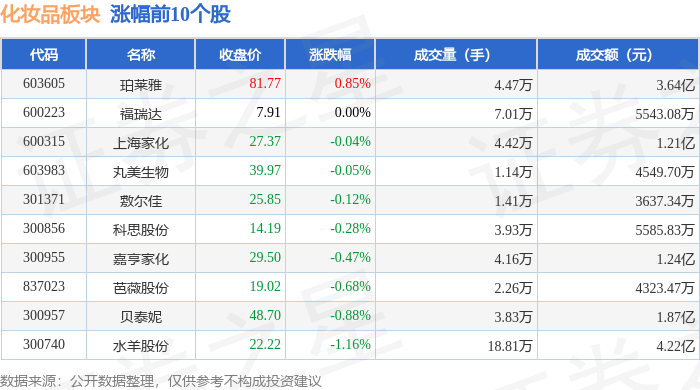
Market Overview - On September 17, the cosmetics sector declined by 0.24% compared to the previous trading day, with Qingsong Co. leading the decline [1] - The Shanghai Composite Index closed at 3876.34, up 0.37%, while the Shenzhen Component Index closed at 13215.46, up 1.16% [1] Individual Stock Performance - Notable stock performances in the cosmetics sector included: - Tian Cai Ya (603605) closed at 81.77, up 0.85% with a trading volume of 44,700 shares and a transaction value of 364 million [1] - Fu Rui Da (600223) remained unchanged at 7.91 with a trading volume of 70,100 shares [1] - Shanghai Jahwa (600315) closed at 27.37, down 0.04% with a trading volume of 44,200 shares [1] - Other stocks like Marubi (603983) and Beitaini (300957) also experienced slight declines of 0.05% and 0.88% respectively [1] Capital Flow Analysis - The cosmetics sector saw a net outflow of 105 million from institutional investors, while retail investors experienced a net inflow of 54.72 million [2] - The overall capital flow for individual stocks showed varied trends, with some stocks like Jia Heng Jia Hua (300955) experiencing significant net outflows from institutional investors [3] Detailed Capital Flow for Selected Stocks - Jia Heng Jia Hua (300955) had a net outflow of 13.34 million from institutional investors, while retail investors contributed a net inflow of 17.15 million [3] - Other stocks like Fu Rui Da (600223) and Shui Yang Co. (300740) also showed mixed capital flows, with institutional outflows and retail inflows [3]




化妆品板块9月16日涨0.03%,水羊股份领涨,主力资金净流出4320.22万元
Zheng Xing Xing Ye Ri Bao· 2025-09-16 08:52
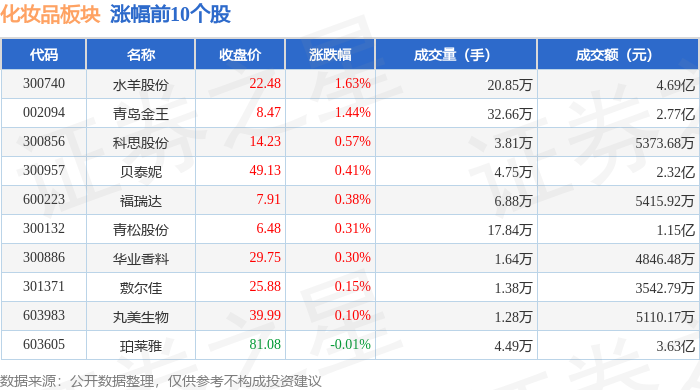
Market Overview - On September 16, the cosmetics sector rose by 0.03% compared to the previous trading day, with Shuiyang Co., Ltd. leading the gains [1] - The Shanghai Composite Index closed at 3861.87, up 0.04%, while the Shenzhen Component Index closed at 13063.97, up 0.45% [1] Individual Stock Performance - Shuiyang Co., Ltd. (300740) closed at 22.48, with a gain of 1.63% and a trading volume of 208,500 shares, amounting to a transaction value of 469 million yuan [1] - Qingdao Kingway (002094) closed at 8.47, up 1.44%, with a trading volume of 326,600 shares and a transaction value of 277 million yuan [1] - Other notable performers include: - Kezhou Co., Ltd. (300856) at 14.23, up 0.57% [1] - Beitaini (300957) at 49.13, up 0.41% [1] - Furuida (600223) at 7.91, up 0.38% [1] Fund Flow Analysis - The cosmetics sector experienced a net outflow of 43.2 million yuan from institutional investors, while retail investors saw a net outflow of 23.0 million yuan [2] - Conversely, speculative funds recorded a net inflow of 66.2 million yuan [2] Detailed Fund Flow for Key Stocks - Shuiyang Co., Ltd. (300740) had a net inflow of 41.1 million yuan from institutional investors, while retail investors faced a net outflow of 71.8 million yuan [3] - Qingdao Kingway (002094) saw a net inflow of 15.3 million yuan from institutional investors, but a net outflow of 7.2 million yuan from retail investors [3] - Other stocks with significant fund flow include: - Beitaini (300957) with a net inflow of 5.7 million yuan from institutional investors and a net outflow of 13.2 million yuan from retail investors [3] - Furuida (600223) faced a net outflow of 10.2 million yuan from institutional investors but a net inflow of 8.9 million yuan from retail investors [3]


行业点评报告:8月社零同比+3.4%,金银珠宝表现亮眼
KAIYUAN SECURITIES· 2025-09-15 13:50
Investment Rating - The industry investment rating is "Positive" (maintained) [1] Core Viewpoints - The report highlights that the retail sector is experiencing steady growth, with a year-on-year increase of 4.6% in retail sales from January to August 2025, amounting to 3,239.06 billion [3][4] - In August 2025, retail sales reached 396.68 billion, reflecting a year-on-year growth of 3.4%, slightly below the expected 3.8% [3][4] - The report emphasizes a strong performance in optional consumption categories, particularly gold and jewelry, which saw a year-on-year increase of 16.8% in August [4][6] Summary by Sections Retail Sales Performance - The total retail sales for January to August 2025 were 3,239.06 billion, with August sales at 396.68 billion, showing a year-on-year increase of 3.4% [3][4] - Essential goods like grain and oil showed resilience, while optional categories like gold and jewelry performed exceptionally well [4] Online vs. Offline Channels - Online retail sales from January to August 2025 reached 999.28 billion, growing by 9.6%, with physical goods online sales at 809.64 billion, up by 6.4% [5] - Offline retail growth has shown a marginal slowdown across various formats, with supermarkets and convenience stores growing by 4.9% and 6.6% respectively [5] Investment Recommendations - The report suggests focusing on high-quality companies in the "emotional consumption" theme, particularly in four main areas: 1. Gold and jewelry brands with differentiated product offerings [6] 2. Retail enterprises adapting to market trends [6] 3. High-quality domestic beauty brands [6] 4. Medical beauty product manufacturers with unique pipelines [6]
化妆品板块9月15日跌0.18%,华业香料领跌,主力资金净流出8338.08万元
Zheng Xing Xing Ye Ri Bao· 2025-09-15 08:49
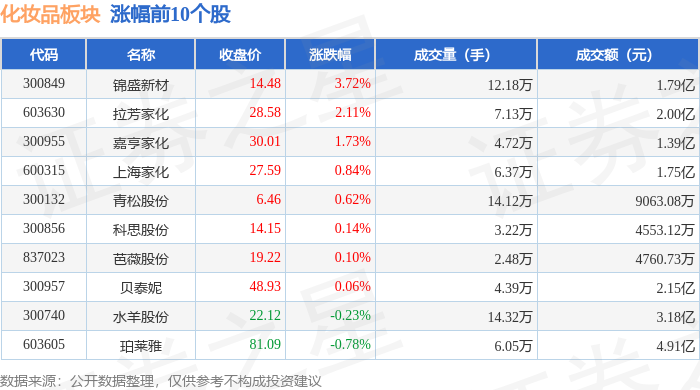
Market Overview - On September 15, the cosmetics sector declined by 0.18%, with Huaye Fragrance leading the drop [1] - The Shanghai Composite Index closed at 3860.5, down 0.26%, while the Shenzhen Component Index closed at 13005.77, up 0.63% [1] Individual Stock Performance - Notable gainers included: - Jinsong New Material (300849) with a closing price of 14.48, up 3.72% and a trading volume of 121,800 shares, totaling 179 million yuan [1] - Lafang Home (603630) closed at 28.58, up 2.11% with a trading volume of 71,300 shares, totaling 200 million yuan [1] - Notable decliners included: - Huaye Fragrance (300886) closed at 29.66, down 1.79% with a trading volume of 18,400 shares, totaling 55.05 million yuan [2] - Marubi Biological (603983) closed at 39.95, down 1.36% with a trading volume of 13,900 shares, totaling 55.49 million yuan [2] Capital Flow Analysis - The cosmetics sector experienced a net outflow of 83.38 million yuan from institutional investors, while retail investors saw a net inflow of 76.42 million yuan [2] - The overall capital flow for individual stocks showed: - Jinsong New Material had a net inflow of 18.50 million yuan from institutional investors, accounting for 10.31% of its total [3] - Huaye Fragrance had a net outflow of 4.23 million yuan from institutional investors, accounting for 6.58% of its total [3]



化妆品医美行业周报:8月电商国货逆势增长,双11备战开启-20250914
Shenwan Hongyuan Securities· 2025-09-14 14:37
Investment Rating - The report initiates coverage with a "Buy" rating for Shuiyang Co., Ltd. [3][13] Core Insights - The cosmetics and medical beauty sector underperformed the market, with the Shenwan Beauty Care Index increasing by 0.2% from September 5 to September 12, 2025, lagging behind the Shenwan A Index by 2.7 percentage points [3][4] - Domestic cosmetics brands showed strong growth in August, with key brands under Shumei Co. achieving a 70% growth rate on Douyin and Taobao platforms, indicating a robust performance despite high base effects [3][9] - The report highlights the upcoming Double 11 shopping festival, suggesting that brands should prepare for promotional strategies [3][9] Summary by Sections Industry Performance - The cosmetics and medical beauty sector's performance was weaker than the market, with declines in the Shenwan Cosmetics Index by 0.5% and the Shenwan Personal Care Index by 0.8% during the specified period [3][4] Key Company Review - Shuiyang Co., Ltd. is positioned as a leading technology-driven beauty company in China, with stable revenue between 4 to 5 billion yuan from 2021 to 2024 and an expected gross margin of 63.01% in 2024, up by 10.94 percentage points from 2021 [3][10] - The company has a dual business model of proprietary brands and CP agency brands, with a strong focus on high-end and global market transformation [3][10][12] E-commerce Data - In August, key domestic brands on Douyin and Taobao platforms showed significant growth, with Shumei Co. brands achieving a 70% increase, and other brands like Maogeping and Runben also reporting substantial growth rates [3][14] Market Trends - The report notes that the overall retail sales of cosmetics in July 2025 grew by 4.5%, indicating a recovery in consumer spending [3][17] - The domestic skincare market is projected to reach 271.2 billion yuan in 2024, despite a slight decline of 3.7% year-on-year, with domestic brands gaining market share [3][26] Company Announcements - Shumei Co. has appointed Dr. Karl Lintner, a pioneer in peptide beauty, as the chief scientific advisor, aiming to enhance its global competitiveness in research and development [3][21]



商贸零售行业周报:高德扫街榜上线,真实数据重构线下信任格局-20250914
KAIYUAN SECURITIES· 2025-09-14 14:12
Investment Rating - The industry investment rating is "Positive" (maintained) [1] Core Views - The report highlights the launch of the "Gaode Street Ranking," which aims to reconstruct the trust framework in offline services through real navigation and travel behavior data [23][27] - The report emphasizes the importance of emotional consumption themes and suggests focusing on high-quality companies in high-growth sectors [6][29] Summary by Sections Retail Market Review - The retail industry index closed at 2396.85 points, up 0.85% for the week, underperforming the Shanghai Composite Index, which rose by 1.52% [12][20] - Among retail sub-sectors, the supermarket sector had the highest weekly increase of 4.78%, while the watch and jewelry sector led with a year-to-date increase of 35.68% [14][18] Industry Dynamics - The launch of the "Gaode Street Ranking" is positioned as a significant step for Alibaba to transition from a navigation platform to a comprehensive local service platform, enhancing user experience and trust [23][27] - The ranking system incorporates real user behavior and credit filtering to provide authentic feedback, potentially disrupting the existing "to-store" business landscape dominated by Meituan and Dianping [27][29] Investment Recommendations - Investment Theme 1: Focus on differentiated gold and jewelry brands with deep consumer insights, recommending companies like Laopu Gold and Chaohongji [6][31] - Investment Theme 2: Highlight retail enterprises that adapt to trends and actively explore changes, recommending Yonghui Supermarket and Aiyingshi [6][29] - Investment Theme 3: Emphasize high-quality domestic beauty brands with differentiated capabilities, recommending brands like Maogeping and Pola [6][30] - Investment Theme 4: Focus on differentiated medical beauty product manufacturers, recommending Aimeike and Kedi-B [6][30] Company Performance Highlights - Laopu Gold reported a revenue of 12.354 billion yuan in H1 2025, a year-on-year increase of 250.9%, with a net profit of 2.268 billion yuan, up 285.8% [38][39] - Chaohongji achieved a revenue of 4.102 billion yuan in H1 2025, a 19.5% increase, with a net profit of 331 million yuan, up 44.3% [41][42] - Maogeping reported a revenue of 2.588 billion yuan in H1 2025, a 31.3% increase, with a net profit of 670 million yuan, up 36.1% [31][34]


关注高端国货美妆发展潜力
Xiangcai Securities· 2025-09-14 10:59
Investment Rating - The industry investment rating is maintained at "Overweight" [3] Core Views - The retail sector showed a slight increase of 0.85% last week, underperforming the CSI 300 index by 0.53 percentage points, indicating a mixed performance across various retail sub-sectors [4][9] - The current Price-to-Earnings (PE) ratio for the retail sector is 42.81X, reflecting a 0.45 percentage point increase week-on-week, with a one-year range between 24.35X and 43.07X [5][17] - The retail sector's Price-to-Book (PB) ratio stands at 2.06X, with a one-year range from 1.19X to 2.07X [5][19] Industry Dynamics - The Shenzhen Stock Exchange adjusted the list of eligible stocks for the Hong Kong Stock Connect, adding 20 stocks including brands related to retail and light manufacturing, which may enhance liquidity and trading opportunities [6][20][22] - In August, domestic beauty brands showed strong performance on Douyin, with Han Shu leading sales at over 700 million yuan, indicating a growing acceptance and market share for domestic brands [7][23] - The rise of domestic beauty brands is attributed to improved product quality and the growing trend of "Guochao" (national tide), which enhances consumer recognition and acceptance [7][23] Investment Recommendations - The report suggests focusing on recently added Hong Kong stocks in the retail sector and high-end domestic beauty brands, particularly those that are scarce in the market, such as Mao Ge Ping [6][24] - The ongoing domestic policies aimed at boosting consumption are expected to further enhance consumer willingness and capacity, supporting the retail sector's growth [7][24]
日化护肤半年报|贝泰妮2025年上半年业绩双降、归母净利润降49%却拿过半收入做营销
Xin Lang Cai Jing· 2025-09-12 10:41
Core Insights - The skincare and daily chemical industry in A-share listed companies shows a persistent trend of high gross margins and low net margins, with over 80% of companies having a gross margin above 50% and more than half having a net margin below 10% [1][2] Group 1: Financial Performance - In the first half of 2025, the top three companies by gross margin are Jinbo Biological (90.68%), Fulejia (81.47%), and Beitaini (76.01%) [2] - Despite high gross margins, over half of the selected companies have net margins below 10%, with Jinbo Biological, Fulejia, and Proya leading in net margins at 45.5%, 26.61%, and 15.41% respectively [2] Group 2: Marketing and Expenses - The high gross margin and low net margin phenomenon is closely linked to the significant marketing expenditures in the industry, with companies like Marubi Biological having a sales expense ratio as high as 56.5% [1][3] - Many companies in the skincare and daily chemical sector are spending over 40% of their revenue on marketing, indicating a highly competitive marketing environment [3] Group 3: Research and Development - The investment in R&D is significantly lower than marketing expenditures, with Marubi Biological's R&D expense ratio being only 2.3% compared to its high sales expense ratio [3] - The focus on marketing over R&D has led to severe product homogeneity, limiting innovation and the ability to meet consumer skincare needs effectively [3]
日化护肤半年报|重营销侵吞利润、丸美生物销售费用率高达56.5%成营销王
Xin Lang Zheng Quan· 2025-09-12 09:24
Core Insights - The skincare and daily chemical industry in A-shares has shown a high gross profit margin but low net profit margin, with over 80% of companies having a gross profit margin above 50% and more than half having a net profit margin below 10% [1][4] - The significant gap between gross and net profit margins is attributed to high sales expenses, which consume profits, with Marubi Biological's sales expense ratio reaching 56.5%, making it the highest in the industry [1][6] Financial Performance - The top three companies by gross profit margin in the first half of 2025 are Jinbo Biological (90.68%), Fulejia (81.47%), and Beitaini (76.01%) [2] - Only four companies reported a gross profit margin below 50%, namely Lafang, Kesi, Qingsong, and Jiaheng, with margins of 49.26%, 32.05%, 17.51%, and 14.98% respectively [2] Profitability Analysis - Despite high gross profit margins, over half of the selected companies have net profit margins below 10%, with Jinbo Biological, Fulejia, and Polaroid leading in net profit margins at 45.5%, 26.61%, and 15.41% respectively [4] - Jiaheng, Lafang, and Qingsong have low net profit margins of -6.26%, 1.58%, and 2.66% respectively [4] Marketing and R&D Expenditure - The high marketing expenses in the industry are closely linked to the high gross and low net profit margins, with many companies spending over 40% of their revenue on marketing [6][9] - Marubi Biological's sales expense ratio is 56.5%, while its R&D expense ratio is only 2.3%, indicating a heavy reliance on marketing over research and development [8] Industry Challenges - The focus on marketing over R&D has led to severe product homogeneity, limiting innovation and hindering brand development [8] - The industry faces ongoing price wars and promotional activities that further erode profitability, creating a vicious cycle [9] - Companies need to balance marketing and R&D expenditures to transition from a marketing-driven to a product-driven approach [9]
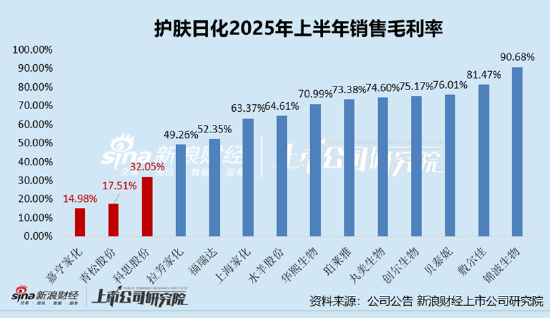
日化护肤半年报|贝泰妮2025年上半年业绩双降、归母净利润降49% 却拿过半收入做营销
Xin Lang Zheng Quan· 2025-09-12 09:24
Core Insights - The skincare and daily chemical industry in A-shares has shown a high gross profit margin but low net profit margin, with over 80% of companies having a gross profit margin above 50% and more than half having a net profit margin below 10% [1][4] - The significant gap between gross and net profit margins is attributed to high sales expenses, which consume profits, with Marubi Biological's sales expense ratio reaching 56.5%, making it the highest in the industry [1][6] Group 1: Financial Performance - The top three companies by gross profit margin in the first half of 2025 are Jinbo Biological (90.68%), Fulejia (81.47%), and Beitaini (76.01%) [2] - Only four companies reported a gross profit margin below 50%, namely Lafang, Kesi, Qingsong, and Jiaheng, with margins of 49.26%, 32.05%, 17.51%, and 14.98% respectively [2] - The leading companies in net profit margin are Jinbo Biological (45.5%), Fulejia (26.61%), and Polaroid (15.41%), while Jiaheng, Lafang, and Qingsong have low margins of -6.26%, 1.58%, and 2.66% respectively [4] Group 2: Marketing and R&D Expenditure - The high marketing expenses in the industry are closely linked to the high gross profit but low net profit, with many companies spending over 40% of their revenue on marketing [6][9] - Marubi Biological's sales expense ratio is 56.5%, while its R&D expense ratio is only 2.3%, indicating a heavy reliance on marketing over research and development [8] - The focus on marketing over R&D has led to severe product homogenization, limiting innovation and hindering brand development [8][9] Group 3: Industry Challenges - The industry faces challenges in balancing marketing and R&D expenditures, with a need to shift from marketing-driven to product-driven strategies [9]