复旦微电

Search documents
复旦微电(688385) - 第十届董事会第五次会议决议公告
2025-11-10 13:15
| 股证券代码:688385 | A | 证券简称:复旦微电 | 公告编号:2025-050 | | --- | --- | --- | --- | | 港股证券代码:01385 | | 证券简称:上海复旦 | | 上海复旦微电子集团股份有限公司 经董事会提名委员会的资格审查后通过,董事会同意提名张玉明先生为公 司第十届董事会独立非执行董事候选人,任期自公司 2025 年第二次临时股东大 会审议通过之日起至第十届董事会届满之日止。 本事项尚需提交股东大会审议通过。 表决结果:同意 9 票,反对 0 票,弃权 0 票。 二、审议通过《关于制定<总经理及总经理办公会工作细则>的议案》 为进一步完善公司规范运作,制定《总经理及总经理办公会工作细则》,原 《总经理工作细则》废止。 表决结果:同意 9 票,反对 0 票,弃权 0 票。 特此决议。 上海复旦微电子集团股份有限公司董事会 第十届董事会第五次会议决议公告 本公司董事会及全体董事保证本公告内容不存在任何虚假记载、误导性陈述或 者重大遗漏,并对其内容的真实性、准确性和完整性依法承担法律责任。 上海复旦微电子集团股份有限公司(以下简称"公司"、"复旦微电")第 十 ...
商业航天:卫星网络将成为太空智能体
HUAXI Securities· 2025-11-10 11:56
Investment Rating - The industry rating is "Recommended" [1] Core Insights - The trend of integrated development of satellite networks is characterized by the convergence of sensing, computing, and communication, evolving into an intelligent entity capable of perception, reasoning, and action [2][5] - The intelligent entity consists of three layers: 1) Global Connectivity Layer, providing comprehensive and optimal connectivity; 2) Fusion Capability Layer, where "cloud-edge-end collaboration" becomes an intrinsic capability; 3) Intelligent Service Layer, where "network as intelligence" offers cognitive-level information services [5][7] - The evolution of satellite networks from "technical tools and infrastructure" to "intelligent ecological hubs" and "value creation platforms" is highlighted, aiming for seamless loops of global perception, intelligent computation, and on-demand services [2][8] Summary by Sections Integrated Sensing and Computing - The sharing of satellite infrastructure allows for multi-modal functionalities on a single satellite platform, exemplified by the Iridium second-generation system integrating communication, navigation, and situational awareness [3] - The communication network is transitioning from "connective collaboration" to "integrated coexistence," with high and low orbit collaboration and integrated space-ground networking as core directions [3] Dynamic Resource Scheduling - The construction of elastic resource networks is possible through dynamic scheduling, as seen in the Zhijiang Laboratory's "Three-body Computing Constellation," which enables in-orbit computing capabilities and resource allocation [4] Global Connectivity and AI-Driven Services - The global connectivity layer features a three-dimensional backbone network with high, medium, and low orbit satellites, each serving distinct roles in global resource scheduling and data processing [5][6] - The intelligent service layer transforms the network into an intelligent entity capable of understanding user intent and providing cognitive-level responses, facilitating applications across various industries [7][10] Case Study: Palantir's Meta Constellation - Palantir's "Meta Constellation" system exemplifies the integration of satellite data with multi-domain data, enabling real-time situational awareness and decision-making across military, commercial, and governmental sectors [8][9] - The system's core functions include planetary-level situational awareness, tactical target tracking, and autonomous learning capabilities, significantly enhancing operational efficiency and responsiveness [10][14] Beneficiary Companies - Companies such as Putian Technology, Holoway, Guoke Military Industry, and others are positioned to benefit from advancements in satellite technology and the growing demand for integrated satellite services [15][16][17]
全球巨头竞逐太空算力新赛道,科创100指数ETF(588030)盘中交投活跃
Sou Hu Cai Jing· 2025-11-10 03:50
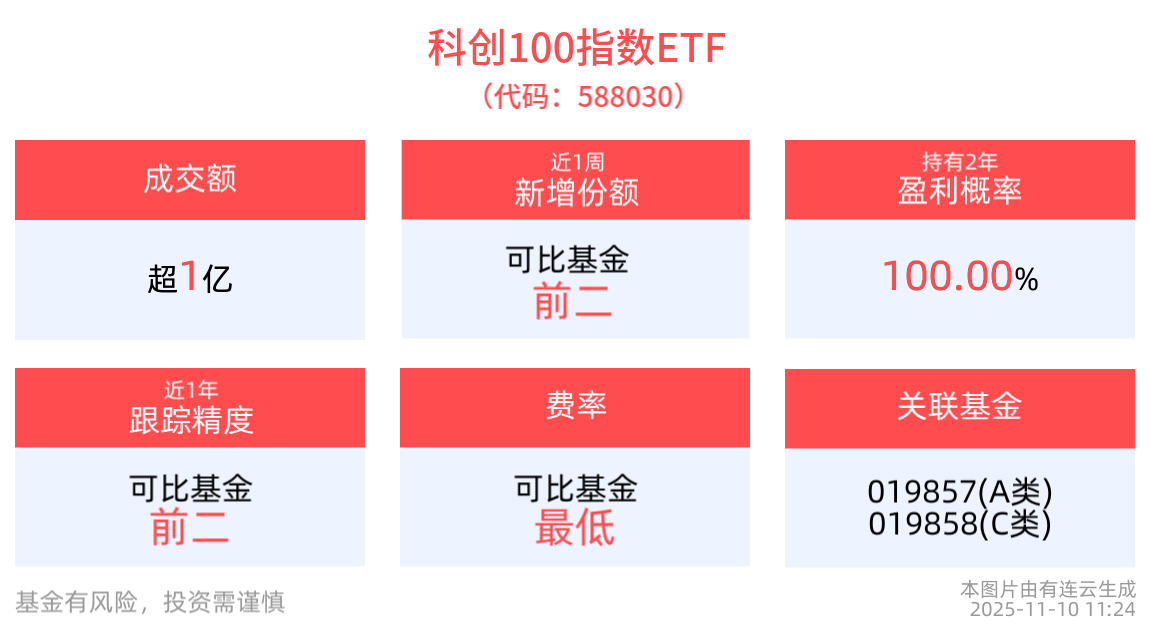
Group 1: Market Performance - The Shanghai Stock Exchange Sci-Tech Innovation Board 100 Index decreased by 1.87% as of November 10, 2025, with mixed performance among constituent stocks [3] - The top gainers included Baike Bio up 4.59%, Zhongke Xingtou up 3.92%, and Zhongxin Bo up 2.82%, while the largest decliners were Xiamen Tungsten down 8.26%, Guodun Quantum down 8.06%, and Huahong Semiconductor down 6.70% [3] - The Sci-Tech 100 Index ETF (588030) fell by 2.02%, with the latest price at 1.31 yuan, but has seen a cumulative increase of 20.11% over the past three months as of November 7, 2025 [3] Group 2: Liquidity and Trading Volume - The Sci-Tech 100 Index ETF had a turnover rate of 2.32% during the trading session, with a transaction volume of 133 million yuan [3] - Over the past year, the average daily trading volume of the ETF was 379 million yuan, ranking it first among comparable funds [3] Group 3: Space Computing Developments - Global tech giants are accelerating their investments in space computing, shifting AI competition from Earth to space, with Google launching Project Suncatcher and SpaceX building a space data center [4] - Chinese companies are also making rapid advancements, with Guoxing Aerospace's "Star Computing" plan and the upcoming launch of the "Tianlibo-10" satellite in 2026, which boasts a single satellite computing power exceeding 10 POPS [4] - Space computing is emerging as a solution to AI computing energy consumption and bandwidth bottlenecks, leveraging near-infinite solar energy supply and high energy efficiency [4] Group 4: Investment Recommendations - Minsheng Securities suggests that supernodes may become a mainstream technology under cluster expansion, enhancing the domestic computing ecosystem [5] - Key areas to focus on include domestic AI computing sectors such as chip design, advanced wafer manufacturing, and liquid cooling technologies [5] - The latest scale of the Sci-Tech 100 Index ETF reached 5.79 billion yuan, ranking it second among comparable funds, with a significant increase of 6 million shares over the past week [5] Group 5: Index Composition - As of October 31, 2025, the top ten weighted stocks in the Sci-Tech 100 Index accounted for 25.77% of the index, including Huahong Semiconductor and Guodun Quantum [6]

北美光通信企业当季业绩表现亮眼,英伟达、谷歌推进太空算力部署
2025-11-10 03:34
Summary of Conference Call Records Industry Overview - The conference call discusses the rapid development of the space computing industry, particularly in commercial aerospace, with major tech companies like NVIDIA and Google launching initiatives such as the Starlink project and Project Suncatch, respectively, to deploy advanced computing capabilities in space [1][2][3] - China is also making significant strides in this area, planning to launch between 1,000 to 3,000 satellites to support its three-body computing constellation, with Potevio Technology as a key supplier [1][3] Key Points and Arguments Space Computing - NVIDIA's Starlink initiative aims to send its first H100 GPU to space by November 2025, while Google's Project Suncatch plans to launch satellites equipped with TPU 6 chips by 2027 [2] - The efficiency of space computing, powered by solar energy, is several times greater than ground-based power, addressing energy shortages [2] - The commercial model for space computing is gradually taking shape, with companies like Nanjing Blue Tower exploring B-end services through satellite interconnectivity [1][3] AI Industry - There is ongoing debate regarding the existence of a bubble in the AI industry, highlighted by OpenAI's projected investment of $1.4 trillion against a quarterly revenue of over $4 billion and losses exceeding $10 billion [4] - Concerns have been raised about the low return on investment (ROI) for cloud service providers in North America, but the long-term growth potential of AI remains strong despite short-term financial data [4][6] Optical Communication Industry - The optical communication sector is experiencing significant growth, with strong demand for 1.6T optical modules and second-generation optical modules, alongside a robust supply chain for optical chips and lasers [5][7] - Companies like Lumentum and Coherent Finisar reported better-than-expected earnings, driven by data center interconnectivity and expanding production capabilities [7] - The demand for 1.6T modules is expected to reach 20 to 30 million units by 2026, while 800G demand could reach 40 to 50 million units [7] Additional Important Insights - Liquid cooling technology is highlighted as a key area of interest, with NVIDIA projecting a market size of $7 billion by 2026, indicating a significant growth opportunity [2][6] - The optical communication industry is seeing technological advancements and capacity expansions, with companies like ZTE pushing for new technology applications [5][7] - Investors are encouraged to focus on leading companies in the optical communication space, such as Zhongji Xuchuang and Tianfu Technology, as well as laser chip companies like Yuanjie Technology and Shijia Photonics [7]

Kimi万亿模型“横空出世”,科创AIETF(588790)蓄力调整,AI应用有望加速落地
Xin Lang Cai Jing· 2025-11-10 03:12
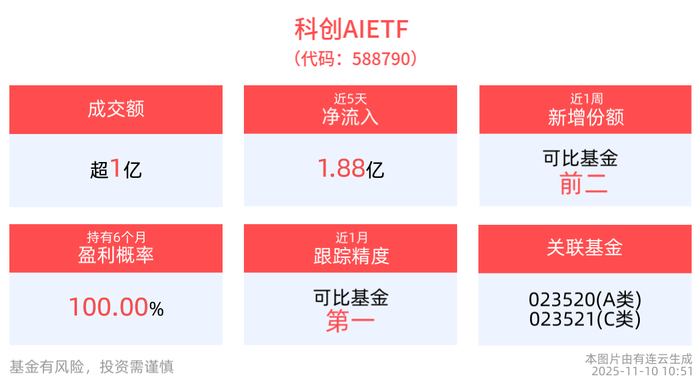
Core Insights - The Shanghai Stock Exchange Sci-Tech Innovation Board Artificial Intelligence Index has decreased by 1.20% as of November 10, 2025, with mixed performance among constituent stocks [2] - The government has issued implementation opinions to accelerate the cultivation and large-scale application of new AI scenarios, emphasizing the need for core technology breakthroughs and application promotion [2][3] - The recent launch of the Kimi K2Thinking model by Moonlight Dark Side has garnered attention, showcasing significant cost advantages over international models like OpenAI's GPT-5 [3] - The total size of the Sci-Tech AI ETF has reached 6.08 billion yuan, ranking it among the top funds in its category [4] Market Performance - The Sci-Tech AI ETF has seen a 23.97% increase over the past three months, with a recent price of 0.77 yuan and a turnover rate of 2.19% [2] - The ETF has experienced a net inflow of 75.248 million yuan recently, with a notable average daily net inflow of 37.674 million yuan over the past five trading days [4] Policy and Industry Developments - The new policy aims to create a closed-loop path for technology breakthroughs, scenario validation, and industrial application, which is expected to accelerate AI development [3] - Major companies like Kingdee and Kingsoft Office are launching new products that integrate multiple AI agents, indicating a shift from AI as a tool to autonomous decision-making [3] - Global tech giants are increasing investments in AI, with Amazon and OpenAI's collaboration valued at 38 billion dollars and Meta planning to invest 600 billion dollars in AI infrastructure over the next seven years [3] Index Composition - As of October 31, 2025, the top ten weighted stocks in the Shanghai Stock Exchange Sci-Tech Innovation Board AI Index account for 70.92% of the index, including companies like Lanqi Technology and Kingsoft Office [5]




华西证券:低轨卫星拐点已至 国内组网加速
智通财经网· 2025-11-07 08:39
Core Insights - The low Earth orbit (LEO) satellite market is becoming a strategic focus in the US-China competition, with the principle of "first come, first served" governing orbital and frequency resources [1][2] - SpaceX has launched over 10,000 satellites, with more than 8,600 currently operational, while China has only about 300 LEO satellites in orbit, indicating a significant gap that necessitates accelerated deployment [1][2] Group 1: Market Dynamics - The LEO orbit can accommodate approximately 60,000 satellites, and strict international regulations require timely launches to retain frequency and orbital rights [2] - SpaceX has applied for resources for 42,000 satellites, while Amazon's Kuiper plans to deploy 3,236 satellites; China's China Star Network and Shanghai Yuanxin plans to deploy around 13,000 and 15,000 satellites, respectively [2] Group 2: Launch Capacity and Technology - Rocket launch capacity is a critical metric, with SpaceX's Falcon 9 capable of 22.8 tons to LEO, while China's Long March 8 has a capacity of only 7 tons, highlighting a significant disparity [3] - The development of commercial rockets and reusable technology is progressing rapidly in China, with several private companies achieving successful launches and narrowing the gap with international standards [3] Group 3: Cost Reduction Strategies - SpaceX has reduced the cost of individual satellites to below $500,000 through mass production, while China's satellite manufacturing is also lowering costs via modular design and batch production [4] Group 4: Market Opportunities - LEO satellites are expected to integrate deeply with terrestrial 5G networks, enabling global seamless coverage, with significant advancements anticipated by 2025 [5] - The combination of artificial intelligence (AI) and LEO satellites is leading to the development of next-generation intelligent satellite systems, with major tech companies like NVIDIA and Google planning to deploy AI-capable satellites [5] Group 5: Future Developments - China's LEO satellite deployment is entering a rapid networking phase, with recent successful launches indicating an acceleration in the pace of deployment [6][7] - The domestic market is moving towards a "constellation deployment" phase, transitioning from "single satellite customization" [7] Group 6: Investment Opportunities - Companies to watch include Fudan Microelectronics (688385.SH) and Unisoc (002249.SZ) as potential investment targets in the LEO satellite sector [8]

半导体板块11月7日跌1.13%,大为股份领跌,主力资金净流出43.38亿元
Zheng Xing Xing Ye Ri Bao· 2025-11-07 08:30
Market Overview - The semiconductor sector experienced a decline of 1.13% on November 7, with Daway Technology leading the drop [1] - The Shanghai Composite Index closed at 3997.56, down 0.25%, while the Shenzhen Component Index closed at 13404.06, down 0.36% [1] Top Gainers in Semiconductor Sector - Kangqiang Electronics (002119) saw a significant increase of 10.02%, closing at 21.08 with a trading volume of 745,900 shares [1] - Wentai Technology (600745) rose by 9.70%, closing at 45.00 with a trading volume of 902,200 shares [1] - Changguang Huaxin (688048) increased by 9.01%, closing at 87.50 with a trading volume of 268,200 shares [1] Top Losers in Semiconductor Sector - Daway Technology (002213) fell by 5.66%, closing at 26.48 with a trading volume of 604,100 shares [2] - Canxin Technology (688691) decreased by 5.28%, closing at 115.73 with a trading volume of 67,900 shares [2] - Fudan Microelectronics (688385) dropped by 4.85%, closing at 57.90 with a trading volume of 136,600 shares [2] Capital Flow Analysis - The semiconductor sector experienced a net outflow of 4.338 billion yuan from institutional investors, while retail investors saw a net inflow of 2.454 billion yuan [2][3] - Notable net inflows from retail investors were observed in Kangqiang Electronics and New Clean Energy, with net inflows of 1.41 billion yuan and 1.15 billion yuan respectively [3] Summary of Trading Data - The trading data indicates a mixed performance among semiconductor stocks, with significant volatility in both gains and losses across various companies [1][2][3]




江苏晶圆测试“小巨人”冲刺科创板,华为哈勃持股,拟募资15亿
3 6 Ke· 2025-11-07 07:00
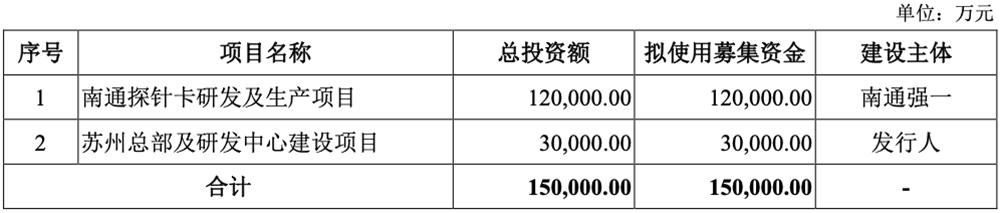
Core Viewpoint - Qiangyi Co., Ltd., a leading MEMS probe card manufacturer in Suzhou, Jiangsu, has submitted its IPO application to the Sci-Tech Innovation Board, with a review scheduled for November 12, 2023. The company aims to raise 1.5 billion yuan for R&D and production projects [1][2][31]. Company Overview - Founded in August 2015, Qiangyi Co., Ltd. has a registered capital of 97.1694 million yuan and is recognized as a national-level "little giant" enterprise specializing in advanced manufacturing [1][2]. - The company focuses on the R&D, design, production, and sales of probe cards, breaking the monopoly of foreign manufacturers in the MEMS probe card sector [1][31]. Market Position - Qiangyi ranks ninth in the global semiconductor probe card industry in 2023 and sixth in 2024, being the only domestic company to enter the top ten [1][2]. - The probe card products are used in both non-storage fields (SoC chips, CPUs, GPUs, RF chips) and storage fields (DRAM, NAND Flash) [1][2]. Financial Performance - In 2022, the company reported revenue exceeding 600 million yuan, with a net profit increase of 1149% [4]. - For the first nine months of 2025, Qiangyi's revenue reached 647 million yuan, a year-on-year increase of 65.88%, with a net profit of 248 million yuan, up 100.13% [6][7]. Future Projections - Qiangyi expects its 2025 revenue to be between 950 million and 1.05 billion yuan, representing a growth of 48.12% to 63.71% year-on-year [7][9]. - The company plans to enhance its R&D capabilities and production capacity for MEMS probe cards, particularly in the storage sector, to improve competitiveness [31]. Client Base - The company has over 400 clients, including major chip design firms and foundries, with significant sales to top clients like Company B, which accounts for over 80% of revenue [2][13][18]. - Qiangyi's major clients include well-known companies such as ZTE Micro, Fudan Microelectronics, and others in the semiconductor industry [2][17]. R&D and Innovation - As of September 30, 2025, Qiangyi had 159 R&D personnel, accounting for 19.85% of its total workforce, and held 182 authorized patents [13][14]. - The company has developed various types of probe cards, including 2D/2.5D MEMS probe cards, and is actively expanding its product offerings [15][16]. Supply Chain and Procurement - Qiangyi's procurement is concentrated, with the top five suppliers accounting for a significant portion of its total procurement costs [22][23]. - The company is working to enhance supply chain stability by sourcing core components domestically, while still relying on imports for certain materials [25][31].
阿里超级 AI 云剑指全球开发者!科创人工智能ETF华夏(589010) 午后弱势震荡,AI成分股普遍承压
Mei Ri Jing Ji Xin Wen· 2025-11-07 06:14
Core Viewpoint - The Sci-Tech Innovation Artificial Intelligence ETF (589010) is experiencing a downward trend, with a current price of 1.382 yuan, reflecting a decline of 1.99% [1]. Market Performance - The ETF opened high but quickly fell, followed by a period of consolidation and a slight afternoon decline, indicating overall weak market sentiment [1]. - Among the 30 constituent stocks, only Xinghuan Technology and Jingchen Co. saw slight increases, while the majority, including Fudan Microelectronics, Haotian Ruisheng, and Chip Original, experienced notable declines, with Fudan Microelectronics dropping over 5% [1]. - The ETF's trading volume was approximately 41.28 million yuan, indicating moderate trading activity [1]. Industry Developments - The World Internet Conference in Wuzhen commenced today, with Alibaba's CEO, Wu Yongming, announcing the company's efforts to build a large-scale AI infrastructure and invest in a super AI cloud to provide leading AI services to global developers [1]. - Open-source securities highlighted the rapid development of large models, which has driven strong demand for AI computing power. OpenAI has committed to acquiring over 26GW of computing resources from suppliers such as Oracle, NVIDIA, AMD, and Broadcom, with potential costs exceeding 1 trillion USD over the next decade [1]. ETF Characteristics - The Sci-Tech Innovation Artificial Intelligence ETF closely tracks the Shanghai Stock Exchange Sci-Tech Innovation Board AI Index, covering high-quality enterprises across the entire industry chain, benefiting from high R&D investment and policy support [1]. - The ETF has a 20% price fluctuation limit and the flexibility of small and mid-cap stocks, which aids in capturing the "singularity moment" of the AI industry [1].
超2800只个股下跌
第一财经· 2025-11-07 03:49
Market Overview - The A-share market showed a slight decline with the Shanghai Composite Index down by 0.16%, the Shenzhen Component Index also down by 0.16%, and the ChiNext Index down by 0.37% [3][4] - The total trading volume in the Shanghai and Shenzhen markets reached 1.25 trillion yuan, a decrease of 71.1 billion yuan compared to the previous trading day, with over 2800 stocks declining [4] Sector Performance - The AI hardware and software sectors led the decline, while the lithium battery supply chain experienced a surge, with fluorine chemical, phosphorus chemical, and photovoltaic concept stocks performing well [3] - The commercial aerospace sector saw a short-term rally, with stocks like Shanghai Huguang hitting the daily limit and Aerospace Technology rising over 6% [6] - The photovoltaic sector continued to strengthen, with several stocks including Hailu Heavy Industry and Tongwei Co. hitting the daily limit, and Tongwei Co. rising over 8% [7] Stock Movements - The semiconductor sector in Hong Kong showed weakness, with stocks like Hua Hong Semiconductor down by 5.49% and Shanghai Fudan down by 3.11% [10] - The A-share market opened lower, with the Shanghai Composite Index down by 0.34%, the Shenzhen Component Index down by 0.54%, and the ChiNext Index down by 0.72% [12][14] - The electrical equipment sector rebounded after hitting a low, with Zhongneng Electric rising over 15% and Moen Electric achieving a four-day limit up [9] Economic Indicators - The People's Bank of China conducted a reverse repurchase operation of 141.7 billion yuan for 7-day terms at an interest rate of 1.40%, with 355.1 billion yuan of reverse repos maturing today [15] - The central parity rate of the RMB against the USD was reported at 7.0836, an increase of 29 basis points from the previous trading day [16]