
宇信科技

Search documents
关键节点在即,蚂蚁确认入局稳定币
Xuan Gu Bao· 2025-06-12 23:32
据智通财经6月12日报道,针对有报道称蚂蚁国际正计划在香港和新加坡申请稳定币牌照一事,6月12 日,蚂蚁国际回应称,正在全球财资管理方面加速投资、拓展合作,将我们的AI、区块链和稳定币创 新投入真实可靠的大规模应用。 蚂蚁国际表示:"我们欢迎香港立法会通过《稳定币条例草案》,将于法案8月1日生效、相关通道开启 后尽快提交申请,希望为香港建设未来国际金融中心贡献更多力量。" 受消息带动,港股云峰金融等尾盘大涨。 华西证券指出,稳定币是指价值与某种法定货币或资产锚定的加密货币。其基于区块链技术发行,具有 很好的开放性,支持可控匿名,可以直接点对点交易,天然具有跨境属性。 根据DEFILLAMA数据,截至2025年6月8日,全球稳定币总市值已攀升至约2503.05亿美元(约合人民 币1.8万亿元),较2019年末的约50亿美元增长了约50倍,呈现出爆发式增长态势。这一趋势不仅彰显 了稳定币在加密货币生态中的迅猛扩张,也凸显了其在支付、交易及去中心化金融(DeFi)等领城日益 不可替代的地位。 其表示,展望未来,稳定币可能会深度融入全球金融体系,最可能的情况是,稳定币将与传统金融体系 互补,成为银行和支付平台(如Vi ...
东兴证券晨报-20250612
Dongxing Securities· 2025-06-12 10:50
Core Insights - The report highlights that the AI wave is driving the electronic industry into a new development phase, with three core areas showing significant growth momentum: wafer foundry, SoC, and thermal management materials [2][3][6]. Wafer Foundry - The wafer foundry segment is expected to benefit from AI development, particularly in servers, data centers, and storage, which are the fastest-growing sub-markets. Global semiconductor sales are projected to exceed $1 trillion by 2030, with wafer demand expected to reach 11.2 million pieces per month in 2025 and grow to 15.1 million by 2030. The growth rates for 2024 and 2025 are forecasted at 6% and 7%, respectively [2][3]. SoC (System on Chip) - AI technology is becoming a crucial component of SoC architecture, enhancing smart processing capabilities for edge devices. The global SoC market is predicted to grow from $138.46 billion in 2024 to $205.97 billion by 2029, with a compound annual growth rate (CAGR) of 8.3% from 2024 to 2029. The demand for SoC in the automotive sector is also rising significantly [3][6]. Thermal Management Materials - The demand for thermal management materials is expected to grow rapidly due to the increased heat generation from AI-enabled devices. The global thermal management market is projected to expand from approximately $15.98 billion in 2023 to $26.43 billion by 2028, with an average annual growth rate of 10.5% [6][7]. Photovoltaic Industry - The photovoltaic industry is currently in a phase of supply-side optimization driven by self-discipline and technological innovation. The first quarter of 2025 saw a performance recovery due to installation rushes, but the industry remains in a loss phase. Key areas for supply-side optimization include silicon materials and battery cells, with a focus on reducing silver usage in production [6][7][8]. Lithium Battery Industry - The lithium battery sector is experiencing a recovery in market conditions, with solid-state batteries and sodium batteries expected to reach a scale application phase. The report suggests that the overall profitability of the lithium battery sector is improving, driven by new technologies and increasing demand from emerging applications [14][15][16]. Metal Industry - The report indicates that the supply-demand structure in the metal industry is improving, particularly for magnesium and lithium. The magnesium industry is expected to enter a state of sustained tight balance, while the lithium supply surplus is gradually improving. The global magnesium demand is projected to grow significantly due to its applications in lightweight and green technologies [18][19][23][24].
东兴证券晨报-20250611
Dongxing Securities· 2025-06-11 11:00
Core Insights - The report indicates that the global metal industry is still in a weak supply cycle, with exploration investments declining for the second consecutive year, down 3% to $12.5 billion in 2024 [3] - The magnesium industry is expected to enter a state of sustained tight balance, while the lithium industry is gradually improving its oversupply situation [2][11] Supply and Demand Analysis - Global mining supply growth is significantly constrained, with actual supply growth dropping from 6.35% to 2.22% in 2024, which is only 49.8% of the average growth rate over the past 30 years [4] - China's actual supply growth for ten non-ferrous metals is projected to remain within the fluctuation range observed since 2012, averaging 6.79% from 2023 to 2024 [4] Industry Trends - The report emphasizes the cyclical, growth, and hedging value of the metal industry, highlighting three main lines of focus: industrial metals with resilient supply-demand states, small metals with enhanced growth attributes, and precious metals with tight supply-demand fundamentals [7] - The proportion of holdings in the non-ferrous metal sector has significantly increased, reaching a historical high of 5.43% in Q1 2024, although it is expected to decline to 2.85% by Q4 2024 due to economic weakness and declining downstream demand [8] Magnesium Industry Insights - The magnesium industry is forming a new modern industrial cluster in China, which is expected to enhance scale efficiency and profitability, aligning with the development of the new energy industry [9] - Global magnesium production is projected to increase from 1.12 million tons in 2024 to 2 million tons by 2027, with a compound annual growth rate (CAGR) of 21% [9] Lithium Industry Insights - The lithium industry is expected to see a gradual improvement in supply-demand dynamics, with global lithium supply projected to grow from 1.231 million tons LCE in 2024 to 1.86 million tons LCE by 2027, reflecting a CAGR of 15% [11] - The demand for lithium is driven by the growth of the electric vehicle market and energy storage systems, with total lithium battery shipments expected to rise from 1,545 GWh in 2024 to 2,778 GWh by 2027 [11] Investment Opportunities - The report identifies key companies in the magnesium sector, such as Baowu Magnesium and Xingyuan Zhuomai, and in the lithium sector, including Tianqi Lithium, Ganfeng Lithium, Yongxing Materials, and Jinyinhai [10][12]
计算机行业专题研究:Agent有望定义万亿劳动力市场
Tianfeng Securities· 2025-06-11 09:58
Industry Investment Rating - The industry investment rating is maintained at "Outperform" [1] Core Insights - The report highlights that the period of 2025-2026 is expected to mark the commercialization of AI Agents, driven by advancements in large model capabilities and the introduction of key players like OpenAI, Anthropic, Microsoft, and Google [2][3] - The total addressable market (TAM) for AI Agents is estimated at approximately 3.61 trillion yuan, with significant opportunities in vertical industries such as IT and finance [2][3] - AI Agents are projected to replace specific standardized roles in various sectors, with a focus on enhancing productivity and ROI for businesses [3][50] Summary by Sections Investment Rating - The report maintains a rating of "Outperform" for the industry [1] Market Potential - The AI Agent market is expected to reach a TAM of 3.61 trillion yuan, calculated based on total salaries, replacement rates, and efficiency optimization [50][52] - Key sectors for AI Agent penetration include coding, banking, human resources, legal, cybersecurity, and customer service, with specific TAM estimates for each [2][3][61] Technological Advancements - The report emphasizes the transition from generative AI to Agentic AI, indicating a new phase where AI can reason, plan, and act autonomously [9][10] - Major advancements in AI capabilities, particularly in memory, planning, and tool usage, are driving the development of AI Agents [16][19] Industry Applications - AI Agents are expected to significantly impact industries with high labor costs, particularly in finance, IT, and legal sectors, where the potential for automation is substantial [57][58] - Specific applications include: - AI in coding, with an estimated TAM of 4357.84 billion yuan [68] - AI in banking, with a projected TAM of 1774.32 billion yuan [77] - AI in human resources, where 43% of companies are expected to integrate AI into recruitment processes by 2024 [80] Key Players and Ecosystem - The report identifies key players in the AI Agent ecosystem, including companies like Alibaba, NVIDIA, and various startups focusing on specific verticals [4][39][41] - The emergence of protocols like MCP and A2A is expected to enhance the interoperability and efficiency of AI Agents across different platforms [21][29]
Agent有望定义万亿劳动力市场



Tianfeng Securities· 2025-06-11 08:42
Industry Rating - The industry rating is maintained at "Outperform" [1] Core Insights - The report suggests that the years 2025-2026 are expected to mark the commercialization of AI Agents, driven by advancements in large model capabilities and the introduction of key players like OpenAI, Anthropic, Microsoft, and Google [2][3] - The total addressable market (TAM) for AI Agents is estimated at approximately 3.61 trillion yuan, with significant opportunities in vertical industries such as IT and finance [2][3] - AI Agents are projected to replace specific standardized roles in various sectors, with a focus on enhancing productivity and ROI for businesses [3][48] Summary by Sections Investment Rating - The report maintains a rating of "Outperform" for the industry [1] Market Potential - The total addressable market (TAM) for AI Agents is estimated at 3.61 trillion yuan, calculated based on total salary levels, replacement rates, and efficiency optimization [50][54] - The report highlights six core scenarios where AI Agents are expected to penetrate first, including coding, banking, human resources, legal, cybersecurity, and customer service [61][62] Key Industry Insights - AI Agents are anticipated to significantly impact the banking sector, with 54% of jobs having a high potential for automation, leading to an estimated TAM of 1774.32 billion yuan in this field [71][77] - In the coding sector, AI is expected to automate up to 99% of coding tasks by the end of 2025, with a TAM of approximately 4357.84 billion yuan [63][68] - The report emphasizes that AI Agents will first replace roles in high-salary, white-collar industries such as finance, IT, and law, where the ROI for AI implementation is more favorable [55][57] Company Recommendations - The report suggests monitoring companies involved in general office applications and enterprise SaaS, as well as those in vertical markets like banking, human resources, and cybersecurity [3][4]
中航证券:RWA生态系统多样化 建议关注三大成长主线
智通财经网· 2025-06-11 08:27
Core Viewpoint - The report by Zhonghang Securities highlights the role of stablecoins in the Real World Assets (RWA) framework, emphasizing their functions in stabilizing pricing, enhancing liquidity, connecting DeFi, optimizing compliance, and attracting institutional funds [1][2] RWA Business and Regulation - RWA business involves the digitization of real-world assets into tokenized products, requiring clarity on asset value, ownership, and legal status [2] - The digitization process must comply with government regulatory frameworks if it involves securities [2] - Revenue sources are diversified, covering issuance, trading, and operational aspects, including issuance service fees, liquidity management returns, asset operation shares, and compliance pricing [2] - Hong Kong has proactively established a regulatory framework for virtual assets and stablecoins, with the Securities and Futures Commission releasing guidelines as early as 2018 [2] RWA Technology, Market, and Ecosystem - RWA utilizes blockchain technology to convert physical assets into tradable digital tokens, supported by a three-layer technology architecture: core architecture, middleware, and application layers [3] - According to Citibank's forecast, the market for tokenized digital securities could reach $4-5 trillion by 2030, while trade finance based on distributed ledger technology (DLT) may reach $1 trillion [3] - The industry forms a closed-loop ecosystem through collaboration, with asset issuers providing underlying value, technology service providers enabling digitization, liquidity providers activating markets, compliance parties ensuring legality, investors injecting funds, and support service providers maintaining operational safety [3] Investment Recommendations - Zhonghang Securities suggests focusing on three growth themes: blockchain + fintech, renewable energy + RWA, and cross-border payments [4] - Specific companies to watch include: - Blockchain + Fintech: Zhongke Jin Cai (002657.SZ), Sifang Jingchuang (300468.SZ), Shenzhou Information (000555.SZ), Yuxin Technology (300674.SZ), Hengbao Co., Ltd. (002104.SZ) [4] - Renewable Energy + RWA: Langxin Group (300682.SZ), GCL Energy Technology (002015.SZ) [4] - Cross-Border Payments: Hailian Jinhui (002537.SZ), Newland (000997.SZ), Lakala (300773.SZ), Xinguodu (300130.SZ), Tianyang Technology (300872.SZ) [4]
“稳定币”话题升温 相关概念股受热捧
Sou Hu Cai Jing· 2025-06-11 01:12
稳定币第一股的圆环集团(Circle)上市首日大涨167%,中国香港地区的《稳定币条例》近期刊宪并将 于8月1日生效……近日,"稳定币"话题持续升温,引来市场广泛关注,在A股市场和港股市场上,多只 概念股表现活跃。与此同时,多家市场研究机构围绕稳定币催生的行业机遇展开深入研判,相关上市公 司更吸引了券商、基金、保险等金融机构密集调研。业内人士提醒,对于相关的概念股,投资者还需谨 慎参与。 稳定币立法迎来进展 所谓稳定币,是一种较为纯粹的支付手段,其价值锚定法定货币(如美元)的加密货币,没有利息,增值 属性弱,是基于分布式账本或类似技术,被大众接受可用于为商品/服务付款,可清偿债务,可投资, 以电子化形式转移、存储或买卖的交易媒介。稳定币省略了传统支付方式中必须的中心节点和基础设 施,从而起到降低支付成本,提升支付效率的作用。伴随着全球数字资产规模急剧膨胀,数字货币的波 动性给持有者带来极大的冲击,稳定币在此背景下应运而生。相关资料显示,截至目前,美国、欧盟、 英国、日本、新加坡都开展了将稳定币作为支付手段的尝试。 光大证券相关人士分析,稳定币具备去中心化的特征,这一方面带来了交易成本较为低廉的优势,另一 方面 ...
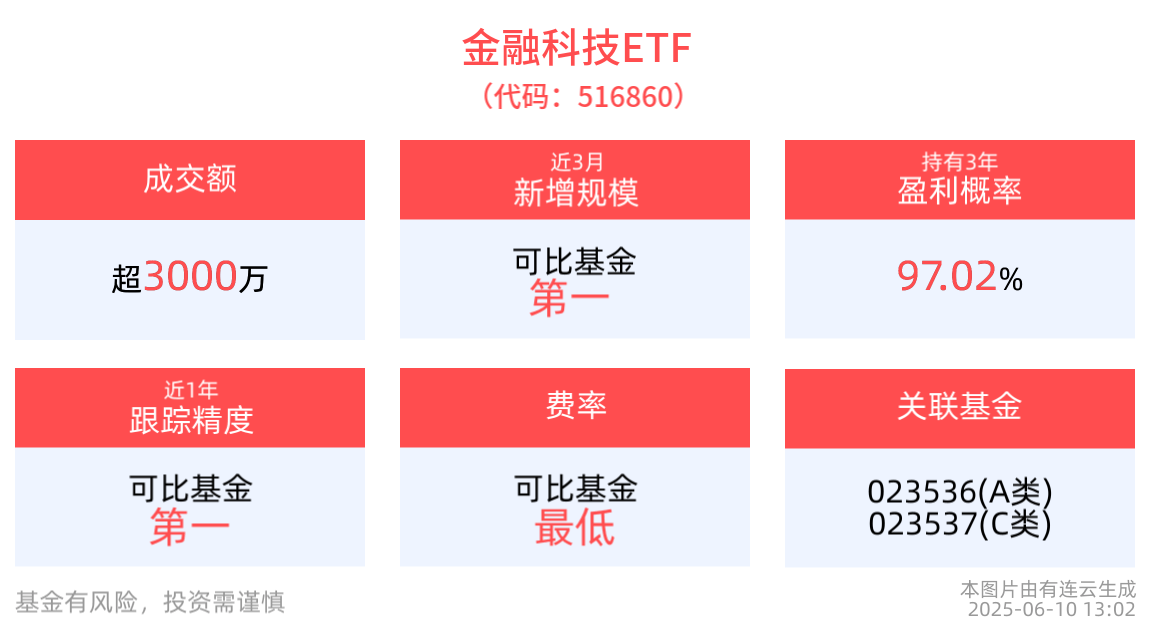
信创产业链整合或将加速推进,金融科技ETF(516860)近3月新增规模居可比基金首位
Sou Hu Cai Jing· 2025-06-10 05:28
Group 1 - The China Securities Financial Technology Theme Index (930986) decreased by 1.49% as of June 10, 2025, with mixed performance among constituent stocks [3] - Chutianlong (003040) led the gains with an increase of 3.97%, while Xinzhi Software (688590) experienced the largest decline at 9.48% [3] - The Financial Technology ETF (516860) fell by 1.36%, with a latest price of 1.23 yuan and a turnover rate of 4.34% [3] Group 2 - Zhongke Shuguang announced a merger plan with Haiguang Information, which is seen as a milestone event in China's information technology sector [3] - This merger is expected to enhance the integration of resources in the industry chain and promote the upgrade of domestic computing power and information technology [3] - The financial technology sector is anticipated to enter a new cycle by 2025, with accelerated industry chain integration focusing on domestic computing power, hardware, operating systems, and EDA [3] Group 3 - The Financial Technology ETF has seen a significant growth of 843.93 million yuan in the past three months, ranking in the top third among comparable funds [4] - As of June 9, 2025, the ETF's net value increased by 83.67% over the past year, placing it in the top 0.60% of equity funds [4] - The ETF's historical performance includes a maximum monthly return of 55.92% and an average monthly return of 10.19% [4] Group 4 - The management fee for the Financial Technology ETF is 0.50%, and the custody fee is 0.10%, which are among the lowest in comparable funds [5] - The ETF has the highest tracking accuracy among comparable funds, with a tracking error of 0.046% over the past year [5] - The top ten weighted stocks in the index account for 52.03% of the total, with Tonghuashun (300033) having the highest weight at 9.50% [5][7]


公募基金调研延续高强度态势 6月第一周调研次数超660次
Zheng Quan Shi Bao Wang· 2025-06-09 06:33
Group 1 - The public fund industry continues to focus on high-intensity research, particularly in hard technology and pharmaceuticals, with 123 public fund institutions conducting 662 research sessions on 112 A-shares in the first week of June [1] - The optical and optoelectronic industry, represented by Hongjing Optoelectronics (301479), received the most attention, with over 20% of public fund institutions participating in 36 research sessions [1] - A total of 22 secondary industries received at least 10 research sessions, indicating a concentrated interest in specific sectors [1] Group 2 - The optical and optoelectronic industry had the highest research activity, with 7 stocks collectively receiving 72 sessions, followed by the chemical pharmaceutical industry with 59 sessions across 6 stocks [2] - The jewelry industry saw a notable increase in attention, with companies like Cuihua Jewelry and Mankalon receiving a total of 46 research sessions [2] - Public fund institutions are increasingly focusing on technology, pharmaceuticals, and consumer upgrades, reflecting current market conditions [2] Group 3 - Yifan Pharmaceutical (002019) discussed its innovative drug development during institutional research, emphasizing the importance of cautious and rational approaches to R&D, particularly for First-in-Class (FIC) drugs [3] - The company is prioritizing the development of its drug F-652 for alcohol-related liver disease in collaboration with U.S. research institutions, while also evaluating risks and opportunities [3] - Yifan Pharmaceutical is also advancing early-stage products like IL-15 fusion protein, which are still in the early research phase [3]
RWA:为现实世界资产开启数字金融之门
AVIC Securities· 2025-06-09 05:09
Investment Rating - The industry investment rating is "Overweight" [3] Core Insights and Investment Recommendations - RWA (Real World Assets) refers to the tokenization of traditional physical assets through blockchain technology, enabling real-time trading and circulation of these assets in a digital network, addressing liquidity issues, trust deficits, and high transaction costs in traditional finance, thus presenting new opportunities for global economic and financial digital innovation [4][8] - The potential market for tokenized digital securities is projected to reach $4-5 trillion by 2030, with trade finance based on distributed ledger technology (DLT) expected to reach $1 trillion [4][8] - The report emphasizes the importance of focusing on three growth themes: blockchain + fintech, renewable energy + RWA, and cross-border payments, highlighting specific companies to watch in each category [4] Summary by Sections RWA Overview - RWA involves the conversion of traditional assets into digital tokens, facilitating online trading and addressing challenges posed by globalization [4][8] - The report outlines the diverse asset classes that can be tokenized, including real estate, private credit, government bonds, commodities, and equities [39] Business Development and Regulation - The process of RWA issuance requires compliance with regulatory frameworks, ensuring asset value, ownership, and legal status are clearly defined [4][30] - The report discusses the regulatory landscape in regions like Hong Kong and the U.S., highlighting the establishment of frameworks for virtual assets and stablecoins [47][49] Technology, Market, and Ecosystem - RWA technology is structured in three layers: core architecture, middleware, and application layer, facilitating the conversion of physical assets into tradable digital tokens [52] - The ecosystem involves various participants, including asset issuers, technology service providers, liquidity providers, compliance entities, and investors, creating a collaborative environment for RWA [9][63] - The report predicts that the global RWA market could exceed $16 trillion by 2030, driven by the increasing adoption of stablecoins and regulatory advancements [54][58]