
上美股份

Search documents
国庆出行活跃,远途游及情绪消费亮眼
HTSC· 2025-10-09 03:04
Investment Rating - The report maintains an "Overweight" rating for the consumer discretionary sector [7] Core Insights - The report highlights robust growth in consumption during the National Day and Mid-Autumn Festival holidays, driven by overlapping holidays and increased travel intentions, with daily cross-regional passenger flow reaching 304 million, a year-on-year increase of 6.2% [2][16] - The report identifies structural opportunities in the consumption sector, particularly in emotional consumption, the rise of domestic brands, and AI-driven consumer experiences [2][5] Retail Sector Summary - Retail sales for key retail and catering enterprises increased by 3.3% year-on-year during the first four days of the holiday [2] - Popular tourist provinces and lower-tier cities showed strong performance, with cities like Qingdao (+8.2%) and Nanjing (+5.9%) leading the way [2][11] - Emotional consumption trends are emerging, with significant sales increases in products like projectors and gaming consoles, which saw year-on-year growth of 245% and 292% respectively [2][12] Tourism Sector Summary - The long holiday period has amplified travel intentions, with long-distance and cross-border travel demand remaining strong [3][16] - Domestic long-distance travel orders increased by 3 percentage points year-on-year, with popular tourist destinations experiencing significant visitor growth [3][17] - Outbound tourism to Hong Kong and Macau saw daily visitor numbers increase by 6.4% and 7.8% respectively [22] Dining and Hospitality Summary - The dining and hotel sectors experienced moderate growth, with average prices remaining stable [4][37] - The average daily sales for duty-free shopping in Hainan reached approximately 1.2 billion yuan, reflecting an 11% year-on-year increase [27] - Hotel revenue per available room (RevPAR) showed a year-on-year increase of 6.27%, driven by growth in average daily rates (ADR) [37] Investment Recommendations - The report emphasizes institutional investment opportunities in the consumer sector for 2025, recommending four main investment themes: the rise of domestic brands, high-growth emotional consumption, the silver economy, and AI-driven consumer experiences [5][9]



国货离成为“中国欧莱雅”,还差多少个第二品牌?
3 6 Ke· 2025-10-09 01:52
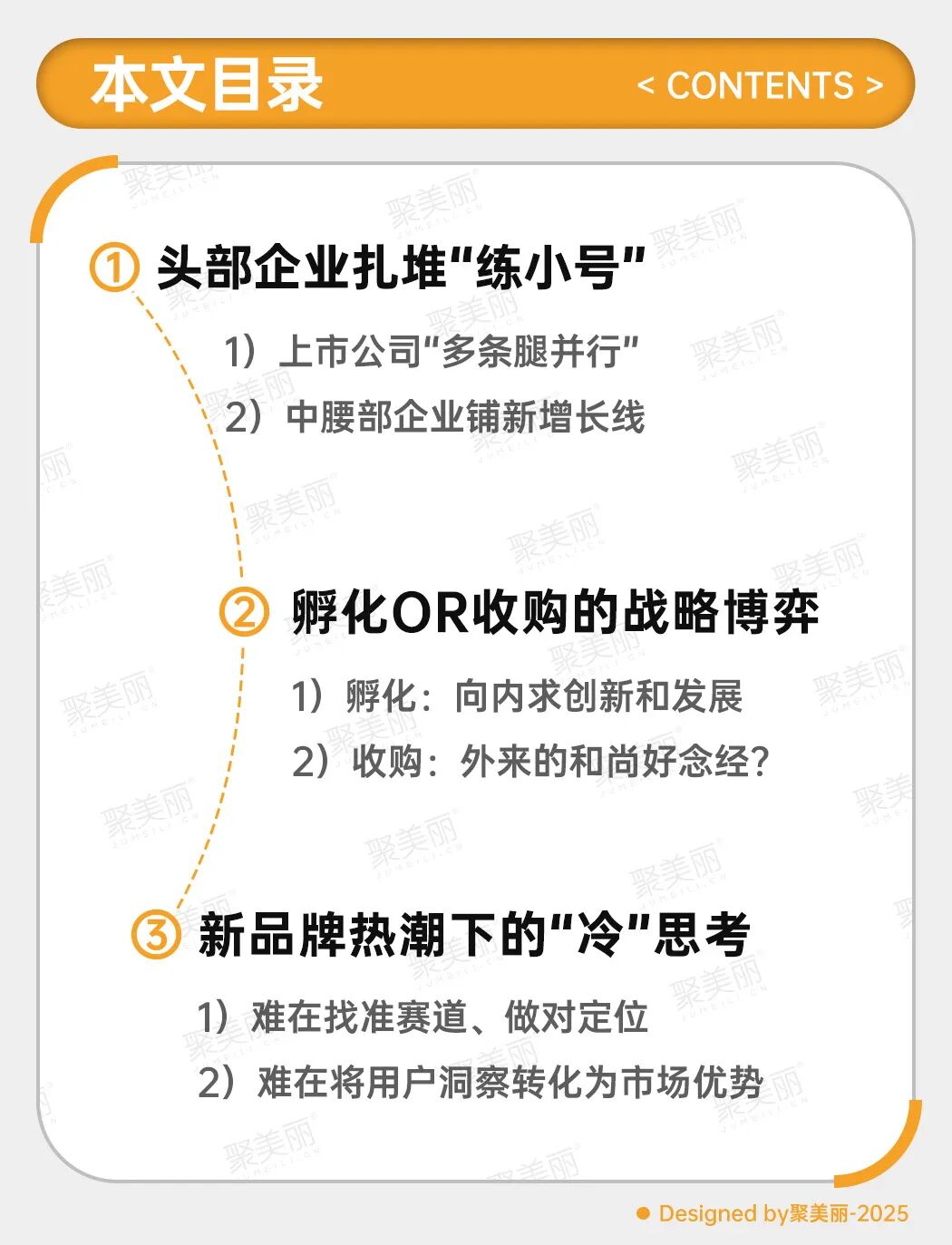
Core Insights - The Chinese beauty industry is experiencing a significant transformation, with many brands exiting the market while others are rapidly launching new sub-brands to adapt to changing consumer demands and market conditions [1][8][24]. Group 1: Industry Trends - The beauty industry is facing a "winter" period, leading to the exit of several brands such as Qiaodi Shanghui and Jing Sheng Zhi Yuan [1]. - Despite the challenges, there is a surge in new brand launches, indicating a robust response from leading companies [1][8]. - Major players like Shangmei Co., Beitaini, and Polaroid are actively developing multiple sub-brands to enhance their market presence [8][24]. Group 2: Company Strategies - Shangmei Co. has launched three new brands this year, including NAN beauty, a high-end anti-aging brand Tazu, and a baby care brand [10][11]. - Beitaini is set to introduce a new acne treatment brand, Ansta, which has been in development for three years [15][16]. - Polaroid is considering overseas acquisitions to fill gaps in its product offerings, targeting markets such as baby care and men's grooming [17][24]. Group 3: Market Positioning - The multi-brand strategy allows companies to cater to diverse consumer needs across different demographics, enhancing their competitive edge [24][29]. - Companies are focusing on leveraging their main brand strengths to create differentiated sub-brands that address specific market segments [27][30]. - The trend of building a multi-brand matrix is becoming standard among leading beauty companies in China, moving away from a single-brand dominance [28][39]. Group 4: Growth Strategies - Companies are employing both internal brand incubation and external acquisitions as primary methods for expanding their brand portfolios [29][33]. - Internal incubation allows companies to innovate and meet emerging consumer demands effectively, while acquisitions provide immediate access to established brands and markets [32][38]. - The balance between these strategies is crucial for sustained growth and market relevance in a competitive landscape [39].


国元证券2025年10月金股组合及投资逻辑
Guoyuan Securities· 2025-10-08 13:41
Stock Recommendations - 运机集团 (001288.SZ)预计2025年EPS为1.29,2026年EPS为2.11,当前PE(TTM)为35.57[2] - 国能日新 (301162.SZ)预计2025年EPS为0.94,2026年EPS为1.24,当前PE(TTM)为75.96[2] - 保隆科技 (603197.SH)预计2025年EPS为2.03,2026年EPS为2.58,当前PE(TTM)为33.01[2] - 中际旭创 (300308.SZ)预计2025年EPS为7.21,2026年EPS为8.90,当前PE(TTM)为65.88[2] - 上美股份 (2145.HK)预计2025年EPS为2.58,2026年EPS为3.23,当前PE(TTM)为39.44[2] Market Performance - 2025年9月国元金股组合自由流通加权收益率为12.44%,等权收益率为11.20%[10] - 同期上证指数上涨0.64%,沪深300上涨3.20%[10] - 表现最佳的ETF为汇添富中证电池主题ETF,上涨38.93%[10] Growth Indicators - 中际旭创市值达到4485.36亿元,ROE接近40%[17] - 国能日新归母净利润增速为32.48%,营业收入增速为43.15%[19] - 保隆科技近一个月涨幅为15.85%,换手率超过100%[17] Risks - 经济恢复及政策发力不及预期的风险[4] - 行业及个股自身经营风险[4]



上美股份(02145) - 截至2025年9月30日止股份发行人的证券变动月报表
2025-10-08 08:37
股份發行人及根據《上市規則》第十九B章上市的香港預託證券發行人的證券變動月報表 截至月份: 2025年9月30日 狀態: 新提交 致:香港交易及結算所有限公司 I. 法定/註冊股本變動 | 1. 股份分類 | 普通股 | 股份類別 | H | | | 於香港聯交所上市 (註1) | | 是 | | | --- | --- | --- | --- | --- | --- | --- | --- | --- | --- | | 證券代號 (如上市) | 02145 | 說明 | | | | | | | | | | | 法定/註冊股份數目 | | | 面值 | | | 法定/註冊股本 | | | 上月底結存 | | | 206,319,319 | RMB | | 1 | RMB | | 206,319,319 | | 增加 / 減少 (-) | | | 35,223 | | | | RMB | | 35,223 | | 本月底結存 | | | 206,354,542 | RMB | | 1 | RMB | | 206,354,542 | | 2. 股份分類 | 普通股 | 股份類別 | 其他類別 (請註明) | | ...
国货排名第七的自然堂赴港股IPO,招股书透露两大隐忧
Sou Hu Cai Jing· 2025-10-02 05:22
Core Viewpoint - The Chinese beauty brand Natureround is set to go public on the Hong Kong Stock Exchange, following the trend of domestic beauty brands seeking IPOs, despite facing challenges such as reliance on its main brand and decreasing R&D expenditure rates [1][5]. Group 1: IPO Details - Natureround Global Holdings Limited submitted its prospectus to the Hong Kong Stock Exchange on September 29, aiming for a main board listing, with Huatai International and UBS Group as joint sponsors [1]. - The company has attracted significant strategic and financial investors, including L'Oréal, which invested 442 million yuan for a 6.67% stake, and Hua Capital, which invested 300 million yuan for a 4.20% stake [1]. Group 2: Market Position and Performance - Natureround claims to be the third-largest domestic cosmetics group in China by retail sales for 2024, although its actual ranking is sixth when compared to other listed domestic brands [5][6]. - The flagship brand, Natureround, has maintained a top-two position in retail sales among domestic brands for 12 consecutive years, but has missed the rapid growth opportunities since 2017 [6][7]. Group 3: Financial Performance - Natureround's revenue has shown stable growth over the past three years, with figures of 4.292 billion yuan in 2022, 4.442 billion yuan in 2023, and projected 4.601 billion yuan in 2024, reflecting growth rates of 3.49% and 3.58% for 2023 and 2024 respectively [6][10]. - The company reported a revenue of 2.448 billion yuan in the first half of 2025, marking a year-on-year increase of 6.43% [6][10]. Group 4: Brand Dependency and R&D - Natureround heavily relies on its main brand, which contributed 94.6% to 95.9% of total revenue from 2022 to 2024, indicating a lack of diversification [8]. - The R&D expenditure rate has been declining, from 2.8% in 2022 to 1.7% in the first half of 2025, raising concerns about the company's innovation capabilities [10]. Group 5: Profitability Challenges - Despite a rising gross profit margin from 66.5% in 2022 to 70.1% in the first half of 2025, the net profit margin remains low, with figures around 7.80% for the first half of 2025 and 4.13% for 2024, primarily due to high sales and marketing costs [10].
港股新消费概念股普跌,名创优品跌3%
Ge Long Hui A P P· 2025-10-02 03:53
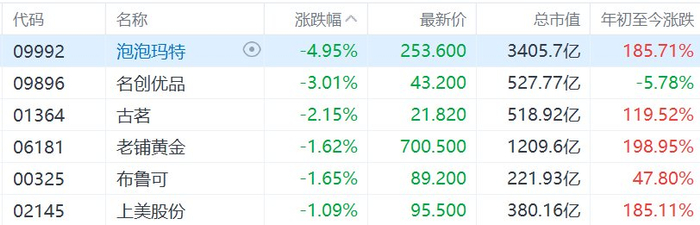
Group 1 - The Hong Kong stock market saw a decline in new consumption concept stocks, with notable drops in companies such as Pop Mart, Miniso, and Gu Ming [1] - Pop Mart experienced a decline of 4.95%, with a latest price of 253.600 and a total market capitalization of 340.57 billion, while year-to-date growth stands at 185.71% [2] - Miniso's stock fell by 3.01%, with a latest price of 43.200 and a market cap of 52.777 billion, reflecting a year-to-date decline of 5.78% [2] Group 2 - Gu Ming's stock decreased by 2.15%, with a latest price of 21.820 and a market cap of 51.892 billion, showing a year-to-date increase of 119.52% [2] - Lao Pu Gold saw a drop of 1.62%, with a latest price of 700.500 and a market cap of 120.96 billion, while year-to-date growth is at 198.95% [2] - Bluco's stock fell by 1.65%, with a latest price of 89.200 and a market cap of 22.193 billion, reflecting a year-to-date increase of 47.80% [2]

2025年第39周:美妆行业周度市场观察
艾瑞咨询· 2025-10-01 00:00
Core Insights - The beauty industry in China is experiencing significant changes, with a focus on high-end fragrance brands, domestic beauty brands' performance, and the integration of science and global strategies in the market [2][3][4][5][6][7]. Industry Environment - Douyin e-commerce has revitalized the perception of "Chinese good ingredients," showcasing natural components from local brands and enhancing consumer trust through expert endorsements and interactive marketing [3]. High-End Fragrance Market - The fragrance category is witnessing growth despite overall market pressures, with projections indicating the Chinese perfume market will reach 24.9 billion yuan by 2025 and exceed 33.9 billion yuan by 2028, reflecting a compound annual growth rate of 8% [4]. Domestic Beauty Brands Performance - In the first half of 2025, the domestic beauty market grew by 3.1%, with leading brands like Proya achieving 5.36 billion yuan in revenue, while others like Huaxi Biological faced challenges [5]. Globalization and Scientific Innovation - The second half of the domestic beauty market is expected to focus on scientific advancements, segmentation of consumer scenarios, and globalization strategies [7]. Medical Beauty and Cosmetic Integration - The medical beauty sector is projected to grow at a compound annual growth rate of 10%-15% from 2024 to 2027, with brands increasingly merging beauty and medical aesthetics to meet consumer demands for comprehensive care [10]. E-commerce and Brand Strategies - E-commerce operators in the beauty sector are facing challenges, with only one company, Ruoyu Chen, showing significant growth amidst a broader industry slowdown [14]. New Product Launches and Brand Collaborations - Major brands like L'Oréal are expanding into the fragrance market with new high-end products, while emerging brands like Huaxizi are innovating in skincare with a focus on traditional Chinese medicine [16][17]. Market Trends and Consumer Behavior - The beauty market is seeing a shift towards affordable and effective products, with brands needing to adapt to changing consumer preferences and the competitive landscape [12][25].

国货美妆超级独角兽要上市了!郑春颖家族迎来资本盛宴!
Guo Ji Jin Rong Bao· 2025-09-30 15:48
Core Viewpoint - Chando Global Holdings Limited, a Chinese beauty unicorn, has applied for a listing on the Hong Kong Stock Exchange, marking a significant milestone for the company and its founder, Zheng Chunying, after 24 years in the capital market [1][3]. Group 1: Company Overview - Founded in 2001 by Zheng Chunying, Chando has grown from a beauty chain in Northeast China to a major player in the beauty industry, launching brands like "Meisu" and flagship brand "Chando" [3]. - Chando has established a multi-brand matrix, including five main brands: Chando, Peffy, Meisu, Chunxia, and Jichu, covering skincare, color cosmetics, and personal care categories [3]. - As of 2024, Chando is the third-largest domestic cosmetics group in China by retail sales, with its single brand ranking second among domestic brands, just below Pechoin [3]. Group 2: Financial Performance - Chando's revenue has shown consistent growth, with reported revenues of 4.292 billion, 4.442 billion, 4.601 billion, and 2.448 billion yuan for the years 2022 to 2025 H1, respectively, with a year-on-year growth of 6.4% in the first half of 2025 [3][4]. - The net profit for the same periods was 139 million, 302 million, 190 million, and 191 million yuan, indicating a stable profit trajectory [3]. Group 3: Market Position and Strategy - The growth in revenue is primarily attributed to the expansion of online channels and an increase in the number of offline retailers, with online revenue share rising from 59.7% in 2022 to 68.8% in the first half of 2025 [4]. - Chando's gross margin improved from 66.5% to 70.1%, although it remains lower than some high-end competitors, indicating potential for further premiumization [4]. Group 4: IPO and Future Plans - The IPO proceeds will be used to enhance direct-to-consumer capabilities, improve online and offline sales synergy, expand the multi-brand matrix, invest in R&D, and strengthen digital capabilities in membership, supply chain, and sales management [7]. - The company aims to enhance its production facilities and expand its international market presence to increase brand recognition and penetration [7].

上美股份根据限制性股票单位激励计划发行3.52万股H股
Zhi Tong Cai Jing· 2025-09-30 15:05
Group 1 - The company, Shangmei Co., Ltd. (stock code: 02145), announced the adoption of a restricted stock unit incentive plan on December 14, 2023 [1] - Under this plan, the company will issue and allocate 35,200 H-shares by September 30, 2025 [1]
上美股份(02145.HK)授出合共5.11万份限制性股票单位
Ge Long Hui· 2025-09-30 15:04
Core Viewpoint - The company, Shangmei Co., Ltd. (02145.HK), announced the grant of a total of 51,130 restricted stock units to five grantees under its incentive plan, representing 0.01% of the total shares issued as of the announcement date [1] Summary by Category - **Company Announcement** - Shangmei Co., Ltd. will grant 51,130 restricted stock units to five individuals [1] - The total number of shares granted represents 0.01% of the company's total issued shares as of the announcement date [1]