
小马智行

Search documents
广汽集团:2025年4月23日,安滴科技在上海车展上发布全球首款前装量产L4级自动驾驶汽车
Zheng Quan Ri Bao Zhi Sheng· 2026-01-22 14:07
Core Viewpoint - GAC Group is actively developing a comprehensive L4 autonomous driving ecosystem, focusing on Robotaxi commercialization through strategic partnerships and investments in autonomous driving technology companies [1] Group 1: Company Initiatives - GAC Group is one of the early domestic automakers to systematically layout around Robotaxi, aiming to create a full chain from R&D, production to commercial operation [1] - The company has incubated a smart mobility platform, Qichuxing, which has launched Robotaxi commercial demonstration operations in multiple locations in the Greater Bay Area [1] - In 2024, GAC Aion and Didi Autonomous Driving will jointly establish Guangzhou Andi Technology Co., Ltd., focusing on L4 Robotaxi R&D and mass production [1] Group 2: Strategic Partnerships and Investments - GAC Capital, a wholly-owned subsidiary, has invested in several domestic autonomous driving technology companies, including Didi Autonomous Driving, WeRide, and Pony.ai, to deepen strategic cooperation around Robotaxi commercialization [1] - On April 23, 2025, Andi Technology will unveil the world's first mass-produced L4 autonomous vehicle at the Shanghai Auto Show, marking a significant milestone in Robotaxi commercialization [1] - The seventh-generation Robotaxi model, co-developed with Pony.ai, will also be officially launched on the same day, laying the foundation for large-scale commercialization of Robotaxi [1]

智驾行业的话语权,究竟掌握在哪些公司手中?
经济观察报· 2026-01-22 11:31
《中国智能驾驶行业趋势白皮书(2025)》认为,能够穿越 周期的幸存者,并非最早出发的,也非口号最响亮的,而是无 一例外地在技术理想与商业现实间找到了那条狭窄的平衡带, 它们普遍具备五大特征。 封图:图片资料室 曾经,智能驾驶的故事由资本狂热书写,L4的技术梦想吸引无数玩家涌入赛道。但当行业从浪漫 期行至商业化攻坚期,活下去成为所有参与者面对的最大难题。 2025年,累计交付超20万套城区NOA辅助驾驶系统的元戎启行,以一份逼近40%的月度市场份 额成绩单,揭示出行业现阶段真正的生存法则:数据是未来燃料,装车量即话语权。 从高举高打的技术公司,到深度绑定长城、吉利等主流车企的规模化供应商,元戎启行的蜕变之 路,是智能驾驶行业从技术竞赛转向数据竞争、从实验室 Demo 走向规模化交付的一个缩影。 根据《 中国智能驾驶行业趋势白皮书(2025) 》,并以元戎启行为例,外界能够看到当下行业 竞争的本质:如何在技术、数据、商业与生态之间找到平衡,成为穿越周期的最终幸存者。 活下去,需要多少车? 2019年后,智能驾驶行业的共识逐渐被重塑。资本不再为遥远的L4故事买单,投资人只问两个问 题:你拿到了多少量产订单?你的收 ...


智驾行业的话语权,究竟掌握在哪些公司手中?
Jing Ji Guan Cha Bao· 2026-01-22 07:36
Core Insights - The smart driving industry is transitioning from a romantic phase focused on L4 technology to a commercial phase where survival is the primary challenge for participants [2][3] - Data is identified as the future fuel of the industry, with vehicle delivery volume equating to market influence and competitive advantage [3][4] Industry Trends - The consensus in the smart driving industry has shifted post-2019, with investors focusing on production orders and revenue sources rather than distant L4 aspirations [3] - The penetration rate of urban NOA (Navigation Assisted Driving) systems is expected to exceed 10% by the end of 2025, marking a critical point for scaling [3][4] Company Strategy - Yuanrong Qixing has achieved a nearly 40% market share in the urban NOA supplier market as of October 2025, with a cumulative delivery of over 200,000 systems [3][4] - The company employs a "car sea strategy," partnering with mainstream brands like Great Wall and Geely to ensure widespread adoption rather than focusing solely on luxury brands [3][4] Data and Technology - Accumulating large-scale data through mass-produced vehicles is essential for the evolution of smart driving algorithms, as more vehicles generate richer scenario data [4][5] - The industry is entering an "AI model-driven phase," where the ability to create a data feedback loop is more critical than the algorithms themselves [6][7] Competitive Landscape - The competition has evolved into a comprehensive battle between third-party suppliers and in-house development by automakers, focusing on technology, production, cost, and data capabilities [8][9] - Leading players like Yuanrong Qixing, Huawei, and Momenta are forming a triad in the market, with vehicle delivery volume being a key differentiator [8][9] Business Model Evolution - The industry is moving from a one-time hardware sales model to a subscription-based software and service model, which requires a substantial user base to be sustainable [10][11] - Yuanrong Qixing's strategy emphasizes the importance of achieving a critical mass of vehicle deliveries to support a subscription model and reduce costs [10][11] Characteristics of Survivors - Successful companies in the smart driving sector are characterized by their ability to create a closed-loop data flow and iterative capabilities [13][14] - A strong alignment between technology choices and business paths is crucial for market validation and operational success [14][15] - Companies must demonstrate healthy cash flow or a clear path to profitability, with vehicle delivery volume being essential for cost distribution and subscription service viability [15][16] - Finding a unique ecological niche within the industry is vital for survival, allowing companies to collaborate effectively with major automakers [16] - The ability to deliver products at scale is critical, as demonstrated by Yuanrong Qixing's successful mass delivery of urban NOA systems [16]

文远知行20260121
2026-01-22 02:43
Summary of the Conference Call for 文远知行 Company Overview - 文远知行 specializes in L4 autonomous driving technology, with a founding team from Baidu's autonomous driving division, holding multiple city road test licenses without any severe accidents [2][5] - The company has diversified its business into Robot Bus, Robot Van, and Robot Sweeper, receiving continuous investment from shareholders like Yutong Group, GAC Group, and Bosch [2][5] Financial Performance - In the first three quarters of 2025, the company reported revenue of 370 million CNY, a 68% year-on-year increase, with Robotaxi business contributing approximately 100 million CNY, accounting for about 30% of total revenue [2][6] - Despite high R&D and sales management expenses leading to losses, the dual listing in the US and Hong Kong provides ample cash reserves [2][6] Global Expansion and Market Strategy - 文远知行 is advancing its autonomous driving business globally, achieving fully unmanned commercial operations in Beijing and Guangzhou, and obtaining a unique unmanned commercial operation license in Abu Dhabi [2][7] - The company has conducted R&D testing and operations in over 30 cities across 11 countries [2][7] Market Outlook for Robotaxi - The Robotaxi market is projected to grow significantly, with expectations that by 2030, it will account for over 30% of China's shared mobility market, reaching a market size of approximately 200 billion CNY [2][8] - 文远知行 is among the top three companies in China focusing on Robotaxi, with plans to deploy 500 to 1,000 Robotaxis in Abu Dhabi by 2026, potentially generating hundreds of millions to over 1 billion CNY in revenue [2][8] Product Line Diversification - In addition to Robotaxi, the company is focusing on other product lines like Bus and Sweeper to enhance operational efficiency and secure more government resources, which could lead to additional Robotaxi licenses [2][9][10] - The Bus initiative has already launched commercial trials in 25 cities with 2,000 intent orders, while the Sweeper product aims to enter new markets through non-Taxi channels [2][9][10] Technological Solutions - 文远知行 offers end-to-end solutions in collaboration with Bosch, utilizing Orin X chips in high-end versions of vehicles, which are expected to be reused in models beyond Chery [2][11] - The company's technological capabilities have been validated through impressive performance in testing, indicating a strong competitive edge [2][11] Future Valuation and Strategic Direction - The company is considered to have a relatively low valuation compared to global peers, with projected revenues of 550 to 600 million CNY in 2025, indicating significant growth potential [2][12] - The unique and executable nature of its overseas and multi-product strategies positions 文远知行 as a noteworthy investment opportunity [2][12]

英特尔涨11.7%,AMD涨7.1%,美光科技涨6.6%,英伟达涨2.9%
财联社· 2026-01-22 00:39
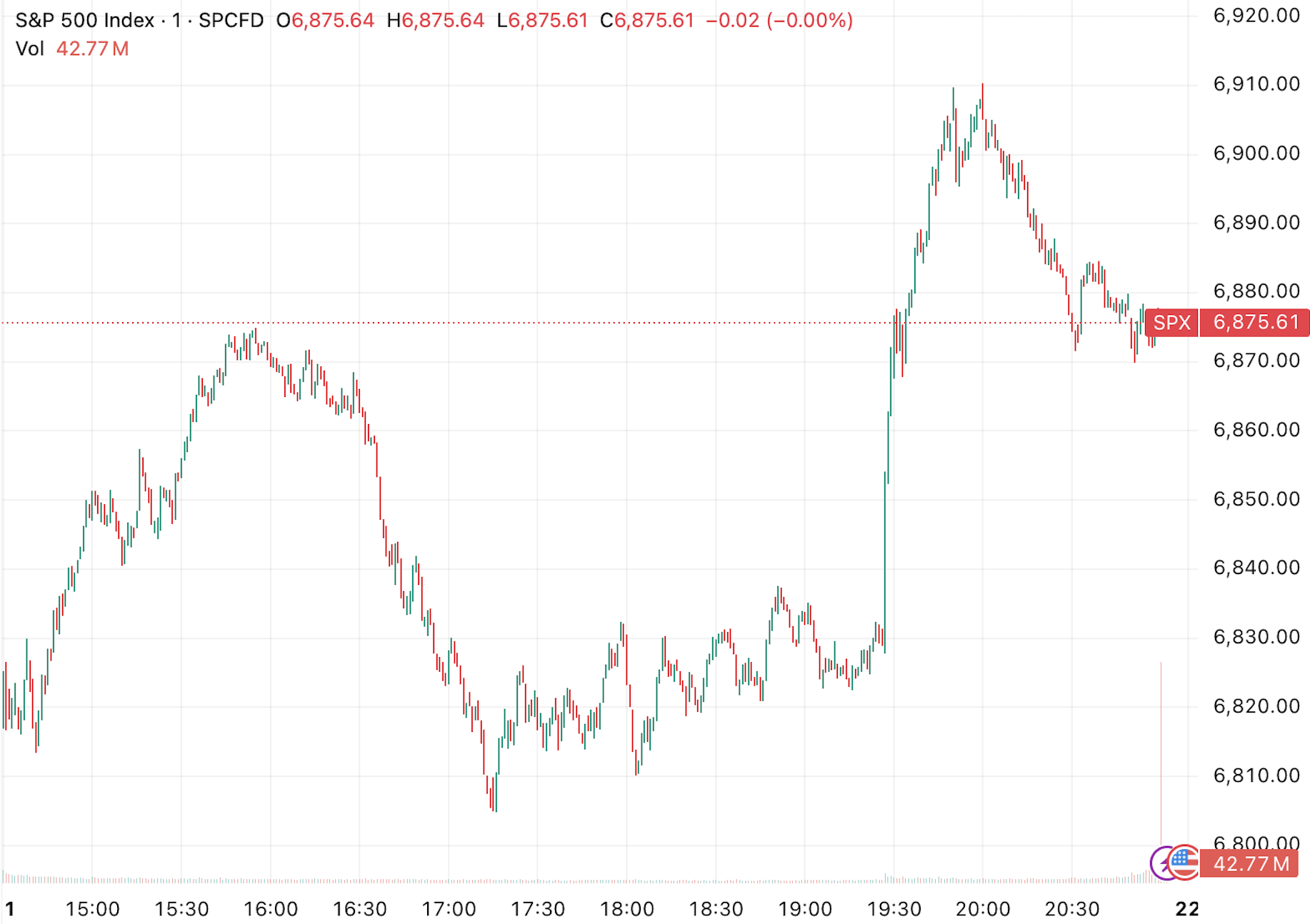
Core Viewpoint - The U.S. stock market experienced a significant rebound following President Trump's cancellation of new tariffs on European countries and his announcement of a "framework agreement" regarding Greenland [1][3]. Market Performance - The Dow Jones Industrial Average rose by 1.21%, closing at 49,077.23 points; the S&P 500 increased by 1.16%, ending at 6,875.62 points; and the Nasdaq Composite gained 1.18%, finishing at 23,224.82 points [2]. Political Developments - Trump stated at the World Economic Forum in Davos that he would not use military force to acquire Greenland, which positively influenced the stock market. He mentioned a productive discussion with NATO Secretary General Mark Rutte, leading to a future agreement framework concerning Greenland and the Arctic region [3]. - Trump had previously announced a 10% tariff on goods from Denmark, Norway, Sweden, France, Germany, the UK, the Netherlands, and Finland, set to take effect on February 1, with a potential increase to 25% by June 1 if an agreement on Greenland was not reached [4]. Market Reactions - The stock market had previously declined sharply due to Trump's escalation of tariff threats and the possibility of military action regarding Greenland, marking the worst single-day performance since October 10 [6]. - The market's reaction to Trump's tariff cancellation reflects a trend where investors no longer assume his statements will be executed, indicating a level of unpredictability in his administration's policies [7]. Stock Performance - Major technology stocks mostly rose, with Nvidia up 2.95%, Apple up 0.39%, Microsoft down 2.29%, Google up 1.98%, Amazon up 0.13%, Meta up 1.46%, Tesla up 2.91%, Broadcom down 1.14%, Oracle down 3.36%, Netflix down 2.18%, Micron Technology up 6.61%, AMD up 7.11%, and Intel up 11.72% [7]. - Chinese concept stocks also saw gains, with the Nasdaq Golden Dragon China Index rising 2.21%, Alibaba up 3.87%, JD.com up 2.43%, Pinduoduo up 1.40%, NIO up 2.41%, Xpeng up 1.70%, Li Auto up 2.48%, Bilibili up 5.65%, Baidu up 8.17%, while NetEase fell 4.07%, Tencent Music down 0.80%, and Pony.ai up 2.55% [7].



广东:推动自动驾驶大模型落地
Nan Fang Du Shi Bao· 2026-01-21 23:11
Core Viewpoint - Guangdong Province has officially issued a set of policies aimed at promoting high-quality development in transportation through artificial intelligence, establishing a comprehensive support system for smart transportation development [2] Group 1: Policy Measures - The policy includes 14 concrete measures to create a full-chain system of "core element supply - innovative scenario empowerment - work mechanism guarantee" [2] - It aims to accelerate the pilot application of intelligent connected vehicles and support the establishment of demonstration application recognition in free trade zones and administrative regions [2][5] Group 2: Data and Technology Support - The measures focus on three main areas: data supply, computing power and algorithm support, and key technology breakthroughs [3] - Guangdong will enhance data governance in the transportation sector, creating a standardized resource directory that includes key areas such as highways, railways, and ports [3] - The province will utilize data centers to support the orderly construction of computing power and deploy edge computing nodes in critical locations to form a collaborative system [3][4] Group 3: Application Scenarios - Eight innovative application scenarios are outlined to transition AI technology from the laboratory to practical use, including remote driving and intelligent decision-making [5][6] - The policy supports the construction of a national "vehicle-road-cloud integration" application pilot city in Guangzhou and Shenzhen, promoting the testing of autonomous driving in logistics scenarios [6] Group 4: Smart Infrastructure Development - The measures propose the integration of AI and domestic BIM technology in smart road construction, enhancing maintenance through unmanned inspections and data analysis [6] - The policy aims to transform road network management from "visible and measurable" to "intelligent research and prevention" [6] Group 5: Enhancing Transportation Efficiency - The integration of AI in rail transport will facilitate the optimization of passenger flow prediction and dynamic capacity allocation [7] - The development of a comprehensive monitoring system for waterways will enhance navigation efficiency and information exchange [7] Group 6: Emergency and Logistics Applications - AI will be applied in civil aviation for flight flow management and airport operations, optimizing resource allocation and enhancing safety [8] - The logistics sector will benefit from AI in demand integration and capacity allocation, improving multi-modal transport efficiency [9]
特朗普取消对欧加征关税,美股三大指数均涨超1%,中概股多数上涨
Feng Huang Wang· 2026-01-21 22:14
美东时间周三,在美国总统特朗普取消针对欧洲国家的新一轮关税、并称已就格陵兰问题达成"协议框架"后,美国股市大幅反弹,三大指数均涨超1%。 (标普500指数日内走势图,来源:TradingView) 截至收盘,道琼斯指数涨1.21%,报49,077.23点;标普500指数涨1.16%,报6,875.62点;纳斯达克指数涨1.18%,报23,224.82点。 特朗普周三在瑞士达沃斯举行的世界经济论坛上发表讲话,表示不会动用武力获取格陵兰,这一表态提振了股市。 随后,特朗普在其自创社交平台Truth Social上表示:"基于我与北约秘书长马克·吕特进行的一次极富成效的会谈,我们已经就格陵兰问题,事实上也是就整 个北极地区,形成了一项未来协议的框架。基于这一共识,我将不会实施原定于2月1日生效的关税措施。" 马斯克于周二表示,公司旗下Cybercab自动驾驶出租车、Optimus人形机器人的初期生产速度将"极其缓慢",之后才会逐步提升。据了解,Cybercab是一款双 座车型,整车未配备方向盘、踏板等人工操控装置。这家电动汽车制造商此前曾表示,Cybercab计划于2026年启动大规模量产,Optimus人形机器人 ...
美股异动|小马智行盘前涨2.3% Robotaxi技术领跑者 券商指其有望充分受益于政策逐步开放
Ge Long Hui· 2026-01-21 09:43
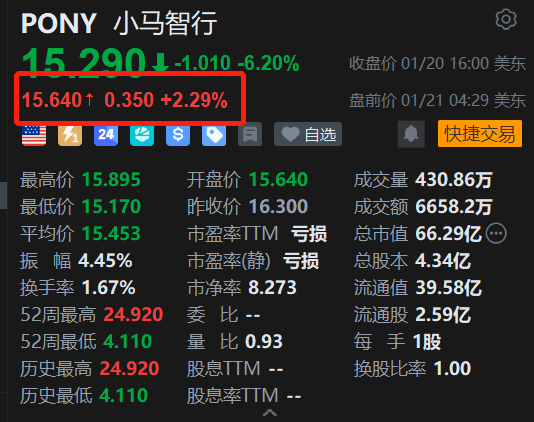
Core Viewpoint - Pony.ai (PONY.US) is recognized as a leading global player in autonomous driving, having obtained autonomous driving licenses in eight countries, positioning itself to benefit from policy liberalization and technological advancements in the industry [1] Group 1: Company Performance - The stock price of Pony.ai increased by 2.3% to $15.64 in pre-market trading [1] - The company is projected to achieve total revenues of 5.55 billion, 9.45 billion, and 19.87 billion yuan for the years 2025, 2026, and 2027 respectively [1] - The current market capitalization corresponds to price-to-sales (PS) ratios of 43.0, 25.2, and 12.0 for the years 2025, 2026, and 2027 [1] Group 2: Industry Outlook - As a leader in Robotaxi technology, Pony.ai is expected to rapidly scale and turn profitable as unit economics improve [1] - The company is positioned to benefit from ongoing cost reductions across the industry supply chain [1]
三重赛道博弈:中资企业跨境上市的路径抉择与现实考量
Sou Hu Cai Jing· 2026-01-21 09:24
2026年的全球资本市场,中资企业跨境上市早已告别"美股为主、港股补充"的单一逻辑。随着纳斯达克 规则趋严、港交所审核拥堵,伦敦证券交易所借规则改革异军突起,形成三大市场鼎足之势。这场选择 背后,不再是简单的估值比拼,而是合规成本、监管适配与企业发展阶段的深度匹配。 网络 图片来源于 但320余家企业排队申报的现状,导致审核周期普遍超一年,对高速成长期的科技、生物医药企业而 言,上市窗口的延误可能意味着估值缩水。成本方面,港股7000万-8000万港元的总费用对中小企业压 力不小,而传统行业三年累计8000万港币利润的要求,也让不少初创企业望而却步。不过18A、18C章 的豁免通道,仍为未盈利生物科技和特专科技企业保留了机会,关键在于能否满足高市值与研发投入占 比要求。 伦交所凭借2024年规则改革,成为跨境上市的"新选项"。其核心变革在于废除三年财务记录要求,建 立"披露监管"导向的统一上市板块,只要满足3000万英镑市值和10%公众持股比例,未盈利创新企业即 可申报。 重大交易无需股东大会批准、关联交易"披露即合规"的规则,大幅提升了企业运营效率,尤其适配有海 外并购需求的中企。但权力下放也意味着责任加重 ...

自动驾驶的“中国方案”:在审慎包容中奔向规模化商用
Zhong Guo Xin Wen Wang· 2026-01-21 08:22
Group 1 - The core focus of the global L4 autonomous driving competition has shifted from laboratory demonstrations to practical mass production and commercial operations [1] - China is a deep participant and innovation source in the global autonomous driving race, leveraging its complex urban road scenarios and comprehensive local supply chain [2][3] - Leading Chinese companies are transforming their technological capabilities into real transportation services, with significant operational expansions and testing initiatives [2] Group 2 - China's autonomous driving development emphasizes safety, integrating it into a comprehensive policy framework that includes "vehicle-road-cloud-network-map" design [3] - The industry adopts a pragmatic approach with a focus on safety redundancy, ensuring that vehicles maintain basic safety capabilities even in the event of system failures [4] - The mainstream business model in the Chinese Robotaxi sector involves collaboration among technology providers, operators, and manufacturers, gradually unlocking commercial scenarios [5] Group 3 - The Chinese industry is addressing challenges such as costs and public perception through deep collaborations with traditional manufacturers and innovative operational models [6][7] - A systematic approach to safety, innovation, and global competitiveness is central to China's autonomous driving strategy, aiming to balance safety and technological advancement [8] - China's unique solutions for complex urban traffic scenarios are expected to provide a globally referenceable "Chinese experience" in autonomous driving [8]
