德方纳米

Search documents
德方纳米(300769) - 2025 Q2 - 季度财报
2025-08-28 12:45
Financial Performance - The company's operating revenue for the first half of 2025 was approximately ¥3.88 billion, a decrease of 10.58% compared to ¥4.34 billion in the same period last year[21]. - The net loss attributable to shareholders was approximately ¥390.77 million, an improvement of 24.24% from a loss of ¥515.82 million in the previous year[21]. - The net cash flow from operating activities was negative at approximately ¥762.91 million, representing an increase in cash outflow of 81.56% compared to ¥420.19 million in the same period last year[21]. - The total assets at the end of the reporting period were approximately ¥16.98 billion, a decrease of 4.65% from ¥17.81 billion at the end of the previous year[21]. - The net assets attributable to shareholders decreased by 6.76% to approximately ¥5.17 billion from ¥5.55 billion at the end of the previous year[21]. - The basic and diluted earnings per share were both negative at ¥-1.41, an improvement of 23.78% from ¥-1.85 in the same period last year[21]. - The weighted average return on net assets was -7.28%, slightly improved from -7.67% in the previous year[21]. - Revenue for the reporting period reached 3.882 billion yuan, with a net profit attributable to shareholders of -391 million yuan, indicating a narrowing of losses[62]. Operational Highlights - The company reported a non-operating income of approximately ¥3.80 million from government subsidies related to its core business[25]. - The company faces various operational risks, which are detailed in the risk management section of the report[4]. - The company reported a fair value change gain of 43,589,475.17 from financial assets and liabilities, with a total non-operating income of 38,407,667.62 after tax impacts and minority interests[26]. - The company has established long-term partnerships with leading lithium-ion battery manufacturers, enhancing its customer resource advantage through stable collaborations[58]. - The company has continuously enhanced its competitive capabilities, resulting in sustained growth in production and sales, supported by ongoing technological innovation and product upgrades[52]. Market Trends - In the first half of 2025, global sales of new energy vehicles reached 9.1 million units, a year-on-year increase of 28%, with domestic sales in China reaching 5.878 million units, up 35.5%[30]. - The domestic production and sales of new energy vehicles in China for the first half of 2025 were 6.968 million and 6.937 million units, respectively, representing year-on-year growth of 41.4% and 40.3%[30]. - The cumulative production of power and other batteries in China for the first half of 2025 was 697.3 GWh, with a year-on-year increase of 60.4%[30]. - The cumulative installed capacity of lithium iron phosphate batteries in China reached 244.0 GWh in the first half of 2025, accounting for 81.4% of total installed capacity, with a year-on-year growth of 73.0%[30]. - The new energy storage industry saw a significant increase, with newly installed capacity reaching 21.9 GW/55.2 GWh in the first half of 2025, a year-on-year growth of 69.4%[33]. Research and Development - The company focuses on the research and development of new cathode materials, including lithium manganese iron phosphate and lithium supplementation enhancers, to enhance battery performance and create new growth points[36]. - The company emphasizes a research and development model focused on innovation and collaboration, with a dedicated lithium power research institute[44]. - The company has developed four core technologies for lithium-ion battery materials, establishing a comprehensive development system and maintaining a leading position in the industry[53]. - The company has applied for a total of 881 patents, including 849 invention patents, showcasing its strong R&D capabilities and technological reserves[55]. - The company is committed to continuous innovation and R&D to keep pace with rapid technological advancements in the battery materials industry, ensuring the timely development of competitive new products[107]. Production and Supply Chain - The production model adheres to safety, lean, and green principles, with strict quality control throughout the manufacturing process[46]. - The procurement model is driven by orders, ensuring a precise and efficient supply chain management system[45]. - The company has adjusted production lines and processes to enhance product competitiveness, impacting project timelines[90]. - The company’s lithium supplementing agent has achieved mass production, with a capacity of 5,000 tons/year, leading the industry in scale and progress[60]. - The company has ongoing projects with a total investment of ¥773.61 million, with a completion rate of 97.13% for the new lithium-ion battery cathode material project[84]. Financial Management - The company has restricted cash of ¥745,732,412.37, with ¥16,660,966.40 frozen and ¥96,653,769.86 pledged for financing[80]. - The total financial liabilities at the end of the period were ¥5,549,052,900, with significant changes due to new borrowings and repayments[78]. - The company reported accounts receivable financing of ¥680,371,070, with a significant increase to ¥974,512,670 at the end of the period, reflecting a change of ¥294,141,600[78]. - The company has implemented strict internal controls and training for personnel involved in hedging operations[97]. - The company has not engaged in speculative derivative investments during the reporting period[98]. Corporate Governance - The company has established a comprehensive human resources management system to improve employee working conditions and performance evaluation[123]. - The company is committed to sustainable development and has initiated energy-saving and low-carbon material development projects[125]. - The company has included 7 subsidiaries in the legally mandated environmental information disclosure list[121]. - The company maintains a focus on compliance and ethical practices, as evidenced by the absence of penalties during the reporting period[134]. - The company continues to monitor its related party transactions to ensure they align with market conditions and regulatory requirements[135]. Shareholder Information - The total number of common shareholders at the end of the reporting period is 48,318[193]. - The largest shareholder, Kong Lingyong, holds 12.97% of shares, totaling 36,346,570 shares, with 9,086,645 shares pledged[193]. - The second-largest shareholder, Ji Xuewen, holds 8.88% of shares, totaling 24,888,262 shares, all of which are pledged[193]. - The company’s strategic investors include various funds and companies, indicating a focus on expanding its capital base and strategic partnerships[185][186]. - The company continues to comply with disclosure requirements regarding shareholding changes and capital structure adjustments[190].
德方纳米:2025年上半年净亏损3.91亿元,同比收窄24.24%
Xin Lang Cai Jing· 2025-08-28 12:44
德方纳米公告,2025年上半年营业收入38.82亿元,同比下降10.58%。归属于上市公司股东的净亏损 3.91亿元,上年同期净亏损5.16亿元,同比收窄24.24%。 ...
GGII:磷酸铁锂赛道“淘汰赛”加剧
高工锂电· 2025-08-28 10:25
Core Viewpoint - The phosphoric iron lithium (LiFePO4) cathode material industry is entering a new phase of expansion after a period of overcapacity and stagnation, driven by high growth in demand for energy storage lithium batteries and the mass production of next-generation materials from H2 2024 to H1 2025 [5][14]. Group 1: Industry Overview - The phosphoric iron lithium cathode material industry is experiencing a downturn due to overcapacity, but is expected to see a resurgence in production starting in 2024 H2 [5]. - By H1 2025, the shipment volume of phosphoric iron lithium cathode materials in China is projected to reach 1.61 million tons, representing a 68% year-on-year increase [5]. - The effective capacity utilization rate for phosphoric iron lithium materials is expected to exceed 70% by 2025 and 75% by 2027 [5]. Group 2: Structural Capacity Issues - There is a structural capacity shortage in the phosphoric iron lithium materials industry, with some leading companies achieving over 90% capacity utilization, while many others struggle due to quality issues [8][9]. - The industry is witnessing a significant upgrade in product quality, with the introduction of third and fourth generation phosphoric iron lithium materials, which is driving the adoption of advanced production processes [8]. - Certain capacities are expected to be eliminated due to inefficiencies and inability to meet new product standards, leading to structural tightness in the industry [9][10]. Group 3: Seasonal Fluctuations and International Expansion - The phosphoric iron lithium materials industry experiences seasonal fluctuations, with the second half of the year typically seeing 151% of the first half's shipment volume [11]. - Due to trade barriers, overseas capacity for phosphoric iron lithium materials is limited, with only 30,000 tons currently established, while plans for overseas capacity reach 580,000 tons [13]. Group 4: Future Expansion Characteristics - The next round of expansion in the phosphoric iron lithium cathode material industry will primarily involve companies with product advantages, focusing on western regions and overseas markets [14]. - High-end products will dominate the expansion, particularly those utilizing advanced production lines [14]. - Equipment for production is expected to become larger and more efficient, with a focus on longer kilns [14]. Group 5: Impact on Equipment Manufacturers - Leading phosphoric iron lithium equipment manufacturers are likely to see an increase in market share as the industry recovers, while many smaller companies may struggle to secure orders [15]. - Companies with product, quality, and scale advantages are expected to continue winning contracts in a competitive environment [15].

碳酸锂数据日报-20250828
Guo Mao Qi Huo· 2025-08-28 04:01
Report Industry Investment Rating - No information provided Core View of the Report - The fundamentals have weak support for the futures price, and it is expected to be mainly volatile and weak [3] Summary by Relevant Catalogs Lithium Compound Prices - SMM battery - grade lithium carbonate average price is 81,600 yuan/ton, down 100 yuan/ton; SMM industrial - grade lithium carbonate average price is 79,300 yuan/ton, down 100 yuan/ton [1] Lithium Futures Contracts - Lithium carbonate 2509 closed at 79,040 yuan/ton, down 0.05%; lithium carbonate 2510 closed at 79,100 yuan/ton, down 0.13%; lithium carbonate 2511 closed at 78,860 yuan/ton, down 0.23%; lithium carbonate 2512 closed at 78,460 yuan/ton, down 0.36%; lithium carbonate 2601 closed at 78,320 yuan/ton, down 0.25% [1] Lithium Ore Prices - Lithium spodumene concentrate (CIF China) is 920 yuan/ton, unchanged; lithium mica (Li20: 1.5% - 2.0%) is 1,245 yuan/ton; lithium mica (Li20: 2.0% - 2.5%) is 1,970 yuan/ton; phospho - lithium - aluminum stone (Li20: 6% - 7%) is 6,710 yuan/ton, up 25 yuan/ton; phospho - lithium - aluminum stone (Li20: 7% - 8%) is 7,775 yuan/ton, up 40 yuan/ton [1][2] Cathode Material Prices - The average price of lithium iron phosphate (power type) is 35,590 yuan/ton, down 30 yuan/ton; the average price of ternary material 811 (polycrystalline/power type) is 145,900 yuan/ton; the average price of ternary material 523 (single - crystal/power type) is 119,400 yuan/ton; the average price of ternary material 613 (single - crystal/power type) is 123,975 yuan/ton [2] Price Spreads - The price spread between battery - grade and industrial - grade lithium carbonate is 2,300 yuan/ton; the price spread between battery - grade lithium carbonate and the main contract is 2,740 yuan/ton, up 60 yuan/ton; the price spread between the near - month and the first - continuous contract is - 60 yuan/ton, down 180 yuan/ton; the price spread between the near - month and the second - continuous contract is 180 yuan/ton, up 60 yuan/ton [2] Inventory - The total inventory (weekly, tons) is 141,543 tons, down 713 tons; the inventory of smelters (weekly, tons) is 46,846 tons, down 2,847 tons; the inventory of downstream (weekly, tons) is 51,507 tons, up 3,224 tons; the inventory of others (weekly, tons) is 43,190 tons, down 1,090 tons; the registered warehouse receipts (daily, tons) is 27,477 tons, up 787 tons [2] Profit Estimation - The cash cost of purchasing lithium spodumene concentrate externally is 78,454 yuan/ton, and the profit is 1,988 yuan/ton; the cash cost of purchasing lithium mica concentrate externally is 81,292 yuan/ton, and the profit is - 2,946 yuan/ton [3] Industry Event - On August 22, a meeting of the lithium iron phosphate material branch council was held to discuss solutions to industry over - capacity and the low - carbon transformation path of the entire industry chain, with 13 participants including 5 listed companies or their subsidiaries [3] Supply and Demand Situation - Although there is a production cut at the Jiangxi mica end, overseas mines, overseas salt lakes, and domestic compliant mines have formed a supplement, showing a structural adjustment on the supply side. On the demand side, weekly production is basically stable, with products moving from upstream to downstream but limited actual consumption [3]
磷酸铁锂加入反内卷阵营,企业称“电池盈利不代表产业链都好”
Hua Xia Shi Bao· 2025-08-28 02:12
Core Viewpoint - The lithium iron phosphate (LFP) industry is facing severe overcapacity and price declines, despite strong demand for LFP batteries, leading to significant losses for many companies in the sector [1][2][6]. Industry Overview - The first meeting of the Lithium Iron Phosphate Materials Subcommittee of the China Chemical and Physical Power Industry Association was held in Shenzhen, focusing on industry overcapacity and the elimination of outdated production capacity [1][2]. - Nine major LFP companies attended the meeting, indicating a high-level discussion on the industry's current challenges and future arrangements [1][3]. Market Dynamics - The price of LFP has plummeted from 166,000 yuan per ton at the beginning of 2023 to 36,000 yuan per ton in 2024, causing significant financial strain on leading companies [6][11]. - Despite the overall market growth, the LFP sector has become the most loss-ridden part of the battery supply chain, with only Hunan Youneng managing to maintain profitability [6][7]. Production Capacity - The LFP production capacity has expanded dramatically, from 2.12 million tons at the end of 2022 to 4.27 million tons by the end of 2023, with nominal capacity exceeding 5 million tons, which is double the previous year's shipment volume [5][6]. - The average operating rate in the industry was as low as 50.41% in June of the previous year, with only Hunan Youneng maintaining a utilization rate of 93.15% [6][11]. Financial Performance - Hunan Youneng reported a revenue of 14.358 billion yuan in the first half of 2025, a 33.17% increase, driven by a 55.38% rise in sales volume of phosphate-based cathode materials [10]. - Other companies like Dongsheng Technology and Anda Technology also reported revenue growth, although they still faced challenges with profitability [10][11]. - Anda Technology recorded a loss of 168 million yuan, but this was a 52.83% reduction compared to the previous year, indicating some improvement in financial health [11]. Future Outlook - The industry is expected to undergo a transformation towards high-end products, with increasing demand for high-density LFP materials, which could improve profitability for leading companies [8][9]. - The overall market dynamics suggest that while the LFP sector is currently struggling, there is potential for recovery as the industry addresses overcapacity and shifts towards higher-quality products [8][10].




电力设备行业点评:协会发布磷酸铁锂发展倡议书,持续助推行业价格稳定
GOLDEN SUN SECURITIES· 2025-08-28 01:44
Investment Rating - The industry investment rating is maintained as "Increase" [4] Core Insights - The association has released a draft initiative to promote the healthy development of lithium iron phosphate (LFP) materials, which are crucial for the growing demand in the new energy vehicle and energy storage sectors. As of the first half of 2025, China's LFP production capacity accounts for over 95% of the global total. However, the industry faces challenges such as low capacity utilization and ongoing losses for many companies due to significant capacity expansion and volatile lithium resource prices [1][2] - The initiative includes four key recommendations: resisting malicious price competition, building a healthy supply chain ecosystem, strengthening capacity self-discipline management, and accelerating the elimination of inefficient capacity to optimize the industry structure [2] - In the first half of 2025, LFP battery installations in China accounted for over 81% of total installations, with a year-on-year shipment growth of 67%. The leading market player, Hunan Youneng, holds a 30% market share with a production of 400,000 tons [3] Summary by Sections Industry Overview - The demand for lithium iron phosphate has been rising due to the booming new energy vehicle and energy storage industries. The production capacity in China is projected to exceed 95% of the global total by mid-2025 [1] Recommendations from the Initiative 1. **Resist Malicious Price Competition**: Establish a cost price index for LFP products to provide objective pricing references [2] 2. **Build a Healthy Supply Chain Ecosystem**: Encourage long-term agreements and collaboration among upstream and downstream companies to mitigate raw material price volatility [2] 3. **Strengthen Capacity Self-Discipline Management**: Implement dynamic control of capacity utilization, with measures to pause new capacity investments if utilization falls below 70% [2] 4. **Accelerate Elimination of Inefficient Capacity**: Shift competitive focus from price to technology, product performance, and service improvement [2] Market Performance - In the first half of 2025, LFP battery installations reached 244.0 GWh, representing a 73% year-on-year increase. The top ten companies showed significant production growth, with some exceeding 200% [3]
龙蟠科技沪港两市融资超30亿负债率增速仍远超同行 产能利用率不足拟定增再募20亿
Xin Lang Zheng Quan· 2025-08-27 11:39
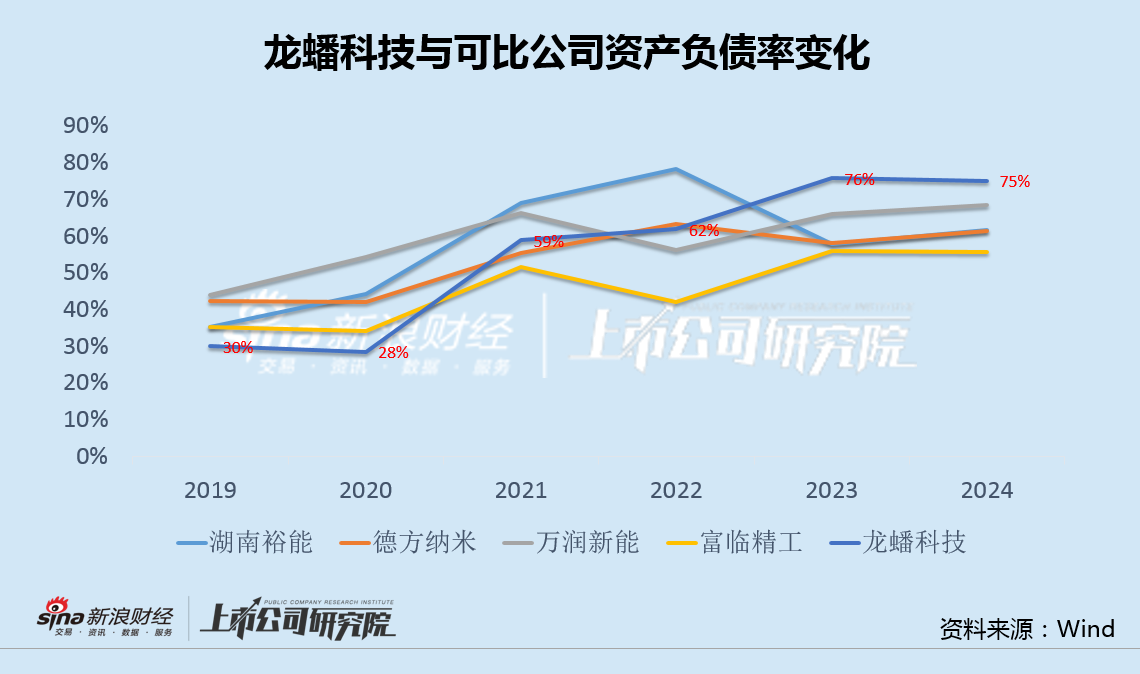
Core Viewpoint - Longpan Technology announced a plan to raise 2 billion yuan through a private placement to fund high-performance phosphate cathode material projects and supplement working capital, despite facing rapid increases in debt levels compared to peers [1][2][8]. Financing Activities - Longpan Technology has raised over 3 billion yuan through various financing methods since its A-share listing in 2017, including convertible bonds, private placements, and Hong Kong IPOs [7]. - The company plans to raise 2.06 million shares, totaling 2 billion yuan, for projects involving 11,000 tons and 8,500 tons of high-performance phosphate cathode materials [2][8]. - Previous financing activities include 400 million yuan from convertible bonds in April 2020 and 2.2 billion yuan from a private placement in June 2022 [3][4]. Debt Levels - Longpan Technology's debt ratio has increased significantly, reaching 78.41% by June 2025, with interest-bearing liabilities totaling 11.6 billion yuan, a 50-fold increase from 245 million yuan at the end of 2017 [10]. - The company's debt growth rate is notably faster than that of comparable companies such as Hunan Youneng and Defang Nano [8]. Capital Expenditure and Utilization - The company has consistently engaged in large capital expenditures, yet its overall capacity utilization remains below 80%, with additional capacity under construction [14]. - Longpan Technology's research and development expenditure has been increasing, significantly outpacing that of comparable companies, but this has not translated into improved profitability [12][15]. Market Performance - Despite the ongoing financing and investment efforts, Longpan Technology's stock price has halved compared to the price during its previous private placement in 2021, raising concerns about the effectiveness of its financing and investment strategies [15].
深汕“半年报”出炉,GDP同比增长12.4%
Nan Fang Du Shi Bao· 2025-08-27 04:23
Economic Performance - The GDP of the Shenzhen-Shanwei Special Cooperation Zone grew by 12.4% year-on-year in the first half of 2023 [1] - The industrial added value above designated size increased by 22.0% year-on-year, with the manufacturing sector growing by 21.0% [3] - Key industries such as electricity, heat production, and supply saw an increase of 28.4% in added value [3] Automotive Industry Development - The cooperation zone is accelerating the construction of a world-class automotive city, led by BYD, forming a trillion-level new energy vehicle and parts industry cluster [4] - Since the signing of the first phase of the BYD Automotive Industrial Park in August 2021, subsequent phases have been launched with total investments exceeding 30 billion yuan [4] - The second phase of the project has commenced production, achieving a daily output of 1,300 vehicles, with plans to produce over 250,000 vehicles in 2024 [4] Investment and Industrial Upgrades - At the recent investment promotion conference, 15 projects were signed, focusing on new energy vehicle thermal management systems and high-end chemical materials [5] - The establishment of the Shenzhen High-end Electronic Chemicals Industrial Park aims to create a hundred billion-level high-performance materials industry cluster [6] - The cooperation zone is also developing an intelligent manufacturing equipment industrial park, attracting robotics companies and technology platforms [6]
碳酸锂数据日报-20250826
Guo Mao Qi Huo· 2025-08-26 12:16
Report Industry Investment Rating - Not mentioned in the provided content Core View of the Report - The fundamentals provide weak support for the futures price, and it is expected to be mainly in a weak oscillation pattern [3] Summary by Related Catalogs Lithium Compounds - SMM battery - grade lithium carbonate average price is 82,500 yuan, down 1,400 yuan; SMM industrial - grade lithium carbonate average price is 80,200 yuan, down 1,400 yuan [1] Lithium Futures Contracts - Lithium carbonate 2509 closed at 79,580 yuan, down 0.72%; 2510 closed at 79,580 yuan, down 0.45%; 2511 closed at 79,380 yuan, down 0.3%; 2512 closed at 79,040 yuan, down 0.15%; 2601 closed at 78,700 yuan, down 0.15% [1] Lithium Ore - Lithium spodumene concentrate (CIF China) is 925 yuan, down 9 yuan; lithium mica (Li20: 1.5% - 2.0%) is 1,265 yuan, down 20 yuan; lithium mica (Li20: 2.0% - 2.5%) is 1,995 yuan, down 60 yuan; phospho - lithium - aluminum stone (Li20: 6% - 7%) is 6,685 yuan; phospho - lithium - aluminum stone (Li20: 7% - 8%) is 7,735 yuan, down 90 yuan [1][2] Cathode Materials - The average price of lithium iron phosphate (power type) is 35,810 yuan, down 340 yuan; the average price of ternary material 811 (polycrystalline/power type) is 145,950 yuan, down 60 yuan; the average price of ternary material 523 (single - crystal/power type) is 119,525 yuan, down 300 yuan; the average price of ternary material 613 (single - crystal/power type) is 123,985 yuan, down 100 yuan [2] Price Spreads - The difference between battery - grade and industrial - grade lithium carbonate is 2,300 yuan, with no change; the difference between battery - grade lithium carbonate and the main contract is 3,120 yuan, down 1,820 yuan; the difference between the near - month and the first - continuous contract is 0 yuan, with no change; the difference between the near - month and the second - continuous contract is 200 yuan, up 20 yuan [2] Inventory - The total inventory (weekly, tons) is 141,543 tons, down 713 tons; the inventory of smelters (weekly, tons) is 46,846 tons, down 2,847 tons; the inventory of downstream (weekly, tons) is 51,507 tons, up 3,224 tons; the inventory of others (weekly, tons) is 43,190 tons, down 1,090 tons; the registered warehouse receipts (daily, tons) is 25,630 tons, up 640 tons [2] Profit Estimation - The cash cost of purchasing lithium spodumene concentrate is 78,817 yuan, and the profit is 2,516 yuan; the cash cost of purchasing lithium mica concentrate is 81,868 yuan, and the profit is - 5,641 yuan [3] Industry Event - A meeting of the lithium iron phosphate material branch council was held to discuss industry over - capacity reduction and low - carbon transformation paths [3] Supply and Demand Analysis - Although there is a production cut in the Jiangxi mica segment, overseas mines, overseas salt lakes, and domestic compliant mines have provided supplements, showing a structural adjustment on the supply side. On the demand side, weekly production is basically stable, with inventory moving from upstream to downstream but limited actual consumption [3]
GGII:印尼加速能源转型催化储能装机“新蓝海”
高工锂电· 2025-08-26 11:01
Core Viewpoint - Indonesia is accelerating its energy transition with a nationwide "Village Cooperative Million Solar Plan," aiming to deploy 100GW of solar capacity over the next five years, which is seen as a significant opportunity for clean energy access and reducing diesel dependency [4][6]. Group 1: Energy Transition in Indonesia - The Indonesian government has approved a plan to deploy 100GW of solar power, with 80GW in a "1MW solar + 4MWh storage" format across 80,000 villages, and 20GW in centralized solar power plants [4]. - Indonesia's power generation has been heavily reliant on fossil fuels, particularly coal, which constitutes over 80% of total generation, while renewable energy sources remain low but are steadily increasing [4][6]. - The country aims to enhance its renewable energy capacity and introduce storage technologies to improve system flexibility and accommodate new energy sources [4][6]. Group 2: Renewable Energy Goals - By 2030, Indonesia's renewable energy capacity is projected to reach approximately 29.3GW of solar energy, with a total renewable energy increase of 42.6GW, and 5.3GW specifically from photovoltaic systems [6][8]. - The solar energy potential in Indonesia is significant, with an overall photovoltaic capacity exceeding 207GW, and by 2050, solar installations could rise to 264.6GW [6][8]. Group 3: Energy Storage Market - Indonesia's energy storage market is in an exploratory phase, with a current installed capacity of 0.4GWh expected to grow to 70GWh by 2030, reflecting an annual growth rate of approximately 136.5% [10]. - The demand for energy storage systems is anticipated to increase due to rising electricity needs and improvements in grid infrastructure, focusing on frequency regulation, load balancing, and backup power [10]. Group 4: Lithium Battery Industry - The lithium battery industry in Indonesia is still in its infancy, heavily reliant on external supply chains for key materials like cathodes, anodes, electrolytes, and separators [10]. - Local manufacturing capabilities and technological systems are underdeveloped, with most local enterprises collaborating with foreign companies or importing finished products to meet project demands [10].