
万科A

Search documents
广东VS江苏:风格迥异的TOP2
Huachuang Securities· 2025-05-09 12:13
Economic Comparison - In 2024, Guangdong's GDP reached 14.16 trillion yuan with a growth rate of 3.5%, while Jiangsu's GDP was 13.7 trillion yuan with a growth rate of 5.8%, narrowing the GDP gap to 462.5 billion yuan from 968.3 billion yuan the previous year[19] - Guangdong's GDP concentration is higher, with the last two cities contributing only 4% of the total GDP, the largest disparity among 24 provinces, while Jiangsu's last two cities contribute 21%, ranking fifth in terms of balance[22] Fiscal Dynamics - From 2019 to 2024, Jiangsu's average net contribution to the central government was approximately 280 billion yuan annually, while Guangdong's was about 780 billion yuan, resulting in an annual gap of 500 billion yuan, equivalent to 25.7% of Guangdong's average fiscal revenue[3] - In 2024, Guangdong's local revenue accounted for 22.6% of its total, while Jiangsu's was only 2.5%, the lowest among 31 provinces, indicating a more centralized fiscal structure in Guangdong[4] Infrastructure Investment - Jiangsu's infrastructure growth rate was 13.3% in 2024, significantly higher than Guangdong's 0.2%, which reflects a divergence in investment trends since 2022[53] - In 2024, Jiangsu's investment in electricity and heat production grew by 98.7%, while Guangdong's was only 3.9%[56] Real Estate Sector - In 2024, Jiangsu's land finance dependency was 49%, compared to Guangdong's 31%, indicating a higher reliance on land finance in Jiangsu[11] - From 2020 to 2024, Jiangsu's land-related revenue decreased from 1.28 trillion yuan to 900 billion yuan, a drop of 3.8 billion yuan, while Guangdong's fell from 1.16 trillion yuan to 520 billion yuan, a reduction of 6.4 billion yuan[11] Consumer Spending - Since the pandemic, Guangdong's consumer spending growth has lagged behind Jiangsu's, attributed to differences in income growth and consumer behavior[12] - In 2024, Jiangsu's rural residents had a higher disposable income compared to Guangdong, contributing to a more robust consumption pattern in rural areas[12] Industrial Structure - Guangdong's industry is more downstream, producing 44% of the nation's industrial robots and 39% of optical electronic devices, while Jiangsu focuses on midstream production, contributing 33% of chemical fibers and 46% of ships[13] - In 2024, Jiangsu's exports to Belt and Road countries accounted for 47.5% of its total exports, surpassing Guangdong's nearly 40%[13]
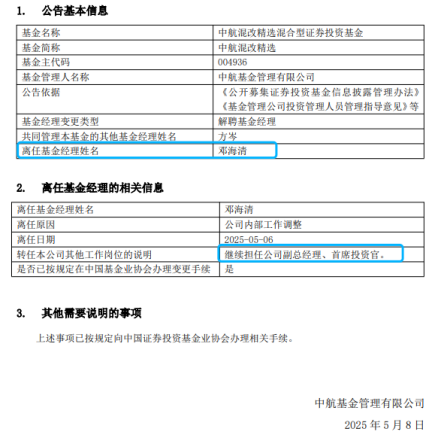
基金经理“大撤退”开启?邓海清卸任中航混改精选,旗下基金“清零”
Xin Lang Ji Jin· 2025-05-09 07:52
Group 1 - The core point of the article is the personnel change at China Aviation Fund, where Deng Haiqing is no longer the fund manager of the China Aviation Mixed Reform Selected Fund (Fund Code: 004936), effective May 6, 2025, and Fang Cen will take over the management of the fund [1][2][3] - The change in fund management coincides with the release of the CSRC's "Action Plan for Promoting the High-Quality Development of Public Funds," which links fund manager compensation to long-term performance [6] - Deng Haiqing's departure is attributed to internal company adjustments, and he will continue to serve as the company's deputy general manager and chief investment officer [3] Group 2 - The fund has faced criticism for its heavy investment in the real estate sector, failing to reflect the diversity of the "mixed reform" theme and not aligning with recent policy support for high-end manufacturing and technology [7][8] - Performance metrics indicate that the China Aviation Mixed Reform Selected Fund has significantly underperformed both its peers and market benchmarks, with a year-to-date decline of 4.33% and a six-month drop of 22.16% [8] - Over the past two and three years, the fund has seen cumulative declines exceeding 31%, underperforming its performance benchmarks by 30% and 36%, respectively, which could lead to substantial salary reductions for the fund manager under the new regulations [8]

中信证券:地产业来到下行周期尽头 行业转向综合素质竞争
智通财经网· 2025-05-09 01:27
Group 1 - The real estate industry is nearing the end of a downward cycle, with companies completing debt restructuring and asset quality stabilizing due to price stabilization and cash flow recovery [1] - Companies are experiencing a comprehensive contraction in operations, with a significant decrease in marketable resources, leading to a long-term reduction in sales and expenditures [1] - The competition in the industry is shifting from simple financial strength to a comprehensive competition based on development capabilities, product premium, and operational efficiency [1] Group 2 - In 2024, contract liabilities for 14 sample companies decreased by 17% year-on-year, down 30% from the peak in 2021, indicating a significant reduction in financial obligations [2] - The ratio of planned area to under-construction area for sample companies increased by 5.6 percentage points to 53.8%, reflecting a strategic reduction in new construction to save costs [2] - New construction area for sample companies is expected to decline by 32% in 2024 and again by 32% in 2025, indicating a cautious approach to investment [2] Group 3 - Companies are actively optimizing asset quality, with total assets for 14 sample companies projected to decrease by 7% to 9.2 trillion yuan by the end of 2024 [3] - The inventory structure is improving, with a 14% decrease in inventory and a 25% reduction in total development costs, while the total development product amount increased by 21% [3] - The gross profit margin for sample companies is expected to decline by 2.7 percentage points to 12.8%, as companies focus on liquidating older inventory while supplementing new stock [3] Group 4 - Interest-bearing liabilities for sample companies slightly decreased by 1% to 2.3 trillion yuan in 2024, with a significant shift in debt structure towards asset-backed financing [4] - The balance of corporate credit financing decreased by 15.2%, while bank loans increased by 5%, indicating a move away from reliance on credit financing [4] - The proportion of credit financing in the total financing structure dropped by 3.9 percentage points to 22%, reflecting a healthier financing environment for the industry [4]

一文解读央行降准降息影响及投资策略
Sou Hu Cai Jing· 2025-05-08 16:34
Group 1 - The core viewpoint of the news is that the People's Bank of China announced a reduction in the reserve requirement ratio and interest rates to stimulate economic growth and support employment amid weak economic data [1][3][4] - The reduction in the reserve requirement ratio by 0.5 percentage points is expected to release approximately 1 trillion yuan in long-term funds [4] - The cut in the re-lending rate by 0.25 percentage points aims to alleviate the financial pressure on small and medium-sized enterprises [4] Group 2 - The immediate impact on the stock market is expected to be positive, with sectors such as real estate, consumer goods, and high-debt industries likely to benefit from lower financing costs [5][6] - Historical comparisons show that after previous rate cuts, the A-share market has generally performed well, with the 10-year government bond yield dropping to 1.6%, the lowest since 2005 [8][9] - The potential for further interest rate cuts exists if economic conditions remain weak, with a possibility of a 10 basis point reduction in the third quarter [10][11] Group 3 - The real estate market may stabilize in first-tier cities, but there are still significant inventory pressures in third- and fourth-tier cities, indicating a divergence in recovery [11] - There is a high likelihood that deposit rates will follow suit and decrease, potentially pushing more funds into the stock market [12] - Investment strategies suggest a balanced approach with a focus on sectors like real estate, automotive, and technology, while avoiding export-dependent industries [13][15]




城市楼市复苏进程调研-深圳篇
2025-05-08 15:31
Summary of Key Points from Conference Call Records Industry Overview - The focus is on the real estate market in Shenzhen, highlighting the recovery process and regulatory changes impacting new and second-hand housing markets [1][6][10]. Core Insights and Arguments - **Market Recovery**: The Shenzhen new housing market is showing signs of stabilization, with average prices increasing by 9%-15% in certain projects, indicating a recovery from previous declines [1][3]. - **Regulatory Changes**: New regulations have improved the usable area of properties, making them more cost-effective. Buyers are increasingly favoring completed homes due to concerns over unfinished projects [1][4][5]. - **Supply Constraints**: New housing supply is tight, with inventory down to 26,000 units, about half of the previous year's levels. The price trend for new properties has shown significant increases post-regulation [1][6][7]. - **Second-Hand Market Dynamics**: The second-hand housing market is experiencing a bifurcation, with some properties seeing price increases of 10%-20% from their lows, while others continue to decline. The overall market is still in a bottoming phase [1][6][10]. - **Investment Shifts**: Investors are shifting focus towards fixed-income products, as current real estate yields exceed those of 10-year government bonds, making it an opportune time for real estate investments despite potential price drop risks [1][11]. Additional Important Insights - **Consumer Behavior**: Consumers are cautious, with a preference for experiential consumption over traditional luxury goods, influenced by external factors such as trade tensions [1][9]. - **Commercial Real Estate Performance**: Vanke's commercial asset, Vanke Bantian Plaza, has shown strong performance with a 99% occupancy rate and stable foot traffic since its opening [8]. - **Future Market Outlook**: The new housing market is expected to remain tight due to limited land auctions and ongoing supply constraints, while the second-hand market will continue to evolve as buyers seek opportunities [6][10]. - **Media Influence**: Media narratives around real estate policies can create confusion among investors, highlighting the need for careful analysis of policy implications [15][17]. This summary encapsulates the key points from the conference call records, providing a comprehensive overview of the Shenzhen real estate market and its dynamics.
万科A(000002) - 万科企业股份有限公司关于行使“22万科03”公司债券赎回选择权的第一次提示性公告
2025-05-08 12:27
万科企业股份有限公司关于行使"22 万科 03"公司债券 赎回选择权的第一次提示性公告 证券代码:000002、299903、149930 证券简称:万科 A、万科 H 代、22 万科 03 公告编号:〈万〉2025-063 本公司及董事会全体成员保证公告内容的真实、准确和完整,对公告的虚假记载、 误导性陈述或者重大遗漏负连带责任。 重要提示: 1.债券代码:149930。 2.债券简称:22万科03。 3.赎回登记日:2025年6月5日。 4.赎回资金到账日:2025年6月6日。 5.赎回价格:人民币102.90元/张(含当期利息,且当期利息含 税)。 5.债券余额:3.50 亿元。 6.债券期限:本期债券期限为 5 年期,附第 3 年末发行人赎回 选择权、调整票面利率选择权、投资者回售选择权。 7.当前票面利率:2.90%。 6.债券赎回比例:100%。 7.摘牌日: 2025年6月6日。 一、"22万科03"公司债券的基本情况 1.发行主体:万科企业股份有限公司。 2.债券名称:万科企业股份有限公司 2022 年面向专业投资者公 开发行公司债券(第二期)(品种一)。 3.债券简称:22 万科 03。 1 ...
万科A(000002) - 万科企业股份有限公司关于行使“22万科03”公司债券赎回选择权的公告
2025-05-08 12:27
万科企业股份有限公司关于行使"22 万科 03"公司债券 | 本公司及董事会全体成员保证公告内容的真实、准确和完整,对公告的虚假记载、 | | --- | | 误导性陈述或者重大遗漏负连带责任。 | 根据《万科企业股份有限公司 2022 年面向专业投资者公开发行公司债券(第 二期)募集说明书》(以下简称"《募集说明书》")中有关万科企业股份有限公 司 2022 年面向专业投资者公开发行公司债券(第二期)(品种一)(以下简称 "22 万科 03"、"本期债券")发行人赎回选择权的条款约定: 发行人将于本期债券第 3 个计息年度付息日前的第 20 个交易日,在指定的 信息披露媒体上发布关于是否行使赎回选择权的公告。若决定行使赎回权利,本 期债券将被视为第 3 年全部到期,发行人将以票面面值加最后一期利息向投资者 赎回全部本期债券。所赎回债券的本金加第 3 年利息在第 3 个年度付息日一起支 付。发行人将按照本期债券登记机构的有关规定统计债券持有人名单,并按照债 券登记机构的相关规定办理。若发行人不行使赎回权,则本期债券将继续在第 4、 5 年存续。 赎回选择权的公告 证券代码:000002、299903、1499 ...
万科A(000002) - 万科企业股份有限公司关于行使“20万科06”公司债券发行人赎回选择权的公告
2025-05-08 12:27
万科企业股份有限公司关于行使"20 万科 06"公司债券 特此公告。 根据《万科企业股份有限公司 2020 年面向合格投资者公开发行公司债券(第 三期)募集说明书》(以下简称"《募集说明书》")中有关万科企业股份有限公 司 2020 年面向合格投资者公开发行公司债券(第三期)(品种二)(以下简称 "20 万科 06"、"本期债券")发行人赎回选择权的条款约定: 万科企业股份有限公司 发行人赎回选择权的公告 发行人有权决定在本期债券存续期的第 5 年末行使本期债券赎回选择权。发 行人将于本期债券第 5 个计息年度付息日前的第 30 个交易日,通过中国证监会 指定的上市公司信息披露媒体发布关于是否行使赎回选择权的公告。若发行人决 定行使赎回选择权,本期债券将被视为第 5 年全部到期,发行人将以票面面值加 最后一期利息向投资者赎回全部本期债券。所赎回的本金加第 5 个计息年度利息 在兑付日一起支付。发行人将按照本期债券登记机构的有关规定统计债券持有人 名单,按照证券登记机构的相关规定办理。若发行人不行使赎回选择权,则本期 债券将继续在第 6、7 年存续。 董事会 证券代码:000002、299903、149142 ...
万科A(000002) - 万科企业股份有限公司关于行使“20万科06”公司债券发行人赎回选择权的第一次提示性公告
2025-05-08 12:27
万科企业股份有限公司关于行使"20 万科 06"公司债券 发行人赎回选择权的第一次提示性公告 证券代码:000002、299903、149142 证券简称:万科 A、万科 H 代、20 万科 06 公告编号:〈万〉2025-061 本公司及董事会全体成员保证公告内容的真实、准确和完整,对公告的虚假记载、 误导性陈述或者重大遗漏负连带责任。 重要提示: 1.债券代码:149142。 2.债券简称:20万科06。 3.赎回登记日:2025年6月18日。 4.赎回资金到账日:2025年6月19日。 5.赎回价格:人民币103.90元/张(含当期利息,且当期利息含 税)。 6.债券赎回比例:100%。 7.摘牌日: 2025年6月19日。 一、"20万科06"公司债券的基本情况 1.发行主体:万科企业股份有限公司。 2.债券名称:万科企业股份有限公司 2020 年面向合格投资者公 开发行公司债券(第三期)(品种二)。 3.债券简称:20 万科 06。 4.债券代码:149142。 5.债券余额:12 亿元。 6.债券期限:本期债券期限为 7 年期(附第 5 年末发行人赎回 选择权、发行人调整票面利率选择权和投资者回售 ...
5月信用债策略月报:回归基本面,信用债如何配置?-20250508
Huachuang Securities· 2025-05-08 10:43
Group 1 - The report emphasizes the importance of fundamental research on issuers in a weak economic environment, highlighting the recent incident involving China Aviation Industry Corporation as a case in point [1][15][22] - It notes that the probability of credit spread compression is high in May, driven by favorable monetary conditions and the need for institutional investors to adjust their preferences in a low-interest-rate environment [1][15][19] - The report suggests that the current market conditions favor short-term credit products, while the demand for medium to long-term credit bonds may be constrained due to regulatory impacts on wealth management products [1][15][23] Group 2 - The strategy for credit bonds includes focusing on high-yielding products and extending duration where possible, particularly in the 4-5 year range, while being cautious about liquidity [2][3][23] - It highlights that the current yield spreads for various credit products are at historically high levels, indicating potential for further compression, especially in the 2-3 year and 4-5 year categories [2][24][26] - The report identifies specific sectors for investment, such as local government bonds and high-rated real estate bonds, while advising caution in lower-rated sectors due to ongoing credit risks [4][5][19]