
长安汽车

Search documents
重庆市两江新区将“领衔”建设成渝跨区域联动经济发展走廊
Xin Lang Cai Jing· 2026-01-31 10:14
中新网重庆1月31日电 (罗永皓)记者于2026年重庆两会期间获悉,中国内陆首个"功能区"转"行政区"的 国家级新区——重庆市两江新区,"十五五"时期将深化与天府新区等国家级开发开放平台融通互动,全 面参与和带动成渝跨区域联动经济发展走廊建设。 《中共重庆市委关于制定重庆市国民经济和社会发展第十五个五年规划的建议》提出:建立川渝国家级 开发开放平台联动联建机制,推动各类开发区和产业集聚区政策叠加、服务体系共建,促进成渝地区优 势产业从"链条型"线性发展向"生态型"体系发展升级。 近年来,成渝两地国家级开发开放平台合作硕果累累。据两江新区发改委相关负责人介绍,两江新区与 四川天府新区合作建立川渝汽车产业联席会议机制,共建两江天府汽车制造、电子信息等8大产业旗舰 联盟,聚集头部企业90余家、会员企业近1000家。两区共同举办技术转移转化大会,促成50余家川渝高 校、科研机构和企业合作,并建立政务服务"一件事跨域办"协同工作机制,联合发布全国首个行政处罚 裁量积分制区域化实施案例。 该区与成都经开区共同运营成渝"五定"公路货运班车,累计开行公路班车超3900车次、运输集装箱超 6700TEU。成都地区货物抵达长江入 ...


2025年中国载货汽车产量为380.8万辆 累计增长13.9%
Chan Ye Xin Xi Wang· 2026-01-31 02:37
Core Viewpoint - The report highlights the growth trajectory of China's cargo vehicle industry, projecting significant increases in production and market dynamics from 2025 to 2031 [1]. Industry Overview - According to the National Bureau of Statistics, the production of cargo vehicles in China is expected to reach 378,000 units in December 2025, representing a year-on-year growth of 20.8% [1]. - The cumulative production of cargo vehicles in China for the entire year of 2025 is projected to be 3.808 million units, reflecting a cumulative growth of 13.9% [1]. Companies Involved - Key listed companies in the cargo vehicle sector include: - FAW Jiefang (000800) - China National Heavy Duty Truck Group (000951) - Foton Motor (600166) - Jiangling Motors (000550) - Ankai Bus (000868) - Changan Automobile (000625) - Dongfeng Motor (600006) - Hanma Technology (600375) - GAC Group (601238) - Aoxin Bus (600213) [1]. Research and Analysis - The report titled "2025-2031 China Cargo Vehicle Industry Market Research Analysis and Investment Prospects" by Zhiyan Consulting provides in-depth insights into the industry, emphasizing the importance of market research and feasibility studies for investment decisions [1].

【乘用车1月月报】内需静待改善,出口韧性较强
东吴汽车黄细里团队· 2026-01-30 14:43
Group 1: Electric Vehicle Market Insights - In December 2025, the retail penetration rate of new energy vehicles (NEVs) reached 58.7%, with a year-on-year increase of 10.9% but a month-on-month decrease of 2.5 percentage points [2][6][14] - The retail sales of passenger vehicles in December 2025 were 2.27 million units, showing a year-on-year decline of 16% and a month-on-month increase of 14.7% [11][14] - BYD maintained a market share of 25% in the NEV sector, while Geely's market share decreased to 11% [22][6] Group 2: Global Market Performance - In December 2025, Southeast Asia's NEV penetration rate exceeded expectations, with a significant contribution from VinFast, leading to a month-on-month increase [3][35] - Chinese automakers exported 641,000 passenger vehicles in December 2025, with 245,000 being NEVs, resulting in a NEV penetration rate of 38.2% [3][7] - The market share of Chinese brands in Southeast Asia reached 14.7%, with a month-on-month increase of 0.8 percentage points [51][62] Group 3: Policy and Market Outlook - The old-for-new vehicle replacement policy is set to be implemented in January 2026, which is expected to stimulate demand in the passenger vehicle market [2][6] - The industry anticipates a recovery in passenger vehicle demand in Q1 2026, driven by the new policy and a shift in consumer sentiment [4][6] - The focus for domestic investments is on companies less sensitive to policy fluctuations, such as JAC Motors, and those expected to see growth in the high-end electric vehicle segment, including Geely and Great Wall Motors [4][6]





中国车企和特斯拉的下一战,战场已定
虎嗅APP· 2026-01-30 13:58
Core Viewpoint - Tesla is shifting its focus towards humanoid robots, with CEO Elon Musk stating that the production of Model S and Model X will be phased out to prioritize the development of the Optimus robot, which Musk believes will underpin 80% of Tesla's future market value [2][3]. Group 1: Tesla's Strategic Shift - Tesla plans to cease production of Model S and Model X, transitioning the Fremont factory to produce Optimus robots [3]. - The introduction of humanoid robots is seen as a critical component of Tesla's new mission, which aims to create a "prosperous and extraordinary world" [2]. - Musk acknowledges that Tesla's main competition in the humanoid robot sector will come from Chinese companies, which are rapidly advancing in AI and robotics [3]. Group 2: Chinese Automakers' Robotics Initiatives - Chinese automakers are actively investing in humanoid robotics, with companies like Li Auto and BYD announcing plans to develop their own humanoid robots [5][6]. - The competitive landscape is intensifying, with various Chinese companies, including Chery and Xpeng, setting timelines for humanoid robot production by 2026 and 2028 [12][13]. - The overlap in technology between electric vehicles and humanoid robots is significant, with around 70% of automotive technology being applicable to robotics [8]. Group 3: Market Potential and Investment Outlook - The global market for humanoid robots is projected to reach $25 trillion by 2050, indicating a massive growth opportunity compared to the automotive sector [9]. - The high degree of technological overlap allows automakers to pivot towards robotics without substantial additional investment, making it a low-cost, high-reward opportunity [9]. - Morgan Stanley reports that China holds a dominant position in the humanoid robot supply chain, accounting for 63% of the market, which could drive down manufacturing costs [14]. Group 4: Competitive Landscape and Challenges - The competition between Tesla and Chinese automakers in the humanoid robot space is expected to intensify by 2027, with both sides having distinct advantages [12][14]. - Tesla's strength lies in its advanced AI algorithms and extensive real-world data, while Chinese companies have demonstrated rapid iteration and cost control capabilities [14]. - Talent acquisition is crucial for success in the humanoid robot sector, with both Tesla and Chinese firms vying for top talent amidst a competitive automotive landscape [17].


宁德时代钠电池“预定”广汽、长安、江淮
高工锂电· 2026-01-30 12:09
Core Viewpoint - CATL is advancing its sodium-ion battery technology from commercial vehicles to a larger application in passenger cars, with a focus on extreme cold testing and battery swapping models [2][4]. Group 1: Sodium-ion Battery Development - CATL's sodium-ion battery brand "Sodium New" will begin extreme cold public testing for passenger vehicles next week, with the Chang'an Auchan model participating first [2]. - The sodium-ion battery is expected to be installed in the GAC Aion UT super model by the second quarter of this year, with a starting price of 49,900 yuan for the battery rental version and 89,900 yuan for the complete vehicle [3]. - The sodium-ion battery has a key specification of 175 Wh/kg energy density, maintaining 90% usable capacity at -40°C, and a cycle life exceeding 10,000 times, positioning it as a scalable production solution [5]. Group 2: Overcoming Challenges - CATL is addressing two main challenges for sodium-ion battery scalability: the stringent verification of low-temperature performance and charging efficiency in passenger vehicles, and the balance between energy density, cost, and user experience in the new chemical system [4]. - The company is also pushing to establish production rhythms in commercial vehicle scenarios before fully entering the passenger vehicle market, having launched the Tianxing II light commercial solution and related sodium-ion battery products [6]. Group 3: Battery Swapping Network Expansion - The expansion of the battery swapping network may enhance the replicability of the sodium-ion technology route, with CATL disclosing the completion of 1,325 battery swapping stations and plans to build over 3,000 stations in more than 140 cities by 2026 [7]. - The strategy emphasizes that "sodium-ion deployment" does not rely solely on one-time battery sales but can leverage the network effects of "battery asset operation + refueling infrastructure," which is particularly crucial for the price-sensitive passenger vehicle market [7].


2025年中国汽车ESG十大事件出炉!
Guan Cha Zhe Wang· 2026-01-30 10:48
2025年,中国汽车产销量超过3400万辆,连续17年居全球第一;新能源汽车以超过1600万辆的产销量再创新高, 在国内乘用车市场的渗透率接近60%;汽车出口总量达710万辆,同比增长21%,继续保持全球汽车出口第一大国 的地位。 过去一年,汽车行业的价格战、60天账期、智驾安全等议题引发全社会广泛关注。国家对汽车行业过度内卷、网 络乱象等现象的治理力度空前,一系列与ESG相关的措施先后出台,推动着汽车行业的生态发展不断改善。 尤其可喜的是,汽车企业的ESG实践不断深入,从被动合规转向主动整合,在做好ESG信息披露的同时,ESG与业 务运营的融合不断深化,并延伸到价值链合作伙伴和产品全生命周期。未来,ESG更加注重实效的趋势将会持 续,成为汽车行业高质量发展的重要抓手。 新年伊始,华汽研究院与观察者网合作,共同发起"2025年中国汽车行业ESG十大事件"评选活动。通过网络投票, 结果如下: 四、中国汽车出口继续保持强势,汽车出海需重视ESG合规挑战 一、中国汽车上市公司ESG信息披露率逐年提升 近年来,中国证监会、沪深北三大交易所等监管机构相继发布了一系列关于ESG信息披露的指引和要求,要求汽 车行业上市公司 ...
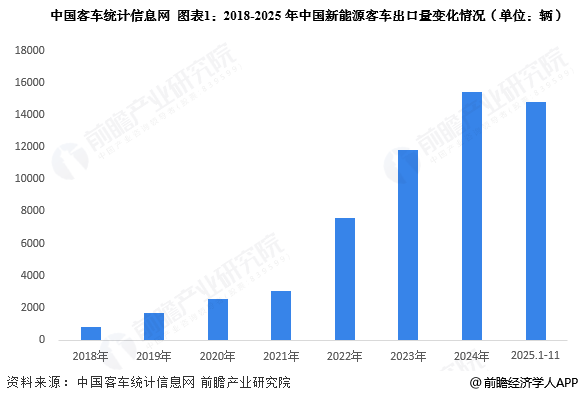
2025年中国新能源客车出口市场现状分析 出口市场新能源渗透率超过18%【组图】
Qian Zhan Wang· 2026-01-30 09:08
Core Insights - The article highlights the rapid growth of China's new energy bus exports, projecting over 15,000 units exported in 2024 and 7,629 units in the first half of 2025, surpassing the total for 2023 [1] - The penetration rate of new energy buses in the export market is expected to exceed 18% by 2024, driven by global trends in energy conservation and low-carbon initiatives [3] - BYD leads the new energy bus export market, with 3,933 units exported from January to November 2025, followed by established manufacturers [6] - Nepal and Chile are the primary export destinations, with China exporting 2,711 pure electric buses to Nepal and 2,010 to Chile in the same period [8] - The average export price of pure electric buses is on the rise, reaching $189,000 in the first eleven months of 2025, while the average price for plug-in hybrid buses has slightly decreased to $126,000 [10] Industry Overview - Major listed companies in the new energy bus sector include Yutong Bus, Zhongtong Bus, CRRC, Ankai Bus, Foton Motor, King Long, BYD, Dongfeng Motor, and Changan Automobile [1] - The export volume of new energy buses has shown a consistent upward trend from 2018 to 2024, indicating a robust growth trajectory in the industry [1][3] - The increase in export volume correlates with the growing global demand for environmentally friendly transportation solutions [3]

乘用车1月月报:内需静待改善,出口韧性较强-20260130
Soochow Securities· 2026-01-30 08:28
证券研究报告 乘用车1月月报:内需静待改善,出口韧性较强 证券分析师 :黄细里 执业证书编号:S0600520010001 联系邮箱:huangxl@dwzq.com.cn 联系电话:021-60199790 2026年1月30日 核心观点 电动化数据跟踪:2025年12月行业景气度低于预期,2026年1月以旧换新政策落地 ———————————————————————————————— ◼ 2025年12月多数省市以旧换新政策预算资金池告罄,消费者观望情绪严重,行业零售同比下滑明显;批发层 面车企主动调节生产/库存节奏,环比下行。2025年12月新能源汽车零售渗透率58.7%,同环比分别+10.9/- 2.5pct。12月乘用车行业渠道去库6.9万辆,其中新能源车去库4.3万辆。12月新能源车格局基本保持稳定,其 中比亚迪市占率25%,环比+0pct;吉利市占率11%,环比-1pct。2026年1月乘用车以旧换新政策落地。 全球化数据跟踪:2025年12月东南亚市场新能源渗透率超预期,比亚迪出口表现超预期 投资建议与风险提示 2 ———————————————————————————————— —————— ...
【深度分析】2025年12月份全国新能源市场深度分析报告
乘联分会· 2026-01-30 08:28
Overall Market - The total market for passenger vehicles in 2025 is projected to have a production of 29.67 million units, with a retail sales figure of 23.74 million units, reflecting a year-on-year growth of 3.8% [9][10]. - The market share of new energy vehicles (NEV) is expected to reach 53.9% in 2025, up from 47.6% in 2024, indicating a significant increase in consumer adoption [10][12]. Submarket Analysis - The breakdown of the total market shows that NEVs will account for 12.81 million units in retail sales, representing a 17.6% increase compared to 2024 [10][12]. - The retail sales of fuel vehicles are projected to decline by 14.0% year-on-year, highlighting a shift in consumer preference towards NEVs [9][10]. Export Market - The export of NEVs is expected to grow significantly, with a total of 5.74 million units exported in 2025, marking a 19.7% increase from the previous year [16][17]. - The penetration rate of NEVs in the export market is projected to reach 42.2% in 2025, up from 27.1% in 2024, indicating a strong demand for Chinese NEVs abroad [20][22]. Manufacturer Performance - BYD is leading the NEV market with a wholesale volume of 414,784 units, although this represents a decline of 18.6% year-on-year [25]. - Tesla China ranks third in wholesale sales with 97,171 units, showing a modest growth of 3.6% [25]. - The top ten manufacturers collectively account for 71.5% of the NEV market share, indicating a high concentration in the industry [25][26]. Vehicle Type Segmentation - In 2025, the retail sales of sedans, MPVs, and SUVs are projected to be 12.26 million, 1.30 million, and 10.18 million units respectively, with NEVs showing a positive growth trend across all categories [30][31]. - The retail sales of fuel vehicles in the sedan category are expected to decline by 30.3%, while NEVs in the same category are projected to grow by 2.6% [30][31].



乘用车1月月报:内需静待改善,出口韧性较强
Soochow Securities· 2026-01-30 08:24
Investment Rating - The report maintains a positive outlook on the passenger car sector, particularly in the context of the new vehicle replacement policy and the resilience of exports [2][3]. Core Insights - The passenger car industry experienced a significant decline in retail sales in December 2025, with a year-on-year drop of 16% and a total retail volume of 227,000 units. The wholesale volume was 279,000 units, reflecting a decrease of 9.7% year-on-year [7][10]. - The penetration rate of new energy vehicles (NEVs) reached 58.7% in December 2025, showing a year-on-year increase of 10.9% [10][12]. - The report highlights the stability of the NEV market, with BYD holding a market share of 25% and Geely at 11% in December 2025 [16]. Electric Vehicle Data Tracking - The report indicates that the old-for-new vehicle replacement policy was implemented in January 2026, which is expected to stimulate demand in the passenger car market [2][3]. - In December 2025, the NEV wholesale volume was 156,300 units, with a year-on-year increase of 3.4% [12]. - The report notes a significant inventory reduction in the passenger car sector, with a total decrease of 69,000 units in December 2025, including 43,000 units of NEVs [13]. Globalization Data Tracking - The report tracks the performance of Chinese car manufacturers in international markets, noting that in December 2025, 641,000 passenger cars were exported, with 245,000 being NEVs, resulting in a penetration rate of 38.2% for NEVs [3][43]. - The report highlights the strong performance of BYD in exports, particularly in Southeast Asia, where the NEV penetration rate exceeded expectations [3][27]. - The market share of Chinese brands in various regions, including Southeast Asia and Europe, showed positive trends, with notable increases in the UK market [38][40].

