华为技术有限公司

Search documents
视频 | 传宁德华为4000亿并购谈崩
Xin Lang Cai Jing· 2026-02-06 07:47
来源:汽车营造社 来源:汽车营造社 责任编辑:刘万里 SF014 责任编辑:刘万里 SF014 ...
敲定!3.73亿大单,华为鲲鹏与海光CPU成功入围
是说芯语· 2026-02-06 06:14
上海浦东发展银行(下称"浦发银行")于2月4日集中发布两则重要采购结果公示,分别完成鲲鹏芯片服务器、海光四号芯片服务器两大项目的中标结果公 布,合计中标金额达3.73亿元,标志着该行金融云信创基础设施建设再提速,国产算力在金融核心场景的应用持续深化。 本次两大采购项目的招标公告均于2025年12月26日同步发布,经过规范评审流程后,最终确定中标方。其中,《2025年金融云信创基础设施系统常规扩容 项目等两项目第二批鲲鹏芯片服务器采购项目》由上海恒驰信息系统有限公司以1.58亿元中标,采购内容涵盖第二批鲲鹏芯片服务器及配套维保服务,用 于支撑金融云信创基础设施的常规扩容需求。另一项《2025年金融云信创基础设施常规扩容等二项目之海光四号芯片服务器采购项目》则由北京神州新桥 科技有限公司以2.15亿元中标,除满足金融云信创基础设施扩容外,还将为对公分布式核心重构及核心平台领域公共能力建设项目提供海光四号芯片服务 器与维保服务,助力核心业务系统的信创升级。 上海恒驰信息系统成立于2005年,核心业务聚焦ICT集成、云业务与信息安全,2017年成为华为公有云一级代理,在国产算力部署与云基础设施建设领域 积累了成熟案例 ...



宁德时代拟参股华为数字能源?知情人士:此前双方曾谈过,宁德时代拟参股约20%
Xin Lang Cai Jing· 2026-02-06 05:25
近日,市场流传宁德时代收购华为数字能源。对此,有知情人士告诉记者,"此前双方确实谈过,但因 整体收购成本过高,华为数字能源并非全部出售给宁德时代,而是宁德时代拟参股华为数字能源约20% 股份。"不过,2月6日,多位华为数字能源员工表示,"2月5日晚公司内部已逐级通知不再出售。"注: 华为数字能源是华为技术有限公司100%全资子公司,为华为旗下独立法人实体,2021年6月注册成立, 注册资本30亿元,是华为面向清洁能源与能源数字化的核心业务载体。(蓝鲸新闻) ...
趋势研判!2026年中国数据中心机架行业政策、产业链、市场规模、竞争格局及发展趋势:随着数据中心产业蓬勃发展,数据中心机架规模日益剧增[图]
Chan Ye Xin Xi Wang· 2026-02-06 01:20
Core Insights - The data center rack industry is a crucial infrastructure component that enhances the management, security, and maintenance of IT equipment, facilitating the planning, design, and construction of data centers [2][5] - The market for data centers in China is projected to grow significantly, reaching a scale of 2,773 billion yuan by the end of 2024, with the number of operational data center racks exceeding 8.8 million [6][8] - By the end of 2025, the market size is expected to reach 3,180 billion yuan, with standard rack numbers surpassing 12 million [6][8] Industry Definition and Role - Data center racks are essential components that support and install various computer parts, providing a secure, reliable, and efficient management structure for IT equipment [2][5] Industry Development Status - The data center rack industry is experiencing rapid growth, driven by the development of the digital economy and the increasing demand for information network data [6][8] - The compound annual growth rate (CAGR) for the number of operational data center racks from 2019 to 2024 is over 20% [6] Industry Chain - The upstream of the data center rack industry includes raw materials such as metals (steel, aluminum, copper), plastics, and rubber, while the midstream involves the production and system integration of data center racks [6] - The downstream applications include enterprise data centers, edge data centers, AI computing centers, and high-performance computing/AI clusters [6] Industry Policy Environment - The data center is recognized as a vital part of the new infrastructure in China, with government policies supporting its investment and construction [10] Industry Competitive Landscape - The high-end market for data center racks is dominated by international giants, while domestic players like Huawei, Inspur, and ZTE are capturing significant market share in the IDC market and large internet companies [11][13] - The rise of domestic enterprises is accelerating the trend of local substitution, leading to increased market concentration [11] Industry Development Trends - The future of data center racks is expected to focus on "intelligent, liquid-cooled, and high-density" physical infrastructure units, integrating power supply, efficient heat dissipation, comprehensive sensing, and intelligent management capabilities [15]





科技巨头加速抢占超节点高地
Zheng Quan Ri Bao· 2026-02-05 16:45
Core Insights - The evolution of AI large models from single-modal to multi-modal is driving an exponential increase in computing power demand, with supernodes becoming a key foundation to overcome computing bottlenecks [1] - Huawei aims to provide scalable and effective computing power for the global AI industry through innovations in "clusters + supernodes," marking supernode deployment as a significant focus for its AI infrastructure strategy by 2026 [1] - Huawei's self-developed AI computing cluster, Atlas900 supernode, has been deployed over 300 sets since its launch, serving more than 20 clients across various industries, indicating a new phase of large-scale application [1] - The demand for computing power and communication efficiency is growing exponentially as model parameters evolve from hundreds of billions to trillions, making supernodes essential for supporting complex computing needs [1] Industry Developments - Supernodes are seen as the ecological foundation for transitioning computing power from "usable" to "usable effectively," pushing the industry from "single-point performance competition" to "system-level efficiency competition" [2] - Major Chinese tech giants are rapidly occupying the supernode landscape, with companies like Alibaba Cloud and Tencent Cloud releasing their own supernode solutions, while infrastructure firms focus on hardware breakthroughs [3] - Huawei's supernode technology has achieved breakthroughs in three key areas: ultra-large bandwidth, ultra-low latency, and unified memory addressing, enabling "computation without waiting for communication" and eliminating traditional cluster data exchange issues [3] - The supernode architecture is becoming the mainstream form of future intelligent computing centers, with leading domestic companies establishing a clear first-mover advantage in this field [3] Collaborative Efforts - Wuhan Yangtze Computing Technology Co., a subsidiary of FiberHome Technologies, has partnered with Ascend to release the Ascend Intelligent Manufacturing series solutions, while StarRing Information Technology has announced collaboration with Huawei in intelligent computing products [4] - The development of supernode technology is recognized as a crucial direction for AI advancement, with two main paths emerging: single vendor solutions for extreme computing efficiency and collaborative ecosystems to leverage multiple capabilities [4] - Domestic leading enterprises' focus on supernode technology is gradually altering the international computing power competition landscape, emphasizing the importance of ecosystem collaboration for optimizing computing efficiency and fostering sustainable innovation [4]
数据中心机架行业市场规模、产业链全景及市场竞争格局分析报告(智研咨询)
Xin Lang Cai Jing· 2026-02-05 12:25
报告导读: 数据中心机架是数据中心的基础设施之一,它的使用可以将计算机硬件设备集中管理,提高IT设备的安全性和可维护性,并且利于数据中心的规划、设计和 建设。数据中心是信息基础设施的重要组成部分,是"新型基础设施"中的"基础设施"。随着国家数字经济的发展和信息网络数据的迭代式增长,数据中心作 为重要的信息枢纽,在"十四五"规划中定义为新基建,其产业得到蓬勃发展,机架规模日益剧增。据工信部数据,截止到2024年年底,我国数据中心市场规 模增长至2773亿元,在用数据中心机架规模超880万架;2025年底,我国数据中心市场规模达到3180亿元,标准机架规模突破1200万架。 为探究数据中心机架行业变化趋势(怎么变)、用户需求(要什么)、投放选择(投向哪)、运营方法(如何投)及实践案例(看一看),智研咨询发布了 《2026-2032年中国数据中心机架行业市场竞争态势及投资战略研判报告》。 观点抢先知: 行业定义及作用:数据中心机架是数据中心的基础设施之一,是计算机硬件设备中的一种构件,用于支撑和安装各种计算机部件,包括主板、CPU、内存、 硬盘等。其主要作用是提供一个安全、可靠、高效的设备安装和管理的机构。机架的使 ...

数智化转型绘就医疗服务新图景
Ren Min Wang· 2026-02-05 01:31
Group 1: Core Insights - The introduction and continuous upgrade of digital systems at Shantou People's Hospital have fundamentally improved information sharing and operational efficiency in healthcare [1][4] - The integration of digital technologies such as big data, cloud computing, blockchain, and artificial intelligence is driving the construction of a healthy China, as emphasized in the 20th National Congress report [1] - The digital transformation in healthcare is seen as a key support and core engine for the high-quality development of hospitals, enhancing service models and operational management [1][3] Group 2: Company Overview - Weining Health Technology Group, established in 1994, provides comprehensive digital solutions and services in the healthcare sector, serving over 6,000 medical institutions, including more than 400 tertiary hospitals [2] - The latest version of Weining Health's smart medical product, WiNEX, was launched in 2020, featuring core functionalities such as patient services, medical services, and management services, with capabilities in artificial intelligence and cloud-native architecture [2] - Weining Health aims to assist clients in achieving digital transformation and becoming a trusted provider of digital products and services in the healthcare field [2] Group 3: Industry Trends - The healthcare industry is undergoing three significant transformations: the integration of online and offline services, a shift towards an "AI + doctor" medical paradigm, and a transition to patient-centered service models [3] - The essence of healthcare is focused on individual specialties and diseases, with the ultimate goal of empowering doctors through smart medical products and services [3] - The deployment and upgrade of digital systems in hospitals require collaboration between software and hardware vendors, ensuring continuous tracking, verification, and optimization [4][5] Group 4: Technological Integration - A unified language system is essential for future system upgrades and iterations, providing a solid foundation for digital transformation [5] - The integration of data and interconnectivity through digital upgrades allows doctors to access comprehensive and accurate information, leading to optimized treatment plans for patients [5] - The digital transformation is seen as a catalyst for various industries, emphasizing the importance of patient-centered services and health as a fundamental goal [5]

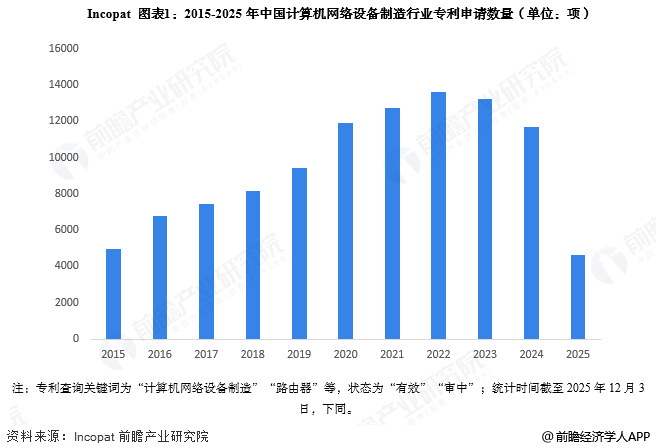
2025年中国计算机网络设备制造行业技术发展分析 专利公开数量大幅增加【组图】
Qian Zhan Wang· 2026-02-04 12:41
Core Insights - The Chinese computer network equipment manufacturing industry is experiencing a significant increase in patent applications and publications, indicating a robust growth trajectory in innovation and technology development [1][3]. Patent Applications - The number of patent applications in the Chinese computer network equipment manufacturing sector has been on the rise, reaching a peak of 13,596 applications in 2022, with a projected total of 4,654 applications by December 2025 [1]. - Huawei Technologies Co., Ltd. leads in patent applications with a total of 4,121, followed by State Grid Corporation with 1,258 applications [6]. Patent Publications - The number of patent publications in the industry is also growing rapidly, with an expected total of 16,244 publications in 2024 and 12,967 by December 2025 [3]. Key Technologies - The focus of patent applications is heavily on H04L (digital information transmission) with 54,874 applications, followed by H04W (wireless communication networks) with 16,936 applications [8]. Development Directions - The main development directions in the industry include: - High-speed and low-latency technologies driven by advancements in 5G-A and 6G, aiming for higher transmission rates and lower latency [11]. - Integration of artificial intelligence in network devices for smart traffic management and operational efficiency [11]. - Adoption of green energy technologies to meet carbon neutrality goals, including liquid cooling and modular designs [11]. - Focus on domestic production of core components to enhance supply chain security and reduce reliance on imports [11].
重庆青山 × 华为达成数智化转型合作 赋能制造业高质量发展
Zhong Guo Qi Che Bao Wang· 2026-02-04 09:40
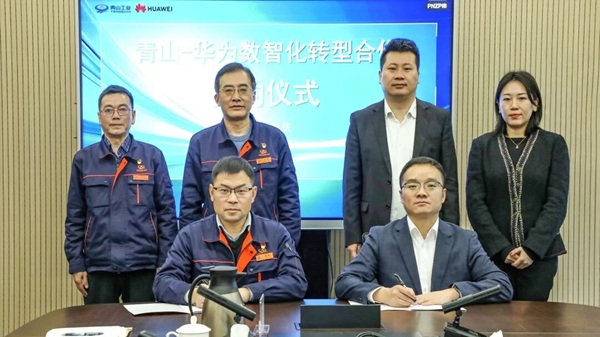
Core Viewpoint - Chongqing Qingshan and Huawei Technologies Co., Ltd. have signed a cooperation agreement for digital transformation, marking a significant step towards enhancing the smart manufacturing capabilities of both parties [1][3] Group 1: Cooperation Focus Areas - The collaboration will focus on three core areas: 1. Promoting the deep integration of "Artificial Intelligence+" to empower the company's entire business development with AI technology [3] 2. Establishing a new paradigm for intelligent manufacturing centered on smart factory construction, integrating advanced technologies such as cloud computing, 5G, AI, and IoT to explore AI applications in core production scenarios [3] 3. Building a robust digital infrastructure to support industrial simulation, agile development, and all business scenarios, laying a solid foundation for the company's digital transformation [3] Group 2: Strategic Implications - This partnership represents a critical transition for Chongqing Qingshan from the 1.0 stage to the 2.0 stage of digital transformation, emphasizing the need for a shift in development concepts and a stronger awareness of digitalization [3] - The collaboration aims to leverage shared technology and ecosystem building to enhance the manufacturing sector's transformation and upgrade, contributing to the high-quality development of China's manufacturing industry [3]
英特尔官宣:大举进军GPU
半导体行业观察· 2026-02-04 01:38
Core Viewpoint - Intel plans to produce graphics processing units (GPUs) to compete with Nvidia, with a focus on data centers and has recently hired a top GPU architect from Qualcomm [2][3] Group 1: GPU Development - Intel's CEO, Pat Gelsinger, announced the hiring of a chief GPU architect, emphasizing the importance of this role for the company's GPU plans [2] - The GPU initiative will target the data center market, where Nvidia has established a significant presence [2] - Eric Demers, a former Qualcomm executive, will report to Intel's data center chip head, indicating a strategic move to enhance Intel's capabilities in this area [2] Group 2: Customer Engagement and Manufacturing - Intel is actively collaborating with several customers to understand their needs and is preparing to ramp up production based on customer orders [2] - The company is seeing interest in its 14A manufacturing technology, with expectations to begin mass production later this year [2] Group 3: Competitive Landscape - Gelsinger expressed concern over Huawei's recruitment of around 100 top designers, despite U.S. restrictions on Huawei's access to chip industry tools, indicating a potential competitive threat [3] - The semiconductor industry has seen Intel lag behind other major players, who have benefited from the growth in AI data centers [3] Group 4: Market Challenges - Intel's recent quarterly performance was overshadowed by production disruptions and supply issues, despite better-than-expected results [4] - The company has received significant investments from the U.S. government, SoftBank, and Nvidia, highlighting ongoing financial support [4] - Gelsinger identified the memory chip shortage as a major challenge, exacerbated by rising demand from AI data centers, with expectations that this issue will not ease until at least 2028 [4]