赤子城科技

Search documents
智通港股52周新高、新低统计|1月15日



智通财经网· 2026-01-15 08:42
Core Viewpoint - As of January 15, a total of 105 stocks reached their 52-week highs, with notable performers including 德莱建业 (01546), 东曜药业-B (01875), and 大森控股 (01580) achieving high rates of 78.00%, 51.36%, and 37.61% respectively [1]. Summary by Category 52-Week Highs - 德莱建业 (01546) closed at 0.355, with a peak of 0.445, marking a high rate of 78.00% [1]. - 东曜药业-B (01875) closed at 4.190, reaching a high of 4.450, with a high rate of 51.36% [1]. - 大森控股 (01580) closed at 0.275, with a peak of 0.300, achieving a high rate of 37.61% [1]. - 顺兴集团控股 (01637) and 怡园酒业 (08146) also showed significant increases, with high rates of 36.36% and 24.74% respectively [1]. Additional Notable Stocks - JBB BUILDERS (01903) reached a high rate of 24.12% with a closing price of 2.830 [1]. - 天臣控股 (01201) and 江苏创新 (02116) had high rates of 15.38% and 15.00% respectively [1]. - 万国黄金集团 (03939) and 竣球控股 (01481) also performed well, with high rates of 12.95% and 12.44% respectively [1]. 52-Week Lows - The report also noted stocks reaching 52-week lows, with 天彩控股 (03882) showing a low rate of -14.42% [3]. - 中国智慧能源 (01004) and 基石控股 (01592) followed with low rates of -13.64% and -12.86% respectively [3]. - 弘毅文化集团-旧 (02990) and 中原建业 (09982) also reported significant declines of -9.09% and -6.06% respectively [3].
社交出海大年,成也AI败也AI
创业邦· 2026-01-14 10:10
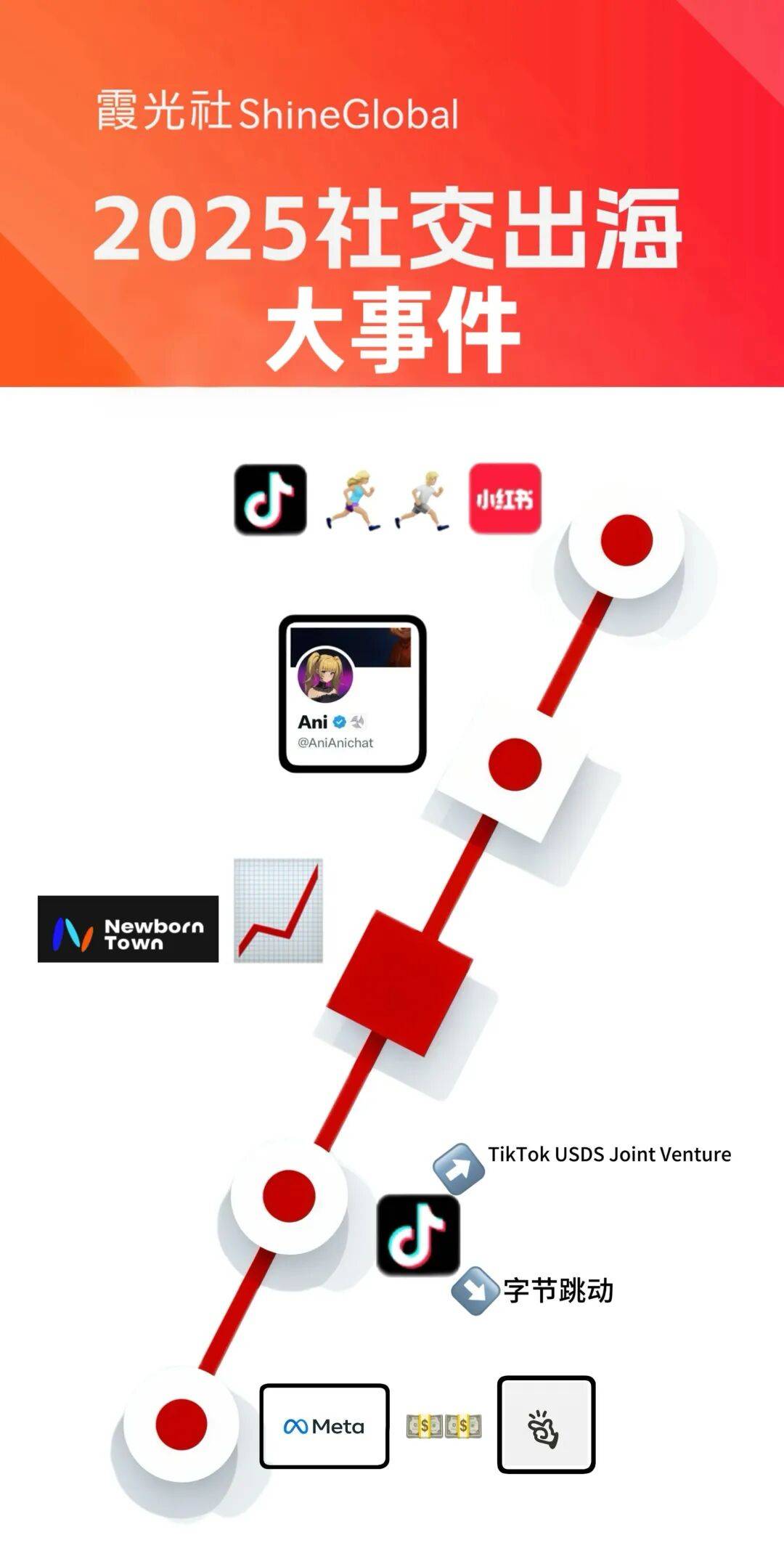
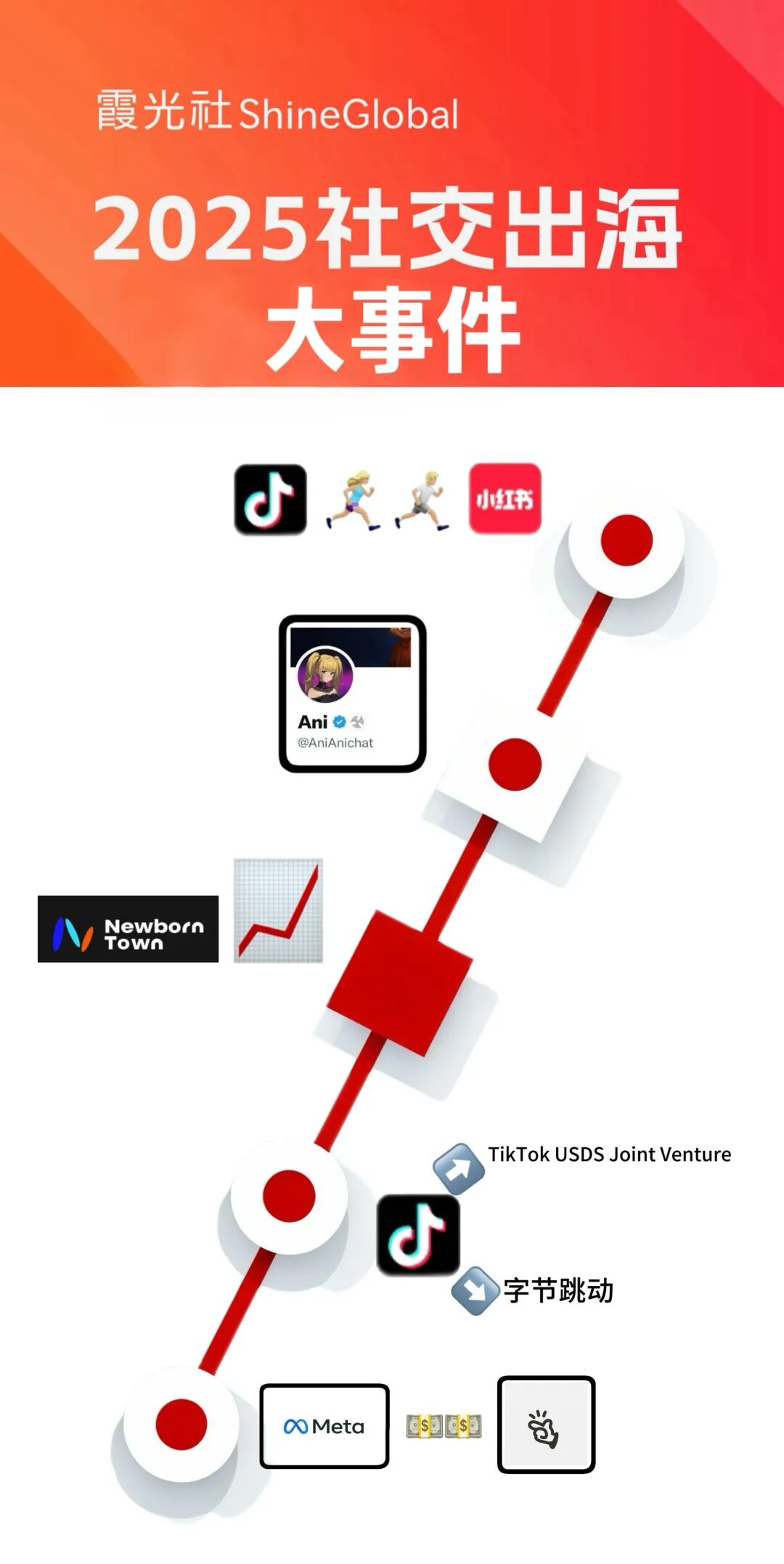
Core Insights - The article discusses the significant trends and developments in the social media industry, particularly focusing on the globalization of social applications and the integration of AI technology in 2025 [5][10][21]. Group 1: Social Media Trends - In 2025, social media expansion saw major events, including the surge of users on platforms like Xiaohongshu following the TikTok ban in the U.S., with over 700,000 new users in just two days [5]. - The Middle East has emerged as a lucrative market for social media, with 74,256 new social apps launched in countries like Saudi Arabia and the UAE in 2025 [12]. - The average monthly active users for BIGO reached 260.4 million globally, with Bigo Live having 28.9 million monthly active users, indicating strong engagement in the Middle East [12]. Group 2: AI Integration in Social Media - The integration of AI in social applications has become a focal point, with significant commercial success stories emerging, such as Meitu's BeautyCam topping app charts in 119 countries [21][23]. - AI-driven applications accounted for over 75% of growth in the social sector, with notable examples including Talkie, which reached 34.89 million monthly active users [23]. - The AI social landscape is characterized by a mix of opportunities and challenges, with many applications struggling to maintain user engagement after initial success [25][26]. Group 3: Marketing and User Acquisition - The cost of customer acquisition has doubled in regions like the Middle East, with average costs reaching around $3 per user, indicating a shift from explosive growth to a focus on sustainable user retention [34]. - There is a notable trend towards precision marketing, with a 12.43% decrease in the number of social applications investing in advertising, while the average monthly material volume per advertiser increased by 47.37% [35]. - Influencer marketing has gained traction as a key strategy for connecting brands with users, particularly in markets where safety and community trust are paramount [36][38]. Group 4: Localization Strategies - Localization has become a critical strategy for social media companies, focusing on product design, user experience, and brand engagement to resonate with local cultures [40][41]. - The emergence of "invisible" localization strategies, where local companies act as intermediaries while leveraging Chinese expertise, has been observed, exemplified by the app JACO achieving top rankings in Saudi Arabia and the UAE [42]. - Companies are increasingly recognizing the importance of integrating into local communities and creating value to enhance user trust and engagement [45]. Group 5: Regulatory Challenges - The social media landscape in 2025 is marked by stricter regulatory scrutiny, with numerous applications facing bans due to compliance issues, particularly concerning child safety [46][48]. - The rise in regulatory challenges has led to a significant number of applications being removed from markets, prompting a shift in resources towards more compliant platforms [49]. - Companies are advised to diversify their market presence and focus on both global and local strategies to mitigate risks associated with regulatory changes [49].


社交出海大年,成也AI败也AI
Sou Hu Cai Jing· 2026-01-14 07:19
Core Insights - 2025 is marked as a significant year for social media expansion, with major events impacting the industry, including user migration from TikTok to Xiaohongshu and the introduction of AI-driven applications [1][2]. Group 1: Social Media Trends - The influx of "TikTok refugees" to Xiaohongshu resulted in over 700,000 new users within two days, indicating a shift in user engagement between platforms [1]. - In the Middle East, social media applications are increasingly focusing on attracting high-value streamers, with some platforms offering over 100% revenue share to secure talent [6][8]. - The number of new social apps launched in the Middle East reached 74,256, highlighting the region's growing importance in the social media landscape [9]. Group 2: Market Dynamics - The average monthly active users for BIGO reached 260.4 million globally, with Bigo Live accounting for 28.9 million, demonstrating the platform's strong market presence [7]. - The competitive landscape in the Middle East is characterized by a significant presence of Chinese companies, which dominate the social media sector [8]. - The cost of customer acquisition in the Middle East has doubled, with current costs around $3 per user, indicating a shift towards a more competitive market environment [32][33]. Group 3: AI Integration - AI technologies are increasingly integrated into social media applications, with AI-driven features contributing to over 75% of growth in the sector [21]. - Successful AI applications, such as BeautyCam, have achieved significant global downloads and revenue, showcasing the potential for AI in enhancing user engagement [21]. - The combination of AI and social interaction is still evolving, with many companies exploring new ways to integrate AI into social experiences [32]. Group 4: Localization Strategies - Localization has become a critical strategy for social media companies, particularly in the Middle East, where adapting to local cultures and user preferences is essential for success [37][39]. - Companies are increasingly employing local teams to enhance their understanding of regional markets, which helps in building trust and user loyalty [41][43]. - The trend of "invisible localization," where local companies act as intermediaries while leveraging Chinese expertise, is gaining traction in the Middle East [42]. Group 5: Regulatory Environment - The global social media market is facing stricter regulatory scrutiny, with multiple platforms being banned for violations related to child safety and content moderation [46][49]. - New regulations in various countries, including the U.S. and Australia, are imposing restrictions on social media usage among minors, impacting user demographics [47][48]. - The increasing number of app removals due to compliance issues is reshaping the competitive landscape, favoring established platforms with robust compliance measures [49][50].
2025出海盘点:社交出海大年,成也AI败也AI
3 6 Ke· 2026-01-13 12:28
Core Insights - 2025 is marked as a significant year for social media expansion, with notable events such as the influx of users from TikTok to Xiaohongshu and the launch of AI-driven social applications [1][2][6] Group 1: Social Media Trends - The year saw a surge in social media applications, particularly in the Middle East, with 74,256 new social apps launched in countries like Saudi Arabia and the UAE [7] - Southeast Asia is emerging as a new growth area for social media, with platforms integrating local influencers to enhance user engagement [14][16] - The competitive landscape in the Middle East is intensifying, with many new entrants struggling to gain traction against established players [11][12] Group 2: AI Integration - The integration of AI in social applications has become a focal point, with significant advancements leading to a surge in user engagement and monetization opportunities [17][20] - Successful AI-driven applications, such as BeautyCam, have achieved top rankings in multiple countries, showcasing the potential of AI in enhancing user experience [21][23] - The AI social sector is characterized by a mix of opportunities and challenges, with many new entrants failing to sustain their growth [28][26] Group 3: Marketing Strategies - The marketing approach for social media applications is shifting from aggressive user acquisition to more refined strategies focusing on brand value and user retention [35][36] - Influencer marketing has gained prominence as a key strategy for connecting brands with users, particularly in markets where user safety and community trust are paramount [38] Group 4: Localization Efforts - Localization remains a critical strategy for social media companies, particularly in the Middle East, where adapting to local cultures and user preferences is essential for success [39][41] - The concept of "invisible localization" is emerging, where local companies act as intermediaries while leveraging the expertise of Chinese firms in technology and operations [42][45] Group 5: Regulatory Challenges - The social media landscape is facing increased regulatory scrutiny, leading to the shutdown of numerous applications due to compliance issues [48][49] - Companies are urged to diversify their market presence and enhance local operations to mitigate risks associated with regulatory changes [50]




兴业证券:港股通新一轮调整在即 48只港股标的或入围
Zhi Tong Cai Jing· 2026-01-09 07:33
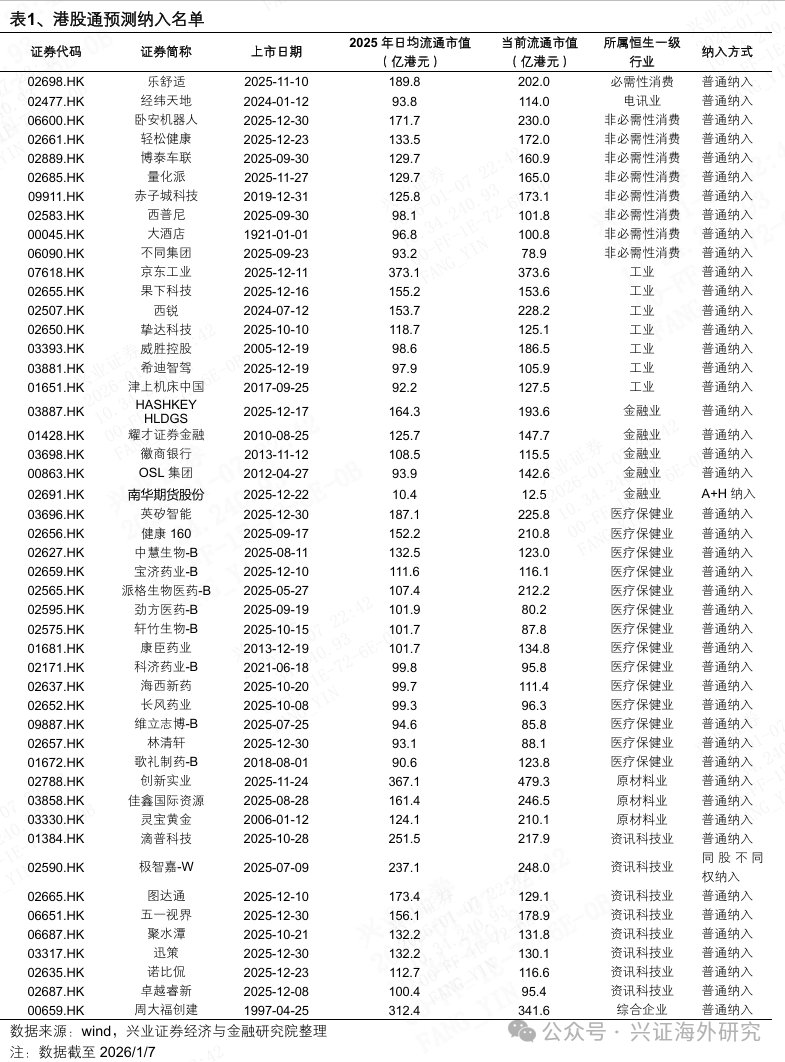
Core Viewpoint - The semi-annual review of the Hang Seng Composite Index has concluded, and a new round of adjustments to the Hong Kong Stock Connect eligible stocks is imminent, with results expected to be announced on February 20 and effective from March 9, 2025 [1][2]. Group 1: Adjustments and Market Impact - A total of 48 Hong Kong stocks are expected to be included in the Hong Kong Stock Connect eligible list based on simulated calculations [2][3]. - The market capitalization threshold for new eligible stocks has been raised to HKD 9 billion as of December 31, 2025 [3]. Group 2: Industry Distribution of New Eligible Stocks - The new eligible stocks are primarily concentrated in the following sectors: - Healthcare: 14 companies, including names like 英矽智能 and 健康160 [3]. - Information Technology: 8 companies, including 滴普科技 and 极智嘉-W [3]. - Consumer Discretionary: 8 companies, including 卧安机器人 and 轻松健康 [3]. - Industrial: 7 companies, including 京东工业 and 果下科技 [3]. - Financials: 5 companies, including HASHKEY HLDGS and 徽商银行 [3]. - Materials: 3 companies, including 创新实业 and 佳鑫国际资源 [3]. - Consumer Staples: 1 company, 乐舒适 [3]. - Telecommunications: 1 company, 经纬天地 [3]. - Conglomerates: 1 company, 周大福创建 [3]. Group 3: Detailed List of New Eligible Stocks - A detailed list of stocks expected to be included includes: - 乐舒适 (2025-11-10, average daily market cap: HKD 1.898 billion) [4]. - 经纬天地 (2024-01-12, average daily market cap: HKD 0.938 billion) [4]. - 卧安机器人 (2025-12-30, average daily market cap: HKD 1.717 billion) [4]. - 轻松健康 (2025-12-23, average daily market cap: HKD 1.335 billion) [4]. - 博泰车联 (2025-09-30, average daily market cap: HKD 1.297 billion) [4]. - 京东工业 (2025-12-11, average daily market cap: HKD 37.31 billion) [4]. - HASHKEY HLDGS (2025-12-17, average daily market cap: HKD 1.643 billion) [4].

赤子城科技(09911) - 截至2025年12月31日止股份发行人的证券变动月报表
2026-01-02 08:34
股份發行人及根據《上市規則》第十九B章上市的香港預託證券發行人的證券變動月報表 截至月份: 2025年12月31日 狀態: 新提交 致:香港交易及結算所有限公司 公司名稱: 赤子城科技有限公司 呈交日期: 2026年1月2日 I. 法定/註冊股本變動 | 1. 股份分類 | 普通股 | 股份類別 | 不適用 | | | 於香港聯交所上市 (註1) | | 是 | | | --- | --- | --- | --- | --- | --- | --- | --- | --- | --- | | 證券代號 (如上市) | 09911 | 說明 | | | | | | | | | | | 法定/註冊股份數目 | | | 面值 | | | 法定/註冊股本 | | | 上月底結存 | | | 3,000,000,000 | USD | | 0.0001 | USD | | 300,000 | | 增加 / 減少 (-) | | | | | | | USD | | | | 本月底結存 | | | 3,000,000,000 | USD | | 0.0001 | USD | | 300,000 | III.已發行股份及/或 ...
嘀嗒出行报告:上下班是顺风车第一大场景,乘客00后占比近两成
Xin Lang Cai Jing· 2025-12-31 07:49
Core Insights - Dida Chuxing released the "2025 Workplace Carpool User Profile and Experience Insight Report," based on big data and surveys from nearly 10,000 users, highlighting user demographics and consumption preferences [1][3]. User Scenarios - Commuting is the primary scenario for carpooling, with passengers and drivers selecting this option at rates of 55% and 82.1% respectively. The second to fourth scenarios for passengers are station-to-station trips (35.6%), trips to hometowns (32%), and personal errands (31.8%). For drivers, the second to fourth scenarios are personal errands (45.8%), trips to hometowns (38.2%), and station-to-station trips (19%) [1][3]. User Demographics - The majority of carpool passengers are aged 20-25, 26-30, and 31-40, with respective proportions of 16.7%, 17.7%, and 28.8%. Additionally, those under 20 account for 2.8%, making the total for those under 25 approximately 19.5%. This indicates that the post-2000 generation is a significant group among carpool passengers. Among surveyed passengers, around 10% identify as university students. Carpool drivers are primarily aged 31-40 and 41-50, with respective shares of 43.9% and 30.4%, totaling 74.3% [1][3]. Vehicle Trends - From 2019 to 2025, the proportion of newly certified vehicles aged one year or less and two years or less is on the rise. By 2025, the share of vehicles aged one year or less among new certifications has increased sixfold compared to 2019, while the share of vehicles aged two years or less has grown by over five times [2][4]. Brand Rankings - The report ranks the total commuting order completion volume for certified carpool drivers from January to October 2025, with the top ten brands being Tesla, Xpeng, Leap Motor, NIO, Zeekr, Li Auto, Hongmeng Zhixing, Zhiji, Leda, and Xiaomi [2][4]. Regional Insights - The data indicates that regions with larger and denser cross-city carpool commuting orders are primarily concentrated in the Pearl River Delta, Yangtze River Delta, Beijing-Tianjin-Hebei, Shandong Peninsula, and Chengdu-Chongqing city clusters. The top five cities with the highest frequency of commuting carpooling are Shanghai, Dalian, Qingdao, Tianjin, and Shenyang [2][4].
餐饮企业出海:从“开门店”到“打系统战”
Jing Ji Guan Cha Wang· 2025-12-31 04:25
Core Viewpoint - Chinese restaurant chains are accelerating their overseas expansion, but the success of this endeavor heavily relies on the establishment of a suitable digital operation system for international markets [2] Group 1: Digital Operation Challenges - Companies face significant challenges in building a unified POS system, global supply chain data integration, and cross-border team collaboration management as they scale internationally [2] - The complexity of unifying the POS system includes compliance adaptation across regions, hardware and software compatibility, currency and payment integration, dynamic loading of multi-language UIs, and interconnectivity of membership systems [2] - The existing domestic digital operation systems are not directly transferable to overseas markets, necessitating a complete reconstruction of supply chain management, membership management, financial management, and employee management systems [2] Group 2: Supply Chain Management Issues - A recent incident in North America highlighted the inadequacies of the existing supply chain digital management system, which failed to account for local delivery cost variations, leading to delivery fees consuming 30% of revenue in remote areas [3][4] - The company has decided to invest several million yuan to reconstruct its supply chain digital management system, focusing on local demand analysis, multi-language interface adaptation, cross-border compliance reviews, and real-time logistics monitoring [5][6] - The restructuring aims to create a "central warehouse + third-party cooperation" model to reduce logistics costs and develop alternative suppliers to mitigate risks associated with supplier concentration [6] Group 3: Financial Management System Gaps - The absence of a global financial management system has created challenges in providing real-time cash balance and profitability data for overseas operations, hindering decision-making for business expansion [7][8] - Current financial management systems can only aggregate revenue data from three weeks prior, making it difficult to provide timely insights into overseas operations [8] - Many companies have faced issues with payment recognition and reconciliation due to the complexity of local payment channels, leading to inefficiencies in financial management [9] Group 4: Membership Management System Adaptation - Rising customer complaint rates in overseas markets indicate that the domestic membership marketing management system is not effectively adapted to local consumer behaviors [12] - Companies are exploring the need for a global membership marketing management system to address localization issues, data fragmentation, and the reliance on online marketing [13] - The development of such a system must comply with local data privacy regulations, such as the EU's General Data Protection Regulation [13]

离开中兴华为的人在中东做出小腾讯?
Di Yi Cai Jing· 2025-12-24 10:45
Group 1 - The article discusses the vibrant social culture in the Middle East, particularly in Saudi Arabia, where coffee shops are bustling with people late into the night, reflecting a strong preference for socializing in person [1] - Chinese companies have recognized the high demand for social interaction in the MENA region over the past decade, successfully transitioning this demand online through products like voice rooms and social gaming, leading to the establishment of social entertainment empires such as YALA and Zhizhongcheng [1] - The unique lifestyle in the Middle East, influenced by extreme heat and cultural factors, results in a peak social activity period from 9 PM to midnight, making social gatherings a primary form of entertainment [1] Group 2 - The Middle East market is often described as having abundant opportunities, but it poses significant challenges for Chinese companies accustomed to rapid success, as the market operates at a slower pace [2] - The entry barriers in the Middle East are high, with initial investments of several million dollars being necessary to participate in the market, indicating that it is not a suitable testing ground for small companies [2]
那些从中兴、华为离开的人,在中东做出了下一个“小腾讯”
第一财经· 2025-12-24 10:28
Core Viewpoint - The article discusses the unique social dynamics and market opportunities in the Middle East, particularly focusing on how Chinese companies have successfully adapted their products to meet local cultural preferences and social habits, leading to significant growth in the region's entertainment and social media sectors [3][8][12]. Group 1: Market Characteristics - The Middle East is characterized by a strong social culture, with locals frequently gathering in cafes and public spaces to socialize, especially during the cooler evening hours [3][4]. - The region has a high demand for social interaction and entertainment, which has been successfully translated into online platforms by Chinese companies [6][8]. - Users in the Middle East are highly engaged with social media, averaging 8.4 accounts per person, with UAE users reaching 10.5 accounts, indicating a strong market for social applications [8][12]. Group 2: Company Performance - Yalla and Chaozi City (赤子城) have emerged as significant players in the Middle Eastern social media market, with Chaozi City reporting a revenue growth of over 50% in 2024, reaching 5.1 billion yuan [9]. - In the first half of 2025, Chaozi City's revenue grew by 40% to 3.2 billion yuan, with a net profit increase of 118% to approximately 500 million yuan [9]. - Yalla's revenue for 2024 was reported at 340 million USD (approximately 2.39 billion yuan), with a stock price increase of over 70% since the beginning of the year [9]. Group 3: Cultural Adaptation and Localization - Successful products like TopTop and Yalla have been developed through extensive local research, ensuring they align with the cultural and social habits of Middle Eastern users [6][7]. - Features such as family badges in TopTop were inspired by local customs, enhancing user engagement by reflecting cultural identity [7]. - Yalla's design is rooted in the traditional "Majlis" culture, facilitating a familiar social experience for users [7][8]. Group 4: Challenges and Market Entry - Entering the Middle Eastern market requires significant investment and time to build local networks, which can be a challenge for companies used to faster-paced environments [4][16]. - The market has high entry barriers, with initial costs for registration and compliance being substantial, often requiring millions to establish a presence [16][17]. - As competition increases, companies that have already established a foothold in the region are likely to perform better, making it harder for new entrants to succeed [17].