
迈瑞医疗

Search documents
检验互认驱动:黑灯实验室智能化路径与市场机遇
思宇MedTech· 2026-02-13 04:08
Core Viewpoint - The article emphasizes the importance of standardization in medical testing and the integration of the IVD market to enhance the efficiency and quality of healthcare services in China, particularly through the implementation of result recognition policies [2][3]. Group 1: Result Recognition Policy - Result recognition is a key strategy in China's healthcare reform aimed at reducing redundant tests and lowering overall medical costs by unifying technical standards and breaking down data barriers [3]. - The core value of the recognition policy is a systematic approach to "cost control, quality improvement, and efficiency enhancement," with clear targets set for 2025, including over 200 mutual recognition projects within city domains [4]. - The market demand is shifting from merely increasing testing volume to a pressing need for "quality homogenization" and "service integration," creating growth opportunities for products and services that help medical institutions meet recognition standards efficiently and cost-effectively [4]. Group 2: Current Status and Challenges - A four-tier recognition framework has been established across the country, with increasing depth and breadth of implementation [5]. - The core challenges to effective implementation include three major gaps: insufficient comparability of results, fragmented quality control systems, and lack of coordination among supporting mechanisms [7]. - The recognition of results and the DRG/DIP payment reform are aligned in their goals of improving efficiency and controlling costs, but they face execution challenges due to quality shortcomings in mutual recognition [8]. Group 3: Standards and Technological Integration - The foundation of result recognition relies on the "homogenization" of management and technology between laboratories, primarily through two core international standards: ISO 15189 and ISO 17511 [9]. - ISO 15189 focuses on establishing a comprehensive quality management system, while ISO 17511 ensures the traceability of measurement results to international standards [10]. - The integration of these standards into intelligent laboratory systems is crucial for ensuring the reliability of test results and facilitating automated processes [18]. Group 4: Market Dynamics and Growth - The automated laboratory market in China is projected to grow at a compound annual growth rate (CAGR) exceeding 30%, with the black-box laboratory model expected to surpass 15 billion yuan by 2026 [23]. - The market is driven by policy compliance and operational efficiency, with high demand for solutions that reduce human labor reliance by over 60% while enhancing throughput and stability [23]. - The competitive landscape features three main types of players: medical device manufacturers, specialized automation integrators, and healthcare IT companies, each focusing on different aspects of the market [25]. Group 5: Investment Opportunities - The shift towards intelligent laboratory solutions necessitates a comprehensive approach that includes not just automation hardware but also a complete "turnkey" intelligent system that ensures stable and recognizable results [26]. - The business model is evolving from one-time hardware sales to ongoing service subscriptions, reagent consumption, and data analysis services, particularly in resource-constrained environments [27]. - There is a growing need for innovative IVD products that can seamlessly integrate with automated systems, emphasizing the importance of standardized interfaces and built-in traceability data [29]. Group 6: Risk and Success Factors - Identifying structural risks is crucial as the market experiences rapid growth driven by policy and capital, with a focus on sustainable revenue and profit generation [34]. - The dual engines of policy and capital define market dynamics, but companies must ensure their business essence can sustain growth beyond initial policy-driven demand [35]. - Successful companies typically build multiple layers of competitive advantages, including technology-market fit, resilient business models, and advanced data governance capabilities [42][44].


礼来新药在华获批,医疗创新ETF(516820)备受关注
Xin Lang Cai Jing· 2026-02-13 02:33
Group 1 - The core viewpoint of the news highlights the performance of the China Securities Pharmaceutical and Medical Device Innovation Index, with Zhejiang Medicine leading the gains at 1.43% and Xinhecheng experiencing the largest decline [1] - The Medical Innovation ETF (516820) has a latest price of 0.36 yuan, with a turnover rate of 0.28% and a transaction volume of 5.138 million yuan during the trading session [1] - Over the past month, the average daily transaction volume of the Medical Innovation ETF reached 62.8359 million yuan, indicating strong market interest [1] Group 2 - Recently, Eli Lilly's drug, Migalastat, received approval from the National Medical Products Administration of China for two formulations to treat moderate to severe active Crohn's disease and ulcerative colitis, marking a significant advancement in targeted therapies for autoimmune diseases in the digestive system [1] - According to CMB International, the pharmaceutical industry is experiencing structural differentiation due to medical insurance cost control and normalized centralized procurement, with resources increasingly concentrating on innovative pharmaceutical and medical device companies with technological barriers [1] - Since Q4 2025, both domestic and foreign institutions have been increasing their positions in the innovative pharmaceutical and medical device supply chain, reflecting a clearer market logic for allocating innovative assets with clinical value and overseas potential [1] Group 3 - The China Securities Pharmaceutical and Medical Device Innovation Index (931484) selects 30 publicly listed companies with good profitability, growth potential, and research innovation capabilities to reflect the overall performance of the pharmaceutical and medical device sector [2] - As of January 30, 2026, the top ten weighted stocks in the index include WuXi AppTec, Mindray Medical, Heng Rui Medicine, Aier Eye Hospital, and others, accounting for a total of 63.9% of the index [2]

中银晨会聚焦-20260213-20260213
Bank of China Securities· 2026-02-13 00:50
Core Insights - The report predicts a "front low and back high" trend for the real estate market in 2026, suggesting potential recovery opportunities in the sector [1][3] - It emphasizes the importance of stabilizing the market through inventory reduction and boosting demand and confidence, while also supporting reasonable financing needs of real estate companies [3][4] - The report identifies three main investment lines: stable companies in core cities, "small but beautiful" firms with significant breakthroughs, and commercial real estate companies exploring new consumption scenarios [1][9] Market Outlook - The real estate market is expected to face continued pressure in 2025, with a focus on policy measures to prevent a sharp decline [3][4] - The report forecasts a decline in key real estate indicators for 2026, including a projected 8% decrease in sales area to 810 million square meters and a 12% drop in sales revenue to 7.4 trillion yuan [5][6] - It anticipates a gradual recovery in the market, with potential policy and fundamental turning points in Q1 and Q4 of 2026, respectively [7][8] Investment Recommendations - The report suggests focusing on companies with strong fundamentals in first and second-tier cities, such as China Resources Land and China Merchants Shekou [1][9] - It highlights the potential of Poly Real Estate Group as a "small but beautiful" firm that has made significant sales and land acquisition breakthroughs [9] - The report also points to commercial real estate companies like China Resources Vientiane Life and Swire Properties that are actively exploring new operational models [1][9]





医药生物周报(26年第5周):Roche口服BTK抑制剂PPMS三期临床数据公布
Guoxin Securities· 2026-02-13 00:45
Investment Rating - The report maintains an "Outperform" rating for the pharmaceutical and biotechnology sector [5][39]. Core Insights - The pharmaceutical sector has shown resilience, outperforming the overall market, with traditional Chinese medicine leading the gains [1][28]. - Roche's oral BTK inhibitor Fenebrutinib has demonstrated non-inferiority to Ocrelizumab in treating primary progressive multiple sclerosis (PPMS), marking a significant advancement in the treatment landscape [2][11]. - The global market for multiple sclerosis (MS) treatment exceeds $20 billion, with unmet needs in PPMS due to limited treatment options [3][25]. Summary by Sections Market Performance - The overall A-share market declined by 1.3%, while the biopharmaceutical sector increased by 0.1%, indicating a stronger performance relative to the market [1][28]. - Specific segments within the biopharmaceutical sector showed varied performance, with traditional Chinese medicine rising by 2.6% [1][28]. Clinical Data and Drug Development - Roche's Fenebrutinib trial for PPMS included 985 patients and achieved its primary endpoint, showing a 12% reduction in disease progression risk compared to Ocrelizumab [2][11][24]. - The safety profile of Fenebrutinib was comparable to Ocrelizumab, with a similar incidence of adverse events [22][24]. Company Earnings Forecast and Investment Recommendations - Key companies in the sector, such as Mindray Medical, WuXi AppTec, and Aier Eye Hospital, are rated as "Outperform" with projected earnings growth [4][39]. - Mindray Medical is highlighted for its strong R&D and international expansion, while WuXi AppTec is recognized for its comprehensive drug development services [39]. Valuation Metrics - The TTM price-to-earnings ratio for the pharmaceutical and biotechnology sector stands at 37.31x, compared to the overall A-share market at 21.98x [35][36]. - Specific segments like chemical pharmaceuticals and biological products have higher valuations, indicating investor confidence in these areas [35][36].



“硬科技军团”领跑全国
Shen Zhen Shang Bao· 2026-02-12 18:33
Group 1 - Shenzhen's listed companies are experiencing a surge in "new quality productivity" focused on hard technology and future industries, with R&D investment nearly doubling during the 14th Five-Year Plan period, reaching 210.3 billion yuan in 2024, a 91.35% increase from 2020 [1] - In the first three quarters of 2025, disclosed R&D expenses totaled 156.33 billion yuan, marking a historical high with a year-on-year growth of 11.59%, significantly outpacing the national average [1] - Approximately 80% of newly listed companies are from the Sci-Tech Innovation Board and the Growth Enterprise Market, with a total of 216 companies, representing over half of A-share Shenzhen enterprises, leading among major cities in China [1] Group 2 - A notable "innovation matrix" has formed in Shenzhen, with companies like UBTECH Robotics, Youjia Innovation, and SUTENG Juchuang leading in future industry directions, showcasing Shenzhen's advantages in the new technological revolution and industrial transformation [2] - The "Robot Valley" in Nanshan, centered around companies like UBTECH and Huichuan Technology, has created an industrial ecosystem, with UBTECH's Walker S1 robot being utilized in factories of major companies like BYD and Geely [2] - Huichuan Technology, valued at nearly 200 billion yuan, has increased its R&D investment from 1.023 billion yuan to 3.147 billion yuan over the past five years, successfully developing key components for humanoid robots [2] Group 3 - Innovation is not limited to individual companies but is also evident in collaborative evolution across industries, exemplified by Shenzhen Hanno Medical's breakthrough in developing China's first ECMO system, set to enter the EU market in May 2025 [3] - Mindray Medical, a major shareholder of Hanno Medical, has played a crucial role in supporting its technological advancements, illustrating the model of larger companies fostering innovation in smaller firms within the industry chain [3]
医药生物周报(26年第5周):Roche口服BTK抑制剂PPMS三期临床数据公布-20260212
Guoxin Securities· 2026-02-12 12:27
Investment Rating - The report maintains an "Outperform" rating for the pharmaceutical and biotechnology sector [5][39]. Core Insights - The pharmaceutical sector has shown resilience, outperforming the overall market, with traditional Chinese medicine leading the gains [1][28]. - Roche's oral BTK inhibitor Fenebrutinib has demonstrated non-inferiority to Ocrelizumab in a Phase III trial for primary progressive multiple sclerosis (PPMS), marking a significant advancement in treatment options for this condition [2][11]. - The global market for multiple sclerosis (MS) treatment exceeds $20 billion, with Roche's Ocrevus projected to generate CHF 7 billion in sales by 2025, indicating substantial unmet needs in the PPMS segment [3][25]. Summary by Sections Market Performance - The overall A-share market declined by 1.3%, while the biopharmaceutical sector increased by 0.1%, indicating a stronger performance relative to the market [1][28]. - Specific segments within the biopharmaceutical sector showed varied performance, with traditional Chinese medicine rising by 2.6% and medical services increasing by 1.3% [1][28]. Clinical Data and Drug Development - Roche's Fenebrutinib trial included 985 PPMS patients and achieved its primary endpoint, showing a 12% reduction in disease progression risk compared to Ocrelizumab [2][11]. - The trial results suggest potential benefits for upper limb function, reinforcing the viability of BTK inhibitors in MS treatment [3][25]. Company Earnings Forecast and Investment Recommendations - Key companies in the sector, such as Mindray Medical, WuXi AppTec, and Aier Eye Hospital, are rated as "Outperform" with projected earnings growth over the next few years [4][39]. - Mindray Medical is highlighted for its strong R&D and international expansion, while WuXi AppTec is recognized for its comprehensive drug development services [39]. Valuation Metrics - The TTM price-to-earnings ratio for the pharmaceutical and biotechnology sector stands at 37.31x, compared to the overall A-share market at 21.98x, indicating a premium valuation for the sector [35][36]. - Within the sector, chemical pharmaceuticals and biological products have higher valuations at 45.18x and 46.09x, respectively [35].
我国首款“全自研”机械臂骨科手术机器人“上岗”,医疗创新ETF(516820)交投活跃
Xin Lang Cai Jing· 2026-02-12 02:53
Core Viewpoint - The medical innovation sector is experiencing growth, highlighted by the successful debut of China's first fully self-developed orthopedic surgical robot, indicating advancements in medical technology and potential investment opportunities in the sector [1][2]. Group 1: Market Performance - As of February 12, 2026, the CSI Medical and Medical Device Innovation Index (931484) increased by 0.05%, with notable gains from companies such as WuXi AppTec (up 3.39%) and Kanglong Chemical (up 1.37%) [1]. - The Medical Innovation ETF (516820) is currently priced at 0.37 yuan, with a trading volume of 794.40 million yuan and a turnover rate of 0.42% [1]. - Over the past month, the average daily trading volume of the Medical Innovation ETF was 65.14 million yuan [1]. Group 2: Industry Insights - CITIC Securities believes that surgical robots represent one of the best business models in the medical device sector, as installed equipment will drive continuous consumption of consumables, leading to stable revenue and cash flow [2]. - The global market for surgical robots is estimated to exceed 1 trillion yuan, with significant growth potential in penetration rates and market size [2]. - Domestic leaders in the surgical robot market are accelerating product iterations, achieving performance levels close to global leaders, and have a substantial portion of their revenue from overseas markets, which are experiencing high growth [2]. - AI is expected to empower surgical robots to achieve autonomous operations, further assisting or replacing some surgical procedures performed by doctors, which will benefit industry penetration rates and enhance company valuations [2]. Group 3: Index Composition - The CSI Medical and Medical Device Innovation Index comprises 30 publicly listed companies with strong profitability, growth potential, and research innovation capabilities, reflecting the overall performance of the medical and medical device sector [2]. - As of January 30, 2026, the top ten weighted stocks in the index include WuXi AppTec, Mindray Medical, and Heng Rui Medicine, collectively accounting for 63.9% of the index [2].

国信证券:医药生物行业关注低估值和业绩修复的服务及消费板块 创新药出海合作持续深化
Zhi Tong Cai Jing· 2026-02-12 02:08
Core Viewpoint - The report from Guosen Securities indicates that the medical services and consumer-related sectors have experienced long-term adjustments, resulting in valuations at historical lows. By 2026, improvements in supply structure, increased treatment volumes, and store optimization are expected to lead to a dual recovery in fundamentals and valuations, with AI empowerment providing new momentum for leading companies [1][2]. Group 1: Medical Services and Consumer Sectors - The medical services and consumer-related sectors are currently undervalued and poised for performance recovery, with a focus on specific sub-sectors [2]. - In medical services, improvements in supply structure and consumer environment are anticipated to gradually revive business, with stable customer spending and increased treatment volumes. Leading companies are expected to provide positive earnings guidance for 2026, indicating a potential dual recovery in fundamentals and valuations. AI-related business developments are also expected to drive new growth for leading medical service firms. Key companies to watch include Aier Eye Hospital (300015), Gushengtang, Tongce Medical (600763), and Haijia Medical [2]. - The pharmacy sector has shown significant marginal improvement in performance since Q3 2025, with leading companies improving same-store performance quarterly. Regulatory support from nine ministries emphasizes the long-term development direction of industry concentration and chain rate enhancement, with non-pharmaceutical adjustments and store structure optimization driving short-term performance improvements. Key companies include Yifeng Pharmacy (603939) and Dazhenglin (603233) [2]. Group 2: Home Medical Devices - The growth of home medical device companies is driven by increased product penetration and domestic production rates. Rapid growth is observed in products like Continuous Glucose Monitors (CGM) and sleep apnea machines, with leading domestic brands expanding internationally. Traditional categories like blood pressure monitors are increasingly focusing on the high-end market, with domestic brands steadily increasing market share. The combination of high domestic growth and new overseas markets is expected to contribute to sustained performance growth for home medical device companies. Key companies include Yuyue Medical (002223), Kefu Medical (301087), Sanofi Biological (300298), and Ruimaite (301367) [3]. Group 3: Innovative Drug Development - The collaboration for the international expansion of innovative drugs continues to deepen, with recent significant agreements between Shiyao Group and AstraZeneca, as well as Innovent Biologics and Eli Lilly. These collaborations highlight the growing recognition of China's innovative drug development capabilities by multinational pharmaceutical companies, showcasing the efficiency and cost advantages of Chinese innovative drugs [4]. Group 4: Investment Portfolio for 2026 - The investment portfolio for 2026 includes A-shares such as Mindray Medical (300760), United Imaging Healthcare, WuXi AppTec (603259), New Industry (300832), Meihua Medical (301363), Adebiotech (300685), Zhend Medical (603301), Yaokang Biological, Kingmed Diagnostics (603882), Aier Eye Hospital, Yuyue Medical, Yifeng Pharmacy, and Dazhenglin; H-shares include Kangfang Biologics, Kelun-Botai Biologics-B, Hutchison China MediTech, Kangnuo-B, Sanofi Biopharma, Gushengtang, and Aikang Medical [5].


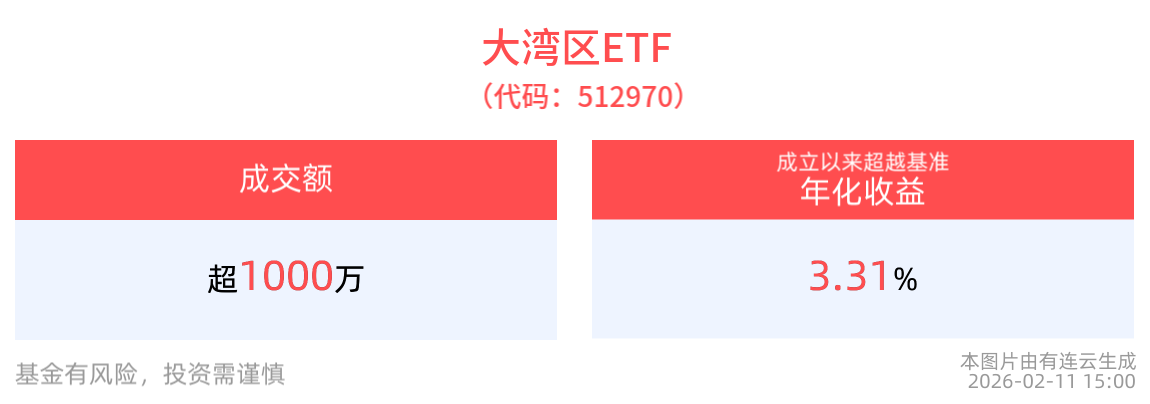
成交额超1000万元,大湾区ETF(512970)成立以来超越基准年化收益达3.31%
Xin Lang Cai Jing· 2026-02-12 01:56
Group 1 - The core index, the CSI Guangdong-Hong Kong-Macao Greater Bay Area Development Theme Index, has seen a decline of 0.63% as of February 11, 2026 [2] - The top-performing stocks include Greenmeadow with a rise of 9.95%, Xinjubang up by 8.16%, and Shengyi Technology increasing by 2.55% [2] - The ETF tracking this index, with a recent price of 1.51 yuan, has decreased by 0.59% [2] Group 2 - The Greater Bay Area ETF has a turnover rate of 16.96% during trading, with a total transaction volume of 11.77 million yuan, indicating active market participation [2] - The ETF has a one-year Sharpe ratio of 1.41 as of February 6, 2026 [2] - The maximum drawdown for the ETF this year is 5.52%, with a relative benchmark drawdown of 0.02% [2] Group 3 - The CSI Guangdong-Hong Kong-Macao Greater Bay Area Development Theme Index reflects the performance of listed companies benefiting from the Greater Bay Area development [3] - The index includes various sub-indices, selecting a maximum of 50 Hong Kong market securities, 300 companies from the Shanghai-Hong Kong-Shenzhen market, and 100 mainland market securities [3] - The top ten weighted stocks in the index account for 44.55% of the total index weight, with notable companies including Ping An Insurance, Luxshare Precision, and BYD [3][4] Group 4 - The top ten stocks by weight in the index show varied performance, with Ping An Insurance down by 1.01% and BYD up by 1.62% [4] - The weight of the top stock, Ping An Insurance, is 8.31%, while the lowest weight among the top ten is 2.63% for Mindray Medical [4]
中银晨会聚焦-20260212-20260212
Bank of China Securities· 2026-02-12 01:01
Group 1: Macro Insights - January CPI growth rate year-on-year was lower than expected, while PPI growth rate was slightly higher than expected, influenced by the Spring Festival timing and base period rotation [4][5] - The average impact of the base period rotation on CPI and PPI year-on-year indices is estimated to be approximately 0.06 and 0.08 percentage points, respectively, which is relatively small [4][5] - CPI in January increased by 0.2% month-on-month and year-on-year, with core CPI rising by 0.8%, indicating a mixed inflationary environment influenced by seasonal factors and external inputs [5] Group 2: Real Estate Sector - The traditional residential development sector is contracting, while commercial real estate is entering a policy-driven growth phase, with a focus on creating new consumption scenarios to meet diverse consumer needs [12][13] - The shift from traditional commercial spaces to new consumption scenarios emphasizes emotional engagement and immersive experiences, moving beyond mere transactional spaces [14][20] - The rise of non-standard commercial projects, characterized by innovative space and operational models, is gaining traction, particularly in major cities like Shanghai and Beijing [16][17] Group 3: Chemical Industry - The dye industry is experiencing price increases due to rising costs of intermediate products, with significant price hikes observed in January, benefiting integrated companies with stable market shares [24][25] - The concentration of supply in the dye industry is improving due to stringent safety and environmental regulations, which may lead to a more favorable market environment for leading companies [26][27] Group 4: Electronics Sector - The demand for AI computing materials is expected to rise significantly as cloud service providers increase capital expenditures, leading to a supply-demand mismatch in the electronic fabric market [29][30] - Traditional electronic fabric production is transitioning to low-dielectric materials, with price increases anticipated across both traditional and low-dielectric electronic fabrics due to supply constraints [32][33]